
Every season, athletes push harder — and their knees pay the price. An ACL tear sidelines a premier league striker. Chronic instability slows down a competitive skier. Generic knee braces can’t meet the biomechanical demands of serious sport. That’s why custom knee braces for sports have shifted from niche medical devices to performance-critical equipment — and the global sports bracing market is growing faster than most buyers expect.
Sourcing for a sports brand? Evaluating OEM partnerships? Building a product line that converts? You need to know what separates a well-engineered orthopedic knee brace built for sports performance from a mass-produced shell. That knowledge is your competitive edge.
Knee Brace Design Makes Products “Custom” for Sports
“Custom” gets thrown around a lot in the sports equipment industry. But with knee braces, the gap between real customization and marketing fluff is measurable — in millimeters, in injury rates, and in athlete performance.
Anatomical precision
Off-the-shelf braces use generalized sizing. Industry benchmarks show generic braces carry up to a 20–30% fit variance compared to the athlete’s actual anatomy. That gap leads to slippage, misalignment, and poor joint protection during high-load movements.
Real customization closes that gap through a clear process:
- Anatomical assessment — measuring the individual’s joint alignment and leg geometry
- 3D scanning or multi-point measurement — advanced systems hit sub-millimeter accuracy (under 1mm tolerance)
- CAD-based design and prototype fit-testing — completed before final fabrication
Personalized Mechanics
Fit is half the equation. What sets a high-performance custom knee brace for sports apart from a standard product is how the mechanics match sport-specific movement patterns.
- Hinge angle customization: Polycentric hinges adjust to the athlete’s personal range of motion — 0–140° flexion for basketball players, 0–120° for distance runners
- Variable strap tension systems: 4–6 point strap setups calibrated for lateral load demands. This stops slippage during cutting movements in soccer and basketball
- ROM control settings: Extension and flexion stops limit lateral deviation by 15–20°. This is critical for ACL knee brace use during recovery and return-to-sport phases
Sport-Specific Fit
- Running & Cardio: Compression sleeves with silicone padding provide stability and pain relief without restricting movement.
- Football & Skiing (High Impact): Hinged braces offer MCL/ACL protection against valgus forces, with specialized options for linemen.
- Basketball & Volleyball (Jumping): Patella tracking braces or sleeves with stabilizers help reduce patellofemoral pain and support landing.
- Weightlifting & Gym: Compression sleeves with side stabilizers are recommended to maintain knee alignment during heavy lifts.
What’s Inside High-Performance Custom Knee Braces for Sports
Material and components choice is where the performance gap between generic and custom knee braces becomes impossible to ignore.
Knee Brace Material Options
There are mainly three types of knee sleeve material. Beyond standard yarns and fabrics, brands often use functional materials to produce upgraded versions of existing designs.
Knitted Yarn
A knitted knee brace is produced directly from yarn on a circular knitting machine, forming a tube-like sleeve. Four main yarn types are used: polyester, nylon, bamboo or bamboo charcoal, and polypropylene. Patterns and compression zones are created by varying the knit structure.
The following table reflect general trends for typical sports-support yarns, though exact values depend on yarn specifications and finishing:
| Property | Polyester | Polypropylene | Nylon | Bamboo / Bamboo Charcoal |
| Cost (Lowest to Highest) | 1st (Lowest) | 1st (Lowest) | 3rd | 4th (Highest) |
| Softness (Lowest to Highest) | 2nd | 1st (Least soft) | 3rd | 4th (Softest) |
| Stretch & Shape Retention (Lowest to Highest) | 1st (Least) | 2nd | 4th (Best) | 3rd |
| Abrasion Resistance (Lowest to Highest) | 3rd | 1st (Least resistant) | 4th (Most resistant) | 2nd |
| Moisture Absorption (Lowest to Highest) | 2nd | 1st (Least absorbent) | 3rd | 4th (Most absorbent) |
| Drying Speed (Slowest to Fastest) | 3rd | 4th (Fastest) | 2nd | 1st (Slowest) |
| Odor Control (Lowest to Highest) | 1st (Least effective) | 2nd | 3rd | 4th (Most effective) |
Stitched Fabrics
A stitched knee brace is made from flat material sheets cut into panels and sewn into shape. It is thicker and more structured than a knitted sleeve, with distinct front/back orientation. Adjustability is achieved through straps and Velcro, allowing users to customize tightness. These are typically rehab braces, post-injury supports, and products requiring strong shaping or limited range of motion. Cost increases with panel count and design complexity due to more cutting, sewing, and extra components, making unit cost generally higher than a comparable knitted sleeve.
Common Materials:
Stretch Fabric (Nylon/Spandex/Polyester): 4-way stretch used as layers or main body in lighter designs for comfort and movement.
SCR/SBR Neoprene: Dense synthetic rubber offering firm support, cushioning, and heat retention.
Mesh Fabric: Lightweight, open-weave material placed in high-airflow zones (e.g., back of knee) to improve breathability and comfort during extended wear.
Functional Materials
Silver/Copper-infused Fibers
To tackle the top user complaint—odor—we use silver or copper ions in yarns or apply an antibacterial finish. These silver/copper-infused knee sleeves are ideal for extended wear in warm or humid conditions.
Testing shows 99.999% bacterial reduction against K. pneumoniae and S. aureus within 24 hours, with copper content up to 4,000 ppm verified by Intertek. Similar testing can be arranged for new developments.
Far Infrared (FIR) Yarn and Fabric
FIR knitted knee sleeves contain ceramic or mineral particles and are typically placed in the inner or middle layer of supports. They’re ideal for users with chronic knee discomfort, or athletes seeking extra warmth and recovery benefits post-training.
Magnetic Fibers
Magnetic fiber builds on FIR yarn by adding fine magnetic particles, giving the fabric both FIR and magnetic properties while remaining soft and textile-like. These close-fitting knee sleeves can be verified via Gauss value testing and wash-durability assessments.
Cooling Yarns and Fabrics
Thin cooling knee/calf sleeves for court sports and gym training use special fiber cross-sections, mineral-infused yarns, or moisture-transfer structures to boost heat dissipation and provide a cool touch. Ideal for hot or high-sweat environments.
Menthol Finish
Microencapsulated menthol on the inner fabric releases a brief cooling sensation through friction with skin. The effect is strongest on first use and fades with washing. Primarily used for short-term post-activity relief, e.g., menthol knee sleeves in first-aid or recovery kits.
Knee Brace Components Options
Mastering the following three categories ensures custom knee brace reliability, fewer returns, and premium pricing.
Support
Spiral stays: Flexible flat springs that prevent sideways knee collapse while bending with the joint. Ideal for sports sleeves needing extra support without added bulk.
Steel-plastic stays: A balanced mid-option—lighter than metal hinges, stiffer than basic plastic. Great for more structure than a simple sleeve, while preserving comfort and low weight.
Metal hinges: The stiffest option, offering strong side-to-side control. Best for true braces in post-injury, post-op, or heavy-duty use.
Protection
Patella gel ring: A soft gel ring around the kneecap that helps distribute pressure and keep the patella properly aligned within its natural “window.” Commonly found on open-patella knee sleeves.
Impact pads (honeycomb/hex/EVA): Foam pads placed in high-impact areas such as the front of the knee. Used in products like volleyball and basketball knee pads.
Secure Fixation
Silicone Anti-Slip: The standard design uses wavy or dotted patterns on the top and bottom edges to improve grip and keep the brace secure during intense activity.
2-4 adjustable straps with custom widths:These adjustable straps use hook-and-loop closures, allowing users to customize tightness and positioning based on limb shape. However, many products attach the hook side directly to the main fabric. Repeated fastening against knitted or brushed surfaces causes pilling and pulling, making the brace look worn even when still functional—a common source of complaints and low ratings.
To address this, AOFIT, your reliable knee brace manufacturer, typically:
- Designate specific loop zones or landing areas for the hook side.
- Use loop fabrics or hook-compatible patches in those zones instead of exposing the main body fabric.
- Choose outer fabrics that resist pilling in high-contact areas.
The Custom Knee Brace Manufacturing Process: From Measurement to Delivery
Most buyers never see what goes into a custom knee brace for sports. That’s a real problem when you’re choosing a supplier. Understanding the process helps you make better sourcing decisions. Here’s how it works, stage by stage.

- Material Sourcing & Inspection: We start by carefully selecting and inspecting all performance fabrics and accessory components to confirm they align precisely with your required specifications.
- Precision Pattern Cutting: Leveraging advanced cutting systems, we trim materials to match approved design templates, ensuring every piece is uniform and ready for assembly.
- Main Body Formation: This stage builds the product’s core structure. Depending on the design, we use high-accuracy knitting, lamination, or molding processes to form the primary shape.
- Stitching & Assembly: Our experienced team joins the cut components using reinforced seam techniques, balancing strength and comfort for long-lasting wearability.
- Component & Branding Integration: We then attach all functional details and branding elements—such as support stays, straps, gel cushions, and custom logos—with careful attention to placement and finish.
- Ironing & Final Shaping: Each item is professionally pressed and shaped to lock in its intended form, remove any creases, and deliver a crisp, shelf-ready appearance.
- Quality Inspection & Packing: Every product undergoes a rigorous final quality check. Once approved, it is neatly folded and packed according to your packaging instructions.
- Dispatch & Global Shipping: After a final order count and verification, your shipment is prepared and dispatched for worldwide delivery—ensuring safe, on-time arrival.
How to Choose the Right Custom Knee Brace Supplier
Here’s the checklist that separates reliable custom knee brace manufacturing partners from vendors who can’t scale with you.
Certifications That Are Non-Negotiable
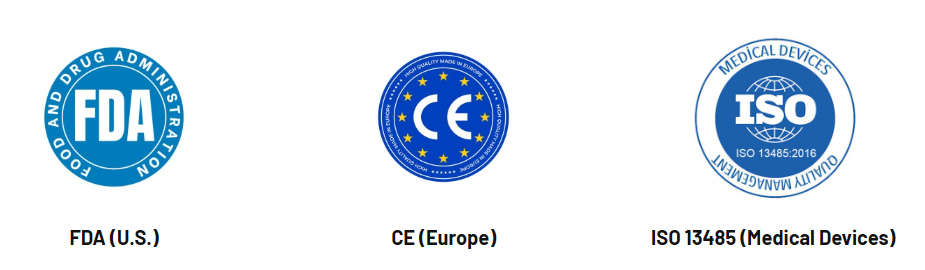
Start here. Every supplier worth evaluating must hold three key credentials:
ISO 13485 — medical device quality management
CE marking — under EU Directive 93/42/EEC
FDA 510(k) clearance — for Class I/II knee braces
No documentation? Walk away.
Customization Capability Depth
Check their actual range — not their sales pitch. You want confirmed support for:
3D scan-based fit
Multi-angle correction (varus/valgus at 8–15°)
Sport-specific hinge configurations
MOQ flexibility
Look for suppliers who handle runs from 500 units upward without dropping per-unit quality.
Risk Screening: Four Questions to Ask Every Supplier
| Risk Area | Key Question | Benchmark Standard |
| Sample Testing | Can braces survive 1,000 flex cycles without cracking? | ISO 10993 biocompatibility pass; sample delivery under 2 weeks |
| Factory Audit | What’s your defect and abnormality rate? | Below 5% — with documented process improvement support |
| Lead Time | What’s your production timeline at volume? | First batch: 30 days. Repeat orders: 15 days |
| After-Sales | How do you handle complaints and warranty claims? | Response within 48 hours; revision/rework service included |
Conclusion
The data is clear. The demand is growing. And the performance gap between generic and custom knee braces for sports has never been wider.
Sourcing for a sports brand? Equipping a professional team? Scaling an OEM operation? The question isn’t whether to go custom. It’s about finding the right manufacturing partner. You need precision fit, sport-specific engineering, and consistent quality at volume.
Here’s your next move:
- Audit your current product line or sourcing criteria against the buyer’s checklist in this guide
- Identify the gaps
- Reach out to AOFIT, a proven custom knee brace manufacturer — who backs their capabilities with certifications, material transparency, and real MOQ flexibility
The athletes wearing your product are counting on that decision. Make it count.