
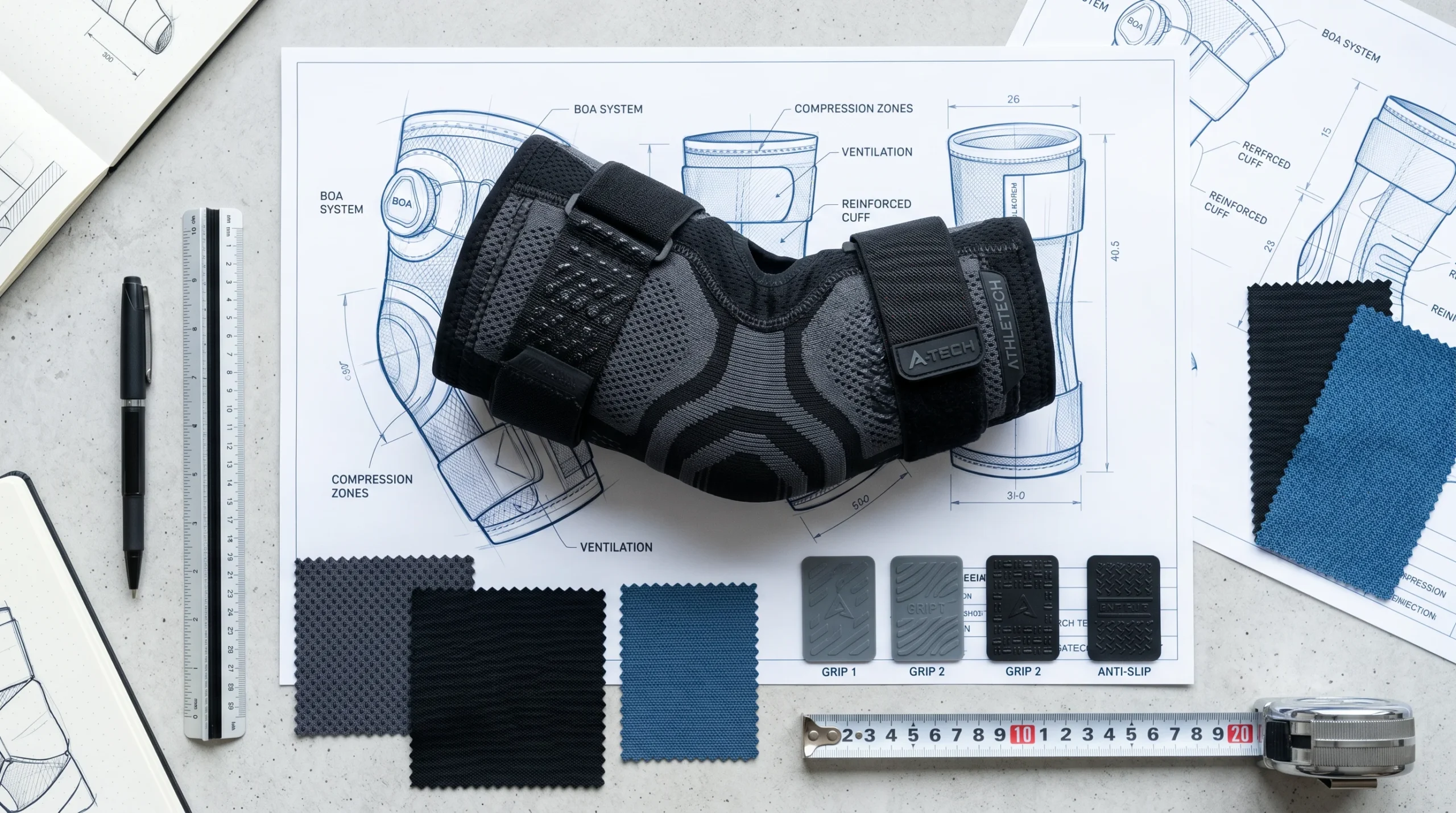
Finding a custom elbow brace that is in stock is harder than most product catalogs suggest. You need one that holds up under real athletic strain, earns repeat orders from physio clinics, and carries your brand without looking like a cheap private-label product.
The gap between a brace that moves units and one that drains your return budget comes down to early decisions — long before the first sample ships. Material selection, compression structure, strap mechanics, silicone placement. Get those right, and you’ve built a product. Get them wrong, and you’ve built inventory.
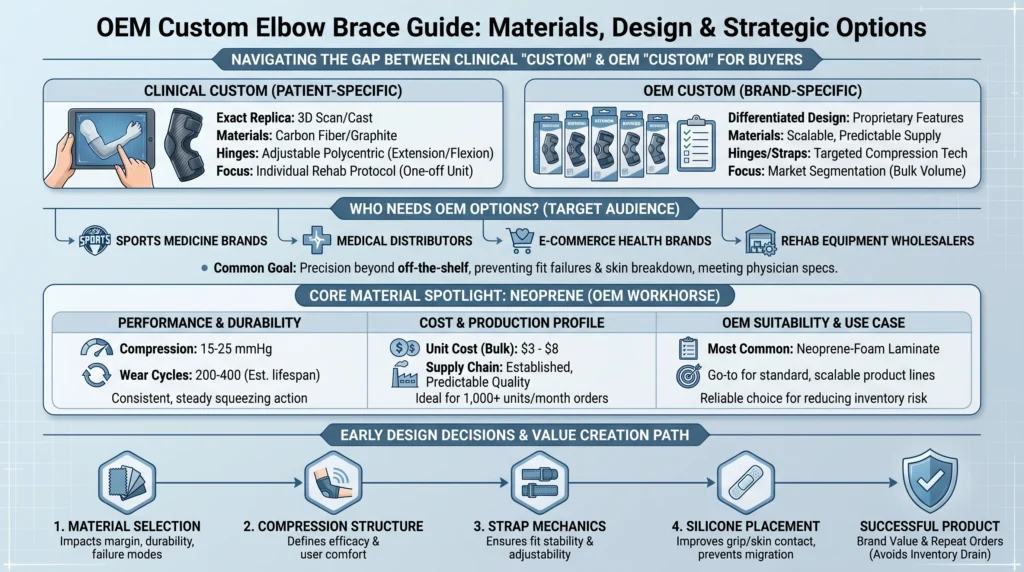
This guide covers everything a brand owner, distributor, or OEM buyer needs to know.
What Is a Custom Elbow Brace and Who Needs OEM Options?
Not every elbow brace earns the word custom. The term gets stretched across products that are stock designs with a logo slapped on them. Nothing more.
A true custom elbow brace is built from an exact replica of the patient’s arm. That means either a traditional cast or a digital 3D scan. The frame uses carbon fiber or carbon graphite. The hinges are bilateral polycentric — with extension and flexion stops you can adjust to match a specific rehab protocol. Each unit is built around one arm. Not a size chart.
That’s the clinical definition. In the OEM world, “custom” carries a different meaning — and that gap matters to buyers.
Who needs OEM options:
- Sports medicine brands — supplying braces for tennis elbow, golfer’s elbow, and contact sport hyperextension injuries
- Medical distributors — working with orthopedic clinics where standard sizing leads to fit failures or skin breakdown
- E-commerce health brands — building private-label lines that need differentiated design features, not generic sleeves with a printed logo
- Rehabilitation equipment wholesalers — sourcing products that must meet physician-specified range-of-motion requirements
The common thread isn’t the end user. It’s the demand for precision. Off-the-shelf options fall short — and buyers in these categories know it.
Core Materials for Custom Elbow Braces: Performance, Cost & OEM Suitability Compared
Material choice is where product margins are won or lost — and where most OEM buyers make their first expensive mistake.
Four material categories dominate the custom elbow brace market. Each has a production profile, a price ceiling, and a failure mode. Know them before you spec a sample.
Neoprene: The Production Workhorse
Elbow brace neoprene material is the industry default — and for good reason. You get steady compression in the 15–25 mmHg range, 200–400 wear cycles, and a unit cost of $3–$8 at bulk volume. Running OEM orders of 1,000+ units per month? Neoprene-foam laminate is the go-to. Supply chains are established, quality is predictable, and material costs stay low enough to protect your margin.
The tradeoff is real, though. Moisture retention is high. Neoprene traps heat. For athletic buyers, that’s a dealbreaker — unless you pair it with a breathable elbow brace fabric liner or add ventilation perforations.
Polyamide Blends: Performance Tier
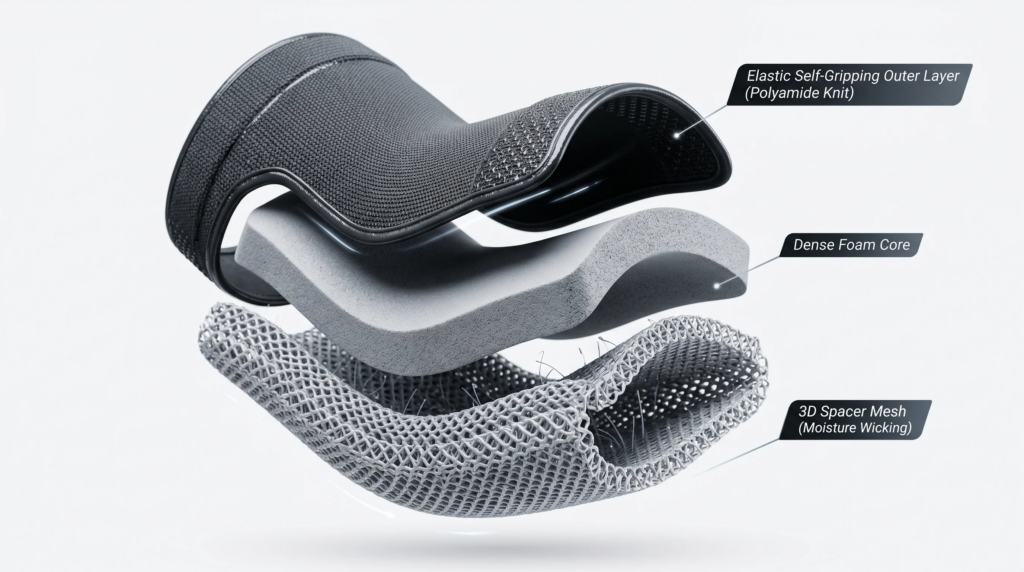
Polyamide laminate systems fix the heat problem. These use a 3-layer build — elastic self-gripping polyamide outer, neoprene foam core, 3D spacer fabric inner — similar to AirPren™-style construction. Compression runs 20–30 mmHg. Durability reaches 400–600 cycles. Moisture retention drops close to zero.
Custom orthopedic elbow support products aimed at medical distributors or post-injury athletic recovery fit this tier well. Plan for $8–$12 per unit in materials. Retail pricing lands between $40–$80.
3D-Printed Rigid Hybrid: Premium and Precise
This tier suits low-volume premium lines — 50–200 units per month. 3D-printed TPU or resin frames paired with neoprene sleeves give you per-patient fit geometry that compression fabrics can’t match. Durability reaches 500–800 cycles. Material cost runs $20–$30 per unit. Lead time is 2–4 weeks.
It’s a slower, costlier process. But for premium positioning or clinical use cases, the precision justifies it.
Material Selection at a Glance
| Material | Compression | Durability | OEM Suitability | Bulk Cost |
|---|---|---|---|---|
| Neoprene | 15–25 mmHg | 200–400 cycles | Excellent | $3–$8 |
| Polyamide blend | 20–30 mmHg | 400–600 cycles | Excellent | $5–$12 |
| Closed-cell foam | 10–20 mmHg | 150–300 cycles | Good | $2–$6 |
| 3D-printed rigid | 30–40+ mmHg | 500–800 cycles | Moderate | $15–$35 |
The right material isn’t the most advanced one. It’s the one that fits your volume, hits your margin target, and matches what your end user actually needs to recover.
Key Design Features That Define a High-Converting Custom Elbow Brace
Design features don’t just determine clinical performance. They determine whether your product earns a reorder or a return request.
A short list of features separates a custom elbow brace that buyers keep recommending from one they quietly drop from their catalog. Here’s what’s on that list.
Adjustable ROM Stops: The Feature Physios Specify
ROM adjustability is a must for any brace targeting rehabilitation or post-surgical recovery. Industry standard runs in 15° increments. Thuasne‘s system offers five extension stops (0°, 15°, 30°, 45°) and three flexion stops (90°, 110°, 120°). DonJoy takes a different approach with its bilateral polycentric hinge design. It adjusts to each patient’s protocol and builds medial and lateral ligament support into the hinge geometry.
For custom orthopedic elbow support products aimed at clinical buyers, this adjustability is what turns a physio’s interest into a standing order.
Shell Material: Where Weight and Strength Intersect
Carbon fiber and carbon graphite shells give you tight joint control without adding bulk. The DonJoy Custom Edition Pro comes in at under 20 oz total weight — 5mm lower profile than its predecessor. End users wearing a brace under a sleeve or through a full training session will notice that.
Elbow brace silicone padding and formable aluminum cuffs work alongside rigid shells. They shape to each patient’s anatomy for a close, custom fit. DonJoy’s four telefit cuffs auto-adjust with no impingement. It’s a small detail. The fit difference is real.
Strap Mechanics and Profile
Non-elastic straps give you more consistent stabilization than elastic alternatives. This matters most in high-demand sport use, where brace migration under load creates real problems.
Low-profile construction cuts down on bulk. For a tennis elbow brace custom design lines built for active users, a low-profile build has a direct impact on wearability scores. And wearability scores have a direct impact on reviews.
OEM Customization Options: What You Can Specify as a Brand Partner?
Most brand partners walk into their first OEM conversation with a logo file and a color swatch. That’s not a brief. That’s a starting point — and a thin one.
The manufacturers worth working with will push you further. They want a specification document, not a mood board. Here’s what you can — and should — lock down before a single sample gets cut.
Visual Identity and Brand Integration
Surface-level customization is the baseline. Logo placement, colorways, label design, packaging structure — these are the minimum. A capable OEM partner handles all of it. But they need your brand guidelines in writing, not a verbal description of what “feels right.”
Color matching across dispenser bodies, strap webbing, and packaging needs to be specified together. Gaps across those three elements are easy to spot. Buyers notice.
Technical Specifications You Control
This is where real product differentiation happens:
- Compression targets — specify mmHg range by intended use case (recovery vs. active sport)
- Strap configuration — single wrap, dual wrap, figure-8; elastic or non-elastic
- Silicone padding placement — epicondyle support ring position, density, shore hardness
- Ventilation structure — perforation pattern, mesh panel integration, total airflow area
- Closure system — hook-and-loop width, grip strength rating, repositionability cycle count
Vague specs produce vague samples. Every parameter you leave undefined becomes a decision the factory makes for you.
Compliance and Scalability Requirements
Set your regulatory targets upfront — CE marking, FDA registration, ISO 13485 for clinical distribution channels. These are not afterthoughts. They shape material selection, production process, and documentation requirements from day one.
Build scalability into your initial spec. Starting at 300 units and projecting 3,000 within 18 months? Say so. A manufacturer who knows your growth path can structure tooling and supply chain agreements that protect your unit cost as volume grows. That’s far better than renegotiating from scratch on every reorder.
How to Evaluate a Custom Elbow Brace OEM Manufacturer: 7 Critical Criteria
The gap between a real production partner and a production problem shows up fast — usually in the first technical conversation. Know what questions to ask. These seven criteria tell you which side of the line a manufacturer sits on, before you commit to anything.
1. Equipment Precision and Production Range
A manufacturer that can only produce neoprene compression sleeves is not a custom elbow brace OEM manufacturer. That’s a sleeve factory.
Look for proven capability across hinged braces, adjustable strap systems, and custom-molded rigid designs. Check that ROM adjustability covers the full clinical range. The industry benchmark for elbow orthoses is 0° to 110°. Ask about single-jointed versus multi-jointed frame systems. Single dorsal uprights reduce boney impingement — that detail matters to clinical buyers. The factory rep should know what it means. If they don’t, stop the conversation there.
2. Material Competency
Ask for samples. Not photographs — physical samples.
You want to see rigid plastic and metal components sitting alongside flexible elbow brace neoprene material in the same product line. That range shows the factory has solved both sides of the engineering challenge: maximum support and wearable comfort. Check that they stock open-cell materials for wrap-around closures. These reduce skin irritation in long-wear situations. Also, request a sample with adjustable fulcrum-point elbow pads. A solid sample should show a length adjustment range between 10.25″ and 12.25″.
3. Design Experience Across Clinical Use Cases
One generic compression sleeve does not make an elbow brace portfolio. Ask for case studies. You want examples covering fractures, tendonitis, arthritis, postoperative recovery, and ligament sprains — all five. A manufacturer with real design depth will have them. Ask whether they’ve built static-progressive ROM positioning systems and dynamic ratchet-style passive stretch braces. These are two separate product types, built on different mechanical principles. A factory that has made both understands the full range of custom orthopedic elbow support. Their portfolio should also show low-profile, non-bulky construction. Patient compliance depends on wearability — there’s no way around that.
4. Certifications and Quality Culture
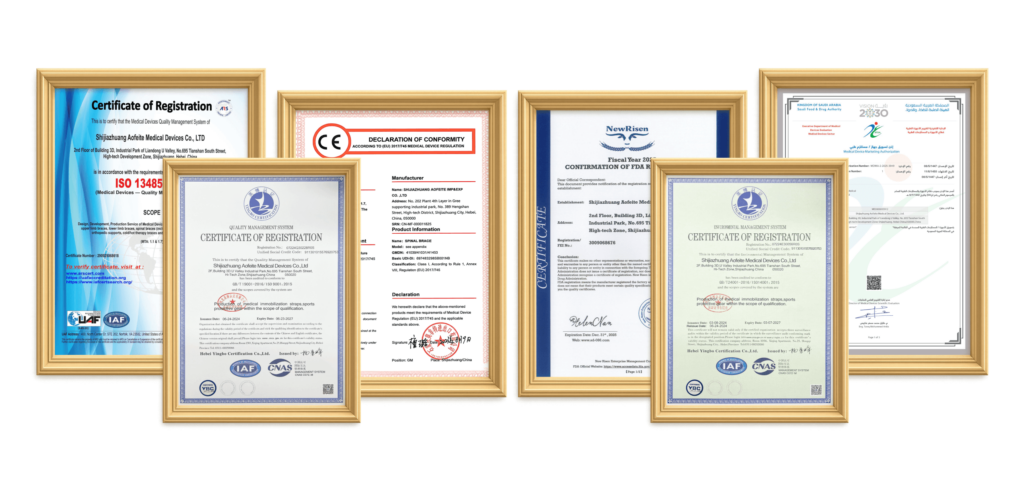
ISO 13485 is the baseline. Distributing into U.S. medical channels? FDA 21 CFR Part 820 compliance is required, full stop. Ask for the documentation — not just a verbal confirmation.
Then push one level deeper. A certificate is easier to fake than a quality culture. Ask about their engineer and technician training programs. Ask about their continuous improvement process. Then ask for their rework and scrap rate. The industry standard for custom orthoses sits below 5%. A factory that won’t share that number — or dances around it — has already given you your answer.
5. Material Safety and Biocompatibility
For any custom elbow brace sold through clinical or medical retail channels, this is not an optional step.
Get hypoallergenic and latex-free material options confirmed in writing, with supporting documentation. Request adverse reaction testing results and material biocompatibility records. A manufacturer without these on file has either skipped the testing or doesn’t understand why it’s required. Neither scenario works for a product worn directly against compromised or post-surgical skin.
6. Response Time and Collaboration Depth
Set a clear benchmark: technical questions deserve a real, substantive response within 24 hours. A factory that takes 48+ hours to reply during the vetting phase — the point where they’re trying to win your business — will not get faster once your purchase order is in the queue.
Speed is one thing. Depth is another. A capable partner sends technical drawings, detailed material specs, and itemized cost estimates without needing to be asked twice. They do pre-production planning, not just order-taking. For elbow compression sleeve OEM work and complex hinged designs alike, that design collaboration capacity is what separates a manufacturer from a vendor.
7. Scalability, Pricing Transparency, and Supply Chain Stability
Three questions to close your evaluation:
Can they scale with you? Confirm production capacity for small custom batches — 1 to 10 units — and for higher-volume runs. Get lead times for both. Standard designs run 2–4 weeks. Custom designs run 4–8 weeks. Ask about pediatric sizing and specialized ROM ranges. The infrastructure for product line extension needs to exist now — it won’t appear on demand later.
Is the pricing honest? Request itemized quotes that break out material costs, labor, customization fees, tooling, and quality control as separate line items. Custom elbow braces run $150–$400 per unit, depending on complexity. Pricing that falls well below that range — with no clear explanation of materials or process — is not a deal. It’s a warning sign. Factor in defect rates and warranty terms (standard is 12–24 months for manufacturing defects) before you compare unit costs.
Is the supply chain stable? Verify supplier relationships for neoprene, plastics, metal hinges, and closures. Ask point-blank about contingency plans for supply disruptions. On-time delivery performance should hit above 95%. Ask for the data. Don’t accept a verbal claim.
Red Flags vs. Green Flags
| Red Flags | Green Flags |
|---|---|
| Can’t explain ROM adjustment mechanisms | Detailed technical documentation ready on request |
| No certifications or audit documentation | ISO 13485 or FDA compliance confirmed |
| Response time over 48 hours | Under 24 hours; proactive follow-up |
| Refuses samples, case studies, or facility tours | Offers tours and provides verifiable references |
| Pricing far below market with no explanation | Transparent, itemized cost breakdown |
The right custom elbow support supplier won’t make you pull this information out of them. They’ll bring it to the table — because they’ve been through these questions before, and their answers hold up every time.
The OEM Order Process: From Initial Inquiry to First Shipment
Six steps separate your product idea from finished custom elbow braces at your warehouse door. Skip one, and you pay for it — in delays, rework costs, or a first shipment that doesn’t match what you signed off on.
Here’s how a clean OEM process runs:
-1024x576.png)
1. Inquiry & Requirement Confirmation
Send your specs upfront. Cover the intended use case, target compression range, strap configuration, branding requirements, and projected volume. The more detail you bring to that first conversation, the faster the factory gives you something useful back. Incomplete briefs slow everything down — no exceptions.
2. Quotation
You’ll get an itemized quote. Materials, labor, customization, tooling, and QC each appear as separate line items. For elbow compression sleeve OEM orders, bulk pricing kicks in at 500 units.
3. Contract & Order Confirmation
Lock every spec in writing before production starts. Any detail left open becomes a factory decision — made without your input. That’s how mismatches happen.
4. Sample Development & Approval
Physical samples ship to you for review. Check compression, fit, strap mechanics, and elbow brace logo customization placement against your brief. Approve, revise, or reject — all before mass production starts.
5. Manufacturing & Quality Inspection
Production runs to your confirmed spec. A solid manufacturer keeps the rework/scrap rate under 5%. QC runs before packing — not after a problem lands at your door.
6. Packing & First Shipment
Lead times run 2–4 weeks for established designs. For custom sports elbow support built from scratch, expect 4–8 weeks. Total time from confirmed order to first delivery is around 6–10 weeks.
That timeline is not a suggestion. It’s a hard planning number. Put it in your launch calendar before you brief a manufacturer — not after.
Custom Elbow Brace Applications by Market Segment: Matching Design to Target Buyer
The global orthopedic braces market hit $4.67B in 2024. By 2030, that number will reach $7.01B. The elbow-specific segment alone climbs from $1.4B to $2.35B by 2032. That’s not a niche. It’s a buying category with real momentum — and three distinct buyer segments pulling it in different directions.
Each segment has its own hard design requirements. Spec for the wrong one, and your product fails the buyer who matters most.
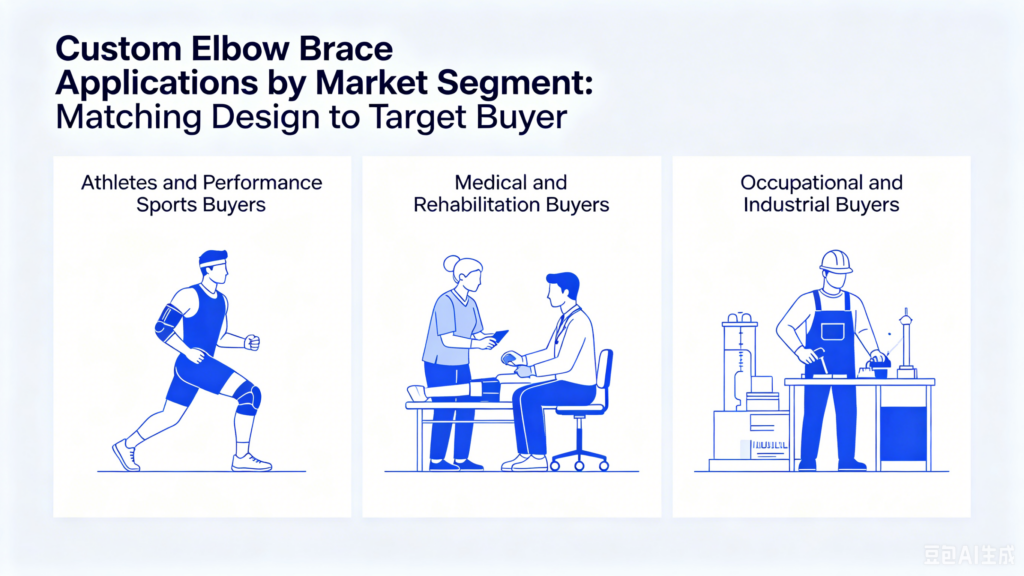
Athletes and Performance Sports Buyers
Carbon fiber frames. Bilateral polycentric hinges. ROM adjustment from 0° to 120° with hyperextension stops. A baseball pitcher or contact sport athlete needs all of this — and the DonJoy Custom Edition Pro is built around exactly that. Precise fit under load isn’t a preference. It’s the product itself.
Medical and Rehabilitation Buyers
Post-surgical UCL tears and chronic epicondylitis need heat-moldable thermoplastic construction. Fabrication takes 1–2 weeks. Lightweight materials keep wear compliance high. No compliance means the product doesn’t work — no matter how well it’s made.
Occupational and Industrial Buyers
Repetitive strain environments call for padded shells, adjustable straps, and valgus/varus offload designs. These redistribute joint force by 20–30%. Durability under sustained, heavy use is the top spec. Everything else comes second.
| Segment | Critical Design Feature | Primary Buyer Need |
|---|---|---|
| Athletes | Bilateral hinges, carbon fiber frame | Re-injury prevention under load |
| Rehabilitation | Custom-molded, lightweight thermoplastic | Healing support, wear compliance |
| Occupational | Padded shells, adjustable straps | Strain prevention, work durability |
Custom elbow braces make up 10–15% of the 1,176 elbow products tracked in the U.S. market. That’s where the margin lives — as long as your design matches the buyer wearing it.
Conclusion
A great custom elbow brace doesn’t happen by chance. It takes smart material choices, solid design decisions, and a manufacturing partner who understands what your end users need.
Sourcing a neoprene elbow brace for a sports recovery line? Developing a breathable compression sleeve for a medical retail brand? Ready to build your custom elbow brace line? Contact us, and let’s turn your product brief into something your customers reach for every time.