

Yes — tennis elbow bands can work, but only when they’re used correctly and for the right condition. The 2025 RCT by Hoseini et al. found that counterforce braces reduced pain intensity and tendon thickness at the second and fourth weeks after starting treatment. A counterforce brace can help reduce pain and relieve strain on the injured tendon during gripping or lifting activities. But it’s not a cure, and wearing one incorrectly may provide little benefit.
In this guide, we’ll explain how they work, when they help most, how to wear them properly, and what to expect realistically from using one.
What Is Tennis Elbow and Why Does It Cause Pain?

Tennis elbow is a degenerative tendinopathy, not an acute inflammatory condition. This distinction matters because many people mistakenly treat it as “tendonitis” requiring anti-inflammatories and complete rest — approaches that often fail.
The condition originates at the origin of the extensor carpi radialis brevis (ECRB) , where this muscle attaches to the lateral epicondyle — the bony bump on the outside of your elbow.Repetitive wrist extension and gripping create mechanical overload, leading to microtears and structural breakdown within the tendon itself.Tendon degeneration is characterized by disorganized collagen fibers, increased water content, and a loss of tensile strength — not by inflammatory cells rushing to the site. This explains why resting alone rarely resolves chronic cases.
Typical triggers that reproduce tennis elbow pain include:
- gripping objects tightly (a handshake, a coffee mug, a screwdriver)
- lifting with the palm facing down — especially heavy items like suitcases or grocery bags
- typing or prolonged mouse use without adequate forearm support
- twisting motions — opening jars, turning doorknobs, using a wrench
- the backhand stroke in tennis, which eccentrically loads the wrist extensors
How to differentiate tennis elbow from golfer‘s elbow?
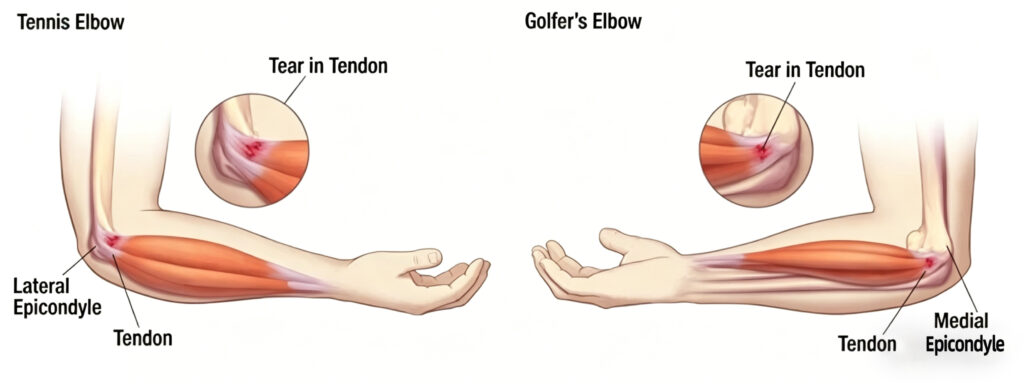
| Feature | Lateral Epicondylitis (Tennis Elbow) | Medial Epicondylitis (Golfer’s Elbow) |
| Pain location | Outside (lateral) aspect of the elbow | Inside (medial) aspect of the elbow |
| Triggering motion | Wrist extension (bending wrist backward) | Wrist flexion (bending wrist forward) + gripping |
| Commonly aggravated by | Backhand stroke, lifting with palm down, typing | Forehand stroke, throwing, swinging a hammer |
If your pain is on the inside of the elbow, a tennis elbow band applied to the outside arm is not the right product for you. The distinction is essential before you make any purchase decision.
How Does a Tennis Elbow Band Work?
Think of a counterforce brace like a clamp on a fraying rope. The rope has a weakened section just before its attachment point. Placing a clamp before that weakened area shifts tension away from the damaged zone toward a stronger portion of the rope.
Biomechanical research shows that the tennis elbow band works by applying targeted pressure to the muscle belly of the ECRB, which changes the angle of muscle pull at its tendon attachment on the lateral epicondyle. Instead of the tendon bearing the full load during gripping or wrist extension, some of that force gets distributed into the strap — effectively creating a new “origin point” for the forearm muscles.
The optimal compression point is 1 to 2 inches below the elbow joint. Biomechanical models demonstrate that placing the brace at this distance reduces the forces acting at the tendon origin more effectively than when placed elsewhere. Braces with an integrated pad positioned directly over the ECRB belly offer greater local pressure concentration than plain elastic straps, making them more biomechanically efficient for tennis elbow relief.
Correct Placement & Tension: Why Most People Wear Tennis Elbow Band Wrong?
Most failed outcomes with tennis elbow bands trace back to one of three placement or tension errors. Fix these before concluding that bands “don‘t work for you.”
Optimal placement (visualize this): Place the band on your forearm 1 to 2 inches below the elbow crease, directly over the bulge of the extensor muscles when you make a fist. The padded component — if your band has one — should sit on the muscle belly, not on the lateral epicondyle itself.Compressing bone instead of muscle negates the entire mechanical principle of counterforce bracing.
The tension standard:
- Snug enough that the muscle bulges slightly against the band when you clench your fist
- Loose enough to slide one finger comfortably between the strap and your skin
- No numbness, tingling, or skin discoloration in your fingers or hand
The three most common wearing mistakes:
| Mistake | Why it fails |
| Position too high (directly over the elbow joint) | Pressure falls on the lateral epicondyle, not the ECRB belly — no force redistribution occurs |
| Over-tightening | Impedes venous return and compresses the posterior interosseous nerve, causing hand numbness |
| Under-tensioning | Insufficient compression fails to alter the muscle‘s angle of pull — placebo effect at best |
When to Wear Tennis Elbow Band and When to Take It Off?
Wear your tennis elbow band: only during activities that consistently trigger pain — sports, repetitive work tasks, heavy lifting, or prolonged typing.The band serves as a task-specific tool, not a permanent accessory. Removing it during rest allows normal circulation and prevents muscular dependence.
Do NOT wear your band:
- During sleep — nighttime compression offers no benefit and risks unintended circulation restriction
- While at rest — the forearm muscles do not require offloading when they are inactive
- During low-demand activities that cause no pain — unnecessary bracing may encourage muscle inhibition
Tennis Elbow Band vs. Compression Sleeve vs. Full Elbow Brace: Which One Do You Need?
Not all elbow supports serve the same purpose. The table below clarifies the distinction.
| Type | Mechanism | Best for | When to use | Key limitation |
| Counterforce strap (tennis elbow band) | Targeted compression over ECRB muscle belly; redistributes load away from tendon origin | Sharp, activity-specific pain in confirmed lateral epicondylitis | During sports, work, gripping tasks | No targeted load redistribution |
| Compression sleeve | Graduated circumferential compression; reduces general swelling; provides warmth and proprioceptive feedback | Mild generalized aching, post-activity soreness, mild tendinopathy | During day-long wear at desk or moderate activity | Swelling support, lacks precise relief for provoked symptoms |
| Wrist splint | Immobilizes wrist in neutral position; forces rest of wrist extensors | Acute severe tennis elbow, night-time use, cases where counterforce strap failed | 6 weeks during daily activities (except sleep and bathing) | Restrictive; strength loss possible |
| Full elbow brace (hinged/hard-shell) | Joint stabilization through mechanical limitation of range of motion | Elbow instability, ligament injury, post-operative protection | Not for standard tennis elbow | Overkill; unnecessary immobilization prolongs recovery |
Does a compression sleeve work for tennis elbow? The short answer: poorly for active pain. A sleeve provides broad, diffuse pressure with no focal point over the ECRB belly. It may feel comforting for general elbow soreness, but lacks the force multiplication effect that defines effective counterforce bracing. For pronounced cases with clearly provoked pain, a counterforce strap is the correct starting point.
Wrist splints as an alternative. Research suggests that wrist splints may reduce tennis elbow pain faster than counterforce straps within the first six weeks, though outcomes converge by the six-week mark. For people over 45 or those with very painful stubborn cases, a wrist splint may be a better first-line choice.Some practitioners advocate prescribing a cock-up wrist splint alongside a forearm counterforce brace for chronic lateral epicondylitis.
Bottom line: Start with a counterforce strap with a localized gel or silicone pad for moderate tennis elbow. If that fails after 2–3 weeks of proper use, consider a wrist splint for enforced rest, not a full forearm sleeve.
How to Choose the Right Tennis Elbow Band: 4 Features That Actually Matter
When evaluating tennis elbow bands, most marketing emphasizes generic claims about “support” and “compression.” The engineering differences that determine real-world effectiveness are far more specific.
1. Localized pressure pad vs. plain elastic strap
Braces that incorporate a gel, silicone, or pneumatic pad placed directly over the ECRB muscle belly produce superior targeted pressure concentration compared to uniform elastic bands.Biomechanical studies confirm that pad-integrated designs reduce forces at the ECRB origin more effectively than plain compression bands. Plain elastic straps distribute compression diffusely; pad designs deliver focal load, which is precisely what counterforce bracing requires.
Gel-pad supports represent the most structured option in this category. They pair a strap or sleeve with a point-specific compression element that neither a plain strap nor a sleeve alone can provide. Clinicians tend to recommend this type for moderate-to-significant lateral epicondylitis where a basic strap has stopped delivering relief.
2. Material breathability and comfort
Tennis elbow bands are typically worn during physical activity, often for hours at a time. Neoprene offers good compression but limited breathability, leading to sweat accumulation and skin irritation. Mesh-backed or perforated materials provide better moisture management for extended wear.
3. Adjustability range
A single “universal” size fits only a subset of forearms. Look for a hook-and-loop closure system with enough strap length to accommodate your arm‘s circumference while still allowing fine-tuned tension adjustments.The ability to modify tension as swelling subsides or as the tendon recovers is an underappreciated advantage.
4. Low-profile design for activity-specific wear
If you need the band while working with tools, typing, or playing racket sports, a bulky design will interfere with motion. Slim-profile straps that stay in place during dynamic movement are worth prioritizing over padded models that shift or bunch.
For those seeking a counterforce brace that combines all four of these engineering principles — localized silicone pad pressure, breathable construction, fully adjustable fit, and a low profile suitable for active use — custom elbow brace solution is designed specifically to address these identified performance gaps. Advanced features such as double-strap fixation and anatomically contoured gel pads provide the focal compression that generic elastic bands cannot achieve, making them an appropriate upgrade if you have already tried a standard strap without success.