
You’ve taped up your ankle, laced your goggles, and now you’re standing at the pool edge with one question — will this brace hold up once I hit the water? That’s a fair question. Most people don’t stop to ask it before they jump in.
Neoprene ankle braces have become the top recommendation for swimmers and aquatic rehab patients. But the full picture — the material science, the real trade-offs, and the situations where neoprene earns its spot — doesn’t get covered enough.
You might be working through an ankle sprain recovery and trying to stay in the water. Or you’re hunting for a waterproof ankle brace for swimming that won’t fall apart after three laps. Either way, this guide gives you a straight answer.
What Makes a Neoprene Ankle Brace “Swimming-Ready”?
Four criteria separate a swim-ready ankle brace from one that just tolerates getting wet.
Water Resistance: Closed-Cell or Nothing
Swim-grade ankle braces use neoprene with a closed-cell structure. Over 90–95% of the internal cells are sealed, independent air pockets. Each pocket runs 100–300 micrometers across. There are tens of thousands per cubic centimeter. None of them connect to each other. Water hits the surface, finds no path through, and stops cold.
The result: volume water absorption below 0.5–3.0% after 24 hours of full immersion. Compare that to open-cell foam or standard fabric braces. Those soak up 10–30% of their volume in water. That’s not a small gap. It’s the difference between a brace that still works at meter 30 and one that turned into a sponge by meter five.
Quick-Dry Performance
A brace that takes 18 hours to dry is useless for everyday training. The practical benchmark: surface-dry within 4–6 hours at room temperature. Quality neoprene with nylon or polyester outer layers hits 2–4 hours. Cotton-padded braces? Closer to 12–24 hours. The padding is the real problem — thick foam cores hold water long after the shell feels dry.
Wet-State Compression and Stability
Neoprene rubber is hydrophobic by nature. Short-term immersion shifts its modulus by less than 5–10%. The material barely registers the water. Cotton-blend and spandex fabrics don’t hold up the same way. Saturation drops their elastic modulus by 20–40%. So the same amount of stretch delivers far less compression to your joint.
For a neoprene compression ankle sleeve, studies and clinical data show pressure variation of less than 5–10% before and after full water exposure. Traditional fabric braces? Compression loss of 15–25% or more under the same conditions.
Chlorine and Saltwater Durability
Neoprene handles pool chemistry well. Wetsuit-grade materials can last 1–3 years in high-chlorine environments. The weak points are metal hardware and velcro. Use 316 stainless steel or plastic buckles only. Standard nickel-plated parts can rust within weeks in chlorinated water.
After every swim, follow these steps:
– Rinse with tap water
– Air dry in the shade
Skip this care routine, and even good neoprene breaks down faster than it should.
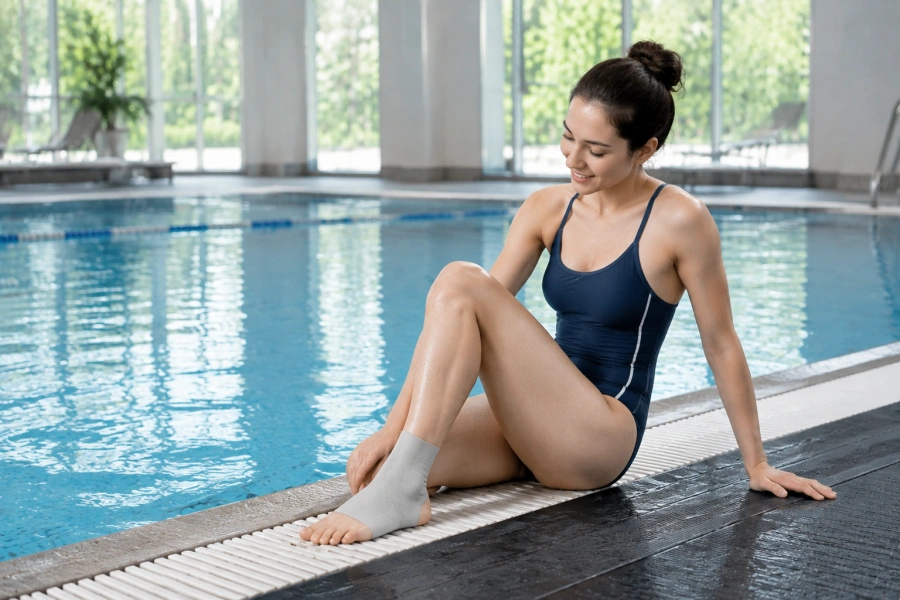
Neoprene vs Other Materials: Which is the best ankle brace for swimming
Three materials dominate the ankle brace market. Each went through the same conditions: chlorinated pool water, continuous kicking, extended immersion. The differences that came out were clear.
Neoprene: The Balanced Option
Neoprene doesn’t win on any single metric. It wins because it doesn’t fail on any of them.
Water resistance? Strong. Compression when wet? Consistent. Flexibility for kicking? Enough to keep your stroke clean without losing lateral control. Dry time? Not the fastest — but much quicker than padded rigid structures.
That balance is what swimming demands. No other material delivers all five at once.
Rigid Plastic Stirrup Braces: Strong on Land, Limited in the Pool
Rigid stirrup braces — the hard-shell, air-bladder designs — give you the highest inversion control available. For early ankle sprain recovery on land, they work well.
In the pool, the trade-offs are hard to ignore:
- Kick efficiency drops — hard shells block the foot-pointing motion your stroke depends on
- Internal liners, straps, and air bladders trap water and take a long time to dry
- Comfort during long swims falls short of neoprene, again and again
The verdict: rigid braces are built for protection and keeping the ankle still. Swimming needs movement. That’s a clear mismatch.
Elastic Knit Sleeves: Light, Fast-Drying, Undersupported
Elastic knit fabric dries fastest of the three. It’s also the most flexible. For mild daily discomfort or low-load activity, it does the job.
For swimming? The support gap is real. Knit fabric soaks up water fast, loses compression once saturated, and gives you no real lateral stability under kick forces.
ProBrace has pointed out that ankle braces fit for swimming are rare on the market — and that gap reflects a real design problem. Most knit sleeves were never built for sustained use in water.
| Feature | Elastic Knit | Rigid Plastic | Neoprene |
| Water Resistance | Low (can absorb water) | High (but rigid) | Excellent (quick-dry, non-absorbent) |
| Drag in Water | High (increases resistance) | Medium (bulkier material) | Minimal (ultra-thin, form-fitting) |
| Compression Level in Water | None | High (can restrict movement) | Moderate (targeted support) |
| Fit Stability in Water | Good (with straps) | Poor (can shift) | Excellent (seamless, non-slip) |
Who Should Wear a Neoprene Ankle Brace for Swimming?
Not everyone on the pool deck needs one. But for certain swimmers, a neoprene ankle brace isn’t optional — it’s what keeps you in the water instead of sitting out another week.
Here’s who benefits.
Ankle Sprain Recovery (Grade I–II, Sub-Acute Phase)
The right window starts around day 5–7 after injury. Swelling has dropped. Sharp pain is fading. But those lateral ligaments are still rebuilding. That’s where neoprene earns its place in the pool.
Chronic Ankle Instability and Aqua-Fitness
Up to 20–40% of people who sprain their ankle once develop chronic instability. That “giving way” feeling doesn’t stop at the pool edge. It follows you onto wet stairs, slippery tiles, and rocky open-water entries.
Aqua-fitness moves like lateral shuffles, shallow-water jumps, or step movements put real stress on an unstable ankle. Neoprene gives you two things rigid braces don’t: proprioceptive feedback and enough mechanical support to catch a bad step before it turns into a new injury.
One thing to keep in mind — wearing a brace non-stop won’t fix the root problem. Pair it with 3–4 sessions of balance and strengthening work per week. Save the brace for high-risk sessions where the conditions call for extra support.
Chronic Pain Conditions: Arthritis and Tendinopathy
Older swimmers with ankle osteoarthritis, or anyone dealing with Achilles or peroneal tendinopathy, turn to the pool because it removes impact load. Neoprene builds on that benefit. You get compression, joint warmth, and mild movement control — all from one sleeve.
In fitness pools running 26–29°C, neoprene keeps tissue temperature steady and stiffness down. In cooler open water, thermal protection matters even more. For post-surgical ankles cleared for aquatic gait training, the brace adds just enough stability to prevent small slips during early-phase pool walking and step work.
Water-Sport Competitors Returning from Injury
Surfers, water polo players, springboard divers, and open-water triathletes all face a similar challenge — unpredictable entry and exit conditions, lateral cutting, and uneven surfaces. Many already use 2–5mm neoprene booties that act as de facto braces.
For a structured return to sport, the approach mirrors land-based brace use: 4–6 weeks of steady wear during training and competition. This applies especially in high-demand settings like reef breaks, mass-start triathlon swims, or shallow-water polo play.
When to Skip It
- Acute fractures or Grade III sprains — these need rigid immobilization, not soft neoprene
- Open wounds or unhealed surgical incisions — warm, wet, closed environments speed up tissue breakdown and raise infection risk
- Known neoprene or latex allergy — longer pool sessions increase exposure and can worsen reactions
- Low-risk routine swimming where a brace replaces rehab — passive support doesn’t build the neuromuscular control that stops long-term instability
The brace belongs in your bag for high-risk sessions. Your rehab program handles the rest.
How to Choose the Right Waterproof Ankle Brace for Swimming
Three things decide whether neoprene works in the pool — design type of ankle braces, fit, and what the label means. Get one wrong, and you’ve bought a brace that restricts your kick or collapses under pressure by lap ten.
Evaluate an ankle brace for swimming first
- Dorsiflexion and plantar flexion are preserved — you need ankle movement to kick
- Inversion control is firm but not rigid — too much restriction kills stroke efficiency
- Compression, warmth, and swelling reduction are built into the design
- Post-swim comfort — does it trap water? Does it feel tight after extended wear?
Match the Design to Your Injury and Your Stroke
Sleeve-style braces (3–5mm neoprene, no straps) are the standard starting point. You get steady 15–25 mmHg compression with almost no impact on freestyle or backstroke kick mechanics. You can walk without instability and your goal is swelling control or mild pain relief? This is your pick.
Figure-8 strap designs are the next step up when your ankle still gives way on land. The crossed strap limits inversion and eversion. That matters most in breaststroke, where end-range external rotation puts real stress on your lateral ligaments. Your doctor cleared you for pool work, but stairs still feel shaky? The figure-8 gives you lateral control that a plain sleeve can’t match.
Wrap-style braces fix one specific problem: swelling that changes through the day. Your ankle circumference shifts 0.5–1.5cm between morning and evening? An adjustable wrap lets you turn compression up or down as needed.
Get the Sizing Right Before You Get in the Water
Measure your ankle circumference at the malleolar line — the horizontal point across both ankle bones. Do it in the afternoon, or right after training. At that point, tissue is a bit expanded from blood flow. Swimming pushes circulation further, so a brace that feels like 7/10 tightness on land tends to drop to 4–5/10 in the water. That’s the target comfort range.
Standard sizing runs:
– S: 17–20cm
– M: 20–23cm
– L: 23–26cm
Land between sizes? Go up and pick a model with an adjustable strap.
Thickness matters more than most buyers expect. The best thickness for swimming is 3/16 inch (≈4.8mm). It balances support and flex without adding enough buoyancy to shift your plantar flexion angle. Go above 6mm and the material’s own buoyancy (neoprene density: 0.3–0.4 g/cm³) starts working against your downward kick.
Read the Label — “Water Resistance” Is Not “Waterproof”
Water-resistant means the surface sheds water for a short time. Seams and velcro still soak it up. In a pool, these braces pick up 10–30g of water weight, dry out slowly, and lose compression faster than the label claims.
For regular pool use, skip the label marketing. Check three things instead:
- Material: 100% neoprene or a neoprene-nylon blend with a smooth inner knit layer
- Seam construction: flatlock or blind-stitch seaming — fewer needle holes means less water getting in at stress points
- Use-case language: the product description mentions swimming, water sports, or aquatic therapy
Also: avoid any brace with metal hinges or nickel-plated hardware. Chlorinated water eats through standard metal parts within weeks. Plastic buckles and metal-free velcro closures are the only way to go.
Conclusion
Neoprene isn’t a perfect material — nothing is. But the science is clear on ankle support that holds up in water. It stays snug, resists chlorine breakdown, and keeps working long after other materials fail. That’s not marketing language. That’s just how neoprene behaves.
Recovering from an ankle sprain but not ready to quit swim training? Good. Neoprene, the right waterproof ankle brace for swimming gives you both protection and performance. No trade-offs. No compromises.
Ready to update your product lines? Contact AOFIT for a custom ankle brace solution. Aofitbrace builds their swim-specific line around this exact spec — 3/16-inch neoprene, a nylon/spandex inner lining that fights the post-swim “stuck to skin” feeling, and plastic hardware throughout. That combination is what makes a brace worth using for real swim training ankle protection, not just a single session in the shallow end.