
If you’re dealing with nagging elbow pain, you’ve probably seen two common products online: the golfers elbow brace and the tennis elbow brace. At first glance, they look nearly identical. So, which one do you actually need?
The short answer is that the difference comes down to where the pain lives—on the inside or outside of your elbow. Choosing the wrong support won’t just waste your money; it can delay healing and even make things worse.
This guide will walk you through every detail of the golfers elbow brace vs tennis elbow brace decision, from pain location and brace mechanics to wearing techniques and product recommendations.
What Is Golfers Elbow vs Tennis Elbow? (Pain Location & Symptoms)
Before you buy any support, you need to understand which condition you’re dealing with. Many people misuse the terms, but the clinical difference is straightforward.
Pain Location: Inside vs Outside
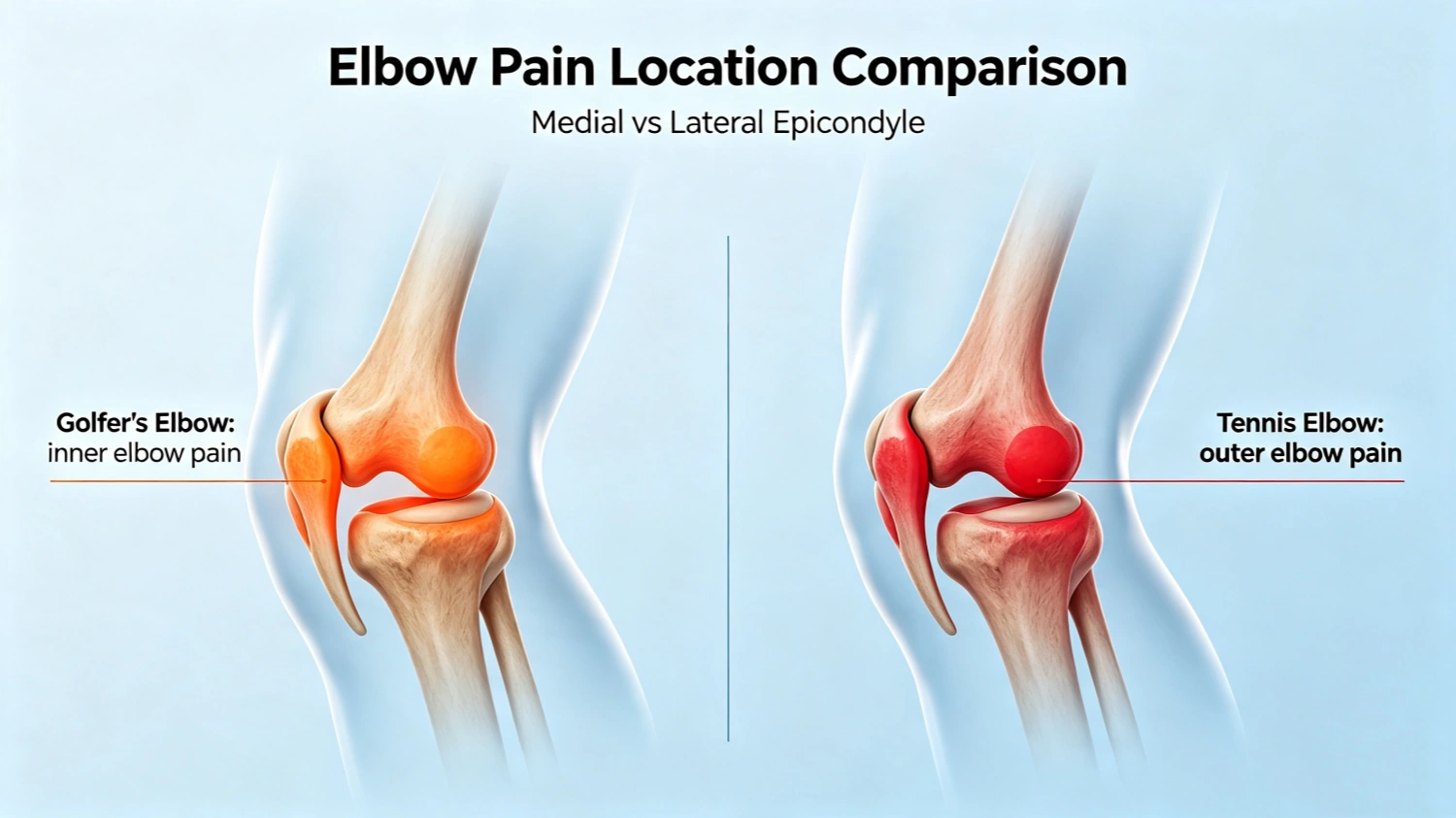
- Golfers elbow (Medial Epicondylitis) – Pain on the inside of your elbow, where the forearm flexor muscles attach to the medial epicondyle.
- Tennis elbow (Lateral Epicondylitis) – Pain on the outside of your elbow, where the forearm extensor muscles attach to the lateral epicondyle.
Typical Symptoms: How to Self-Assess?
Both conditions share common triggers but express themselves differently.
| Symptom | Golfer’s Elbow (Medial) | Tennis Elbow (Lateral) |
| Pain triggered by | Gripping, wrist flexion, throwing | Lifting, wrist extension, shaking hands |
| Weakness | Reduced grip strength | Difficulty holding a coffee cup or turning a doorknob |
| Movements that hurt | Swinging a club, hammering, typing | Backhand stroke, using a screwdriver, carrying a suitcase |
| Common in | Golfers, baseball players, office workers | Tennis players, painters, plumbers |
Both conditions stem from repetitive forearm overuse. You don’t have to play golf to develop golfer’s elbow, and you don’t need a racket for tennis elbow.
If your pain is on the inside, you’re likely looking for a golfers elbow support wrap. If it’s on the outside, a tennis elbow support strap is your starting point.
How a Tennis Elbow Brace Works (Lateral Epicondylitis)
A proper tennis elbow treatment brace isn’t just a piece of elastic fabric. It’s a mechanical device designed to offload tension from an inflamed tendon.
Core Structure: Counterforce Strap + Lateral Pad
The standard tennis elbow brace consists of two key parts:
- A counterforce strap (the adjustable band)
- A pressure pad positioned over the forearm extensor muscle belly—not the bone
You wear it about one thumb-width below the lateral epicondyle (the outer bony bump).
Mechanism of Action
Here’s how it works: When you grip or lift something, your extensor muscles contract, pulling on the lateral epicondyle. That repetitive tug aggravates the tendon. The strap compresses the muscle belly, absorbing and distributing that force away from the attachment point. The result? Less pain during activity.
When to Use an Elbow Sleeve
For chronic cases or all-day wear, an elbow sleeve offers gentle compression and warmth. It doesn’t provide the same focused offloading as a tennis elbow support strap, but it improves pain-free grip strength over time. Many people combine both: a strap during heavy tasks, a sleeve for daily comfort.
How a Golfers Elbow Brace Works (Medial Epicondylitis)
The golfers elbow treatment follows the same mechanical logic—just rotated 180 degrees.
Structure: Same Strap, Different Position
A golfers elbow brace is also a counterforce strap. The only structural difference is the pad location:
- Pad sits over the flexor/pronator muscle belly on the inside of your forearm
- Strap positioned one thumb-width below the medial epicondyle
How It Reduces Pain?
When you flex your wrist or rotate your forearm inward (think: swinging a club or turning a doorknob), your flexor muscles pull on the medial epicondyle. The strap compresses those muscles, reducing the tensile load at the bone attachment. That’s why a well-fitted elbow brace for golfers elbow can provide near-instant relief during aggravating movements.
What About “2-in-1” Braces?
You’ll see products labeled as “Tennis/Golfer’s Elbow Brace.” These are dual-use straps with a rotatable or repositionable pad. They work perfectly fine for either condition—as long as you rotate the pad to the correct side (medial for golf, lateral for tennis). Don’t assume a “tennis” label means it won’t work for the inside of your elbow. Many of the best brace for medial epicondylitis options are actually repurposed tennis straps with adjustable pads.
Golfers Elbow Brace vs Tennis Elbow Brace: Key Differences at a Glance
| Feature | Tennis Elbow Brace | Golfer’s Elbow Brace |
| Pain location | Lateral epicondyle (outside) | Medial epicondyle (inside) |
| Pad position | Over extensor muscle belly (outer forearm) | Over flexor muscle belly (inner forearm) |
| Target muscle group | Wrist extensors | Wrist flexors & pronators |
| Aggravating motions | Backhand, lifting, gripping palm-down | Swinging, throwing, gripping palm-up |
| Strap placement | 1 thumb-width below lateral epicondyle | 1 thumb-width below medial epicondyle |
| Best for | Tennis, climbing, typing | Golf, baseball, manual labor |
Here’s the key takeaway: You do not need two different products. The brace itself is nearly identical. Only the pad orientation changes. A single adjustable counterforce strap can serve both conditions if you know where to place it.
Can You Use a Tennis Elbow Brace for Golfer’s Elbow (and Vice Versa)?
This is one of the most common questions we hear. And the answer is: Yes, with conditions.
When Interchangeable Use Works
A universal counterforce strap (one with a centered, movable or double-sided pad) works for both medial and lateral epicondylitis. All you have to do is rotate the pad to the painful side—inside for golfer’s elbow, outside for tennis elbow.
If your brace has a fixed pad designed specifically for the lateral side, using it for golfers elbow will place the pad on the wrong muscle group. It won’t cause harm, but it also won’t help much.
Practical Limits of Swapping
- Pad adjustability – Does your strap allow you to reposition the pad 180 degrees? If not, buy a true dual-purpose model.
- Strap width – A very narrow tennis strap may not provide enough coverage on the thicker flexor muscle belly.
- Bilateral pain – If both sides hurt, a single strap won’t solve it. You need a professional evaluation.
When to Avoid Swapping
If you’ve tried swapping and felt no relief after 1–2 weeks of correct use, stop guessing. The issue might be:
- A different pathology (radial tunnel syndrome, cervical radiculopathy, arthritis)
- Incorrect initial diagnosis (pain location can be misleading)
At that point, see a physical therapist or sports medicine provider.
How to Wear Each Brace Correctly (Placement Guide for Both Conditions)
Even the best elbow brace for tennis elbow fails if you wear it wrong. Let’s fix that with a simple step-by-step.
Tennis Elbow Brace Placement (Lateral Pain)
- Find your lateral epicondyle – The bony bump on the outside of your elbow.
- Measure one thumb-width down – Place your thumb just below that bony point. That’s where the strap goes.
- Position the pad – The pressure pad should sit directly over the extensor muscle belly (the fleshy part, not the bone).
- Tighten to “comfortable snug” – You should feel compression, not numbness. If your fingers tingle, it’s too tight.
Golfers Elbow Brace Placement (Medial Pain)
- Find your medial epicondyle – The bony bump on the inside of your elbow.
- Measure one thumb-width down – Same rule applies.
- Rotate the pad – It must sit over the flexor muscle belly on the inner forearm.
- Snug, not cutting off circulation – Check that you can still make a full fist without extra pressure.
Common Placement Mistakes (And Consequences)
| Mistake | What Happens |
| Pad directly on the bony epicondyle | Zero force offloading; the strap pushes into the painful spot |
| Strap too tight | Hand numbness, tingling, or swelling from compressed nerves/veins |
| Strap too high (above the epicondyle) | No mechanical advantage; the muscle isn’t compressed |
| Strap too loose | Slides around; provides inconsistent pressure |
When to Wear It
- During activity – Wear the strap only during movements that trigger pain (golf, lifting, typing).
- All-day wear – Not recommended unless you have constant pain with basic tasks. For that, switch to an elbow sleeve for gentle continuous support.
Which Brace Is Better for Your Condition?
No single answer fits everyone. Use this three-scenario framework to choose.
Scenario 1: Acute Pain During Sports or Work → Counterforce Strap
You feel sharp pain only when swinging, lifting, or gripping. A strap is your best friend. It provides immediate mechanical offloading without restricting range of motion.
- Tennis elbow → Lateral pad strap
- Golfer’s elbow → Medial pad strap (or adjustable dual-use)
Scenario 2: Chronic, Dull Ache or All-Day Discomfort → Elbow Sleeve
You wake up with stiffness. The pain is there even when you’re not moving. A sleeve’s uniform compression improves local blood flow and proprioception, which helps reduce chronic irritation. You can also wear a sleeve under a strap during heavy tasks.
Scenario 3: You’re Not Sure Where the Pain Is → Adjustable Dual-Position Brace
If your pain shifts or feels diffuse, buy a brace with a removable or rotatable pad. This lets you test placement on both the medial and lateral sides without buying two products. Many of the best brace for lateral epicondylitis and medial cases are actually the same adjustable model.
What Does the Research Say?
A 2025 systematic review in the Journal of Orthopaedic & Sports Physical Therapy confirmed that counterforce straps provide short-term improvements in pain-free grip strength and immediate pain reduction during aggravating activities. However, the same review noted that long-term healing outcomes depend more on rehabilitation exercises and activity modification than on bracing alone.
In plain English: A brace helps you function today. Exercises and load management heal you for tomorrow.
The Three Pillars of Brace Success
No brace works unless you get these right:
- Correct diagnosis – Inside vs outside matters.
- Correct placement – One thumb-width below the epicondyle, pad on muscle not bone.
- Activity modification + rehab – A brace is a tool, not a cure.
Best Golfer’s Elbow Brace & Tennis Elbow Brace Recommendations
Now let’s match products to your specific needs. All recommendations below are from aofitbrace.com and designed for real-world use.
Best for Tennis Elbow (Lateral Pain)
AOFIT Tennis Elbow Support Strap
- Pad design: Fixed lateral contour with dual-density foam
- Material: Breathable neoprene-free fabric
- Adjustment: Single-pull velcro with silicone grip lining
- Best for: Acute lateral pain during tennis, climbing, or repetitive gripping tasks
Why it works for you: The pad is specifically shaped to fit the extensor muscle belly without digging into the radial nerve. For most active individuals, this is the best elbow brace for tennis elbow in terms of comfort-to-support ratio.
Best for Golfer’s Elbow (Medial Pain)
AOFIT Golfer’s Elbow Compression Strap
- Pad design: Rotatable pad (can also be used for tennis elbow)
- Material: Moisture-wicking elastic with anti-migration strips
- Adjustment: Dual velcro straps for precise tension control
- Best for: Medial pain from golf, baseball, or heavy manual work
Why it works for you: The rotatable pad is the star feature. You’re not locked into a single use case. If your diagnosis shifts or you develop bilateral symptoms, this strap adapts. It’s the top pick for anyone needing an elbow brace for golfers elbow that doesn’t require a second purchase later.
Best Dual-Use Brace (When You’re Unsure or Have Both)
AOFIT 2-in-1 Counterforce Elbow Brace
- Pad design: Double-sided (firm on one side, soft on the other) + removable
- Material: Perforated elastic for all-day wear
- Adjustment: Single strap with color-coded placement markers
- Best for: Unclear diagnosis, switching between activities, or testing before committing to a side-specific brace
Why it works for you: This model is the answer to the golfers elbow brace vs tennis elbow brace confusion. Wear it on the inside for golf, flip it to the outside for tennis. The placement markers eliminate guesswork. If you only buy one brace, make it this one.
Final Verdict: Which Brace Wins?
There is no winner in the golfers elbow brace vs tennis elbow brace debate—because they are the same device used differently. The real question is: Do you know where your pain is coming from?
- Inside elbow pain → Golfer’s elbow → Medial pad placement
- Outside elbow pain → Tennis elbow → Lateral pad placement
Choose an adjustable or dual-use brace if you’re unsure. Match a side-specific strap if you have a clear diagnosis from a healthcare provider. And always remember: a brace manages symptoms. Healing requires smarter movement and consistent rehab.
Need help deciding? Contact us with your needs—we’ll recommend the right brace for medial or lateral epicondylitis within 24 hours.