
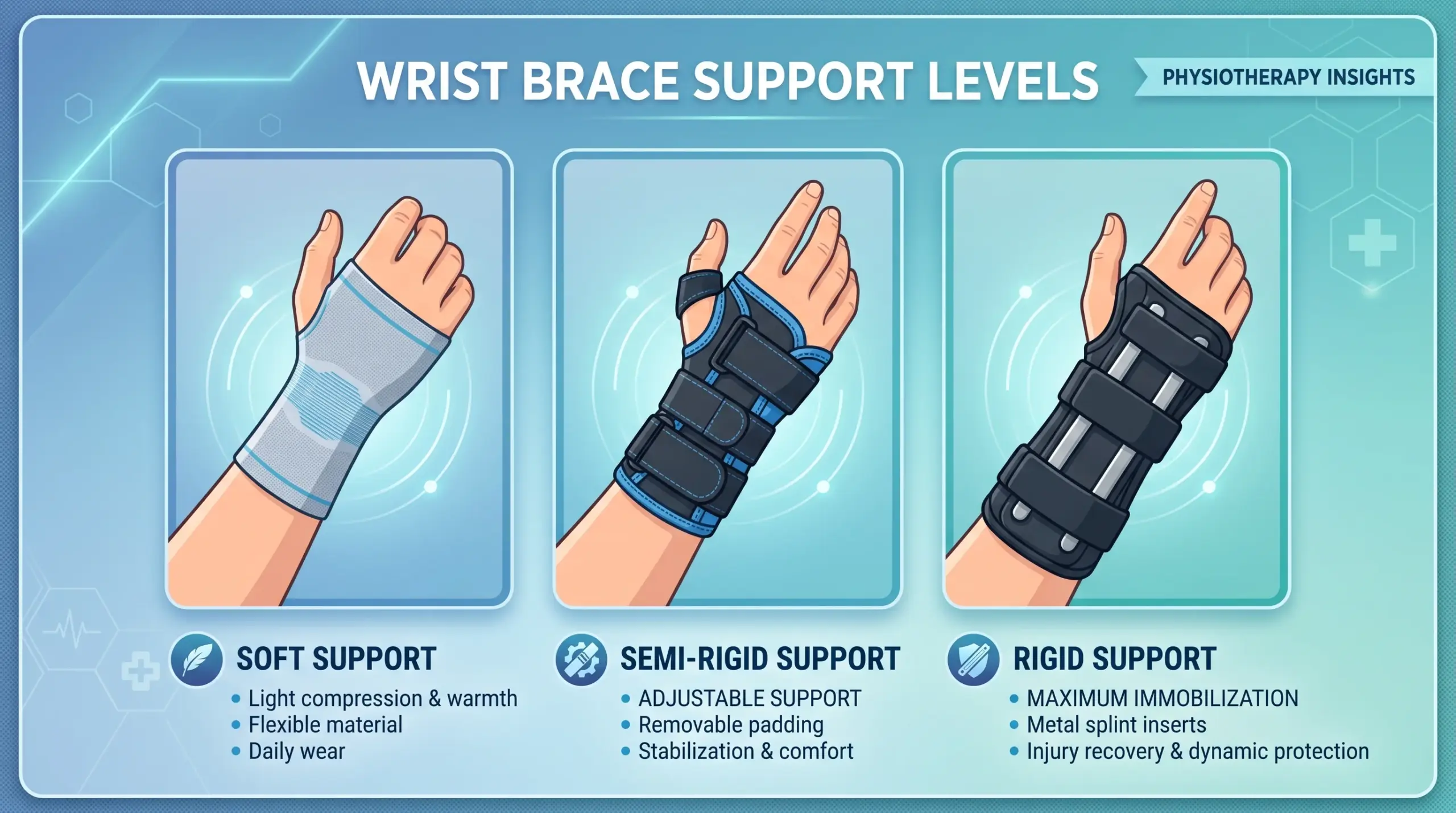
Your wrist has been bothering you for weeks. Maybe it’s a dull ache that flares up at the keyboard. Or a sharp twinge when you lift your coffee mug. Perhaps it’s lingering soreness from a weekend injury that just won’t quit. You’ve decided a wrist brace is the answer.
So you open a browser tab — and now you’re staring at a wall of options: rigid splints, compression sleeves, night braces, thumb spicas. No clear explanation of what any of it means for your situation.
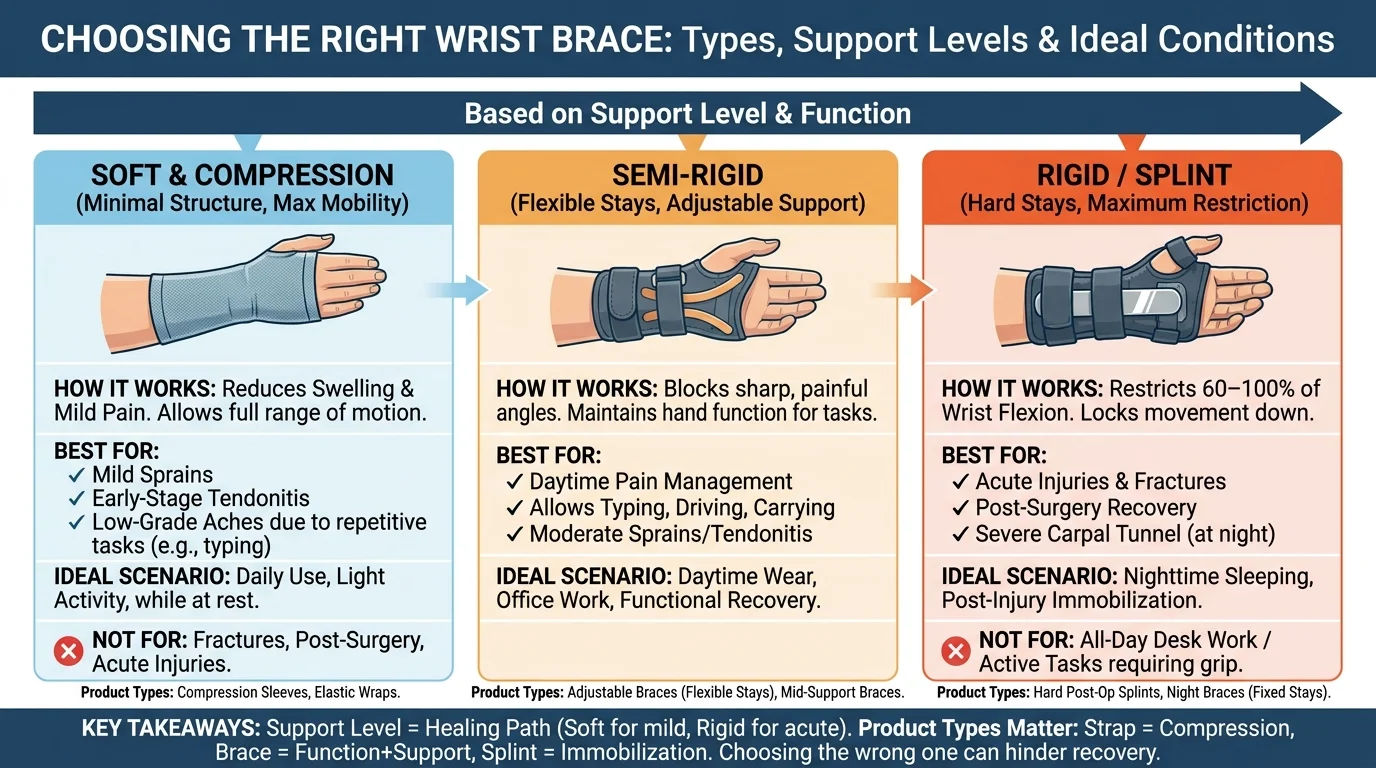
Here’s what you need to know: not all wrist braces work the same way. Picking the wrong type can slow your recovery instead of helping it. This wrist brace guide covers the major types of wrist braces, their designs, how they work, and the specific conditions they are built for. That way, you can stop guessing and choose the right support based on your needs.
What Makes Different Types of Wrist Braces And Why It Matters?
Three variables determine whether a wrist brace does its job: support level, product type, and wear scenario. Get all three right, and recovery moves forward. Miss one, and you end up either under-supported — re-injuring the same tissue — or over-restricted, losing grip strength you’ll need to rebuild later.
Support level is the starting point:
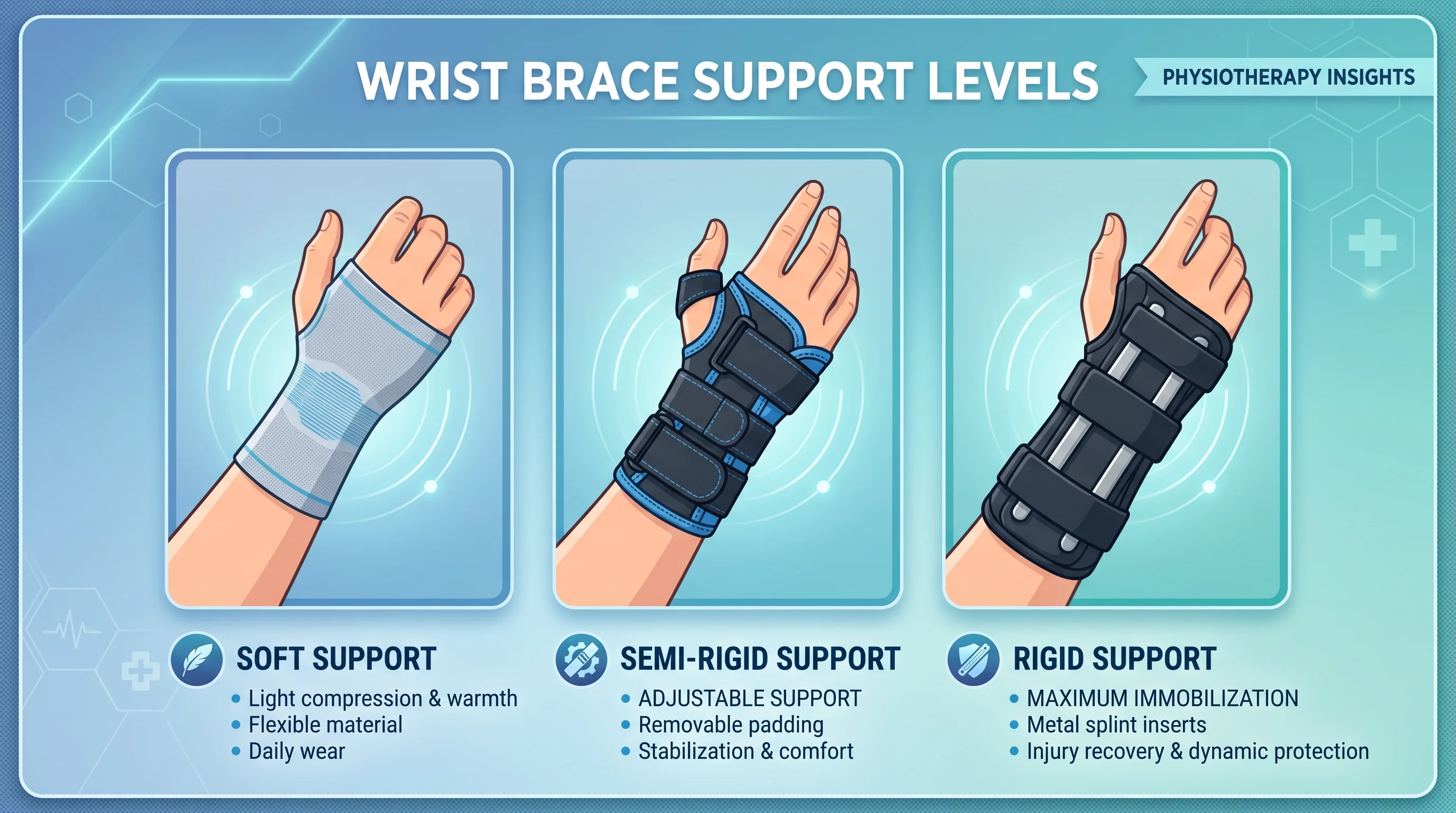
Soft (compression sleeves, elastic wraps) — minimal structure, maximum mobility. It cuts swelling and mild pain without limiting your movement. Good for mild sprains and early-stage tendonitis. Not the right choice for fractures or post-surgical wrists.
Semi-rigid (flexible stays, adjustable straps) — blocks the sharp angles that trigger pain. You can still type, drive, and carry without trouble. This is the middle ground most daytime wearers need.
Rigid (hard metal or plastic stays) — restricts 60–100% of wrist flexion. It suits acute injuries, post-surgery recovery, and nighttime carpal tunnel management. Not built for all-day desk work.
Product type matters just as much when choosing a wrist brace for different conditions. A wrist strap is a compression tool. It helps during a tennis set, but it won’t cut it for a moderate sprain. A wrist brace supports the joint while keeping function intact. A wrist splint locks movement down.
Soft Wrist Braces & Compression Sleeves — Best For Mild Pain and Daily Use

Soft wrist braces cover the ordinary, persistent discomfort most people live with. For users looking for the best wrist brace for mild pain, daily activities, or preventive support, soft designs often provide the right balance between comfort and mobility.Think: the low-grade ache after a long day at the keyboard. The mild soreness after a weekend of gardening. The early tendon irritation you keep putting off.
These braces deliver light-to-moderate compression across the joint. They reduce swelling and take the edge off broad, hard-to-pinpoint pain — without locking your wrist down or turning a simple task into a chore.
Two Formats Worth Knowing
Wrist compression sleeves are the go-to for all-day wear. Slip them on like a sock, and you get broad, even compression across the entire joint. Great for discomfort that feels general rather than concentrated in one spot.
Flexible wrist supports give you a bit more control — adjustable straps, easy Velcro closures, and a more structured fit. These work well on days when swelling shifts around, or you need to take the brace on and off between tasks.
Who This Type Is For
Mild sprains and light strains
Early tendonitis or repetitive-use irritation
Office and typing fatigue
Light sports and everyday prevention
What to Look for Before Buying
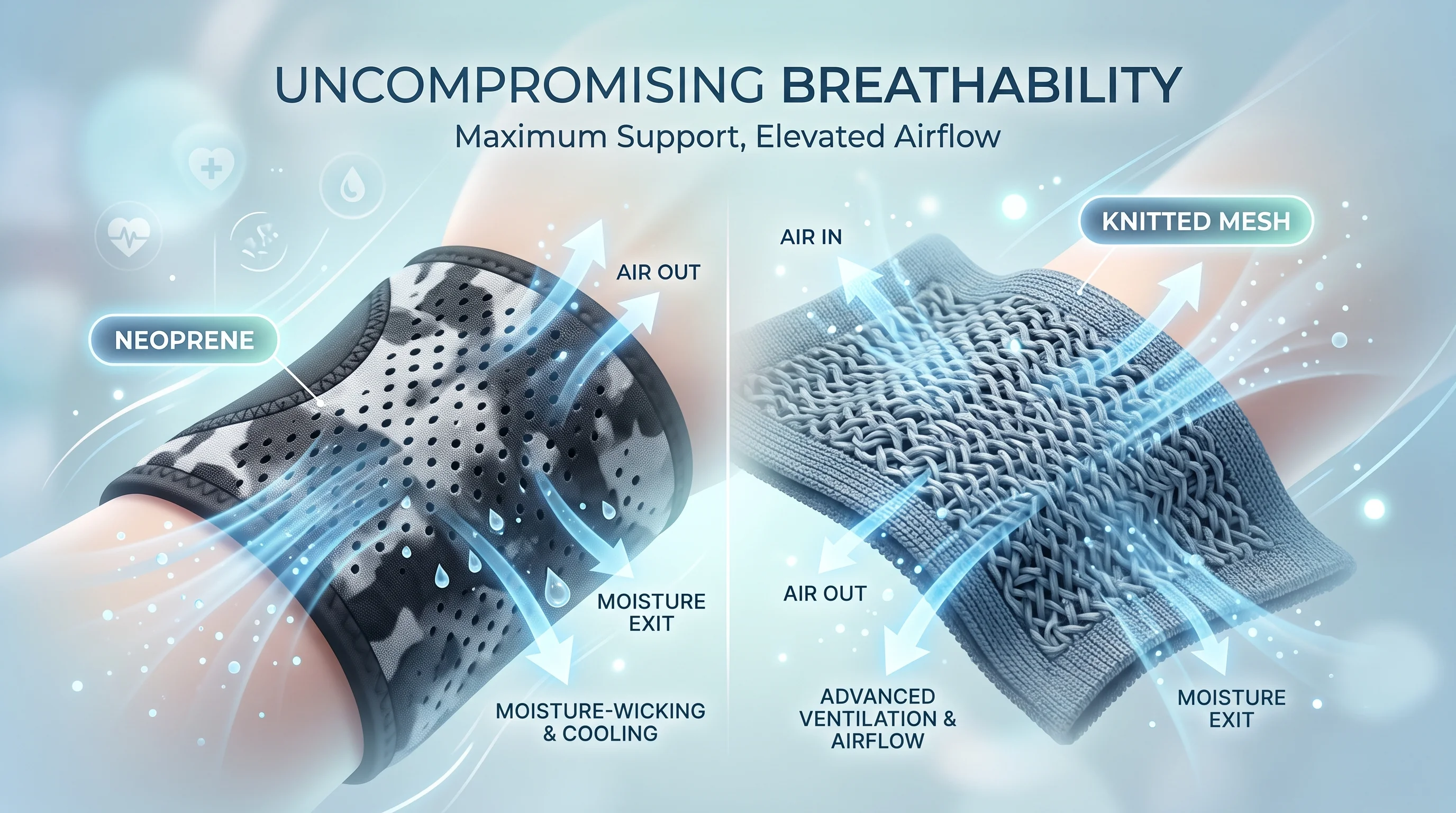
Choose soft, breathable fabric — neoprene, elastic, or cotton blends that stay cool and dry through a full workday. Go for adjustable Velcro straps if your swelling changes throughout the day. Also run this quick fit check: slide one finger between the sleeve and your skin. Snug is good. Tight is not.
One Clear Limitation
Soft braces are comfort tools, not immobilizers. Some wrists need real motion restriction after a fracture, post-surgery, or during acute injury recovery. In those cases, you need a firmer, reinforced design. Grabbing a compression sleeve instead won’t just fall short; it can slow down healing.
Semi-Rigid Wrist Braces (Cock-Up Splints) — Best For Carpal Tunnel and Moderate Sprains
Among the different types of wrist brace designs available, the semi-rigid cock-up splint is one of the most research-backed options you can buy without a prescription.
This design holds your wrist at 0–5° of extension (true neutral). That’s the exact position that takes pressure off the median nerve inside the carpal tunnel. Let your wrist bend even a little during sleep, and that pressure shoots up. The semi-rigid palmar stay — a metal or hard plastic insert along the palm side — acts as a physical stop. It keeps your wrist in place even while you’re asleep and can’t control it.
Why “Semi-Rigid” Beats a Soft Wrap Here
Elastic wraps stretch. After two to three hours of wear, they lose positional control. Your wrist drifts out of neutral, which defeats the whole point. A semi-rigid cock-up splint with a palmar metal bar extending at least halfway up the forearm holds firm through a full 7–8 hour night.
For carpal tunnel syndrome, steady neutral night splinting tends to produce clear symptom improvement within 4 weeks.
Beyond Carpal Tunnel
The same design works well for moderate wrist sprains, mid-stage tendonitis, and repetitive strain injury. The idea is the same: cut off painful extremes of motion without locking the hand down entirely.
Rigid Wrist Braces & Immobilizing Splints — Best For Fractures and Post-Surgery Recovery
A fractured wrist or post-surgical recovery is no time for half measures. Bone and reconstructed tissue need to stay completely still. Rigid wrist braces exist for one purpose: near-total immobilization.
Rigid wrist braces get their rigidity from metal (aluminum or steel) or hard plastic stays. These stays lock down wrist flexion, extension, and side-to-side movement, reducing range of motion to near zero. In clinical terms, that level of support lines up with short-arm casting — the go-to standard for non-displaced fractures. Traditional plaster hits that stability at 8–10 layers. Fiberglass synthetic materials match it at just 6–8 layers.
What to Look for in a Rigid Brace
For a wrist brace for fracture or post-surgery use, the design needs to check every one of these boxes:
Internal stay material: aluminum or steel bar, not flexible plastic
Coverage: palm base to mid-forearm — both the palm side and the back of the wrist
Fastening: multiple adjustable straps
Fit note: measure wrist circumference at the distal radioulnar joint. Remeasure every 2 hours for the first 48 hours — swelling shifts, and fit needs to keep up
One Trade-Off to Manage
Wearing a rigid brace all day comes with real downsides. Muscle atrophy and joint stiffness build up faster than most people expect. A practical approach: rigid brace at night, softer support during low-demand daytime hours. Work back toward controlled movement gradually, with a physical therapist guiding the pace.
Watch for numbness, skin discoloration, or swelling that gets worse. Any of those signs — remove the brace right away and check the fit. A rigid brace that still can’t keep a fracture stable means it’s time to move to full circumferential casting.
Thumb Spica Braces — The Specialized Choice for Thumb and Wrist Pain
A thumb spica brace does something no standard wrist splint can. It immobilizes both the thumb and the wrist at the same time, while leaving your other four fingers free. That dual coverage comes down to anatomy. The brace runs along the radial (thumb) side of your hand — from near the thumb tip all the way to mid-forearm. It holds the wrist at 25° extension and positions the thumb in a relaxed, slightly open angle.
Do You Actually Need One?
This design targets a specific set of conditions:
De Quervain’s tenosynovitis — inflammation of the tendons along the thumb side of the wrist. Thumb spica splinting is the standard first-line treatment for this.
Skier’s thumb/gamekeeper’s thumb — ligament injuries at the thumb’s MCP joint. A wrist-only brace can’t reach this area.
Thumb CMC arthritis — stabilizing the base joint cuts down on pain during everyday tasks.
Scaphoid fractures — the brace supports the radial carpus, right where scaphoid injuries happen.
Partial vs. Full Thumb Spica
A partial thumb spica locks the MCP joint and wrist in place, but keeps some thumb-tip movement. That makes it practical for daytime wear — you still get a functional grip.
A full thumb spica extends to the thumb tip for maximum restriction. Doctors reserve this type for acute fractures or serious ligament instability.
The rule is straightforward: the farther the brace extends along the thumb, the less movement you keep and the more protection you get.
Night Wrist Braces — Why Sleeping With a Brace Can Transform Your Recovery
Most people don’t realize that sleep itself is often the problem.
Your wrists naturally curl inward during sleep — a resting position that can increase pressure inside the carpal tunnel and aggravate symptoms. The numbness, tingling, and aching you manage during the day may return overnight and affect how you feel the next morning.
For many people experiencing nighttime wrist discomfort, sleeping with a wrist brace can help maintain a neutral wrist position and reduce unnecessary strain during sleep. This makes night splints an important category when comparing types of wrist braces for nerve-related symptoms and repetitive stress conditions. Understanding when and how to use a night wrist brace is an important part of choosing the right support solution.
A night wrist splint helps break this cycle by holding the wrist in a neutral 0–15° extension position through the night. This can help create more space inside the carpal tunnel when the wrist is most vulnerable to prolonged flexion. Occupational therapists often recommend nighttime splinting as an early conservative approach because sleep-related wrist positioning can contribute to symptom flare-ups.
What Makes an Effective Night Brace
A rigid or semi-rigid palmar stay — metal or hard plastic, running from mid-forearm to the palm base — is essential. It blocks wrist flexion while you sleep. The stay holds its position through 7–8 hours of unconscious movement, so your wrist stays protected all night.
Breathable fabric (spandex blends or ventilated neoprene) keeps skin cool and dry. Dense, cheap neoprene traps heat and causes skin irritation — that’s the fastest way to rip the brace off at 2 a.m. and never put it back on.
Multiple adjustable Velcro straps let you adjust for nighttime swelling. Fit rule: each strap should be snug enough to stay put, but loose enough that one finger slides underneath without resistance.
Distributed padding along the palmar side — no hard ridges pressing straight into the carpal tunnel area.
Day and Night: Knowing When to Combine
For mild-to-moderate carpal tunnel, start with night-only splinting. Add daytime use only when repetitive tasks trigger clear symptoms — and cap those sessions at 2–4 continuous hours. Follow each session with at least 1 hour brace-free to keep circulation and muscle function intact.
For more acute or severe cases, pair a rigid night brace with a lighter daytime compression sleeve. You get round-the-clock support without the muscle atrophy risk that comes from wearing a rigid brace all day long.
One firm line: notice numbness getting worse, skin discoloration, or swelling increasing while you wear the brace? Take it off right away and check the fit before putting it back on.
Sports Wrist Braces — Support That Moves With You
Athletic wrists rarely get a break. Sports wrist braces are built around that fact.
The design challenge is a tough one. A good wrist support brace needs to hold the wrist in neutral, limit over-extension and side deviation, and still leave enough range of motion to grip a barbell, return a serve, or catch a pass. That’s a balance.
For athletes looking for a deeper understanding of how wrist support helps improve performance and reduce strain during sports activities, our guide on sports wrist support explains key benefits, design considerations, and how to choose the right support level.
The right support level depends on your sport and your situation:
Lifting / CrossFit → Go for compression braces with adjustable straps. They restrict wrist hyperextension under load. The goal is stability and force distribution.
Basketball / Volleyball → Look for lightweight, low-profile designs. They absorb impact without getting in the way of your hands. Less interference, more feel.
Tennis / Golf → Moderate support works best here. It protects against repetitive swing stress — firm enough to guard the joint, flexible enough to keep your rhythm intact.
Wrist Brace Comparison Table: Match Your Condition to the Right Type
|
Brace Type |
Support Level |
Best For |
Wear Scenario |
Activity Restriction |
|---|---|---|---|---|
|
Elastic wrap / strap-style |
1–1.5 (light) |
Mild sprains, new tendonitis, sport protection |
Sports, gym, day-to-day tasks |
Low — full ROM preserved |
|
Compression sleeve/glove |
1 (light) |
Arthritis stiffness, mild overuse, prevention |
All-day, office, low-intensity sports |
Very low — focused on symptom relief |
|
Semi-rigid brace |
2 (moderate) |
Moderate tendonitis, beginning-stage carpal tunnel, mid-grade sprains |
Daytime desk work, driving, light tasks |
Medium — grip and typing still functional |
|
Rigid volar splint |
3 (maximum) |
Acute flare-ups, severe tendonitis, post-fracture, post-op |
Night immobilization, acute recovery phase |
High — wrist kept still |
|
Carpal tunnel neutral splint |
2.5–3 |
Carpal tunnel numbness, nighttime symptoms, repetitive keyboard use |
Night use; also fits high-repetition desk work |
Moderate-high — fingers free |
|
Forearm-long rigid brace |
3 (maximum) |
Post-fracture stabilization, severe ligament injury, post-surgery |
Medical/rehab settings |
Very high — wrist and forearm both restricted |
How to Choose the Right Wrist Brace?
Q1: Is this an acute injury or chronic overuse?
Acute injuries need strong immobilization. Damaged tissue has to rebuild, and movement gets in the way.
Chronic conditions like repetitive strain from typing or mouse use are different. You need moderate, functional support that reduces load without locking your wrist down. It should limit stress, not freeze your hand.
Nighttime numbness and tingling? That pattern points to nerve compression. You need a neutral-position night splint.
Q2: How severe are your symptoms?
When comparing different types of wrist braces, match your support level to your symptom intensity:
Mild discomfort → light compression
Persistent pain that worsens at work → moderate support with preserved function
Acute instability or significant swelling → near-full immobilization
Q3: When will you wear it?
Daytime wear — flexibility and a low profile matter most. You still need to type, drive, and get things done.
Nighttime wear — positional control is the priority. The brace has one job: keep your wrist neutral while you sleep.
Sports wear — stability wins. Look for a secure, non-slip fit that stays put under pressure.
Q4: Have you measured correctly?
Measure at the narrowest point of your wrist. Keep it in a neutral, unbent position. Then:
Cross-check the brand’s sizing chart — palm and forearm measurements vary by design
Confirm left vs. right hand before ordering
After fastening, one finger should slide under each strap without forcing it
Sizing done right means the brace actually works. Too loose and you lose support. Too tight and you cut off circulation.
Q5: When should you stop self-treating?
Take the brace off and get medical attention if you notice any of these:
Fingers turning white, red, or blue
Swelling getting worse, not better
Grip strength dropping
Skin blistering or pressure sores where the brace sits
A wrist brace manages symptoms. It doesn’t diagnose what’s causing them.
Conclusion: Choose the Right Wrist Brace Solution for Your Needs
Choosing the right wrist brace depends on the level of support required, the specific condition, and the intended use. Understanding different types of wrist braces helps users select the right solution for injury recovery, pain management, sports protection, or daily support.
Whether you need a compression sleeve, a night splint, or a reinforced immobilizing design, selecting the right wrist support brace can improve comfort, protection, and long-term usability.
As an experienced wrist brace manufacturer, AOFIT provides customized wrist support solutions for brands, distributors, and healthcare professionals worldwide. With OEM/ODM capabilities, strict quality control, and flexible production options, we help partners develop reliable wrist brace products that meet different market needs.
Contact us today to discuss your custom wrist brace requirements and find the right solution for your business.