

Breaking a wrist bone floods your mind with questions. The biggest one? “Do I need a cast, or will a wrist brace for a fractured wrist get the job done?”
The answer is more nuanced than any waiting room pamphlet will tell you. A good wrist immobilization brace can support healing, cut down pain, and even beat traditional casting for certain fracture types. But that’s only true if you know which fractures respond well to bracing, how to wear one right, and when a brace falls short.
Does Wearing A Wrist Brace For Fractured Wrist Help?
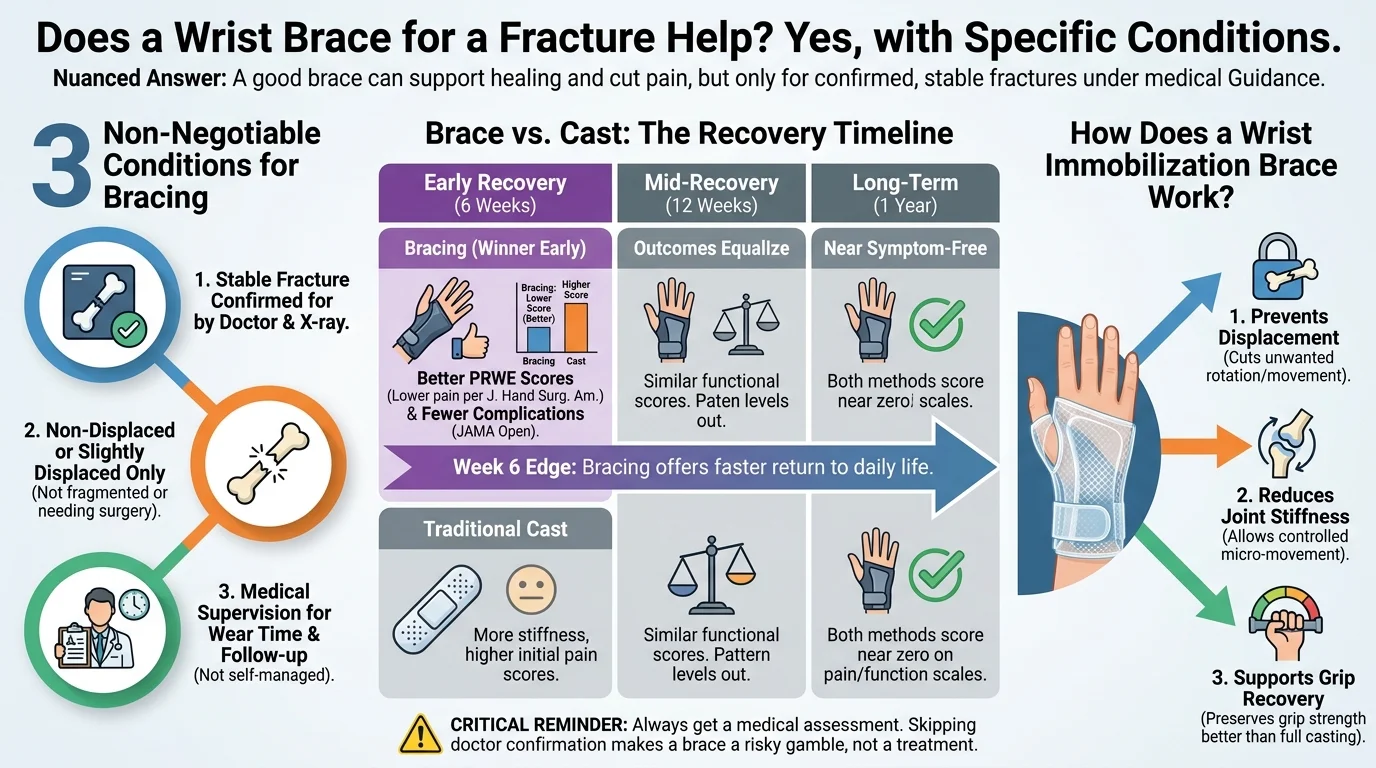
Three words sum it up: yes, with conditions.
The clinical evidence is clear. A wrist brace for a fractured wrist can match traditional casting — but the fracture must be confirmed stable by a doctor and X-ray first. Skip that step, and a brace becomes a gamble, not a treatment.
Here’s what the data shows:
Brace vs. Cast: The Numbers Side by Side
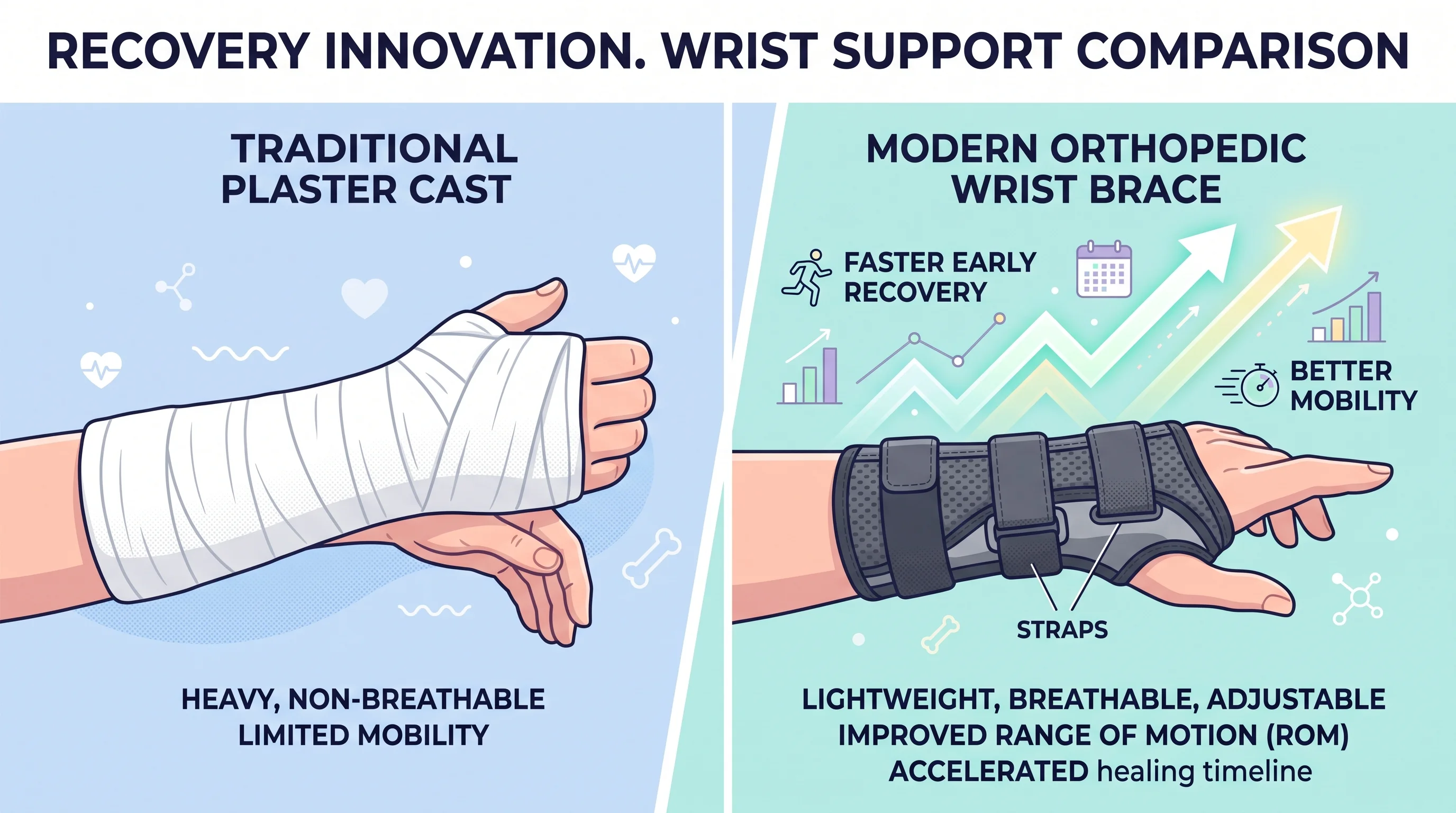
For stable, non-displaced distal radius fractures, functional bracing holds up well against plaster:
- At 6 weeks post-surgery, PRWE scores (a validated measure of wrist pain and function) read 30 for cast patients vs. 20 for brace wearers — a clear early advantage for bracing
- By 12 weeks, both groups scored 11. By one year, both scored 3 — near symptom-free
- A JAMA Network Open trial found that a custom-optimized wrist splint for fracture recovery delivered better functional scores and fewer complications at 6 weeks compared to traditional casting. Results came together by 12 weeks
The pattern holds: bracing wins early, then levels out. That early edge matters. It separates weeks of stiffness from a faster return to daily life.
What a Wrist Immobilization Brace Does
A rigid wrist brace or orthopedic wrist brace works in three key ways:

- Preventing displacement — cadaver studies show functional bracing cuts down unwanted extension-rotation and palmar-dorsal movement compared to no fixation
- Reducing joint stiffness — braces allow controlled micro-movement. This may cause less radiocarpal joint stiffness than full casting
- Supporting grip recovery — some wrist movement inside the brace helps preserve or improve grip strength.
The Conditions That Cannot Be Skipped
A wrist fracture recovery support brace is safe to use under these three conditions:
- A doctor has confirmed the fracture is stable through imaging
- The fracture is non-displaced or only slightly displaced — not fragmented, not inside the joint, and not needing surgery to reset
- Wear time and follow-up stay under medical supervision — not self-managed
Complex or unstable fractures need rigid fixation or surgery first. Wearing a distal radius fracture brace without a proper diagnosis is a risk.
How a Wrist Fracture Brace Supports the Healing Process?
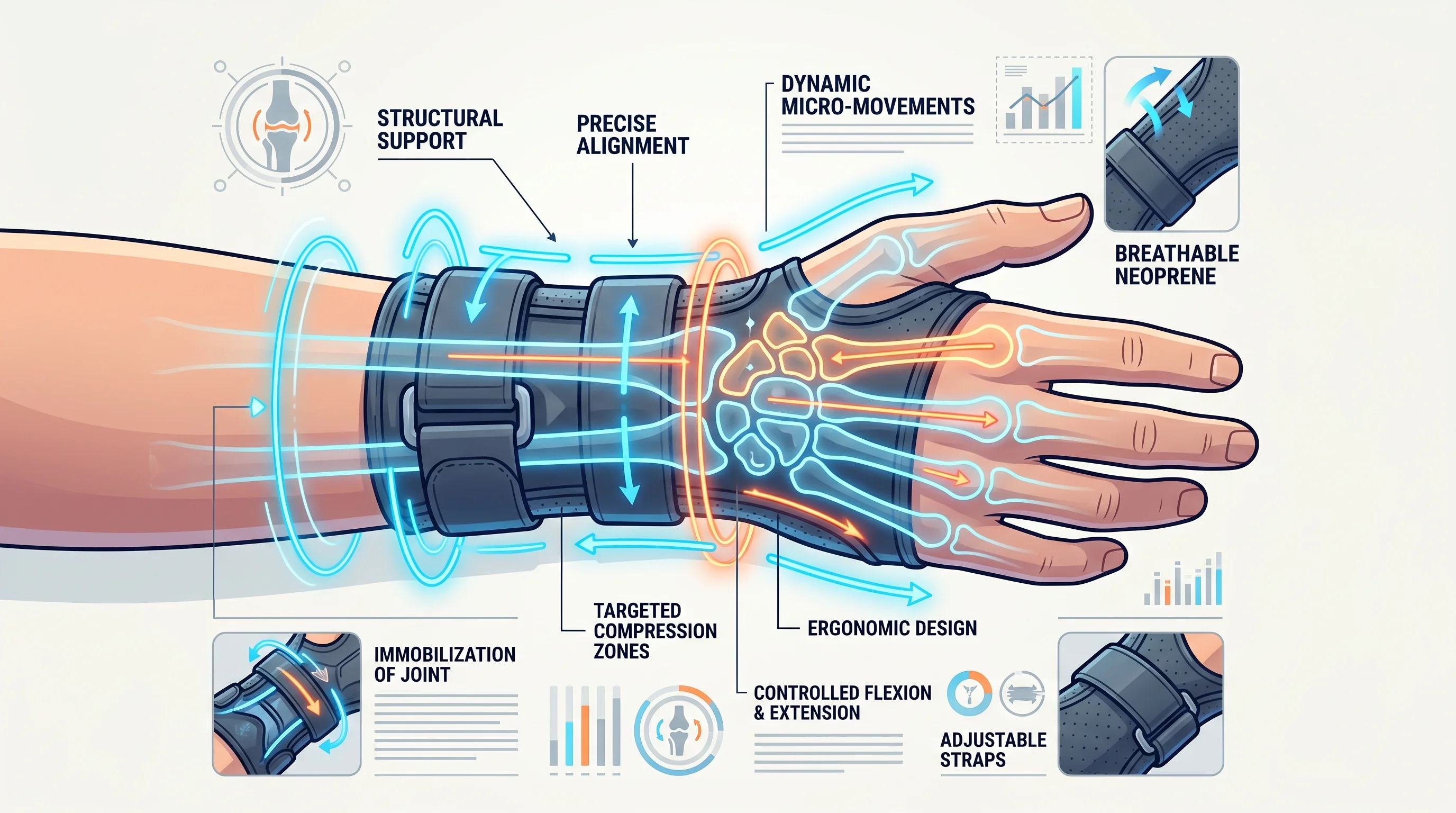
Bone healing is not passive. It needs the right mechanical environment, and a well-fitted wrist fracture brace delivers exactly that.
The mechanism works on three levels: limiting harmful motion, maintaining bone alignment, and reducing the mechanical stress that drives pain. All three functions together make a wrist immobilization brace a real therapeutic tool.
Stabilization: Holding the Fracture in Place
Cadaveric studies comparing functional bracing to traditional casting found no significant difference in translation or rotation under repeated loading. The brace held fracture fragments in place during sagittal plane movement just as well as fiberglass.
In a Colles’ fracture series, the brace group showed less dorsal displacement than the plaster cast group. Fewer patients also needed remanipulation. That’s a meaningful outcome. Fewer remanipulations means less disruption to the healing site, less pain, and a smoother recovery overall.
Pain Reduction Through Mechanical Offloading
A fractured wrist that moves without control forces the surrounding tendons and ligaments to absorb that stress. A rigid wrist brace breaks this cycle. It limits motion and cuts down repetitive mechanical loading on soft tissues during the inflammatory phase. That’s the period the body is most sensitive to disruption.
The PRWE score data backs this up. Post-surgical patients wearing a removable orthopedic wrist brace scored 20 at 6 weeks on pain and disability measures. Cast wearers scored 30 at the same point. Both groups reached 11 by 12 weeks, but those first weeks are the hardest. Starting lower on the pain scale makes a real difference.
Swelling, Skin, and the Practical Reality of Wearing One
Early brace wear often overlaps with hand swelling. As swelling shifts, brace fit changes. A brace that fits poorly creates pressure points, abrasions, and skin breakdown.
Three practical checkpoints:
- Check fit daily in the first week — especially if tightness builds up overnight
- Remove and inspect skin at each brace change — look for blisters, redness, or pinch marks
- Switch to a removable design once your doctor clears you. You get finger movement, better hygiene, and gradual rehabilitation — all while keeping wrist fracture recovery support in place
The staged approach makes sense: rigid immobilization first, removable brace later. That’s how healing works. You protect the fracture, then you rebuild function.
Wrist Brace vs Cast vs Splint for Fractured Wrist: What the Evidence Shows
Most fracture patients face three options: a rigid plaster cast, a removable splint, or a fitted wrist brace. The common assumption is that harder means better. The clinical data tells a different story.
Bone Alignment: Does the Cast Hold Better?
- For stable distal radius fractures, randomized controlled trials show no significant difference in radiological alignment between cast immobilization and removable braces or splints at four to six weeks. Palmar tilt, dorsal angulation, and radial deviation measurements came out nearly identical across both groups.
- The same pattern showed up in metacarpal shaft and neck fracture studies. At the four-week mark, dorsal-palmar and radial-ulnar angulation were equivalent between splint and cast groups. The brace group showed no increased loss of reduction either.
The conclusion is straightforward: a traditional plaster cast holds no measurable alignment advantage over a well-fitted functional brace or splint in stable fractures.
Function and Pain: Where the Differences Show Up
The most telling data comes from the 5–6 week window. That’s the point where treatment choices create the clearest separation.
In a custom 3D-printed splint versus traditional cast trial for distal radius fractures:
- At 6 weeks: The splint group scored better on the Patient-Rated Wrist Evaluation (PRWE), with fewer complications
- At 12 weeks: The functional gap closed. The difference was no longer meaningful
For post-surgical volar plate fixation patients, the numbers tell the same story:
| Timepoint | Cast (PRWE) | Wrist Brace (PRWE) |
|---|---|---|
| 6 weeks | 30 | 20 |
| 12 weeks | 11 | 11 |
Grip strength showed no significant difference between groups at any measured point. Pain scores stayed within the minimum important difference at every follow-up, putting both options in the clinically equivalent range.
Patient Preference: What People Want to Wear
In pediatric wrist fracture trials at the six-week mark:
- 60% of parents and 68% of children in the cast group said they would have preferred a splint
- In the splint group, just 5% of parents and 12% of children preferred a cast
For buckle fractures, a removable brace scored higher on satisfaction, convenience, and preference at almost every measured point. Complication rates favored the non-rigid device, with a relative risk of 3.02.
The Honest Long-Term Picture
By 12 weeks, the method of immobilization stops mattering in most stable fracture cases. Function scores, grip strength, range of motion, and pain levels all converge regardless of the original treatment choice.
The wrist brace earns its advantage in those first difficult weeks. You get lower early pain scores, fewer skin complications, and a clear preference for wearing something removable over something fixed. That early edge stays in the patient’s memory, even if the 12-week X-ray looks identical.
The evidence points to a clear clinical split: rigid casting for unstable or high-displacement fractures; functional bracing or splinting for stable ones. Long-term outcomes land in the same place either way. The early experience with a brace is measurably better.
What Types of Wrist Fractures Can a Brace Treat?
Not every fractured wrist belongs in a brace. Good outcomes versus painful setbacks come down to one thing: fracture stability. Get that assessment right, and a wrist immobilization brace becomes a useful tool. Get it wrong, and you’re wearing something that cannot do the job.
Fracture Types Where a Brace Works
- Stable distal radius fractures (extra-articular)
This is the strongest use case for a distal radius fracture brace. A fracture is stable when it holds its position without drifting over time. At that point, conservative treatment with a brace or splint is a sound medical choice. Most treatment protocols follow a similar path: rigid immobilization for about six weeks to allow adequate bone healing, then a switch to a removable wrist stabilizer for injury protection for one to two weeks.
For a brace to be appropriate here, imaging needs to confirm three things:
- Radial shortening ≤ 3 mm
- Dorsal tilt ≤ 10°
- Intra-articular step-off ≤ 2 mm
Exceed any of those thresholds, and surgical fixation becomes the recommended path, not a brace.
- Non-displaced or stress fractures of the carpal bones
Hairline, stress-type, or slightly displaced carpal fractures — including certain scaphoid injuries — often call for a short-arm removable wrist brace or thumb-spica splint. The goal is to restrict flexion, extension, and load-bearing. The brace limits movement and reduces mechanical stress while the bone heals on its own. This approach holds up only if the fracture line doesn’t pass all the way through the bone and the patient can stick to activity restrictions without cutting corners. - Post-surgical transition (after volar plate fixation)
Once a plate is in place and providing internal stability, the bone has structural protection. A removable orthopedic wrist brace at this stage serves a different purpose. It keeps the wrist from moving too much, encourages rest, and fills the gap between full immobilization and normal function. Most post-surgical protocols introduce a protective splint or brace from around day 11 through week five. From week six onward, patients gradually shift into grip training and active range of motion work.
When a Brace Is Not Enough
- Severely unstable distal radius fractures — those with significant comminution, complete intra-articular involvement, or displacement beyond the imaging thresholds above — require surgical fixation. A removable brace carries too much risk of the patient not using it correctly. It also lacks the three-dimensional stability these fractures demand — stability that even a plaster cast would struggle to maintain.
- The same logic applies to fractures that failed closed reduction. The bone cannot stay in an acceptable position after manipulation. No amount of careful brace-wearing changes that outcome.
The One Rule That Applies Across All Cases
A wrist fracture recovery support brace works within a treatment structure. The decision to use a brace, and which type to use, must come from a doctor who has reviewed the imaging. Fracture stability cannot be self-diagnosed from symptoms alone. Putting on a wrist cast alternative without that confirmation places the full risk on the patient.
A well-fitted rigid wrist brace is effective, but only under the right conditions.
How Long Should You Wear a Wrist Brace for a Fractured Wrist?
For most adults with an uncomplicated distal radius fracture, the total brace-wearing period is 8–10 weeks:
- Weeks 0–5 or 6: A rigid splint or cast worn at all times
- Weeks 5–10: Switch to a removable wrist immobilization brace. Start with near-constant wear, then cut down the hours each week
- Around week 8–10: Most people no longer need the brace for regular daily tasks — but higher-risk activities may still call for it
For those who’ve had surgery (ORIF with a volar plate), the schedule shifts a bit. A post-op splint covers the first two weeks. From weeks 2 through 6, a removable orthopedic wrist brace takes over. Most surgeons give the green light to stop regular brace use at the six-week mark, as long as imaging confirms solid healing.
What Changes the Timeline
Not every wrist fracture follows the same path. A few factors push the timeline longer:
- Fracture complexity — scaphoid fractures often need up to 3 months of immobilization
- Bone density — older adults and those with osteoporosis tend to heal at a slower pace
- Imaging progress — the cast-to-brace switch happens only after X-rays confirm bridging callus and stable alignment
How to Know You’re Ready to Stop
- X-rays show union — bridging callus with no displacement
- Pain is minimal at rest and during light daily tasks
- Grip is functional — you can lift a cup of coffee without discomfort or instability
Get your doctor’s sign-off before you stop wearing your wrist fracture recovery support brace.
How to Choose the Right Wrist Brace for a Fractured Wrist?
The right wrist immobilization brace depends on four things: structural rigidity, coverage length, size accuracy, and matching the brace to your healing stage. Get all four right, and your brace becomes a real recovery tool.
Match Rigidity to Your Fracture Stage
A fractured wrist goes through three distinct phases. Each phase requires a different level of support.
- Weeks 0–2 (acute or post-surgical): You need near-rigid immobilization. Look for a rigid wrist brace with a firm palmar plate that holds the wrist at 0–10° extension. This blocks flexion, extension, and rotation — the three movements most likely to disturb a healing fracture line.
- Weeks 2–6 (stable but not healed): A semi-rigid distal radius fracture brace works well here. It still blocks side deviation and excessive bending. Plus, it’s more comfortable for all-day wear.
- Week 6 onward: Switch to a lighter orthopedic wrist brace. It supports grip training and gradual loading without locking the joint in place.
For a stable distal radius fracture, the brace needs to cover the wrist and distal forearm — about 18–22 cm — to control both rotation and flexion. That length is not optional. A short brace that ends at the wrist leaves the fracture site open to rotational stress.
Get the Size Right
- Swelling shifts every day in the first 72 hours. A brace that fits on day one may be too tight by day two, or too loose by week three.
- Measure the circumference at the widest point of the wrist — at the level of the distal radioulnar joint. Also measure at the base of the thumb if the brace includes a thumb loop. Take that as a separate measurement.
- Pick a product with a clear sizing chart based on wrist circumference in centimeters. Your measurement should fall in the mid-upper range of a size bracket. That gap gives you room to adjust as swelling changes.
- A well-fitted wrist stabilizer should allow one finger’s width under each strap — about 1–1.5 cm. Tighter than that puts pressure on nerves. Looser than that means the brace isn’t doing much at all. Check strap tension every two hours during the first week.
Stop wearing the brace and get medical advice right away if you notice:
– Numbness or tingling in the fingers
– Pale or bluish skin tone
– Persistent pressure pain along the palm or inner wrist
5 Parameters to Check Before You Buy
Before buying any wrist fracture recovery support, confirm these five things:
- Wrist circumference range — does the size bracket actually match your measurement?
- Palmar plate rigidity — rigid metal or high-density plastic for the acute phase; semi-rigid composite for the recovery phase
- Range of motion restriction — does the design clearly limit flexion and extension beyond 10–15° while keeping fingers and thumb completely free to move?
- Number of straps — at least three segmented straps let you adjust tension at different points across the wrist and forearm
- Stage compatibility — is this brace built for acute immobilization, mid-recovery support, or rehabilitation-phase protection?
Conclusion
A wrist brace for fractured wrist healing is more than a comfort tool. Choose the right one and wear it as directed. You get a brace that plays a real role in the recovery process. It stabilizes distal radius fractures, eases the shift out of a cast, keeps your bones aligned, and reduces swelling. It works in the background of your daily life: steady, reliable, doing its job.
The key is matching the brace to your specific injury. Wear it with intention, not just hope.
Stop second-guessing your recovery. Contact our orthopedic team for product specifications and bulk order inquiries. AOFIT’s range of wrist braces is built around real anatomy, real injuries, and real recovery timelines.