
Your wrists take a beating, and most athletes don’t notice until something goes wrong. Heavy deadlifts, snatch PRs, weekend basketball games, that familiar ache shows up fast. The right sports wrist support keeps you training. The wrong one puts you on the sideline. Dozens of options flood the market right now. Picking the wrong one wastes money and slows your recovery.
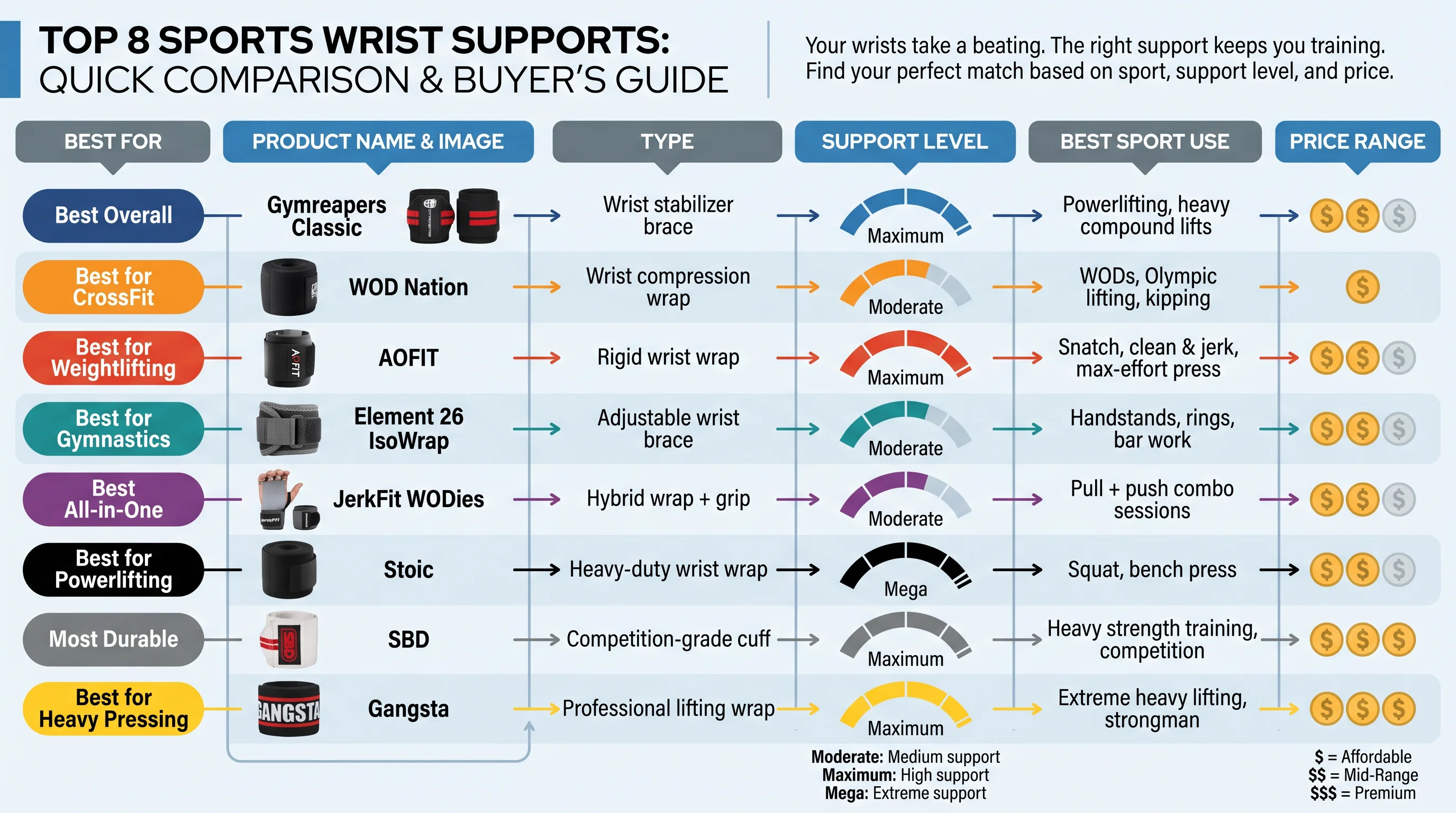
So we tested eight of the most talked-about wrist supports across real training scenarios. For each one, we break down who it’s built for, where it delivers, and where it falls short.
Quick Comparison Table: All 8 Sports Wrist Supports at a Glance
| Best For | Product | Type | Support Level | Best Sport Use | Price Range |
|---|---|---|---|---|---|
| Best Overall | Gymreapers Classic | Wrist stabilizer brace | Maximum | Powerlifting, heavy compound lifts | $$ |
| Best for CrossFit | WOD Nation | Wrist compression wrap | Moderate | WODs, Olympic lifting, kipping | $ |
| Best for Weightlifting | AOFIT | Rigid wrist wrap | Maximum | Snatch, clean & jerk, max-effort press | $$ |
| Best for Gymnastics | Element 26 IsoWrap | Adjustable wrist brace | Moderate | Handstands, rings, bar work | $$ |
| Best All-in-One | JerkFit WODies | Hybrid wrap + grip | Moderate | Pull + push combo sessions | $$ |
| Best Lightweight | Rogue Lightweight | Wrist support strap | Light–Moderate | Overhead work, Olympic lifts | $$ |
| Best Bundle | Gymreapers Straps & Wraps | Combo system | Moderate–Maximum | Mixed strength training | $$$ |
| Best Budget | Warm Body Cold Mind Elastic | Elastic wrist support band | Light | General fitness, entry-level training | $ |
Support levels — what each one means:
– Light — soft compression, full range of motion stays intact
– Moderate — cuts down some movement, good for sports with repeated wrist strain
– Maximum — holds the wrist in place, made for lifting heavy loads
What Makes a Great Sports Wrist Support?
The Five Criteria
- Stability — The heaviest weight on the scale. A quality wrist stabilizer brace should reduce your wrist’s range of motion by 30–50% under load. You still need to grip, push, and pull without losing control. Light support trims ROM by 10–20%. Maximum support locks the joint within 20–30% of neutral.
- Comfort and Breathability — We wore each wrist wrap for at least two straight hours per session. A solid wrist compression wrap should score ≤3/10 on a heat discomfort scale after moderate training.
- Sport Adaptability — A wrist support band built for heavy bench press work functions completely differently from one made for basketball or tennis. The movement demands are not the same. We tested each product in its intended sport. We checked for slippage under 5mm during lateral movements and a grip score drop no greater than 2 points on a 10-point scale.
- Durability — Quality materials should hold their compression performance through at least 50–100 wear-and-wash cycles.
- Value — Price context matters. A $15 elastic wrist support band and a $45 adjustable wrist brace are not in the same category. We scored value within each price tier.
1. AOFIT Wrist Wraps — Best Overall for Strength Sports
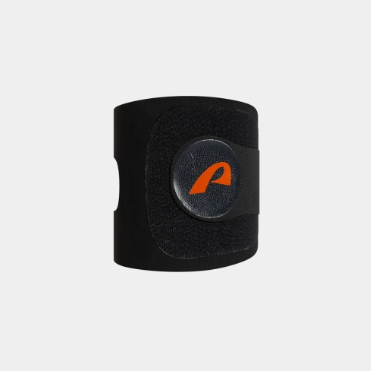
Most wrist wraps push you to pick one: maximum rigidity or everyday comfort. AOFIT’s flex support design skips that tradeoff entirely.
The compression-based stabilization cuts down on excessive wrist movement. But it doesn’t lock your joints stiff. You still get natural movement, which is what intermediate and advanced lifters need for pressing, overhead work, and high-rep accessory sets. Plus, the antibacterial, sweat-wicking fabric keeps heat buildup low. No peeling it off mid-session.
Where it excels:
- Bench press, overhead press, dips, and plank-based movements
- Long training blocks that need multi-hour wear
- Lifters dealing with early-stage overuse or repetitive strain
Where it has limits:
- Not the right pick for 1RM competition powerlifting — stiff 36″ wraps still own that space
- Fixed compression gives you less tightness adjustment than traditional wrap-style systems
Bottom line: You train 3–5 days a week. You mix heavy compounds with accessory volume. You need wrist support that works at the gym and holds up at your desk. This wrist wrap fits that life.
2. Gymreapers Classic Wrist Wraps — Best Heavy-Duty Support for Maximal Loads
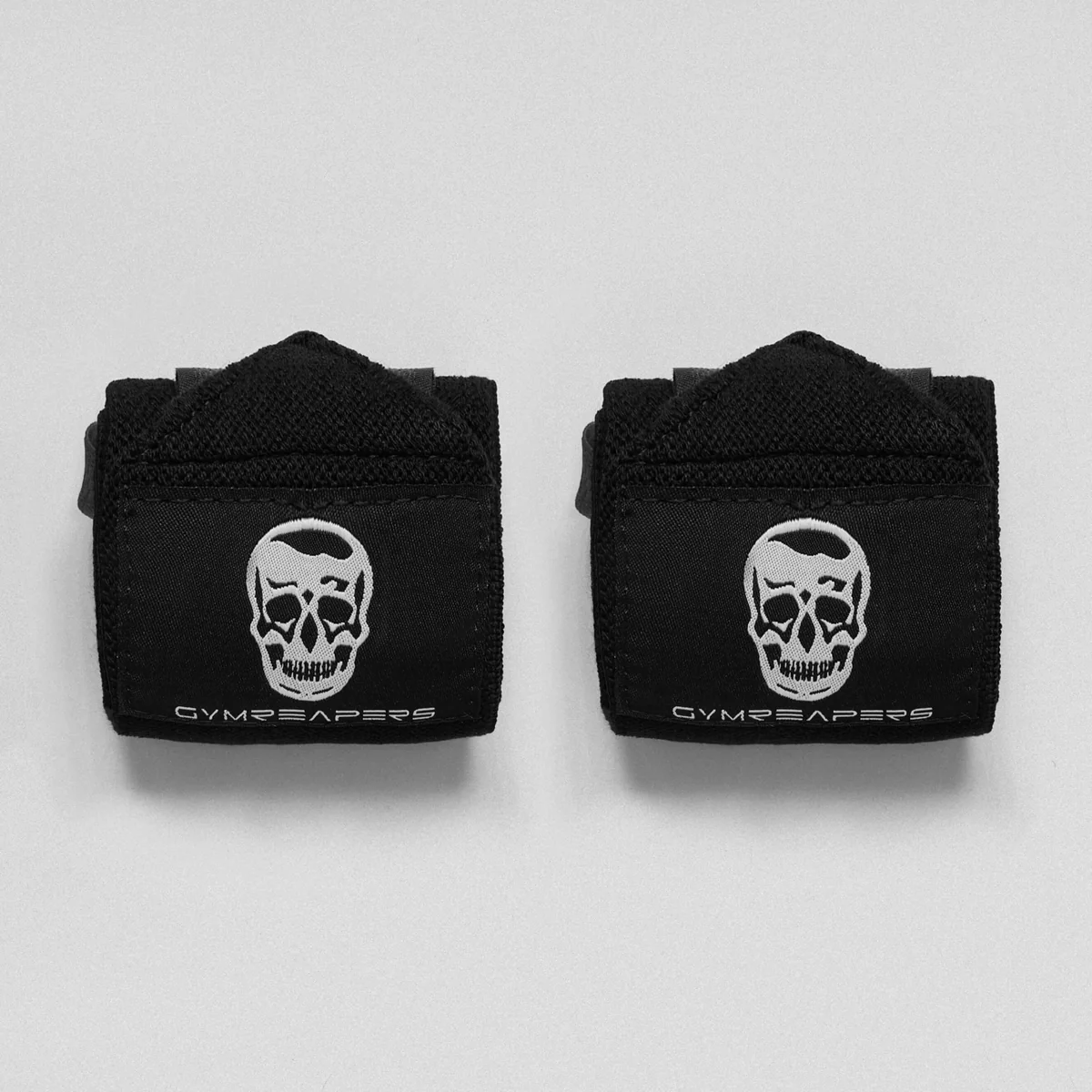
IPF-approved. USPA-approved. Tested by world champion powerlifters. The Gymreapers Classic 18″ wraps don’t need a long introduction — their competition résumé says it all.
The 18-inch length gives you 3–4 full passes around your wrist. That builds real compression right where it counts. The 70% polyester / 30% elastic blend runs stiff. It creates enough tension to limit wrist extension under near-max loads. Gymreapers suggests strapping in at ≥50% of your 1RM. Go tighter as the weight climbs toward true max attempts.
Where it excels:
- Bench press, overhead press, and heavy compound work at 70–100% 1RM
- IPF/USPA competition use
- Lifters dealing with wrist instability under max loads
Where it has limits:
- Too stiff for high-rep CrossFit cycling or technical Olympic warm-ups
- Beginners lifting below 50% 1RM don’t need this much stiffness yet
Bottom line: The Gymreapers Classic gives you maximum wrist joint support and still lets you keep the grip control you need to finish the lift.
3. Rogue Lightweight Wrist Wraps — Best Balanced Pick for CrossFit & HIIT
CrossFit WODs don’t reward athletes who stay locked in one position. Thrusters, front rack cleans, kipping pull-ups — your wrists shift angles at every turn. A rigid powerlifting wrap fights that movement. The Rogue Lightweight Wraps work with it.
The cotton-elastic build breathes through 100-rep sets. Heavy neoprene wraps trap heat and break down your skin. That’s a real problem across 150–300 wrist-loaded reps in a single WOD.
The real advantage is mid-WOD adjustability. No re-wrapping. No Velcro repositioning.
Where it excels:
- Fran-style WODs, thrusters, and overhead volume at 40–70% 1RM
- Fast grip transitions — pull-ups, bar cycling, handstand work
- Athletes who need wrist injury prevention without giving up front-rack mobility
Where it has limits:
- Not built for true max-effort singles
- Less casting effect means less hyperextension protection under near-max loads
Bottom line: This is a wrist support strap built for functional fitness. You get dynamic stability without the stiffness that slows you down.
4. Element26 IsoWrap — Best Minimalist Sports Wrist Wrap for Mobility-Focused Athletes
Most wrist compression wraps fix one problem and create another — lock down extension, lose front-rack mobility. The IsoWrap was built to avoid that tradeoff. It runs narrower than standard 3″ powerlifting wraps. That slimmer profile keeps it flexible enough for snatches, handstands, and bar cycling. You also get two distinct wrapping techniques. Use them to dial compression up or down based on what your wrists need that session.
Two techniques. Two different outcomes:
- Higher wrap position — cuts off end-range extension and tightens grip stability under load. Great for front squats, thrusters, and pressing above 80% 1RM
- Lower wrap position — supports the flexor and extensor tendons while keeping your extension range of motion intact. Better for handstands, push-ups, and gymnastics ring work
Where it excels:
- CrossFit athletes moving through cleans, wall walks, and kipping movements
- Calisthenics and gymnastics athletes who need wrist pain relief without losing body awareness
- Managing chronic overuse and mild tendinitis during active training
Where it has limits:
- Not right for acute injuries, suspected fractures, or sharp pain at rest
- It lacks the stiffness needed for true max-effort powerlifting singles
Bottom line: This is a wrist support band built for athletes who move, not athletes who brace and lock. Mobility stays. Pain doesn’t.
5. Gymreapers Wraps & Straps Bundle — Best Combo for Heavy Pulling Movements
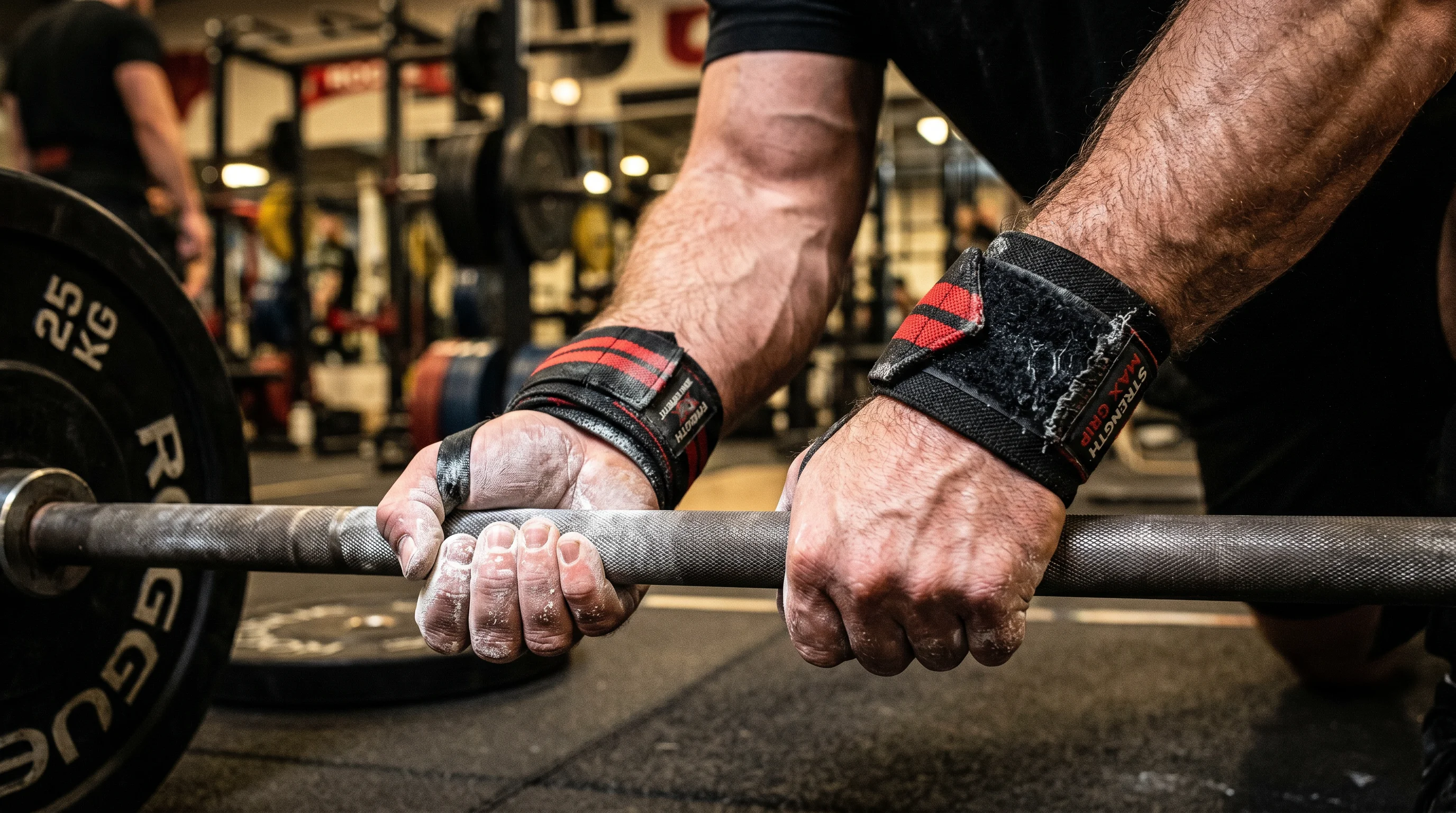
Heavy pulling days hit two weak spots. Your grip fails before your back does. Your wrist position breaks down under mixed-grip stress. The Gymreapers Wraps & Straps Bundle tackles each issue with a dedicated tool. You get lifting straps to protect your grip on deadlifts, rows, shrugs, and pulldowns. Plus, the wrist wraps keep your joints stable during pressing or accessory work after your pulling sets.
Where it excels:
- Deadlift overload sets where grip is the true limiter
- Barbell and chest-supported rows, where lat tension matters more than forearm endurance
- Mixed sessions that combine heavy pulls and wrist-loaded accessory work
Where it has limits:
- Too much gear if you need just one function — buy straps or wraps on their own
- No published numerical performance data; the benefits are qualitative
Bottom line: Your training day runs pulls and press accessories back-to-back? This wrist joint support combo is worth the price.
6. Warm Body Cold Mind Elastic Velcro Wraps — Best Budget Sports Wrist Support
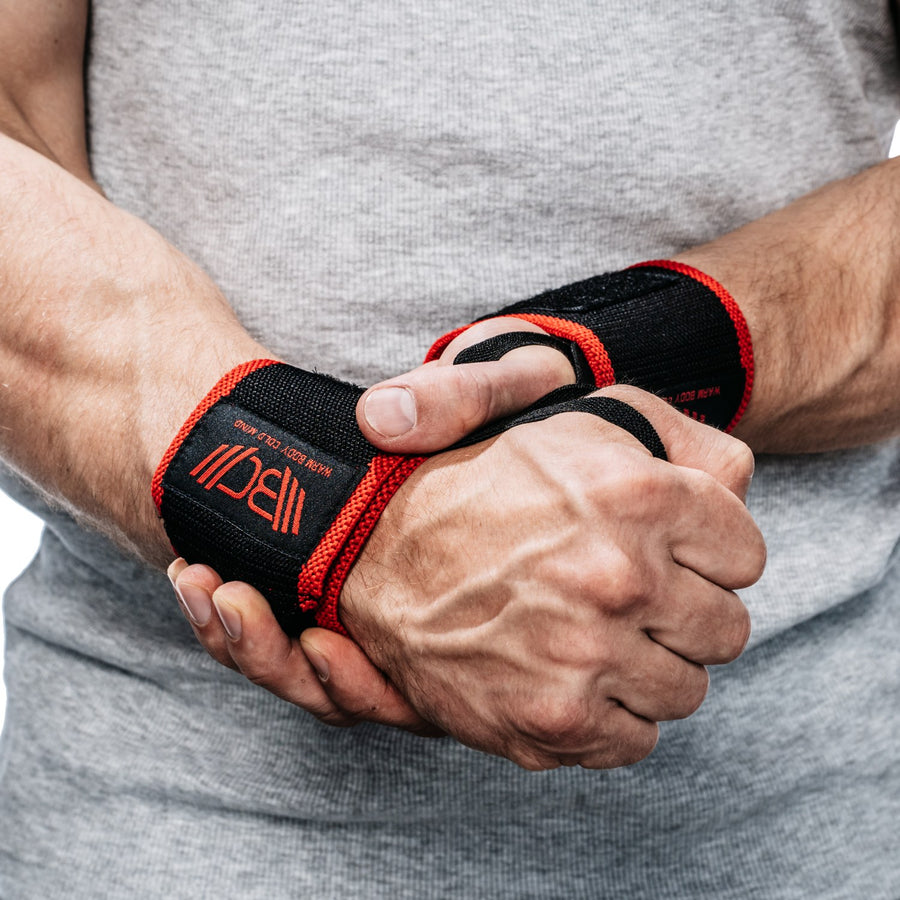
The Warm Body Cold Mind Elastic Velcro Wraps aren’t built for IPF-grade stiffness. What you get is straightforward: cotton-canvas construction, reinforced stitching, and a Velcro closure that stays put through real training sessions.
Two lengths cover most users. The 12″ version works well for beginners and lighter pressing work. Go with 18″ once your loads and your wrist support needs increase.
Where it excels:
- Recreational bench press and overhead volume up to moderate loads
- Beginners building technique confidence with mild wrist pain relief
- Calisthenics and functional movements that need light compression without losing mobility
Where it falls short:
- Max-effort powerlifting needs stiffer wraps
- No published cycle-count durability data
Bottom line: For under $18, this wrist compression wrap does the job for entry-level athletes.
7. JerkFit WODies — Best Wrist Wrap + Palm Grip Integration for Bar Work
With JerkFit built WODies, you get a three-finger palm grip and an adjustable wrist support strap combined into one latex-free unit. Index, middle, and ring fingers slide through the grip. Thin padded fabric takes the bar friction before it hits your skin. The built-in elastic wrap adjusts via Velcro on its own. No repositioning needed.
Where it excels:
- Kipping pull-ups, toes-to-bar, and high-rep bar cycling with far less palm tearing
- Rig-to-barbell WOD transitions without pulling anything off or re-layering
- Moderate wrist compression wrap support is on par with standard strength wraps
Where it has limits:
- No rigid splint, not built for acute injuries or max-effort pressing PRs
- Feels bulkier than plain cloth wraps during straight barbell work
8. WOD Nation WristWraps — Best Value Pick for the CrossFit Community
The hook-and-loop closure of WOD Nation wraps does real work here. It locks tight and cuts unwanted wrist movement. It stays put through high-rep WODs — no sliding, no mid-set fixes needed. The Velcro system also makes on-off transitions faster than thumb-loop wraps. Front rack one minute, pull-up rig the next.
Where it excels:
- High-rep WODs, push press, and clean front-rack position
- Athletes who need wrist injury prevention on a tight budget
- Fast gear swaps during mixed-modal training
Where it falls short:
Larger wrists may find the length a bit short
Bottom line: Flexible enough to move with you. Firm enough to protect you. For CrossFit athletes watching their spending, this wrist support band earns its spot.
How to Choose the Right Sports Wrist Support: 5 Key Factors
1. Support Level Should Match Your Injury
Light support (elastic wraps, compression sleeves) works for minor aches, chronic overuse, and training days when you need a posture reminder. Full range of motion stays intact.
Moderate support (adjustable wrist brace with semi-rigid panels) suits athletes managing real pain who still need to train. It limits end-range flexion and extension without locking your joint down. Think CrossFit, Olympic lifting, and gymnastics recovery.
Maximum support (wrist stabilizer brace with metal or plastic stays) is for post-surgery, acute fractures, and severe sprains. It’s a recovery tool.
2. Material Dictates Comfort Over the Long Haul
- Neoprene holds heat and compression well. It’s ideal for strength training in cooler environments and managing chronic joint pain. The tradeoff is breathability. Wear it through a 300-rep WOD and you’ll feel it.
- Elastic cotton or polyester blends breathe better and sit lighter on the skin. These are the right calls for long sessions, sensitive skin, and anyone training 4–6 days a week. You need something you can wear for two hours straight without tearing it off.
- Hard stays (aluminum or plastic) belong in medical braces, not training gear, unless a clinician prescribes one for you.
3. Sizing Comes Down to One Measurement
- Measure your wrist circumference at the crease where a watch sits. Use a soft tape. That single number maps to most brand size charts.
- One-size adjustable designs work across a wide range but lose precision at the extremes. For wrist pain relief, sports use, or anything medical-grade in particular, a proper multi-size system fits better and compresses with more precision.
- Your hands may swell during heavy lifting or boxing. Measure after training, or size up to an adjustable wrist brace with enough Velcro range to cinch tight even when your wrists are puffy.
4. How Fast You Need It Matters More Than You Think
- For competition or fast-transition training — go with a single or double wide-strap adjustable design. Set your tension once. Rewrap in seconds.
- For longer training sessions, multi-strap braces with semi-rigid panels are fine. You have the time to dial in the fit, and consistency between sets matters more than speed.
5. Clean It or Replace It
Wrist supports fail in two ways: Velcro loses grip, or the elastic loses compression. Both happen faster when the gear doesn’t get washed.
- Elastic fabric and cotton wraps handle hand-washing with cold water and air drying well. For heavy training schedules — four or more sessions per week — wash every one to three uses. That keeps the odor down and the compression consistent.
- Neoprene and braces with metal stays need gentler handling. Hand washes with water under 30°C. No wringer, no dryer.
Velcro is the first thing to go. Washing it tangled with other fabrics destroys the hook side fast. Use a laundry bag, or close the straps before anything else goes in.
Sports Wrist Support by Activity: Scenario-Based Recommendations
| Activity / Sport | Recommended Support Type | Key Specifications | Usage & Duration | Red Flags / Avoid |
|---|---|---|---|---|
| Powerlifting & Gym | 45–60 cm elastic cotton/nylon wrap, 0.3–0.5 cm thick | Tightness 7/10; limits flexion/extension to ±10–15° | Loosen every 20–30 min for sessions >1 hr; wear only for working sets; post-sprain use moderate support 4–6 weeks | Don’t wear throughout entire session; not for warm-up |
| CrossFit & Functional | Moderate-support adjustable brace (elastic + Velcro) | Adjustable tightness, quick-release | Total wear 45–60 min per session | Rigid splints (slow transitions, block natural motion) |
| Basketball & Volleyball | Low–moderate compression band, 1–2 mm thick | Maintains ≥30–40° mobility; tightness ≤5/10 | Wear as needed; avoid one-size if forearm–wrist circumference diff >3 cm | Over-tightening (reduces touch and control) |
| Tennis & Racket Sports | Light compression without metal stays | 15–20 mmHg on affected side for sessions >90 min or >3x/week | Match day: wear during warm-up or only during changeovers; radial/ulnar pain: kinesio tape + light wrap | Rigid braces that restrict wrist deviation |
| American Football & Contact | Mid-rigidity support with internal plastic/aluminum stays | Blocks hyperextension and rotational stress; QBs/receivers: softer wrap + tape | Ensure flat fit under gloves; avoid edge pressure points | Elastic wraps alone (can’t handle collision forces) |
| Skateboarding & Extreme | High-support guard with rigid plastic splint | Limits dorsiflexion to ≤10–20°; width from palm heel to 5–6 cm up forearm | Put on immediately after warm-up; no exceptions | Narrow guards (shift impact to edges) |
| Rock Climbing & Bouldering | Light compression wrap or kinesio tape (2–3 cm above/below crease) | For prior injury: moderate wrap on injured side only | Wear during climbing; root fix = load reduction + technique adjustment | Adding more tape to mask pain (delays root cause) |
| Golf & Repeat Swing | Light compression band, preserves full extension and ulnar deviation | For chronic arthritis: soft sleeve at 15–20 mmHg | Wear 30–60 min before and after play; not during swing | Braces with metal stays that hold neutral position |
Conclusion
Every wrist is different—different sport, different injury history, different joint geometry. That’s why a one-size-fits-all support will always be a compromise. The eight options we tested cover the spectrum, but the best fit isn’t found in a review—it’s built around your wrist. If you’re ready to stop guessing and get support that matches your exact needs, start with custom wrist support to find or build the one that fits you—and only you.