
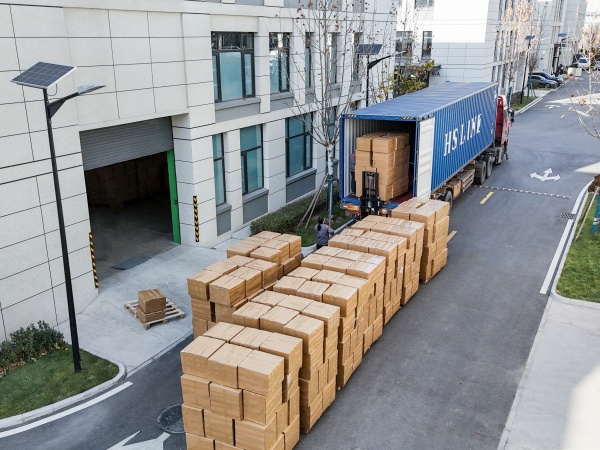
Finding the right medical back brace suppliers in China is harder than it sounds. Thousands of manufacturers claim premium quality — but only a small group delivers on certifications, MOQs, and OEM capabilities that your business needs. One wrong choice can cost you time, money, and customers.
So where do you start? That’s what this guide is for.
We’ve profiled 10 of the most credible medical back brace suppliers in China for 2026. The list covers established orthopedic manufacturers and newer smart wearable brands. You get clear, direct information to help you pick the right partner, negotiate better terms, and grow your supply chain with confidence.
1. Hebei AOFIT BRACE Co., Ltd.
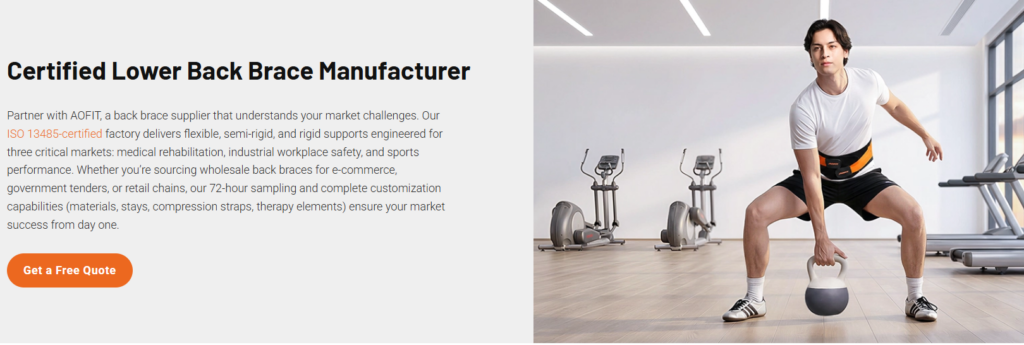
Founded in 2007, AOFIT BRACE produces custom protective gear and orthopedic brace for sports, health, and medical business. You get a direct manufacturing line for your products, supported by free design drafts and reliable quality control. Source custom back support belts and medical braces directly from the factory. AOFIT builds ODM/OEM lower back braces designed for lower back pain, heavy lifting, medical rehabilitation, and sports.
Certifications:
Fully certified (ISO 13485, FDA, CE) to guarantee reliable quality and fast, compliant market entry.
Product range:
-Semi-rigid back braces for Occupational Safety & Heavy Lifting (Warehousing, Construction)
-Rigid orthosis for Orthopedic & Pain Relief (Pharmacies, Clinics)
-Ultra-soft, breathable back braces for Maternity & Women’s Wellness (Maternity Brands, Plus Size)
-Low-profile flexible back support for Athletic & Active Lifestyle (Sports Brands, Gym Gear)
OEM/ODM Capability:
-Material Options (Polyamide/Polyester, Neoprene, Breathable Mesh, Copper-Infused)
-Stays Options (PVC & Resin Composites, Aluminum Plates, Fish-Scale Springs)
-Secondary Compression Straps Options (Mesh Webbing, Fish Silk Fabric, Non-Elastic Rigid Fabric, Dual Nylon Elastic Straps)
-Advanced Therapy Customization (Hot/Cold Therapy Gel Packs, Embedded Magnetic Therapy)
-Rapid Response & Free Design: 24-hour quotes with free mockups and specs to speed sampling and approvals.(custom color, size, packaging and private label logo)
MOQ and lead time:
Standard MOQ for custom back braces is 300 to 500 units per style, depending on design complexity. Sample production typically takes 7–10 days. For bulk orders, lead time is usually 25–35 days depending on order size and customization level.
Best fit:
Global Brand Owners, Wholesalers & Importers, Retailers & E-commerce Specialized Industries
2. Xiamen Huakang Orthopedic Co., Ltd.
Founded in 2014, Xiamen Huakang Orthopedic has built one of the more complete orthopedic OEM operations in Fujian Province. The numbers back it up — 122 employees, 12 production lines, and 1,000+ molds. Their catalog runs from lumbar braces to post-operative TLSO systems.
Certifications: MDR CE, FDA registration, and ISO 13485. That covers the full compliance stack for EU and North American medical distribution channels.
Product range: Lumbar supports, post-op thoracolumbar braces, posture correctors, knee OA offloaders, and pneumatic walker boots. Pricing runs US$14–33 across the range.
OEM/ODM MOQ: ~200–500 units for custom-branded styles.
Best fit: Distributors sourcing a broad orthopedic SKU lineup under one roof.
3. Wecare
Wecare is harder to evaluate than most suppliers. It sits between regional brand-building and OEM manufacturing. So buyers need to ask sharper questions before placing orders.
The company covers both lumbar support and spinal orthotic devices. It targets conservative treatment and post-operative stabilization markets. For medical back brace suppliers in China, that dual focus can work in your favor — as long as the clinical backing is solid.
What to verify before ordering:
- Certifications: Check that ISO 13485 scope covers spinal orthoses directly — not just general rehabilitation products. Cross-check CE and FDA registration yourself. Don’t take it on faith.
- Product classification: Devices need registration as orthopedic or spinal braces — not consumer lumbar supports. That distinction matters for medical-channel sales.
- Clinical documentation: Ask for case data with at least 2 years of follow-up. Get this before you approve medical-channel distribution.
Best fit: Distributors moving into rehabilitation or clinical channels who need a flexible OEM partner with mid-range MOQs.
4. Beijing Jinwei Kangda Medical Instrument Ltd.
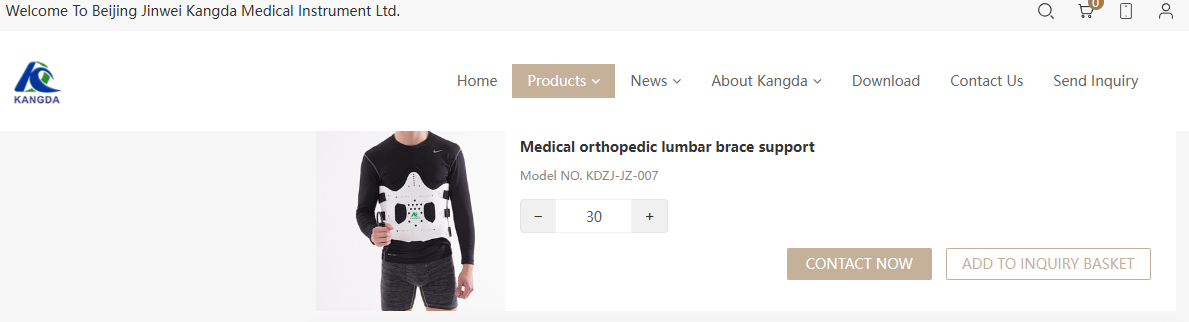
Jinwei Kangda has operated out of Beijing since 2007. What sets them apart from most back brace suppliers is their verified institutional supply relationships — covering China’s Central Reserve, China Meheco, and military procurement channels. That’s not a marketing claim. It’s proof of real, high-stakes supply experience in regulated environments.
Scale: 362 employees, ~$19.9M revenue, 44 combined production lines (casting tape + orthosis braces).
Product range: Orthopedic braces, knee supports, ankle supports, neck braces, casting tape systems, and arm slings.
Notable: Their R&D center was co-built with USA Amerix. That kind of cross-border technical partnership is rare in this space.
MOQ: Not disclosed. Negotiate directly per SKU.
Best fit: You’re sourcing for hospital procurement or institutional distribution? This manufacturer fits. They carry proven credentials in regulated supply chains — something most brace makers simply can’t match.
5. Shanghai Goldenwell Medical Technology Co., Ltd.
Seven factories. One export office. One Shanghai headquarters running the whole operation.
This setup says a lot about Goldenwell — they’re not a single-product manufacturer. They run as a trade-integrated manufacturer built for buyers who need medical devices, sports supports, and medical dressings from one supplier.
Certifications: CE, ISO, GMP, FDA, and CFDA. These cover EU, US, and most developing-market entry requirements.
Product range:
– Back and lumbar supports
– Wrist wraps
– Knee and ankle braces
– Medical consumables — ET tube holders, surgical sutures, and more
OEM/ODM: Available. You can bring your own specs, branded packaging, and label designs. They’ll handle the rest.
Best fit: Distributors building mixed-SKU container loads across medical and sports channels. This works well for buyers targeting Africa, South America, or Eastern Europe.
One honest caveat: the product line is broad. Advanced post-surgical orthoses and deep technical specialization aren’t what they focus on. But for standard back brace OEM at a solid mid-range price? Goldenwell gets the job done.
6. Binary Star Sports Technology (Jiangsu) Co., Ltd.
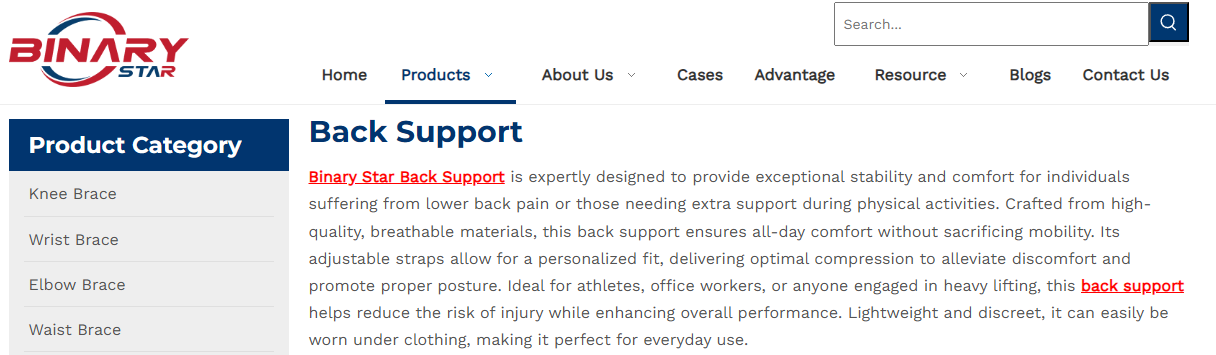
Binary Star is a Jiangsu-based supplier. They focus on sports protection and entry-level rehabilitation. That makes them a solid match for e-commerce brands — not hospital procurement teams.
Their catalog covers the high-traffic body zones: knee, elbow, waist, ankle, and wrist. For back support, products use elastic composite fabric, adjustable straps, and steel or plastic stays. That build works well for gym training, mild lumbar instability, and post-acute recovery support.
Where they shine:
– OEM-ready for Amazon, eBay, and Shopee sellers
– Retail packaging: color boxes, hang tags, PE bags
– Sample lead time: 7–10 days | Bulk: 30–45 days
– MOQ: ~300–500 units per style
The honest limitation: No CE, FDA, or NMPA registration numbers are listed on their public channels. If you’re a clinical-channel buyer with strict medical device certification requirements, check their compliance status directly before placing an order.
Best fit: Sports brands and e-commerce sellers building private-label back support SKUs.
7. Hebei OSKY Medical Instrument Co., Ltd.
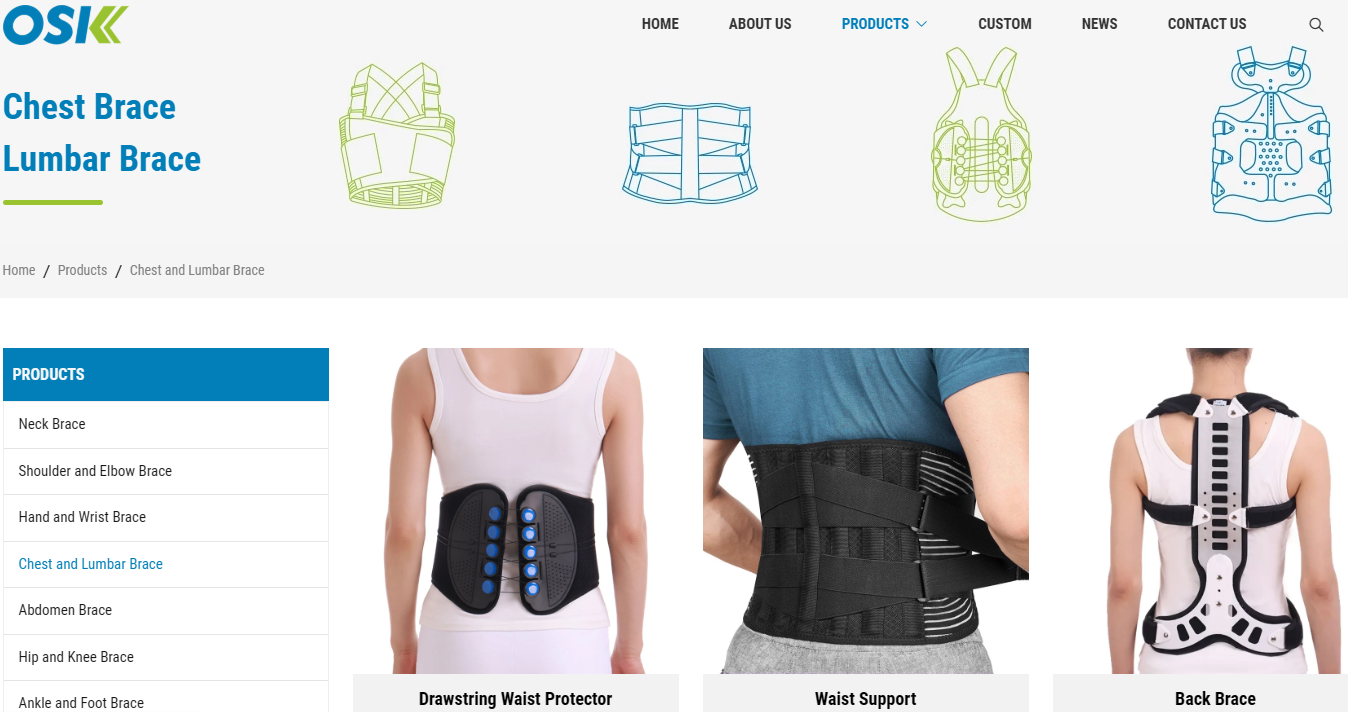
Anping County, Hengshui is the core of China’s orthopedic brace manufacturing zone. OSKY sits right at the center of it.
The company started in 2008, growing out of parent factory JYK Medical. Today, OSKY makes products across four main groups: trunk, upper limb, lower limb, and foot. For back care, their key lines are chest and lumbar braces, abdomen braces, and spine support products.
Scale signals: 51–100 employees, US$5M–$10M annual revenue, 21–30% export ratio. Nearest shipping ports are Shanghai and Tianjin.
What’s missing: No verified ISO 13485 certificate number or medical device registration code shows up in public listings. That’s a real gap. Close it before you move forward with any order.
Best fit: Mid-volume buyers who need standard lumbar and trunk supports from Hebei’s well-established manufacturing base.
8. BOSEGROW
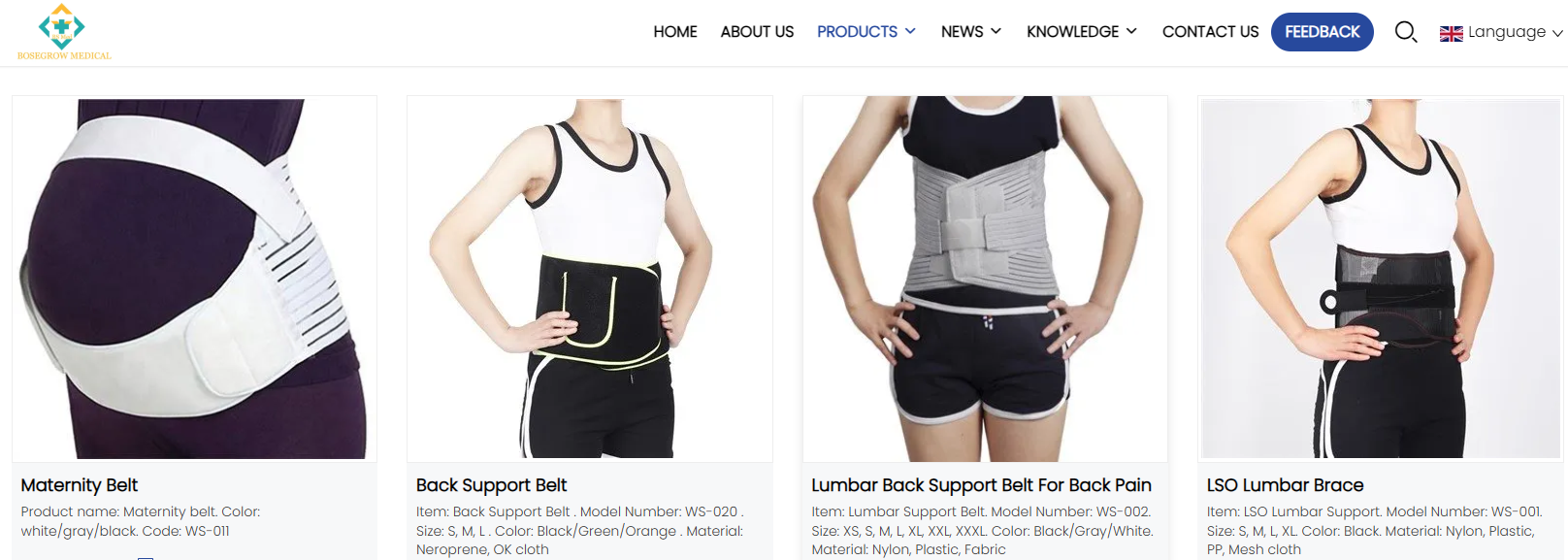
BOSEGROW is a Xiamen-based orthopedic manufacturer with a strong OEM focus. They deliver more than you’d expect at this level — but there are a few gaps worth addressing before you commit.
Their back brace lineup is built for customization. Here’s what you get:
-4–8 aluminum or plastic support stays per brace
-Height adjustable from 20–28 cm
-Dual pull-strap compression targeting the L4–L5 zone
-Optional hot/cold insert pockets, anti-slip silicone strips, and lumbar pad inserts
-Size range: S through XXL (60–130 cm waist)
-OEM sizing in inches available on request
Private label options cover a lot of ground. You can add woven labels, silicone badges, heat transfer logos, full color box printing, multilingual IFU, and EAN/UPC barcode integration. MOQ runs around 300–500 units per style — pretty standard for this product category.
The gap worth noting: ISO 13485 certificates, CE MDR numbers, and FDA registration details are not easy to find on their public listings. There are no client case studies either. No reference accounts show up.
That doesn’t rule them out. It just means you do the verification yourself. Ask for:
-Certificate scans
-An export country list
-Sample inspection reports
Get all three before approving any order.
Best fit: Private-label brands and distributors who need deep OEM customization on lumbar and orthopedic supports.
9. Xiamen Dorrella Health Technology Co., Ltd.
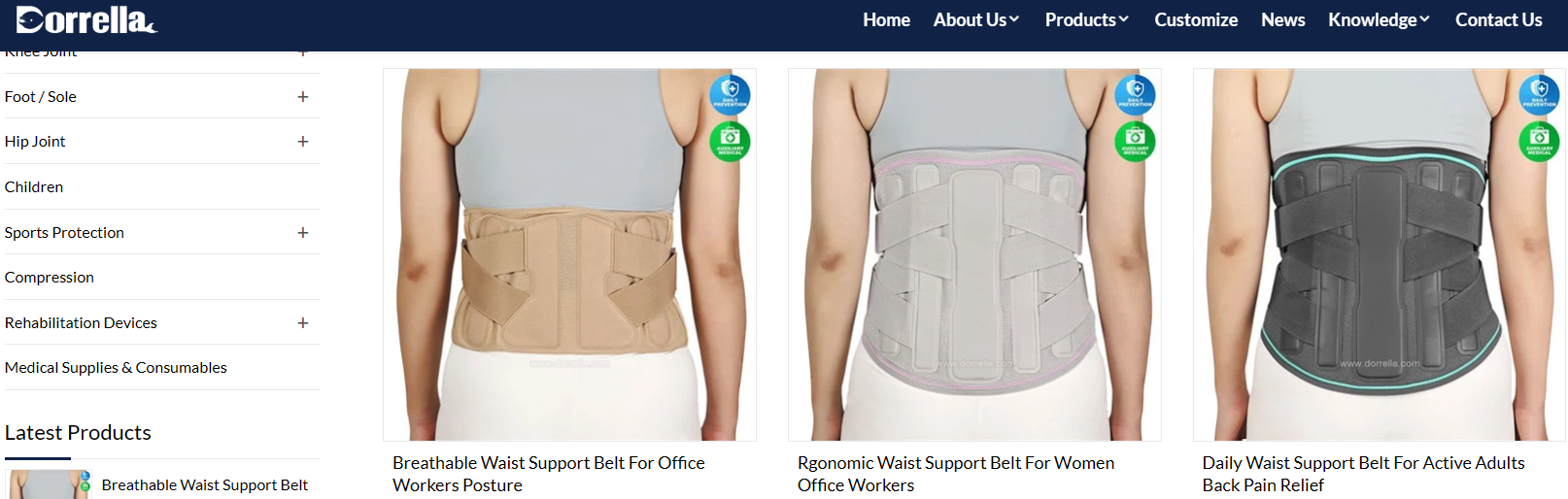
Dorrella has been making orthopedic rehabilitation products in Xiamen’s Torch High-Tech Zone since 2010. The factory covers 2,500 m² with around 100 workers — small setup, but the product range goes far beyond that size.
Certifications: ISO 13485 certified. That puts them in good standing for medical-channel distribution.
Product range:
– Lumbar braces with dual compression straps and steel stays
– Ergonomic office waist belts
– Pneumatic air walker boots
– Cervical collars
– Knee supports
– Ankle braces
– Arm slings
Key distinction: The medical-grade lumbar line uses dual compression bands plus vertical steel stays. It targets disc herniation and post-op stabilization. The ergonomic waist belt is a different product entirely — focused on posture correction and fatigue relief for office or occupational use.
Lead times: 15 working days off-peak. About 30 days during peak season.
Best fit: DTC health brands building a full-body joint care series. Good match if you’re sourcing across both sports protection and rehabilitation SKUs.
10. Unimed (Kunming) Foreign Trade Co., Ltd.
Unimed is based in Kunming, Yunnan Province. It runs as a foreign trade company — not a manufacturer. That difference matters before you spend a single dollar.
Their catalog covers walking canes, commode chairs, limb fixation devices, medical external fixation braces, arm abduction holders, and oxygen generators. The wide range points to a multi-factory sourcing model. They don’t run a single, focused production floor.
What this means for you:
-Mixed-SKU container loads are possible — braces, walkers, and supports in one shipment
-MOQs are flexible: expect 50–200 units per style
-Pricing carries a typical trading markup of 10–30% above factory cost
The compliance gap is real. No ISO 13485 certificate, CE MDR registration, or FDA listing shows up in their public profile. For any back brace going into EU or US medical channels, request the actual manufacturer’s name, production license number, and third-party test reports. Get it in writing, before you approve any samples.
Best fit: Buyers who need multiple SKUs and want to pack rehabilitation and orthopedic accessories into one shipment. Not the right choice for clinical-grade back brace sourcing unless you complete full compliance checks first.
What to Look for in a China Medical Back Brace Supplier
Most buyers get burned not because they chose a bad product — but because they skipped the right questions before placing the order.
This framework separates reliable medical back brace suppliers in China from the ones who waste your time and money.
Certifications: Your Non-Negotiable Starting Point
ISO 13485 is the baseline. No exceptions.
Any supplier targeting medical or rehabilitation channels must hold a valid ISO 13485 certificate. Check the scope. It must cover orthopedic support devices or back brace / lumbar support by name. That wording isn’t on the certificate? The certification doesn’t cover what you’re buying.
Beyond ISO 13485:
- CE (EU market): Verify it follows the MDR pathway — not a generic PPE or consumer goods label. Class I non-sterile products need technical files, risk assessments, and a clinical evaluation summary.
- FDA (US market): Ask for the FDA Establishment Registration number and relevant product codes (e.g., L0631, L0648). They claim 510(k) clearance? Cross-check the number against the company name in the public database.
Suppliers without these credentials are producing sports-grade or consumer-grade products. Those don’t belong in post-operative or clinical distribution channels.
Certifications Are Proof — Not Promises. Don’t accept logos. Demand verifiable numbers.
- CE MDR: Confirm the certificate references EU 2017/745 — not the outdated MDD. Ask for the Declaration of Conformity and the Technical File summary.
- FDA 510(k): Request the K-Number. Run it through the FDA public database yourself. “FDA registered factory” is not the same as 510(k) clearance.
- ISO 13485: The scope must name orthopedic supports or orthoses — not just “textile processing.”
MOQ and Pricing: Know the Benchmarks Before You Negotiate
Go into a negotiation without price benchmarks and you’re leaving money on the table. Here’s what the market looks like in 2026:
| Product Type | EXW Price Range | Typical MOQ |
| Basic elastic lumbar belt | US$3–6/pc | 500–1,000 pcs/style |
| Mid-range adjustable (mesh + straps) | US$7–12/pc | 300–500 pcs/style |
| Medical-grade LSO/TLSO post-op brace | US$15–25+/pc | 200–500 pcs/size/style |
Always clarify these points before comparing quotes:
– Does the price include packaging — retail boxes, OPP bags, outer cartons?
– Is it EXW or FOB? That gap adds up fast on large shipments.
– What’s the warranty policy? Solid suppliers offer free replacement or discount compensation for quality defects within 1–2 years.
A supplier with a lower defect rate might charge a bit more per unit. For medical channels, that’s almost always the smarter call. Fewer returns. Fewer complaints. Better margins over time.
OEM/ODM Capability: What “Customization” Really Means
Not every factory that says “OEM/ODM” can follow through. Push for specifics.
Hardware indicators:
– Factory floor space ≥10,000 m² — signals capacity for mid-to-large volume orders
– Equipment lineup: sewing lines, bonding machines, cutting beds, ultrasonic welding stations, clean packaging zones
Development speed:
– Standard back brace sample: 7–14 days
– Complex post-surgical brace: 15–25 days
Brand customization depth:
– Heat transfer / silicone / woven labels for LOGO
– Retail color box printing (MOQ runs 1,000–2,000 units per design)
– Multilingual IFU (Instructions for Use) — critical for EU compliance
| Screening Factor | What to Look For |
| Supplier role | Manufacturer(factory age)/exporter(product focus) — confirmed |
| Specialization | Orthopedic or medical rehabilitation focus |
| Catalog depth | Broad SKU range, not 2–3 generic listings |
Lead Times and Capacity: Verify, Don’t Trust
Every factory claims fast delivery. Very few can prove it.
Standard bulk production for export orders runs 25–40 days for a 20’GP to 40’HQ container. During peak season (Q3–Q4), add another 5–10 days to your planning window.
Ask every supplier these three questions before you commit:
- What is your production capacity per month? Get shipment records or production reports from the last 3 months — not a verbal claim.
- What’s your largest single-batch shipment? A factory that has moved 50,000+ back braces in one month has proven its logistics and floor capacity.
- Do you accept pre-shipment inspections by third-party firms like SGS or TÜV?
Quality Documentation: The Exact Files to Request
Before approving samples, ask for:
- Material safety: MSDS, REACH/RoHS compliance reports, skin irritation test results, and a latex-free declaration — essential for hospital and allergy-sensitive markets
- Performance testing: Elastic strap durability after 1,000+ stretch cycles, breathability ratings, Velcro adhesion strength after 3,000+ open/close cycles
- Process control documentation: IQC → IPQC → OQC flow charts covering incoming, in-process, and final inspection steps
Push for first-order MOQ reductions of 30–50% to test your market. Once volume clears 20,000 units, lock in annual rebates.
Clarify mold ownership in writing. Include a transfer mechanism before you commit — so you’re covered if you switch factories later.
Conclusion
China’s medical back brace manufacturing scene runs deeper than most buyers expect. Now you have the full picture.
The options range wide — from ISO-certified factories like AOFIT to smart-wearable specialists in Shenzhen. Finding the right medical back brace supplier in China isn’t just a price game. Certifications matter. MOQ flexibility matters. OEM capability matters. So does working with a partner who holds the line on quality when your customers’ spinal health is at stake.
Here’s what to do next:
- Shortlist 3–5 suppliers from this guide based on your product type, order volume, and compliance needs
- Request samples from each one
- Ask direct questions about their quality control process
- Let the data guide your final call — not the brochure
The best medical back brace suppliers in China aren’t hard to find. The gap between a smart sourcing decision and a poor one comes down to knowing what to look for. Now contact AOFIT.