
Every year, thousands of warehouse workers, construction crews, and freight handlers leave work with the same injury — a blown-out lower back from one lift too many. Sometimes it’s a single moment of poor form. More often, it’s months of built-up strain that finally gives out.
Heavy lifting puts your spine at risk. That’s not a question. The real question is what you can do about it — and whether a back brace for heavy lifting makes a real difference or just gives you a false sense of security.
The answer is more layered than most product pages will tell you. This guide covers:
How an industrial lumbar back brace works
Main benefits from wearing one
How to choose the right occupational back support for your work environment
What Is an Industrial Back Brace for Heavy Lifting?
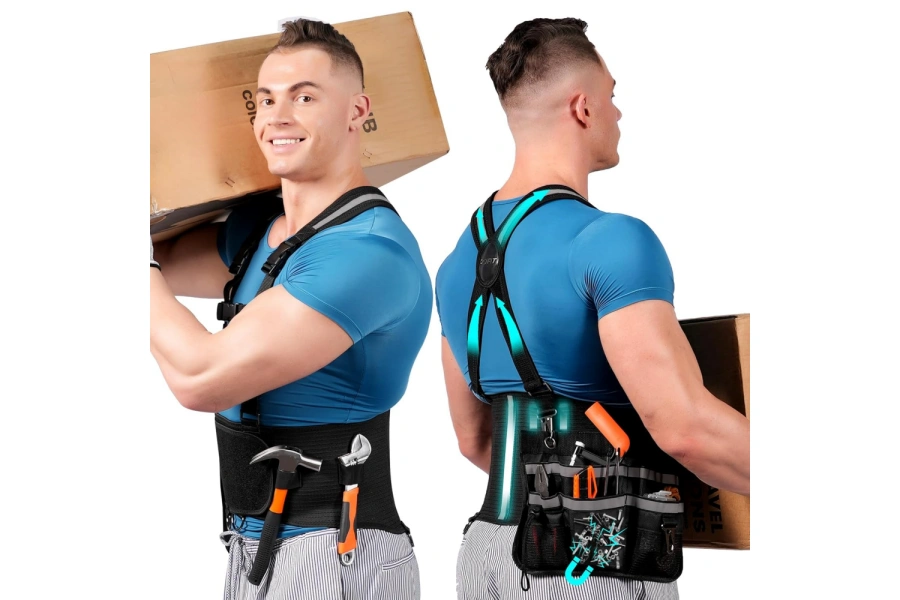
Not all back braces are built the same — and in an industrial setting, that difference is huge.
An industrial back brace is a wide, high-compression lumbar belt built for repeated heavy lifting. Think warehouses, construction sites, freight docks. These aren’t the slim elastic bands you find at a pharmacy. Industrial-grade models have lumbar panels 8–10 inches (20–25 cm) tall. That covers the sacrum through the upper lumbar spine — about double the coverage of a standard consumer support.
That extra coverage isn’t cosmetic. It creates a larger contact surface. You get better resistance against trunk flexion and stronger intra-abdominal pressure (IAP) during a lift.
Biomechanical Mechanisms Behind the Back Brace for Work
1. IAP increase
This is the core mechanism most people never hear about. The belt compresses your abdominal wall. Your deep core muscles — the transversus abdominis and obliques — contract against it. That contraction raises IAP, creating an internal pressure cylinder around your spine. Research suggests a well-fitted lifting belt can boost IAP by 20–40%. That translates to an estimated 5–15% reduction in compressive load on the L4–L5 disc during heavy lifts.
2. Spinal Stabilization and Motion Control
The belt works as an external stabilizing frame. It restricts excessive lumbar flexion, lateral bending, and end-range rotation — the exact movements where disc and facet joint stress spikes. Load shifts away from your fatiguing spinal erector muscles. It spreads across the belt-plus-IAP system instead. That matters a lot during long, repetitive-task shifts.
3. Proprioceptive Feedback
Your trunk bends forward. The belt tightens against your abdomen. That physical signal pushes you toward hip-dominant lifting mechanics in real time — no coaching needed. In high-repetition industrial environments, habits drive most injuries. This behavioral feedback loop is one of the most underrated features of the whole system.
Benefit #1: Lumbar Spinal Support and Stability During Heavy Loads
Pick up a 20 kg box with poor form, and the compressive load on your L5–S1 disc can exceed 6,000–7,000 N. That’s close to the force of a small car pressing down on a single spinal joint. Classic Nachemson disc pressure data makes this clear: relaxed standing puts 0.5 MPa of pressure on L3–L4. Add a 20° forward bend while holding 20 kg, and that number triples to ≈1.7 MPa. Every degree of flexion adds cost to your spine.
This is where a lumbar back brace for heavy lifting earns its place.
What the Brace Does to Your Spine
The stability benefit works through two key mechanisms:
Intra-abdominal pressure (IAP) amplification. The brace compresses your abdominal wall. Your deep core muscles contract against it. That raises IAP. The result is an internal pressure cylinder that takes on part of the compressive load your discs would carry alone. Biomechanical studies show this can cut peak compressive load by 10–40%, depending on belt stiffness and fit.
Motion restriction at the danger zones.
– Well-fitted lumbosacral supports cut lumbar flexion range of motion by 20–60%
– Lateral bending drops by 20–40% in instrumented studies
– This limits the high-risk postures — deep flexion, combined flexion with rotation — where disc pressure and posterior ligament strain both peak
Benefit #2: Posture Correction — A Physical Reminder to Lift Safely
Most workplace back injuries don’t happen because someone is weak. They happen because the body falls into a bad habit at the wrong moment — a slight forward fold, a lazy twist, a load pulled too far from the torso.
A back brace for heavy lifting breaks that habit in real time.
Start to round forward or rotate under load. The belt presses against your midsection. That pressure hits fast and you can’t ignore it. Your body gets the signal before your brain does: straighten up, bend at the hips and knees, pull the load closer.
That’s the posture correction at work — not passive support, but active physical feedback.
The Six-Step Lift the Brace Reinforces
Your safety training covers ergonomic back support lifting. It all comes down to one repeatable sequence:
Assess — check weight, size, and shape before you touch it
Approach — step close so the load stays in your body’s near field
Squat — bend knees and hips, keep your back neutral
Drive — stand with your legs, not your lumbar spine
Pivot — change direction by moving your feet, never by twisting your waist
Reverse — set the load down using the exact same mechanics
Warehouse back brace users pulling from low shelf positions feel this most. Fold at the waist instead of squatting, and the belt tightens right away. That’s the feedback loop closing in real time. For freight handlers doing high-frequency picks, research points to changing posture every 15 minutes during repetitive tasks. The brace supports that reset by making a neutral spine feel like the default, not something you have to think about.
Benefit #3: Compression Support That Reduces Muscle Fatigue and Strain
By hour six of a warehouse shift, your lower back isn’t failing because of one bad lift. It’s failing because of six hundred small ones.
That’s the real story behind muscle fatigue in heavy lifting work. The damage isn’t dramatic — it’s cumulative. Each bend-and-extend cycle pulls on your lumbar muscles and lower back tissue. Do that hundreds of times, and genuine tissue stress builds up. Compression changes that equation.
How Compression Works on Fatiguing Muscle
The mechanism isn’t complicated. But it works at a level most workers never think about.
A back brace applies steady pressure to your midsection — 10–25 mmHg across the lumbar region. Two things happen as a result:
Soft tissue oscillation drops. Research on lower-limb compression shows major reductions in muscle displacement and vibration during repetitive loading. The same physics holds true for your spinal muscles under repeated lifting cycles. Less oscillation means less micro-trauma per rep.
Muscle activation demand decreases. Compression braces cut the EMG output your body needs to hold posture and finish the same task. Your muscles do less work for the same result — and that efficiency gap adds up across a full shift.
How to Choose the Right Industrial Back Brace for Heavy Lifting Work
The wrong brace doesn’t just fail you — it can make things worse. Here’s how to cut through the noise and pick one that holds up on the job.
Four Features That Separate a Real Work Brace From a Gym Belt
Lumbar panel coverage. The panel needs to sit between the top of your pelvis and the bottom of your ribcage. It should cover your sacrum through your lower lumbar spine. It rides up toward your mid-back during a lift? It’s not doing its job.
Dual compression straps. A single elastic layer works fine for mild day-to-day support. Repetitive heavy lifting is a different story. You need a dual-strap system — one layer for base fit, a second to cinch down before a loaded lift. That second strap is what builds the intra-abdominal pressure your lower back needs on a heavy pick.
Anti-roll support stays. Semi-rigid internal stays keep the belt from folding or shifting mid-lift. For warehouse picking and freight handling, this isn’t a nice-to-have. It’s a requirement.
Breathable mesh construction. Industrial shifts run long. Heat and moisture build up fast under a solid neoprene panel. That leads to fatigue and skin irritation well before your shift ends. Breathable mesh cuts that problem out entirely.
Sizing: Measure at the Navel, Not the Waist
Measure at your navel — not your trouser waistline. That’s where the belt sits. That measurement decides whether the compression lands on the right part of your back. Aim for the middle of the brace manufacturer‘s size range, not the edge. Too loose and you lose support. Too tight and you restrict your breathing — that adds to lift risk, not reduces it.
Conclusion
Pulling 12-hour shifts in a warehouse. Hauling materials on a job site. Managing a team where injury downtime costs real money. A lumbar back brace for heavy lifting isn’t a sign of weakness. It’s a smart operational decision.
The research is clear. The mechanics make sense. Workers who use them report less fatigue, better posture awareness, and faster recovery after strain. That said, a back brace delivers its full benefit only with the right fit, proper wear, and solid lifting technique.
Reach out AOFIT and check out the custom back support collection — built for the physical demands of real work environments. Find the right occupational back support for your workers.