
Recovering from whiplash after a fender-bender? Dealing with a flare-up of chronic cervical pain? Or just trying to get through the workday without wincing? A soft collar neck brace can be a practical tool during your recovery.
What really matters is knowing when it helps, how to use it correctly, and whether it fits your specific situation. Getting these factors right is what turns the brace into genuine relief rather than wasted effort—and this guide covers it all.
What Is a Soft Collar Neck Brace? (Core Definition)
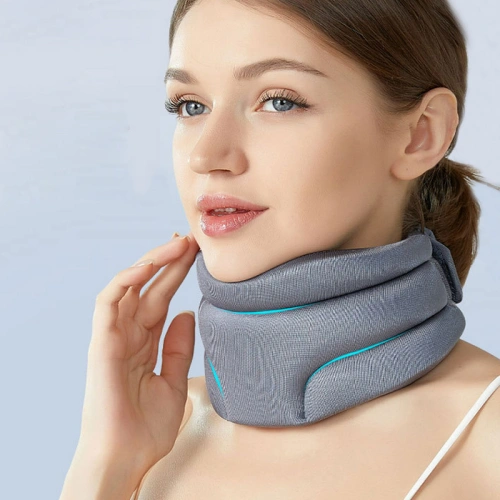
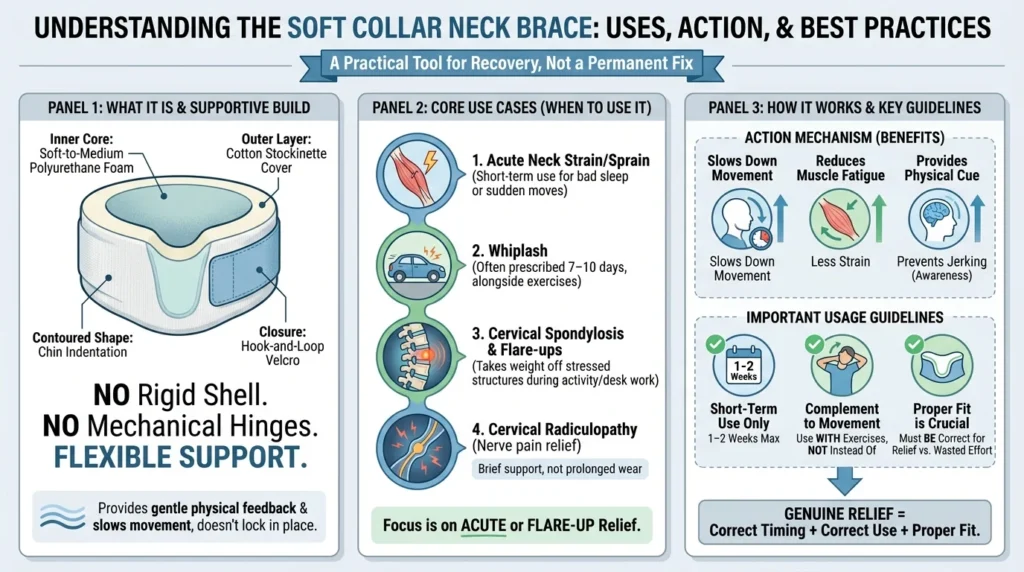
A soft collar neck brace features foam padding encased in a fabric cover. That’s it. No rigid plastic shell. No mechanical hinges. Just compressible foam resting quietly against your skin, doing its job.
The build is consistent across most soft collar neck brace products:
Inner core: soft-to-medium density polyurethane foam
Outer layer: a cotton stockinette cover that rests against your skin
Shape: a contoured ring with a chin indentation that positions the collar in the right spot
Closure: hook-and-loop velcro, sized to fit different neck widths
Here’s what sets it apart: a soft cervical collar supports without locking your neck in place. It slows movement. It cuts down muscle fatigue. It also gives your neck physical feedback — a gentle cue that stops you from jerking your head sideways without realizing it.
What Conditions Is a Soft Collar Neck Brace Used For?
The Core Use Cases
Acute neck strain or sprain is the most common reason people reach for a soft collar. A bad night’s sleep, a sudden move during exercise, a minor fender-bender — any of these can strain neck muscles or ligaments. Short-term use cuts down on movement and lets the tissue settle.
Whiplash from rear-end collisions falls into a similar category. No fracture or instability on imaging? A soft cervical collar is sometimes prescribed for 7–10 days. It goes alongside movement exercises — not as a replacement for them.
Cervical spondylosis and degenerative disc disease flare-ups respond well to brief soft collar support. Older adults tend to get the most out of using it during high-activity periods or long desk sessions. It takes some of the head’s weight off already-stressed structures.
Cervical radiculopathy — nerve root compression from disc problems or degeneration — is another targeted use case. A foam neck collar can limit the specific movements that irritate the nerve. It works best alongside medication and physical therapy, not on its own.
Acute wry neck and muscle spasm (that classic wake-up-and-can’t-turn-your-head situation) respond well to 1–3 days of soft collar use. Combine it with heat and stretching for better results.
Posture-related neck fatigue from long screen sessions is the most common use case. A physical therapist might suggest short wearing windows — not full-day use — as a reminder to hold better posture.
See a Doctor First
Some situations need a professional check before you put on any collar:
Neck pain after a car accident, fall, or direct impact
Arm or leg numbness, weakness, or coordination problems
Pain that gets worse at night or comes with fever or unexplained weight loss
No improvement after 3–7 days of soft collar use
What a Soft Collar Neck Brace Cannot Do
A soft foam cervical collar works for mild-to-moderate conditions. It is not the right choice for:
Suspected or confirmed cervical fractures or dislocations
Unstable spinal injuries after high-force trauma
Progressive neurological decline
Post-surgical stabilization right after fusion or complex decompression procedures
There’s one more hard limit: long-term daily wear. Studies show that prolonged immobilization causes muscle atrophy and joint stiffness. That stretches out recovery instead of cutting it short. The soft collar is a short-term tool. It is not a permanent fix.
How Does a Soft Collar Neck Brace Work? (Mechanism & Functions)
Four mechanisms make a soft collar neck brace work:
1. Load reduction. The collar’s foam structure shifts part of your head’s weight off your cervical muscles and vertebrae. Those muscles get a real break after hours of constant bracing. The catch: rely on that support too long, and your muscles start losing the habit of doing the work themselves. Short-term use matters for exactly that reason.
2. Motion damping. A soft cervical collar cuts about 20% of your neck’s range of motion. You’ll still turn your head. You’ll still nod. What changes is the extreme end — the sharp, fast positions that re-aggravate a strain or irritate a compressed nerve root. Think of it as a speed bump, not a wall.
3. Joint and ligament pressure relief. Cutting down on excessive movement reduces the repetitive grinding between cervical joints. Less friction means a calmer inflammatory response. For people dealing with cervical radiculopathy, that also means less nerve root irritation day to day.
4. Proprioceptive feedback. The collar’s raised back panel touches your neck the moment you over-extend. That physical signal — quiet but instant — trains you to notice bad posture before it turns into a pain spike. For desk workers, that benefit alone is worth paying attention to.
Plus, there’s a thermal side effect worth knowing about. The foam wrap holds warmth around the neck. That improves local circulation and loosens the deep muscular stiffness that shoulder-rolling never quite reaches.
None of these effects are dramatic on their own. But a neck strain recovery brace used the right way — short-term, targeted, as part of a real recovery plan — makes each one count.
Soft Collar vs Hard Collar Neck Brace: Which Do You Need?
A soft cervical collar focuses on comfort and mild support. It eases pain, reduces muscle fatigue, and limits movement slightly.
A hard collar is all about stability. It locks down your cervical spine when the injury is too serious to risk any movement.
Here’s the comparison that matters:
|
Soft Collar |
Hard Collar | |
|---|---|---|
|
Material |
Foam with fabric cover |
Rigid plastic with padded liner |
|
Motion restriction |
Mild — about 20% reduction |
Significant — measurably higher than soft collar |
|
Best for |
Strain, whiplash, chronic pain |
Fracture, major surgery, spinal instability |
|
Comfort |
Higher |
Lower |
|
Driving |
Clinician-approved only |
Not recommended in most cases |
Match your situation to your collar type:
Neck strain, whiplash, or sports injury → soft collar
Fracture, trauma, post-surgical recovery → hard collar
Pain relief without known instability → soft collar
How Long Should You Wear a Soft Cervical Collar?
How long you wear a soft collar neck brace depends on why you need it.
Here’s the breakdown by situation:
General neck pain or moderate strain: No more than 7 days of regular use.
Whiplash (WAD grade 1–2): Research puts effective use at 2–10 days. Ten days is the hard stop.
Post-surgical recovery (e.g., after ACDF): For cases where surgeons prescribe a soft collar, the usual window is 2–3 weeks — full-time for the first week, then tapered down. Many single-level fusion patients don’t use one at all.
How to Wean Off — Don’t Just Stop Cold
A structured taper works better:
Days 1–3: Wear it most of the day. Take it off every hour or two for gentle movement.
Days 4–7: Collar on only for high-pain tasks or commuting. Aim for several hours without it each day.
After day 7 (for general pain): Still reaching for it every day? That’s a sign to check back in with your doctor — not a reason to keep going.
What Happens If You Wear It Too Long
Extended use creates one clear problem: your neck muscles stop doing their job because the collar does it for them. That causes muscle weakening, stiffness, and postural deconditioning — all things that stretch out your recovery instead of shortening it.
There’s a mental side to this, too. Long-term collar use can build a quiet fear of moving your neck. That fear reinforces avoidance behavior, which feeds chronic pain cycles.
How to Wear a Soft Collar Neck Brace the Right Way?
Here’s the process in five clear steps.
Step 1: Choose the right collar height.
Sit upright with your ears stacked over your shoulders and your chin level. Measure the vertical distance from the top of your sternum to the tip of your chin — most adult soft collars run 6–10 cm in front height. A good fit means your chin rests on the upper edge. Eyes forward, nose aligned with your belly button. Looking at the ceiling? The collar is too tall. Chin sinking inside it? The collar is too low.
Step 2: Position the chin notch first.
Undo the Velcro all the way. Center the V-notch under your chin before you wrap anything. The lower front edge should sit just above your sternum. The lower back edge should clear your trapezius without riding up toward your ears.
Step 3: Fasten to one-finger snugness.
Wrap, overlap, and close the Velcro with your neck in a neutral position. Here’s the test: one fingertip should fit between the collar and your skin. Collar rotates? Too loose. Can’t swallow without strain? Too tight.
Step 4: Confirm neutral alignment in a mirror.
Shoulders relaxed. Head level. No hard Velcro tabs pressing against skin. Breathe, swallow, speak — all of it should feel normal.
Common Fitting Mistakes to Avoid
|
Mistake |
What You’ll Notice |
Fix |
|---|---|---|
|
Too tight |
Can’t insert one finger; swallowing feels off |
Loosen a little; recheck snugness |
|
Too loose |
Collar rotates; chin hangs over the edge |
Re-center V-notch; pull ends snugger before closing |
|
Wrong height |
You keep looking upward |
Try a shorter collar; reposition it lower on the sternum |
|
Slouched posture |
Collar gaps at the back, tight at the front |
Sit on a firm chair; refit while upright |
Choosing the Right Soft Collar Neck Brace
Four parameters determine whether a soft collar works for you.
Size and Height: The Non-Negotiable First Step
Measure your neck circumference before buying. Stand upright, eyes forward. Wrap a soft tape measure around the widest point — through the throat and around the back. Most adults fall between 30–45 cm. Standard sizing runs S (28–33 cm), M (33–38 cm), L (38–43 cm), though brands vary.
Height matters just as much. The collar’s lower edge should rest on your collarbone. The upper edge should support your jaw without pressing into your ear. Adult collars range 7–10 cm (low), 10–12 cm (mid), 12–14 cm (tall). Taller options suit post-surgical recovery best.
Fit test: one finger slides between the collar and skin. Your head shouldn’t swing side to side. That’s the target.
Foam Type: Standard vs Memory Foam
|
Standard Foam |
Memory Foam | |
|---|---|---|
|
Price range |
$10–$25 |
$20–$40 |
|
Rebound speed |
Under 1 second |
3–5 seconds |
|
Long-term shape retention |
60–70% after weeks of use |
Over 80% |
|
Best for |
Short-term, light use |
Extended wear, better contouring |
Support Bars: Soft-Only or Semi-Rigid?
Pure foam collars limit sharp, sudden movements — enough for desk fatigue or mild strain.
Collars with built-in plastic stays add moderate restriction. They cut forward flexion more than foam alone. Go semi-rigid if your doctor recommends it after surgery or during an acute cervical flare.
Breathability
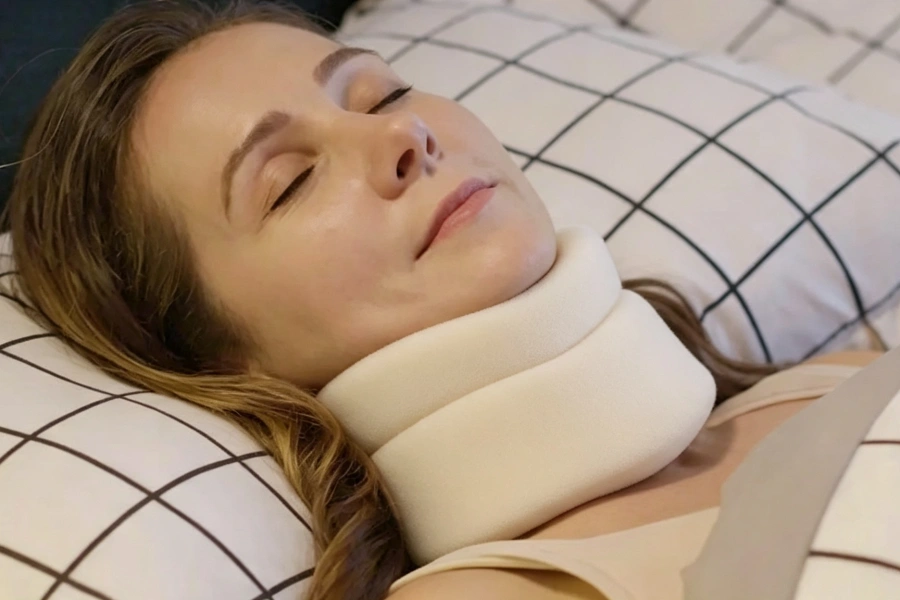
Wearing a collar for more than 4 hours a day? Prioritize mesh outer fabric with perforated foam. Ventilation holes boost heat and moisture release by 20–30%. That’s a real difference across a full workday or overnight use.
Conclusion
Your neck works hard every day — holding up your head, absorbing stress, and sending pain signals through every ache and stiff morning. A soft collar neck brace isn’t a magic fix. But used right, it’s a solid tool. It limits movement so your muscles can rest. It cuts pain during recovery. It gives injured tissue the space to heal.
Browse AOFit‘s soft cervical collars — built for real recovery, not just comfort theater.