

The global orthopedic braces and supports market continues to expand, driven by rising demand from athletes, manual workers, and individuals managing chronic joint conditions. Among all brace materials, neoprene remains one of the most widely used synthetic rubbers in medical and sports applications, valued for its unique combination of compression, heat retention, and flexibility. This comprehensive guide explains what a neoprene elbow brace is, the science behind its effectiveness, who should use it, and how to select a quality product that meets your needs.
What Is a Neoprene Elbow Brace and How Does It Work?

Polychloroprene synthetic rubber — that’s the core material inside every quality neoprene elbow brace. It sounds technical. But how it works on your elbow is simple.
A neoprene elbow brace is a flexible sleeve or wrap. It delivers two things at once: compression and therapeutic warmth. Most people expect one or the other from a support brace. Neoprene gives you both, and that’s what sets it apart.
The Two-Mechanism System
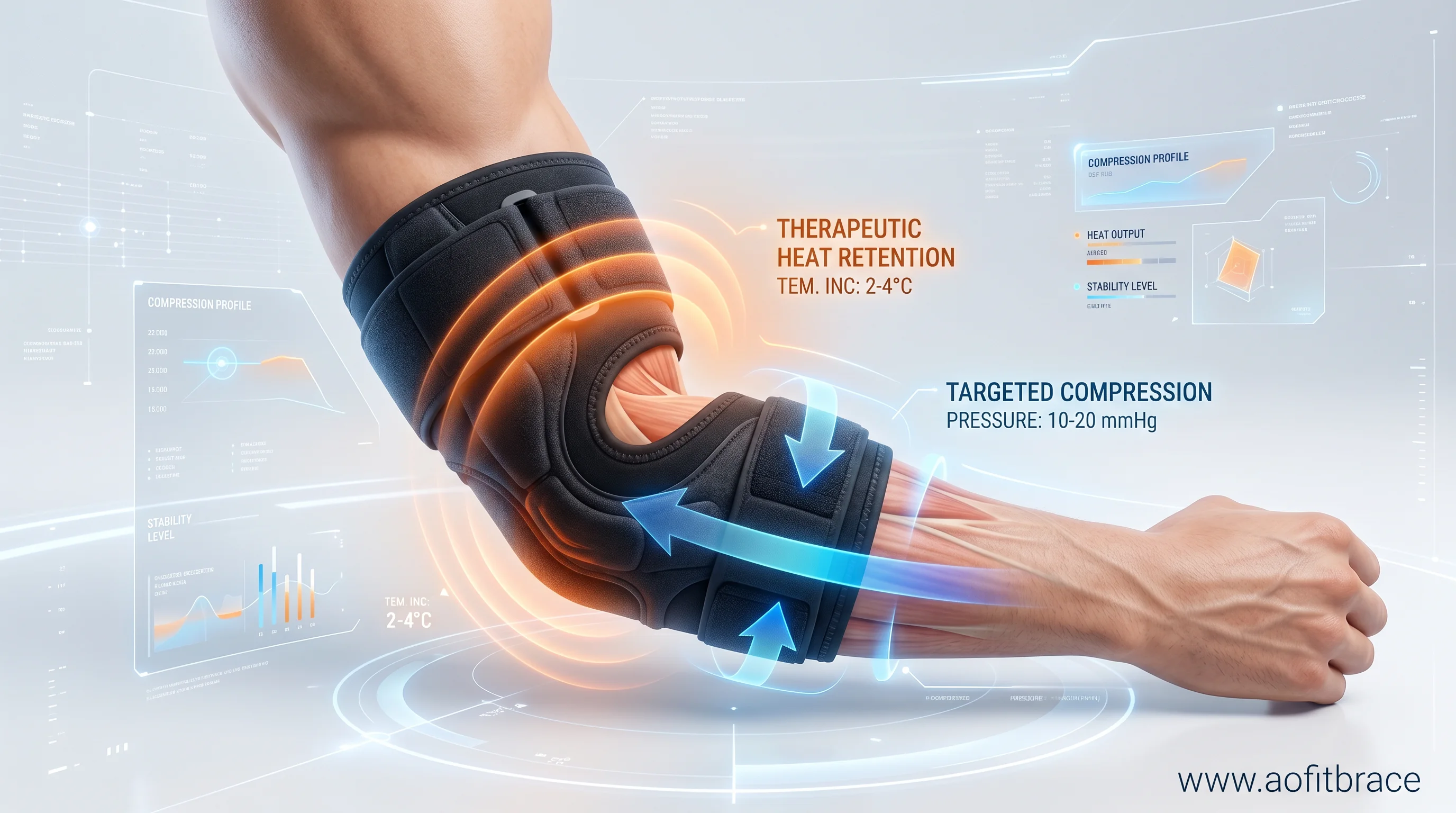
Here’s what’s happening beneath the surface:
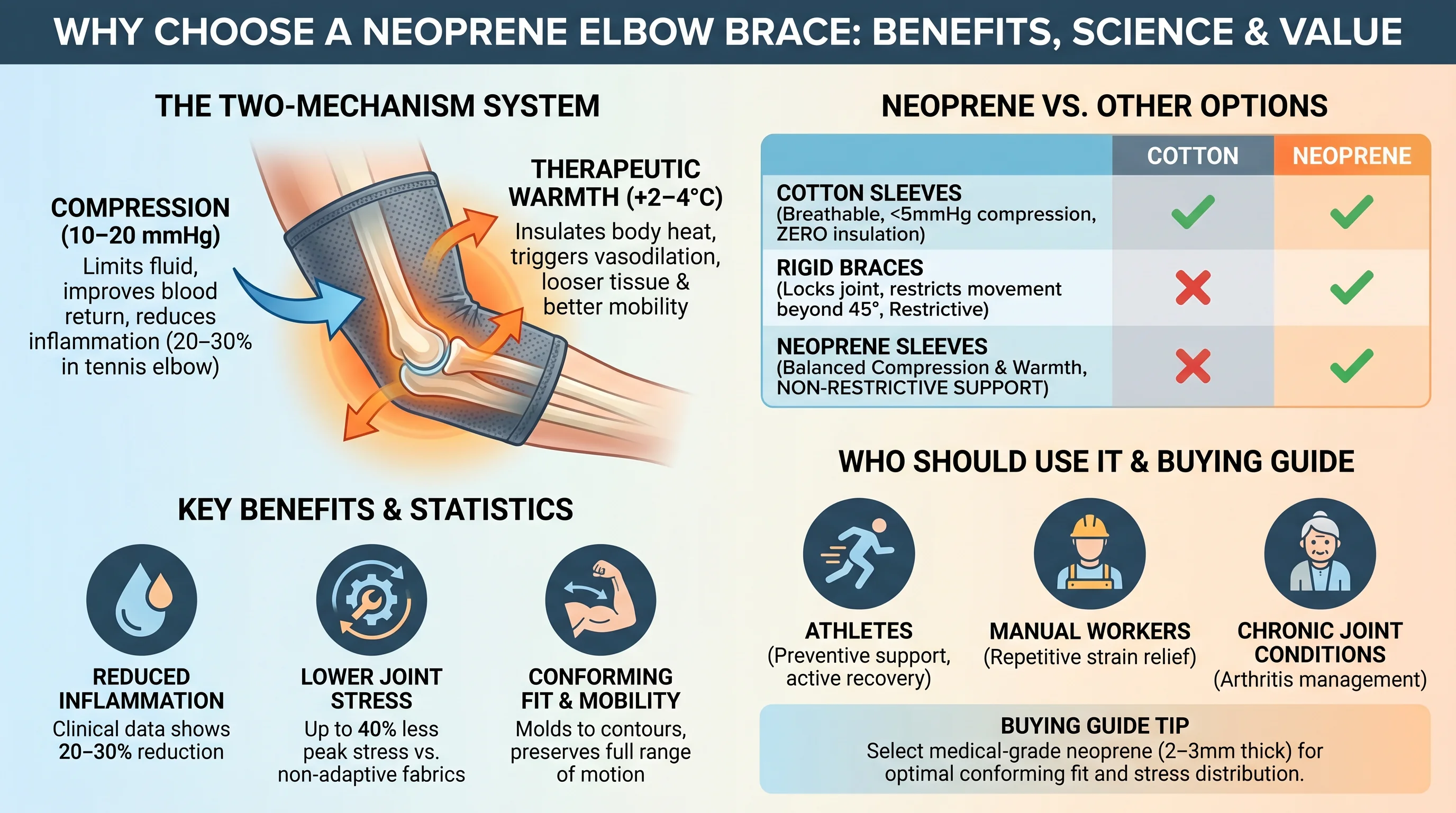
Compression (10–20 mmHg) limits fluid buildup around the joint. It improves blood return and cuts inflammation. Clinical data shows this alone can reduce inflammation by 20–30% in tennis elbow cases — a real number, not a rough guess.
Insulation works alongside compression. The closed-cell foam structure traps your body heat. This raises local tissue temperature by 2–4°C. That heat triggers vasodilation — better blood flow, looser tissue, and more mobility before you even start moving.
Together, these two mechanisms reduce peak stress on the elbow joint by up to 40% compared to non-adaptive fabrics. That’s a major difference, not a minor one.
The Conforming Fit Factor
Medical-grade neoprene runs 2–3mm thick (per ASTM D2000 specifications). At that thickness, it does something rigid braces and cotton sleeves cannot — it molds to your elbow’s exact contours.
This fit spreads force across the surrounding forearm muscles, including the extensor carpi radialis. It avoids concentrating load on vulnerable pressure points like the olecranon and epicondyles. The result is uniform stress distribution — not just extra padding.
Here’s how neoprene compares to other options:
- Cotton sleeves — breathable, but deliver less than 5 mmHg compression and zero insulation
- Rigid braces — lock the joint down, often restricting movement beyond 45°
- Neoprene elbow compression sleeve — preserves your full range of motion while providing real structural support
5 Science-Backed Benefits of Neoprene Elbow Braces
The research on neoprene elbow braces is more convincing than most people expect. These aren’t marketing claims dressed up in medical language. They’re real, measurable outcomes from rehabilitation studies — and they’re worth knowing before you buy.
1. Reduces Inflammation and Speeds Up Healing
Steady compression at the joint does something right away. It limits fluid buildup and pushes better blood flow to damaged tissue. That’s not a theory. It’s the reason neoprene works so well for tennis elbow (lateral epicondylitis) and golfer’s elbow (medial epicondylitis).
Here’s a number worth noting. Braced patients in post-traumatic elbow rehab studies gained a mean range-of-motion improvement of 38°±10° over 6.9 months. Those results match surgical outcomes — without any surgical risk.
2. Prevents Injury During High-Impact Activities
Athletes in repetitive-motion sports — tennis, rowing, weightlifting — cut their injury risk by up to 30% by wearing a brace during training. The reason is simple. Neoprene molds to the joint and shifts load away from vulnerable tendon attachment points. This reduces the slow, building strain that turns into a long-term problem.
Velcro-adjustable designs take it a step further. You can dial in the compression to match your own joint needs — not just a fixed, one-size-fits-all pressure level.
3. Speeds Up Post-Workout Recovery
Compression plus trapped body heat boosts blood flow to the area and clears lactic acid faster. Elbow sleeve wearers recover faster after training. The sleeve’s stretch also improves muscle activity and power output during the session itself.
For post-surgical rehab, the benefits go further:
– Lower risk of venous stasis
– Reduced chance of complex regional pain syndrome
– You stay able to move and handle light tasks during the tissue-healing phase
4. Delivers Therapeutic Warmth for Stiffness and Better Mobility
Neoprene’s heat-retaining properties aren’t a side effect. They’re a real functional advantage. The warmth reduces joint stiffness, eases muscle tension, and helps build range of motion — especially when paired with a physio program.
This matters most in two situations:
– Cold-weather training
– Early-morning workouts before your joints have had time to loosen up
A thermal elbow support fills that gap. Your joint stays warm from the first rep, not the fifth.
5. Built to Last — and Safe to Wear Every Day
High-grade neoprene holds up through repeated compression cycles and moisture exposure. The structure stays solid over time. For everyday use, that kind of durability matters a lot.
Quality neoprene is also latex-free and hypoallergenic. No allergic reaction risk. The moisture-wicking material handles long wear without causing skin irritation or breakdown.
One more practical point: well-made neoprene elbow braces sit flat under clothing. You don’t give up comfort or discretion to get solid support through a full workday.
Who Should Wear a Neoprene Elbow Brace? Key Use Cases
Neoprene elbow braces aren’t built for one type of person or one specific injury. They cover a wide range of problems. Knowing which category fits your situation will save you from buying the wrong product.
Athletes: Sport-Specific Protection

- Tennis and racquet sport players are the most common users, and for good reason. Adults aged 30–50 make up the largest group dealing with lateral epicondylitis. Repetitive wrist extension puts constant load on the extensor carpi radialis brevis tendon — over and over, session after session. A well-placed neoprene tennis elbow band shifts that load away from the tendon and onto the surrounding forearm muscle. Position it 2 cm below the elbow crease, over the affected tendon. Wear it during play. Not 24/7 — just during high-demand periods.
- Golfers deal with the medial side. Repetitive wrist flexion and forearm rotation irritate the inner tendon attachment. A golfer’s elbow brace targets that area. It reduces pain through the swing without blocking movement.
- Weightlifters get a different kind of benefit. Graduated compression boosts circulation and cuts down swelling during bench press and curl movements. Some designs add viscoelastic padding at the epicondyle — extra cushioning right where tendons take the most stress.
Workers: Everyday Repetitive Strain

Construction workers, carpenters, and desk-bound typists all share one common problem: small, repeated injuries that build up over time from repetitive motion.
- Manual laborers do well wearing a neoprene joint support during heavy work periods. It lowers the pulling force muscles put on tendons — and that’s how overuse injuries start and grow.
- Office workers with chronic keyboard and mouse use can wear the sleeve throughout their work hours. It keeps the elbow stable, maintains tissue warmth, and stops the slow buildup that turns into a lasting problem.
Recovery and Chronic Conditions
Post-injury rehab follows a clear pattern:
- Acute phase — compression controls swelling
- Subacute phase — neoprene’s heat keeps blood flowing and speeds up healing
- For conditions like bursitis, tendinitis, and sprains, the compression-plus-warmth combo also helps reduce guarded, hesitant movement — the kind that actually slows recovery down.
- Arthritis patients get real thermal relief. Neoprene’s heat activates heat-sensing receptors, which block pain signals. Morning stiffness is where this makes the biggest difference. The retained warmth reduces joint rigidity before the joint loosens on its own. All-day wear works fine — as long as circulation stays unrestricted.
Neoprene vs. Other Elbow Brace Types: Which Is Right for You?
Four main brace types compete for your elbow. Each solves a different problem. Picking the wrong one doesn’t just waste money — it can slow your recovery.
Here’s how they compare:
| Type | Compression | Heat Retention | Range of Motion | Best For |
|---|---|---|---|---|
| Neoprene sleeve/brace | 20–30 mmHg | High | Medium | Daily wear, sports, early-mid rehab |
| Hinged rigid brace | Medium-high | Low | Low | Post-surgery, ligament tears |
| Elastic fabric sleeve | 10–20 mmHg | Low-medium | High | Chronic pain, active recovery |
| Compression strap/band | Targeted pressure | Low | High | Tendonitis prevention |
Where Neoprene Wins
- Thermal retention is neoprene’s strongest advantage. Elastic fabric breathes — but breathable means cold. Hinged metal braces offer zero insulation. Neoprene traps your body heat and keeps tissue warm through the full session.
- Compression coverage is the second big difference. Straps put pressure on one tendon. Neoprene wraps the full joint — 20–25 mmHg at 5mm thickness, 25–30 mmHg at 7mm for heavy lifting or acute injury.
Thickness matters more than most buyers expect:
– 5mm — daily support, moderate training, all-day comfort
– 7mm — powerlifting, strongman, maximum joint stability
Brace vs. Sleeve — A Distinction Worth Making
People use these two terms as if they mean the same thing. They don’t.
- A neoprene elbow brace has structure — adjustable Velcro straps, gel pads, and targeted compression points. The typical material blend is 65% neoprene, 35% nylon. You get a customizable fit and semi-rigid support.
- A neoprene elbow compression sleeve is a seamless wrap. No straps, no hardware. Slide it on, and you get uniform compression across the joint. It trades adjustability for simplicity and mobility.
Quick rule: dealing with a specific injury that flares up unevenly? Go with the brace — you can dial in the pressure as things change. Need steady compression for prevention or chronic stiffness? The sleeve is simpler and easier to wear every day.
How to Choose the Right Neoprene Elbow Brace: Buying Guide
1. Measure First — Then Shop
Sizing an elbow brace is not guesswork. Measure the circumference of your forearm 12 cm below the elbow joint, with your arm relaxed at your side. Use a flexible tape measure. No tape measure? Wrap a piece of string around the same point, then measure the string flat.
That single number sets your size category. Don’t eyeball it. A half-size error turns a solid brace into a useless one.
2. Match Compression Level to Your Actual Need
Not every situation calls for the same pressure. Here’s the split:
- Light compression (elastic sleeve design) — prevention, desk work, mild stiffness, long wear sessions
- Medium compression with localized padding — active training, chronic epicondylitis, post-workout recovery
For tennis elbow or golfer’s elbow, a pressure band with targeted padding beats a plain sleeve every time. The sleeve gives general support. The band puts direct pressure on the exact problem point — taking tension off the tendon itself.
3. Choose Adjustability Over Convenience
Non-adjustable braces are a shortcut that doesn’t pay off. Your arm swells during activity. Your comfort needs shift from morning stiffness to mid-session intensity. A Velcro strap system lets you adjust pressure in real time — tighter for stability, looser when circulation matters more.
Quality hook-and-loop fasteners hold their grip through 100+ attachment cycles. That’s the number worth checking before you buy.
4. Check the Material Specs
Standard 4mm medical-grade neoprene handles heat retention and compression for most use cases. Look for consistent density, seamless or low-seam construction, and ventilation panels or perforations. This matters more for multi-hour wear. Breathability is not a bonus feature. It’s the difference between a brace you keep wearing and one that ends up in a drawer.
5. Place It Right
This is the most common and most expensive mistake buyers make. Putting the brace on the elbow joint kills its therapeutic value.
Correct placement: 2 cm below the elbow crease, over the forearm. To confirm the position, do a slow wrist extension. You’ll feel the extensor muscle contract under the brace. That’s the right spot.
Quick-Reference Buying Checklist
Before you finalize any purchase, run through this:
- ✓ Measured arm circumference 12 cm below the elbow
- ✓ Compression level matched to activity type
- ✓ Adjustable Velcro strap included
- ✓ 4mm medical-grade neoprene with breathable design
- ✓ Seamless or low-seam construction for extended wear
- ✓ Fastener durability rated for repeated use
Budget context: quality neoprene elbow braces range from $24 to $30+. The price gap reflects fastener durability and material consistency — not compression performance alone. Spending an extra five dollars on a medical-grade option with a solid Velcro system is the right call.
Conclusion
Dealing with a tennis elbow flare-up? Managing a hard physical job? Rebuilding strength after an injury? A neoprene elbow brace gives you what most supports can’t. The right brace doesn’t just sit on your arm. It works with your body — holding therapeutic heat, stabilizing the joint, and helping you recover smarter.
Check out AOFit’s full range of neoprene joint support braces at aofitbrace.com — and find custom elbow brace solutions that match how you move, work, and recover.