
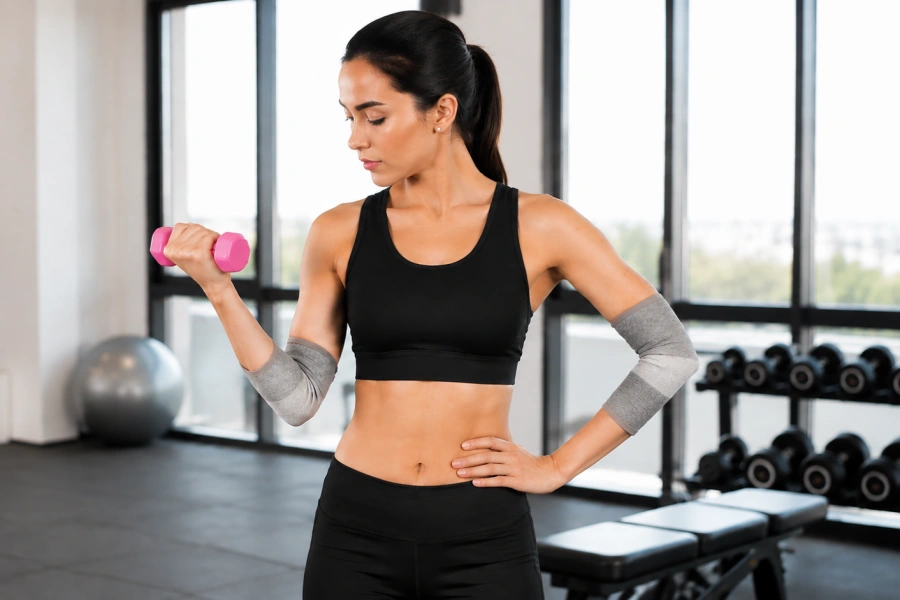
Swing a racket, grip a barbell, or throw a ball often enough, and the tendons start complaining right when you need them most. Grabbing the first sports elbow support you see won’t solve it. A brace that suits a golfer can feel pointless under a barbell, and one built for stability can get in the way of a jump shot. Every sport loads the elbow in its own way, so the right choice changes with the movement. We match each sport to the right gear—covering tennis, golf, lifting, basketball, baseball, and cycling. We’ll also compare compression sleeves, straps, and hinged braces, then finish with what to check before you buy.
Elbow Support for Sports: Match the Right Type to Your Activity
Start with the pain location, then choose your elbow brace.
- Outer elbow pain (tennis elbow): Backhands, badminton smashes, climbing, and barbell grips all strain the outer tendon. A tennis elbow strap works best here. Fasten it about 2–3 cm below the sore spot. If you have general fatigue rather than sharp pain, an elbow compression sleeve can provide enough support.
- Inner elbow pain (golfer’s elbow): Golf swings, pitching, climbing holds, and kettlebell swings pull directly on the inner tendon. Position a golfer’s elbow brace or strap around your upper forearm to ease that tension.
- Long, low-risk sessions: Pick a thin, breathable elbow sleeve with non-slip edges. Make sure it never limits your full range of motion.
- Mild tendonitis: If you have no swelling, weakness, or joint instability, an elbow tendonitis support (either a sleeve or a strap) is a sensible place to start.
- Past instability, especially in throwing, contact sports, or gymnastics: Choose a hinged elbow stabilizer or a dedicated hyperextension elbow brace. A basic elastic sleeve will not stop the joint from hyperextending under force.
- Sprains or post-surgery recovery: Use an adjustable elbow brace with a hinge, and wear it only as your medical team directs.
Elbow Support for Tennis, Badminton, Squash and Pickleball: Strap vs Sleeve vs Vibration-Damping Brace
Racket sports concentrate force right on the outer elbow. Gripping tight, snapping the wrist through a stroke, and absorbing ball contact all stress the forearm extensor muscles, particularly where the ECRB tendon anchors to bone. Low backhand contact, off-center hits, and poor swing deceleration drive that strain higher. Tighter strings also send more shock straight into the arm.

Elbow Strap vs Elbow Sleeve vs Elbow Vibration-Damping Brace:
| Type | Best for | Limits and what to look for |
|---|---|---|
| Elbow compression sleeve | Mild, spread-out soreness, warm-ups, and long sessions with constant movement | Doesn’t isolate and offload a single sore spot. Look for breathable knit fabric, flat seams, and a non-slip top edge. |
| Counterforce (tennis elbow) strap | Outer elbow pain triggered by gripping, such as backhands or smashes | Position it on the forearm muscle belly instead of the bony joint. Fastening it too tight can cause numbness or cold hands. |
| Vibration-damping brace | Hard-hitting, fast play with padding or silicone inserts | Damping materials cushion shock but won’t remove all tendon load. |
Pick by Sport
- Tennis: Use a strap for localized outer pain. Choose an elbow sleeve for lingering ache across long sets. Padded braces suit players dealing with stiff frames, high string tension, or frequent off-center hits.
- Badminton: Smashes and quick defensive resets demand full wrist mobility. Go with a breathable elbow sleeve, or a lightweight strap for clear outer pain.
- Squash: Short, rapid swings and wall rebounds deliver repeated shocks. Choose a padded strap or damping brace built with non-slip materials that stay put when you sweat.
- Pickleball: The paddle is light, but tight gripping and quick volleys still irritate the tendon. Strong evidence hasn’t proven that any paddle design prevents “pickleball elbow,” so borrow tennis logic: a strap for local pain, or an elbow sleeve for general fatigue.
Golfer’s Elbow Brace: What to Wear for Repeated Gripping and Wrist Flexion
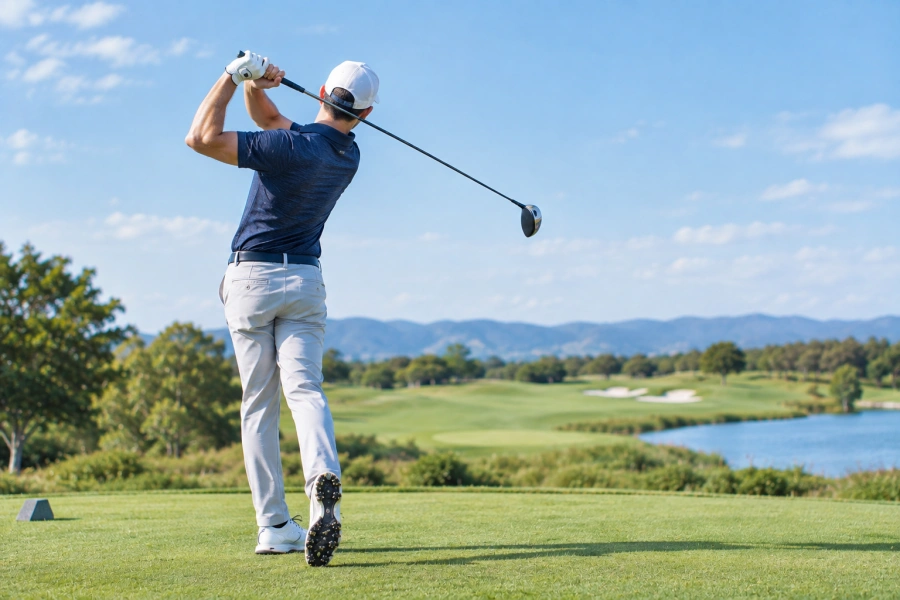
Golfer’s elbow comes down to grip stress as much as swing mechanics. Every time you squeeze the handle, flex your wrist, or rotate your forearm, load runs straight into the inner elbow tendon where the forearm flexor and pronator muscles anchor to the bone (the medial epicondyle). The downswing piles on eccentric load and valgus stress. Clenching the club, shifting weight poorly, or flipping the wrists early drives those forces even higher.
Typical signs:
– Aching, stabbing, or tender spots on the inner elbow
– Pain running down the inner forearm toward the wrist
– Pain when gripping, making a fist, turning a doorknob, or swinging
– Stiffness and a weaker grip
Elbow Strap or Elbow Sleeve? Pick by Situation
| Your situation | Better choice | How to use it |
|---|---|---|
| Clear inner-elbow pain during swings | Counterforce strap | Place the pad on the forearm muscle belly, not on the bony point. Choose an adjustable, padded design. |
| Light range sessions while symptoms linger | Counterforce strap | It spreads tension across the forearm soft tissue. It should feel supportive, never numb or cold. |
| Post-round soreness, stiffness, or warmth only | Elbow compression sleeve | Gives even, mild pressure and warmth. It won’t offload the tendon. |
| Much better, but still playing long rounds | Sleeve or thin strap | Wear the sleeve throughout. Use the strap only during gripping and impact. |
| Pain plus restricted movement | Not a sleeve alone | Cut back swing volume and get assessed. Evidence for sleeves treating confirmed tendinopathy is weak. |
Cleveland Clinic notes that the standard golfer’s elbow brace is a counterforce strap fitted with a raised pad. They point to compression sleeves as a helpful tool for warmth and circulation once acute symptoms settle down. No single strap design beats the rest in clinical testing, so prioritize solid adjustability and controlled pressure. For a closer look at brace types, fit, and support levels, check out our guide on how to choose a golf elbow brace.
What to Check Before You Buy
- Range of motion: It must allow full extension, flexion, and forearm rotation without pinching.
- Profile: Choose a thin, low-bulk design that won’t catch on your sleeve or change how you hold the club.
- Stay-put fit: The strap needs to stay anchored through sweat and repeated swings, with enough hook-and-loop adjustment to match your forearm.
- Pressure: Position the padding over the muscle belly, never directly on the epicondyle or in the crook of the elbow.
- Fabric: For long rounds, a breathable elbow sleeve in nylon/spandex with mesh vents and low-absorption foam is best.
- Comfort: Look for flat inner seams and anti-curl edges.
Elbow Support for Weightlifting, Bodybuilding and CrossFit: Warmth, Proprioception and Full-Range Lifting
Lifters rarely hurt an elbow in one dramatic moment. The damage builds rep by rep, usually where tendons bear the heaviest load.
- Pulling and gripping: Pull-ups, rows, deadlifts, hangs, and kettlebell work load the forearm tendons at the elbow. Outer-elbow pain flares with gripping, rows, and deadlifts, while inner-elbow pain spikes during curls and heavy pulling.
- Pressing and lockout: Bench presses, dips, close-grip work, and skull crushers stress the triceps tendon. Flared elbows, hard lockouts, and sudden volume spikes make it worse.
- Elbow flexion: Barbell curls and chin-ups irritate the front of the joint. Straight-bar curls often feel harsher on the joint than EZ-bar or neutral-grip variations.
Elbow Compression Sleeve: Warmth and Feedback, Not a Stabilizer
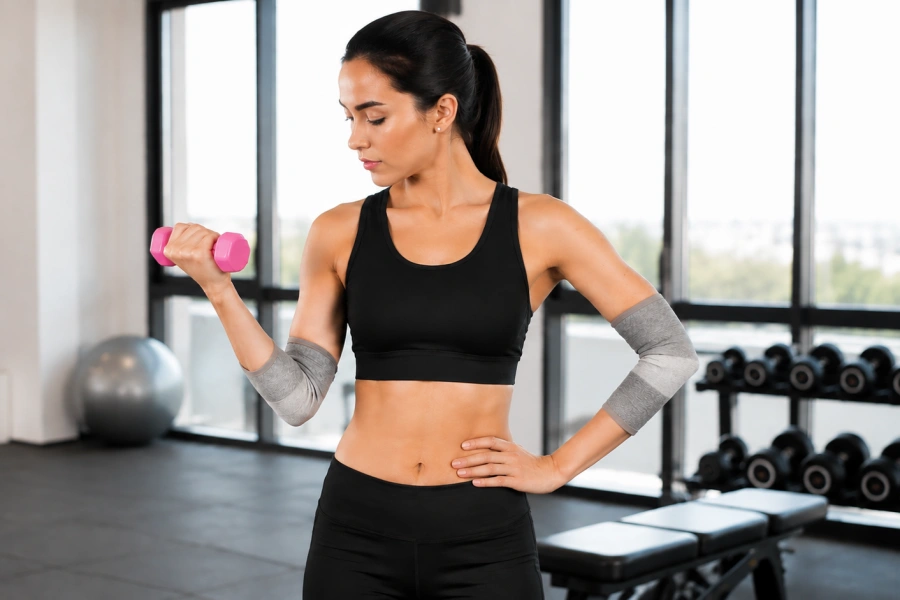
A snug elbow compression sleeve is the sensible default for elbow support for weightlifting and elbow support for CrossFit. It retains warmth and provides sensory feedback while leaving the joint free to move.
Look for:
– 3–5 mm neoprene, or a breathable elbow sleeve in nylon/spandex
– A tapered forearm and upper-arm cut with full elbow coverage
– Silicone grip bands so it will not slide during pull-ups, cleans, or presses
– Flat seams and a low profile for barbell clearance
– Sizing based on upper-arm and forearm circumference
Adjustable Elbow Brace: For Moderate, Localized Pain
Step up to an adjustable elbow brace or strap when pain is moderate, stays in one spot, and flares on a specific lift. It applies targeted pressure while permitting far more motion than a rigid brace, serving well as elbow tendonitis support.
Choose a design with one-handed tension adjustment, a 2–4 cm strap, and padding that stays clear of the olecranon. The closure needs to stay fastened through burpees and high-rep sets.
Elbow Support for Basketball and Volleyball: Light Protection Without Limiting Mobility
Falls are a leading cause of youth sports injuries, and basketball and volleyball give players plenty of chances to hit the floor. Add jumps, hard landings, sudden stops, and body contact, and the elbow takes impact from two directions.
- Acute injuries: Falls, direct hits, and joint twists.
- Overuse: Spikes, blocks, and serves involve repetitive overhead mechanics. Poor form and repeated impact compound the stress on joint ligaments.
Elbow Sleeve First, Hinged Brace Only When Needed
A thin basketball elbow compression sleeve provides even pressure, warmth, and joint feedback. It helps with mild soreness, floor burn prevention, and court impact, serving as practical everyday elbow protection for athletes. It will not stabilize a torn ligament, a dislocated joint, or an unstable elbow.
A hinged elbow stabilizer controls flexion and protects against side-to-side stress. Reserve it for ligament injuries, post-surgery recovery, or physician-directed rehab. Because it adds bulk, weight, and physical restriction, it works poorly as a default for standard play.
What to Look For
- Thickness: Choose a low-profile knit or foam sleeve with padding centered on the elbow tip. Pick one that lets you bend and extend your arm without resistance.
- Movement check: Test the fit through a full bend, complete extension, overhead reaches, spike motions, jump shots, and push-ups.
- Grip: Silicone strips, dots, or elastic bands should keep the sleeve in place without causing numbness, cold fingers, or deep pressure marks.
- Fabric: Pick a breathable elbow sleeve made of nylon and spandex with built-in mesh vents.
- Size: Measure both elbow and forearm circumference for an accurate fit.
Elbow Brace for Baseball, Softball and Throwing Sports: Managing Valgus Stress Realistically
Every hard throw pulls at the inside of your elbow. During arm acceleration, the inner joint stretches, the outer surface compresses, and the back-inside area absorbs shear. That combination creates valgus stress, the driving force behind “thrower’s elbow.”
Over time, this repeated strain wears on the ulnar collateral ligament (UCL) and the flexor-pronator muscles. In younger players, it can trigger medial epicondyle apophysitis or cause posteromedial impingement. Risk climbs quickly with heavy pitch counts, short recovery windows, poor mechanics, and weak forearm muscles.
What an Elbow Brace Can Do
A lightweight compression elbow sleeve for throwing gives you warmth, mild support, and better joint awareness to help manage everyday comfort.
Stop Throwing and Get Checked If You Notice
- Inner-elbow pain, including pain at rest
- Lower velocity, worse control, or throws sailing high
- Swelling, tenderness, stiffness, or a lost range of motion
- A loose or unstable feeling, clicking, catching, or locking
- Numbness, tingling, or weakness in the ring and little fingers
Elbow Protection for Cycling and Contact Sports: Low-Profile Sleeves vs Padded or Hinged Braces
Most bike crashes follow a familiar pattern: you throw out a hand to break the fall, and the point of the elbow (the olecranon) takes the impact. Contact sports add high-speed collisions and sudden hyperextension to that risk. The right gear depends on which of these hazards you deal with most.
Cycling: Match the Gear to the Terrain
Mountain bikers face frequent recommendations to wear elbow pads, and one review cites claims of up to 82% prevention of elbow injuries with consistent pad use.
- Road, gravel, commuting: A low-profile elbow compression sleeve provides warmth, mild joint feedback, and light support while staying flat and discreet under a jersey. FUTURO’s exercise support, for instance, delivers adjustable compression using two straps placed above and below the elbow.
- Trail, downhill, BMX, bike park: Choose a sleeve featuring an integrated impact pad rather than bare fabric. AOFIT’s padded sleeve pairs high-impact-resistant foam in a contoured honeycomb layout with breathable Lycra.
For fit, check that the sleeve:
– Bends comfortably without bunching behind the joint during long rides
– Stays anchored with silicone grip strips or elastic banding
– Dumps heat efficiently, like a purpose-built breathable elbow sleeve
– Keeps the pad centered over the olecranon
Contact Sports: Cushioning vs Control
Sports like football, rugby, basketball, lacrosse, and martial arts combine direct impacts with awkward falls and severe lateral torque. Hyperextension can easily sprain or tear the UCL, the joint capsule, and surrounding ligaments.
A padded sleeve softens direct blows to the olecranon to prevent deep bone bruises and turf burns, but it does not stop the joint from bending backward past its safe limit. For lateral stability and controlled flexion, step up to a hinged elbow stabilizer.
Quick Selection Guide
| Your situation | Best option |
|---|---|
| Road/gravel/commuting, no injury history | Compression elbow sleeve |
| Technical trail or frequent falls | Low-profile padded elbow sleeve |
| Routine practice, low collision exposure, stable elbow | Padded elbow sleeve |
| Repeated bruising from collisions | Low-profile padded elbow brace |
| Past hyperextension, dislocation, UCL injury, surgery, or instability | Hinged elbow brace with extension control, professionally fitted |
Elbow Compression Sleeve vs Counterforce Strap vs Adjustable vs Hinged Elbow Brace
| Type | Best use | Support | Movement limit | Professional guidance |
|---|---|---|---|---|
| Elbow compression sleeve | Mild soreness, swelling, warmth, stable sprain | Low | Minimal | Not needed for mild symptoms |
| Counterforce (tennis elbow) strap | Suspected or diagnosed tennis elbow, golfer’s elbow, activity-related tendon pain | Low–moderate, localized | Minimal | Fitting advice helps; see a clinician if symptoms persist |
| Adjustable elbow brace | Mild-to-moderate instability, controlled recovery | Moderate | Low–moderate | Recommended for instability or persistent symptoms |
| Hinged elbow stabilizer/hyperextension elbow brace | UCL/LCL injury, post-surgery rehab, recurrent instability | High | Moderate–high | Recommended |
How to Choose an Sports Elbow Support?
Match the Support Level to Your Need
| Your need | Construction | What to check |
|---|---|---|
| Mild discomfort, prevention, daily wear | Slip-on compression sleeve | Breathable elastic knit, low profile, even compression |
| Localized tendon pain | Moderate sleeve with tendon pad, or adjustable strap | Adjustable tension, stays put during repetitive use |
| Sport and active recovery | Moderate brace or sleeve | Nylon, polyester, or spandex blend; moisture-wicking; reinforced edges |
| Instability or major injury | Maximum-support stabilizing brace | Multiple straps, rigid or semi-rigid stays, optional padding, professional fitting |
| Post-surgical or motion control | Hinged ROM brace | Adjustable flexion/extension stops, clinician-approved range |
Nail the Fit
- Measure your arm where the manufacturer directs, whether that is the forearm, elbow, or upper arm. Check the brand’s size chart.
- Position straps and pads according to the instructions. Many designs need to sit about 2 cm below the elbow crease.
- Use the two-finger test for adjustable braces: two fingertips should slide underneath the band.
- Look out for slipping or rolling, and make sure the brace does not cause numbness, tingling, or pale skin.
- Check the fit again after moving for a few minutes, since sweat and swelling will alter the tension.
Read the Material and Construction
- Breathable, moisture-wicking fabric keeps you comfortable during long sessions.
- Neoprene provides cushioning and retains heat, so make sure it has ventilation holes if you wear it in warm weather.
- Flat seams and soft, finished edges prevent chafing inside the elbow crease.
- Silicone grips or non-slip yarn keep the sleeve from sliding down your arm.
- Hook-and-loop straps make it easy to loosen or tighten the brace if your arm swells.
- Double-stitched stress zones hold up better around straps, hinges, and pad pockets.
- Washable construction keeps maintenance simple, so check the care tag before buying.
Recommended Sports Elbow Supports at AOFIT by Sport and Support Level
AOFIT has built braces and supports for 16 years, and its lineup matches the support ladder above. Start with the lowest level that covers your issue, then step up if you need firmer hold.
| Support level | Product | Best for | What it offers |
|---|---|---|---|
| Light | Sports Elbow Compression Sleeves | Lifting, tennis, pickleball, golf, cycling, CrossFit/HIIT | Seamless knit with graduated compression that stays snug at the forearm and eases toward the upper arm. Adds warmth and joint awareness without restricting movement. |
| Light–moderate | Tennis Elbow Band | Tennis, pickleball, badminton, squash | Sits below the elbow to take tension off the sore tendon attachment using counterforce compression. Low bulk. |
| Moderate | Basketball Elbow Sleeve | Basketball, volleyball, handball | Graduated compression paired with a 9 mm HEX®-style or EVA pad to take the hit on falls and prevent floor burn. |
| Moderate | 4 mm Strong Elbow Compression Sleeves | Strength training, CrossFit, gym work, racket sports | A 4 mm build that delivers firmer support than a standard sleeve, without a rigid frame. |
| Moderate–high | Adjustable Wraparound Elbow Brace | Tennis/golfer’s elbow, lifting, rehab, daily wear | Wraparound design with adjustable fit and compression. Quick to put on and take off, letting you increase support in stages. |
| High / rehab | Adjustable Hinged Elbow Brace | Post-surgery recovery, injury rehab, range-of-motion control | Lightweight aluminum frame, adjustable ROM stops, secure straps, and soft foam padding at contact points. Fits either arm. |
Custom Sports Elbow Supports for Teams and Brands
AOFIT also manufactures custom elbow braces, with options for custom sizes, colors, logos, and packaging. On hinged models, customization covers the frame, hinge mechanism, ROM limits, straps, foam, fabric, and left- or right-arm setup. The factory provides samples first and supports low MOQs. Sports clubs and brands can request a sample and quote before committing to a production run.
Conclusion
The best sports elbow support fits what your arm does. A tennis player gripping and swinging, a golfer repeating wrist flexion, a lifter pushing through full range, and a cyclist wanting light protection all load the joint differently. That is why one brace rarely suits every sport.
Three things matter most:
- Match the elbow brace type to your sport: a counterforce strap, elbow compression sleeve, adjustable brace, or hinged brace each does a different job.
- Choose the support level you need: don’t take more restriction than your activity calls for.
- Check fit, material, and construction before you buy: the checklist above covers them.
Browse the sports elbow support range at AOFIT, organized by sport and support level, and pick the option that matches how you move.