
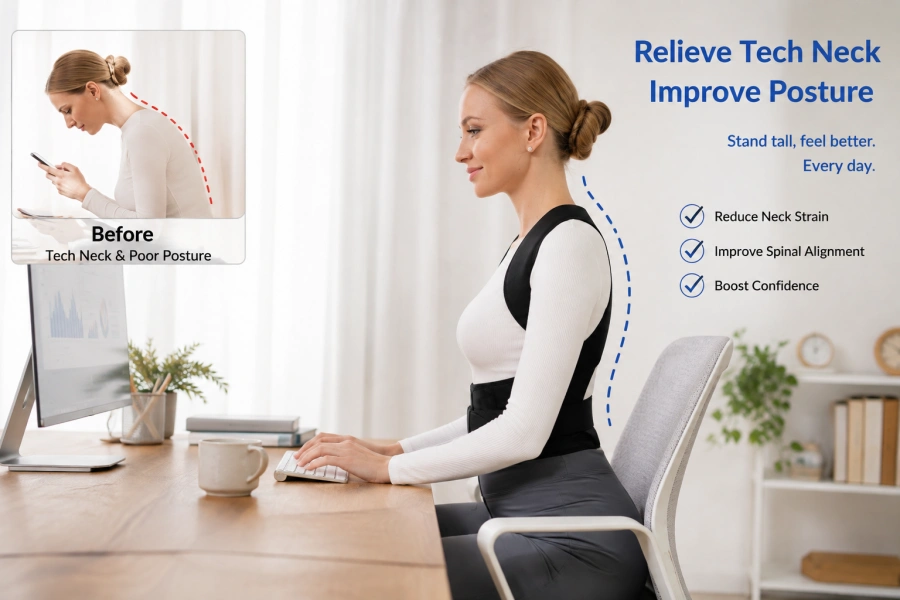
If you’ve spent the last six months squinting at your phone with your chin jutting forward, and now your neck aches by 3 p.m. every day, you’re not imagining it. Forward head posture from hours of scrolling and screen time is a real, measurable strain on your spine, and it doesn’t fix itself.
Before you order the first posture corrector for tech neck online, understand what these devices actually do and what they can’t. This article breaks down the mechanics behind tech neck, what a posture corrector for tech neck realistically fixes, and how to combine one with exercise so you’re not relying on a piece of fabric to undo years of bad habits.
Does a Posture Corrector for Tech Neck Actually Help?
Here’s what the research actually shows. A wearable posture sensor study found 8% lower neck flexion angles and 14% less gravitational load on the neck compared to no device—real, measurable relief while it’s on. That’s the good news for anyone chasing posture corrector effectiveness.
But the data gets murkier when you look at long-term outcomes. A trial with 42 people dealing with forward head posture and neck pain saw improved pain scores and extension range of motion from taping, but no significant difference in overall neck mobility after 48 hours. Another 2026 study of 60 office workers using shoulder posture braces plus stretching found no meaningful change in pain scores or craniovertebral angle—only pain-specific scores improved.
Posture corrector for tech neck works as a short-term cueing tool, not a cure.
What Is Tech Neck? Causes and Symptoms Explained

It’s chronic neck strain from holding your cervical spine bent forward for hours, day after day. Every time you tilt your head down to check a text or hunch toward a laptop screen, you’re asking your neck to hold a position it wasn’t built for.
The numbers explain why this is so common. One study found 42% of people use smartphones more than five hours a day. During that time, most people’s necks bend between 15° and 60°, with the average around 33° to 45°. Texting studies clock average flexion even higher—37° to 47°. That’s a lot of sustained bend on a spine designed for upright posture.
Common Tech Neck Symptoms
Neck pain or stiffness
Headaches, often starting at the base of the skull
Shoulder pain or tightness
Reduced range of motion when turning or tilting your head
Upper back fatigue
Muscle fatigue that worsens as the day goes on
In more advanced cases, tingling or numbness may travel into the arms
Why Ignoring It Backfires
Forward head posture doesn’t just cause soreness. It compounds. Left unaddressed, the repetitive strain has been linked to degenerative changes in the cervical spine over time. If your pain gets worse as the day goes on, or headaches keep starting at the back of your skull, those are signals your body is sending.
How do Posture Correctors for Tech Neck Work?
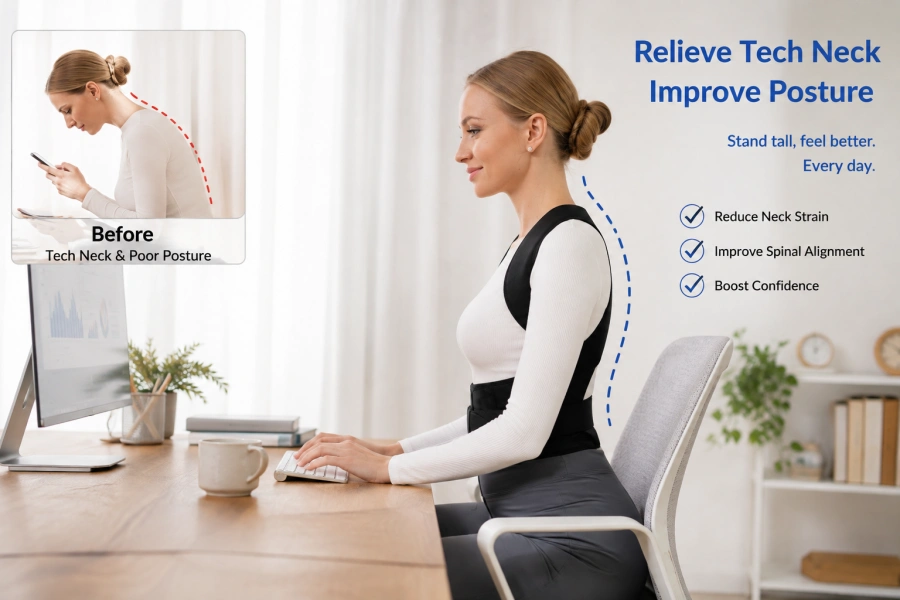
A tech neck posture corrector nudges you physically every time your shoulders roll forward or your chin drops toward your chest. That gentle resistance is the entire mechanism. It is a wearable cue that makes slouching slightly uncomfortable, so you correct it without thinking.
Your neck flexion angle is the real target. Research on smartphone posture found that at 0° neck flexion—basically eyes level, phone held up—people had the lowest gravitational load, the least cervical muscle activity, and the lowest discomfort scores. Compare that to actual phone use: neck flexion averaged around 26° while watching content and jumped to over 30° while typing. That 30°–45° range is exactly where damage accumulates, and it is exactly what a posture brace for neck support is designed to pull you out of.
EMG studies back this up on the muscle level. Corrected sitting posture cut muscle activity in the neck and shoulders compared to forward head posture during computer work. But corrected standing posture demanded more muscle activity in some cases. So a graduated model uses short cueing sessions instead of forcing perfect alignment for eight straight hours. The benchmark to remember is to keep flexion near 0° when possible, and avoid parking your neck at 30°–45° for extended texting or scrolling sessions.
How to Combine a Posture Corrector with Exercise to Fix Tech Neck?
Think of the tech neck posture corrector as your alarm system and exercise as the actual fix. Scapular stabilization training backs this up: one study found it improved craniovertebral angle, reduced upper trapezius and serratus anterior activity, and lowered both NDI (neck disability index) and VAS pain scores. Another trial found that adding scapular stabilization to standard posture correction outperformed correction alone, with better angle improvement, better pain thresholds, and less muscle strain. Systematic reviews rate scapular therapy as moderate-quality evidence for chronic neck pain, including cases involving forward head posture. That’s a stronger, more consistent signal than most standalone brace studies show.
The Micro-Routine (Every 1–2 Hours, While Wearing Your Posture Corrector)
Chin tucks: 10 reps, hold 5 seconds each. Slide your head straight back, not down, to activate deep neck flexors and reset your ear-shoulder alignment.
Scapular squeezes: 10 reps, hold 5 seconds each. Pull shoulder blades down and back without shrugging.
The tech neck posture corrector handles the reminder. These two moves build the muscle control needed to hold the position once you take the posture corrector off.
The Daily Session (10–15 Minutes)
Chin tucks: 2–3 sets of 10–15 reps
Scapular retraction: 2–3 sets of 10–15 reps
Wall angels: 2 sets of 8–12 reps
Thoracic extension against a chair back or foam roller: 1–2 sets, 30–60 seconds
If neck pain is your main complaint, lean harder into scapular stabilization. The data shows it beats posture correction alone for both pain relief and craniovertebral angle improvement.
Order Matters
Let the tech neck posture corrector cue your posture first. Then run chin tucks, followed by scapular retraction or stabilization work, and finish with thoracic or chest stretches. Throughout, keep your chin level, shoulders down, and ribs stacked rather than flared, and resist the urge to shrug. That sequence turns a passive reminder into active correction.
How to Wear a Posture Corrector for Tech Neck Properly?
Start small and build up:
Week 1: 15–30 minutes, or up to 45–60 minutes, during your worst slouch windows (desk work, commuting, studying)
Week 2: 75–90 minutes total, split into two sessions
Week 3: 90–120 minutes daily
Week 4 and beyond: 2–3 hours max, capping at 2–4 hours on high-use days
After 6–8 weeks: taper down by 15–30 minutes weekly as your muscles adapt
Never sleep in it. And whatever time you wear it, rest for roughly the same length afterward—continuous dependence defeats the purpose.
Fit matters more than tightness. Snug, not constricting. You should breathe and move freely. Tighter isn’t more effective; it just raises your risk of skin irritation and reliance on the device instead of your own muscles. Stop immediately if you feel pain, numbness, or breathing discomfort.
Pair it with your environment. Raise your screen to eye level, sit fully back in your chair with feet flat, and stand up every 30 minutes. The brace is a cue—not a substitute for ergonomics.
Are There Side Effects or Risks When Wearing a Posture Corrector for Tech Neck?
Straps and rigid panels press against skin for hours. That friction adds up. Redness, chafing, even blisters show up most often under the armpits, across the shoulder blades, and along belt edges—exactly where cheap braces rub hardest.
Tighter isn’t safer, either. Overcorrection can leave your neck, shoulders, or lower back sorer than before you started. And if a strap compresses nerves or blood vessels near your shoulders, you might feel numbness or tingling down your arms. That’s not normal muscle fatigue—stop and reassess fit immediately if it happens.
Some devices restrict ribcage expansion enough to trigger what researchers call the “straitjacket effect”: shallow breathing, fatigue, even anxiety. If you feel boxed in, loosen it or take it off.
The bigger long-term risk is dependency. Lean on a brace too much, and your core, upper back, and deep spinal stabilizers do less work over time—weakening the exact muscles you’re trying to strengthen. Most guidance caps daily wear well under all-day use for this reason.
Skip it altogether if you have a history of spine injury, or you’re using it instead of actual treatment. And if you sweat heavily or have sensitive skin, breathable materials matter more than you’d think.
Choosing the Right Posture Corrector for Tech Neck
Material matters first. Look for breathable mesh, neoprene-mesh blends, or nylon/polyester/SBR combinations. These balance support with airflow, which is critical if you’re wearing this thing under a shirt for hours at a desk.
Adjustability comes second. Adjustable shoulder straps with hook-and-loop closures let one brace fit different body types. Most brands market “one size fits most” or S–L ranges, which works for a lot of people but not everyone.
Support level should be gentle, not rigid. Tech neck responds better to a light pull-back on the shoulders than a hard, locked-in brace. Look for wide elastic straps, X-shaped or crisscross designs, and S-shaped support bars. These distribute pressure instead of concentrating it.
Comfort is non-negotiable. If it pinches under your arms, rolls at the edges, or slides around by noon, you’ll stop wearing it. Low-profile, discreet designs that stay hidden under clothing tend to get used consistently. That’s the only way any of this works.
Office Work vs. Daily Activity
Desk-bound days call for something thin, breathable, and low-visibility. Active days like commuting, errands, and light workouts need more stability. Look for wider straps, crisscross backs, and better slip resistance.
How AOFIT Fits This Model
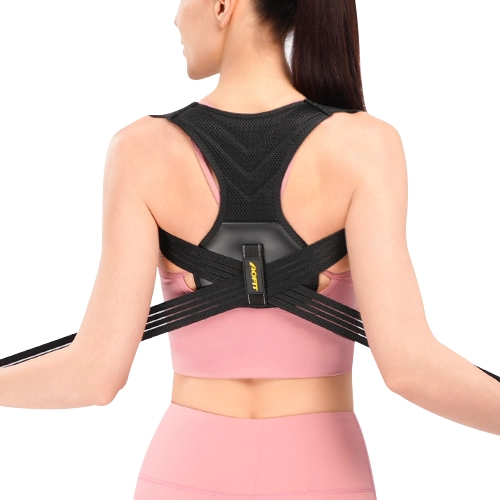
AOFIT’s Figure 8 Posture Corrector leans into “reminder plus light support”: breathable mesh, adjustable X-strap design, universal sizing, and a suggested 1–2 hour daily ramp-up. 3M Tensor and OPTP also use adjustable, breathable, low-profile designs. Core Products goes a different route with strict sizing (XS 26–30 in, S/M 30–41 in, L/XL 41–50 in) for people who need a tighter fit match.
Conclusion
A posture corrector for tech neck won’t magically undo years of screen-hunching overnight, but it’s not snake oil either. Think of it as training wheels for your spine. It interrupts the slouch reflex, retrains muscle memory, and supports your upper back while you build lasting habits. The real fix comes from pairing that gentle reminder with consistent stretching, stronger shoulder muscles, and smarter screen habits — yes, that means occasionally looking at your phone at eye level.
If you’re dealing with persistent tech neck symptoms, start small. Wear a well-fitted tech neck posture corrector for short, focused sessions. Add a few daily mobility exercises. Track how your body responds over a few weeks. Then check out AOFIT’s posture correctors for tech neck relief.