

That nagging ache in your shoulder isn’t just annoying. Your body is telling you it needs support, and the wrong brace can keep you stuck in a cycle of discomfort that never quite resolves. If you’ve been scrolling through options wondering why a neoprene shoulder brace keeps showing up as the go-to pick over bulkier metal-supported designs or basic fabric wraps, you’re onto something. Neoprene earned that spot through function, and there’s real science behind why it’s become the standard for rotator cuff support and injury recovery. We’re covering what makes neoprene different, who gets the most from it, and where it falls short, so you can choose with confidence.
Understanding Neoprene Behind the Neoprene Shoulder Brace

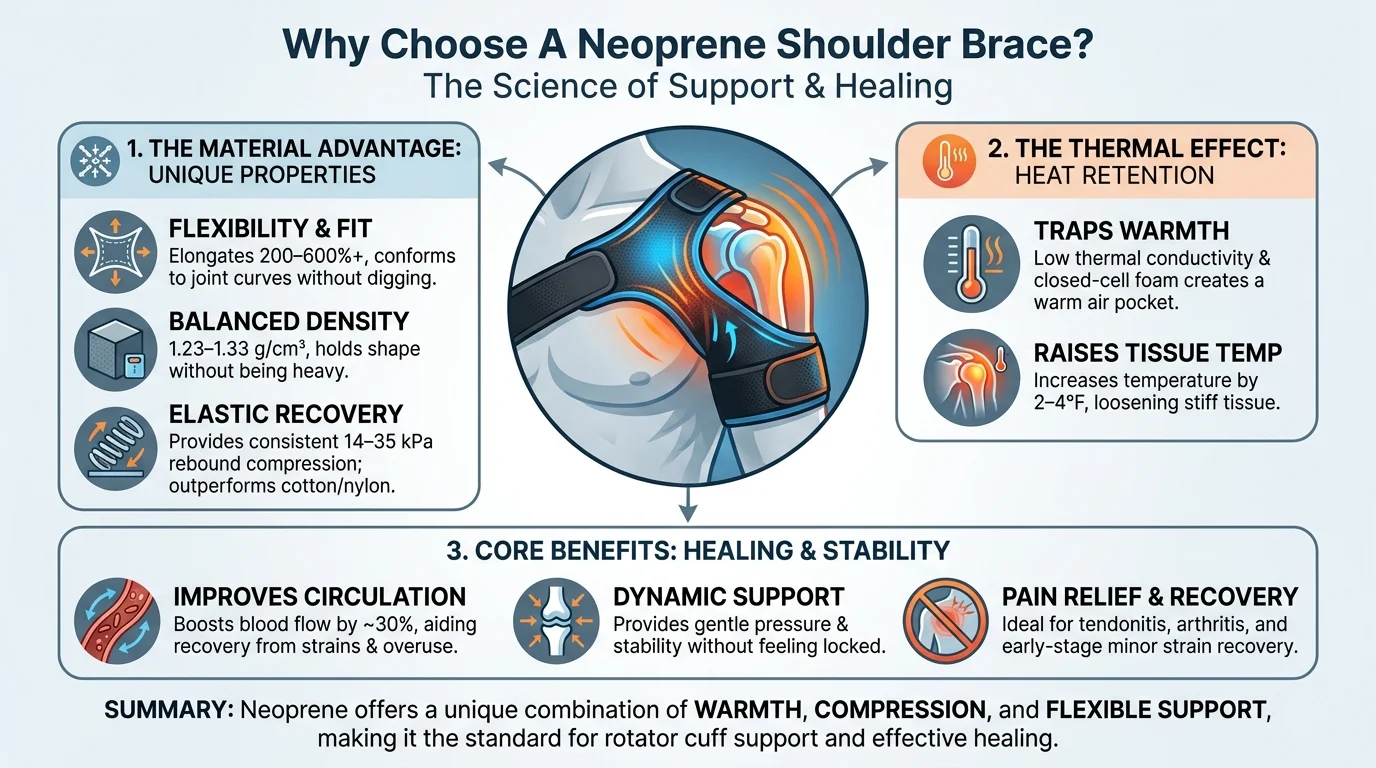
Numbers tell the real story. Neoprene’s density sits around 1.23–1.33 g/cm³ – dense enough to hold its shape against your shoulder but not so heavy it feels like wearing armor. What matters, though, is what happens when you stretch it. The material can elongate 200–600% before it hits its breaking point, and some reinforced blends push past 800%. That flexibility is why a neoprene compression material follows the curve of your shoulder joint instead of digging into one spot.
The Heat Retention Factor
Neoprene’s thermal conductivity is low enough that heat stays trapped near your skin. Add the closed-cell foam structure inside most braces, and you get a pocket of warm, still air working alongside the material. That’s the science behind why a neoprene shoulder support brace feels warm within minutes of putting it on.
Compression That Doesn’t Quit
Compress neoprene by 25%, and it still pushes back with 14–35 kPa of resistance. That rebound creates the “held together” feeling people look for in a good shoulder stability brace. It’s also why neoprene consistently outperforms cotton or nylon-only builds, which lose their elastic recovery after being stretched.
Key Benefits of a Neoprene Shoulder Brace
Three things happen at once when you wear a well-made neoprene shoulder brace: your shoulder warms up, gets gentle pressure, and stays put without feeling locked in place. That combination is rare, and it’s exactly why this material dominates the shoulder pain relief category.
Warmth That Actually Helps You Heal
Neoprene worn against the skin raises tissue temperature by 2–4°F and improves circulation by roughly 30%. That matters for anyone dealing with tendonitis, arthritis flare-ups, or the dull soreness that lingers after overuse. Early-stage recovery from a minor shoulder strain also benefits, since warmth loosens stiff tissue before you even start moving.
Compression Backed by Real Numbers
Most neoprene shoulder braces sit in the 15–25 mmHg compression range. That’s enough pressure to reduce swelling and spread mechanical stress evenly across the joint, without cutting off circulation. This is where shoulder pain relief and swelling control overlap: less fluid buildup means less throbbing and faster recovery between activities.
Stability Without Losing Range of Motion
Soft neoprene shoulder braces fall into the low-to-moderate support category, and that’s a feature. They still deliver proprioceptive feedback—that subtle nudge that stops you from overextending. This makes them a solid fit as a shoulder brace for dislocation risk, plus rotator cuff strain, AC joint irritation, and labrum issues. Users retain roughly 75% to nearly full range of motion while still getting protective support, a stat rigid braces can’t match.
Comfort: Everyday Advantage Over Rigid Shoulder Braces
Neoprene is rated as high-comfort, high-mobility, low-to-moderate support—the opposite profile of rigid designs. That tradeoff matters if you need an adjustable shoulder support for all-day wear or sports. Moisture buildup during intense activity is a known downside, but for daily use, neoprene still wins on wearability as a practical shoulder recovery brace.
Who Needs a Neoprene Shoulder Brace?
-
Rotator cuff strain or tear tops the list. Partial tear, general weakness, or weeks into post-op recovery—neoprene shoulder braces give you rotator cuff support by stabilizing the joint without locking it down.
-
Tendonitis and bursitis respond well too. These are overuse injuries, mild-to-moderate inflammation rather than structural damage. Compression helps relieve pain, reduce swelling, and limit the motions that keep irritating the tissue.
-
Dislocation and AC joint injuries are more conditional. Neoprene works for compression and everyday support once the acute phase is over. For AC/clavicle separations at degree 1, 2, or 3, a physician usually recommends a more rigid orthosis or sling first. Think of neoprene as the follow-up support when instability is severe, not the primary fix.
-
Frozen shoulder and general stiffness benefit from the warmth-plus-compression combo, especially during activity. It won’t replace supervised mobility therapy, but it makes daily stiffness easier to handle.
-
Arthritis and chronic aching shoulders round out the list. A shoulder recovery brace helps here for mild, ongoing discomfort—flare support, activity-related aching, comfort during daily wear.
One thing to keep in mind: neoprene gives supportive compression, not rigid immobilization. If you’re dealing with a fracture, significant dislocation, or severe AC separation, a sling or rigid brace directed by your doctor is the right starting point.
Neoprene vs Other Shoulder Brace Types: Which Should You Choose?
Every shoulder brace material makes a trade-off between motion and protection. Understanding where neoprene lands on that spectrum is the fastest way to pick the right one.
Neoprene vs. Rigid or Metal Shoulder Braces
Rigid braces have one job: restriction. They cut shoulder motion by 60–80%, which is exactly what you want after surgery or with a structural injury that needs to stay still. A shoulder immobilizer or sling-style brace fits that role. Neoprene shoulder sleeves work differently. Motion reduction stays under 15%, so you keep functional movement while still getting support. One study found a neoprene shoulder stabilizer improved joint-reposition sense at 10° from full external rotation. That’s proprioception doing its job in a vulnerable position, something a rigid brace can’t offer.
Neoprene vs. Knit or Elastic Shoulder Sleeves
This comparison comes down to breathability versus structure. Knit and nylon-spandex sleeves wick moisture and breathe better, making them the pick for all-day wear, sleep, or humid climates. Neoprene traps heat instead, which sounds like a downside until you’re managing arthritis stiffness or need firm support during a short, intense training session. Neoprene rates high on stiffness and durability; knit wins on comfort and airflow.
Neoprene vs. Simple Fabric Supports
Fabric supports are light and soft, built for comfort more than mechanics. Neoprene holds its shape and delivers localized compression that fabric can’t match, often 20+ mmHg even without a graduated design. Thickness typically runs 3–7mm with a Shore A hardness of 40–60, which explains the sturdier feel compared to a basic one.
The Fast Decision Grid:
-
Post-surgery or major injury: rigid/metal shoulder brace
-
Sport, acute flare-ups, warmth needed: neoprene shoulder sleeve
-
All-day, breathable, sleep-friendly wear: knit/elastic shoulder sleeve
-
Light comfort only: simple fabric shoulder support
Neoprene sits in the middle-high support zone, more stable and warmer than knit or fabric but not a substitute for true immobilization.
Best Use Cases: Athletes, Post-Surgery Recovery & Chronic Pain Management
Three groups get the most mileage out of a neoprene shoulder brace, and each one uses it a little differently.
Athletes Returning to Training
After a Bankart repair, the first 1–4 weeks are about protecting the repair, not testing it. That means avoiding active external rotation, abduction, and overreaching while the tissue heals. A neoprene shoulder brace fits this window well since it limits risky movement without blocking recovery altogether. Once cleared, athletes typically wear the brace only during high-risk windows—training, lifting, or repetitive overhead work—rather than 24/7.
Post-Surgery Recovery Protocols
Shoulder surgery patients often pair compression with cold therapy: continuous cold use for days 1–3, nighttime-only by days 4–7, and just 2–4 hours post-therapy from day 8 through day 21. Each cold session generally lasts under 15 minutes and is spaced roughly every 2 hours during that first week. A neoprene shoulder brace or shoulder immobilizer often works alongside this schedule, layered under or around cold compression as tissue healing progresses.
Chronic Pain Management
For long-term stiffness or arthritis, heat wins over cold. Deep heating combined with stretching gives better results for pain, daily function, and range of motion compared to surface heat alone. Compression paired with sustained warmth—exactly what neoprene compression material delivers—supports this approach, especially when switched with cold therapy around activity.
What a Neoprene Shoulder Brace Can’t Do?
A neoprene shoulder brace won’t close a rotator cuff tear, repair a labral injury, or mend a torn ligament—the effect is mechanical, not regenerative. Tissue repair still depends on rehab, time, or surgery when that’s what’s needed.
Where Neoprene Falls Short
-
Severe instability: In traumatic anterior instability cases, a rigid shoulder immobilizer reduced joint excursion and humeral head translation more effectively than an elastic, neoprene-style functional brace.
-
High-risk positions: Neoprene reduces abduction and external rotation somewhat, but its elastic build means it can’t restrict motion the way a true motion-limiting brace or immobilizer does.
-
Recurrent dislocation: If you’ve had repeated subluxations, an immobilizer that blocks abduction and external rotation is the safer choice.
Fit Changes Everything
Neoprene depends on skin contact and strap tension to work. Wearing it over bulky clothing, letting the foam pad shift out of position, or choosing a “functional” brace when you need immobilization all weaken its control.
A Realistic Benchmark

A neoprene stabilizer like the Sully brace (around $156.94, neoprene plus elastic straps) is built for relative restriction, not near-immobilization. Use it for pain control and moderate support during activity. For protecting a recent dislocation or preventing recurrence, a hard immobilizer is usually the better category.
How to Choose the Right Neoprene Shoulder Brace?
Adjustability Comes First
Look for multi-point designs with chest, shoulder, and upper-arm straps. Hook-and-loop closures paired with cross-body strapping cover a 28–50 inch chest range, so one adjustable shoulder support can fit most builds without locking you into a rigid size bracket. Skip anything with only one fixed size and no chest chart. Those slip, dig into your armpit, or ride up when you move.
Targeted Compression Beats Uniform Wrapping
The best neoprene shoulder brace for dislocation risk or daily wear won’t just wrap your whole shoulder evenly. It zones compression around the acromion, deltoid, and upper bicep, often through stabilizing pads or built-in compression wraps. That targeted pressure supports movement better than a solid, all-over squeeze.
Get Your Measurements Right
Two numbers matter most: chest circumference and upper arm circumference. Some brands also ask for shoulder width. Rough sizing bands look like this:
-
XS/S: 34–40 inches chest
-
M: 38–42 inches chest
-
L: 42–46 inches chest
-
XL: 45–51 inches chest
Upper arm sizing runs from 9–10.5 inches up to 15–17 inches. If you’re between sizes, prioritize arm circumference and range of motion over chest measurement—too tight limits lifting your arm; too loose means slippage.
Universal Fit Simplifies Everything
Most quality braces are labeled left/right universal, which cuts the risk of ordering the wrong side. If you find a shoulder-specific design, confirm it’s clearly marked, or the strap angles won’t sit correctly.
What to Avoid
Bulky, fully-wrapped designs restrict everyday arm movement, dressing, and driving. Lightweight versions weigh around 90 grams; oversized models bunch at the collar. Skip high-compression products that lack adjustability—concentrated pressure without strap control leads to discomfort during extended wear.
Conclusion
Your shoulder needs support that moves with you. A neoprene shoulder brace provides warmth, compression, and flexibility that let you support your body’s natural healing process—whether you’re managing a rotator cuff injury, recovering from surgery, or staying active without aggravating an old injury.
Not every brace is the same, and not every shoulder injury is either. Match your activity level, injury type, and recovery stage with the right level of shoulder stability brace support.
Visit AOFIT to explore neoprene shoulder braces that help you move confidently again.