
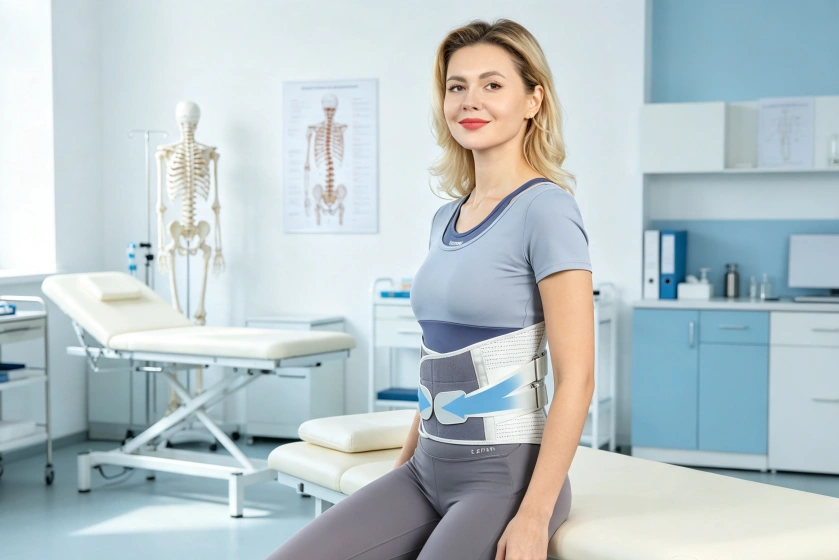
That nagging ache in your lower back follows you into every sleepless night. What you actually need is real, structural support—the kind that comes from a properly fitted, medical-grade back brace designed for your specific condition, whether that’s a herniated disc, sciatica, scoliosis, or spinal stenosis. We’ve spent hours researching, comparing, and narrowing down the best orthopedic back brace options on the market, from rigid clinical-grade models to flexible everyday lumbar support brace picks, so you can find the one that actually fits your life, your body, and your pain.
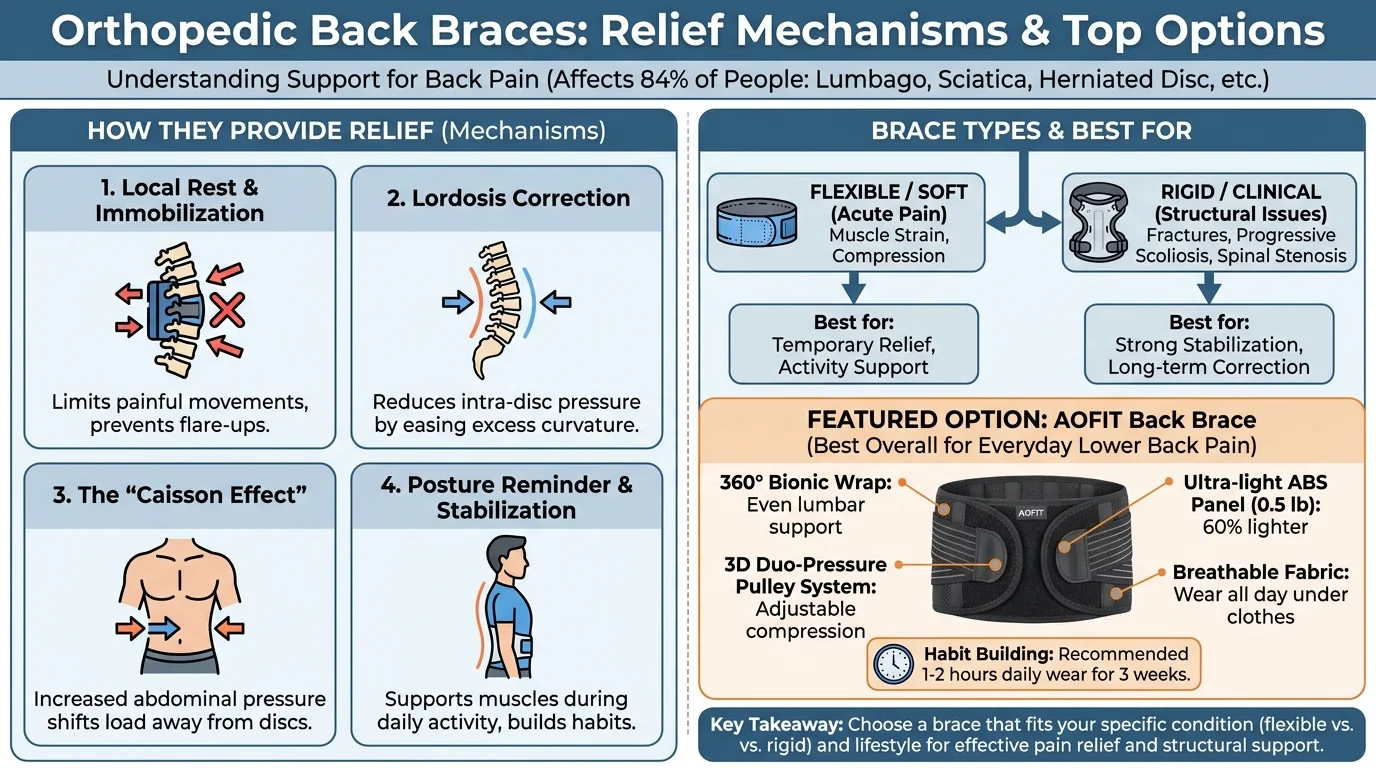
Understanding Back Pain and How Orthopedic Back Braces Provide Relief
84% of people will experience lumbago at some point in their lives. Back pain is basically universal, showing up as lumbago, disc-related pain, sciatica with radiating leg discomfort, muscle strain, or facet joint arthrosis.
An orthopedic back brace helps through several mechanisms:
Local rest and immobilization — limiting the extreme or painful movements that trigger flare-ups
Lordosis correction — reducing intra-disc pressure by easing excess curvature in the lower spine
The “caisson effect” — increased intra-abdominal pressure shifts load away from the lumbar discs
Posture reminder and trunk stabilization — supporting muscles during daily activity
For acute pain, a compression back support belt or soft lumbar support brace is usually enough. For structural issues like recent fractures, progressive scoliosis, or spinal stenosis, a rigid back brace provides the stronger stabilization needed.
AOFIT Back Brace: Best Overall for Everyday Lower Back Pain
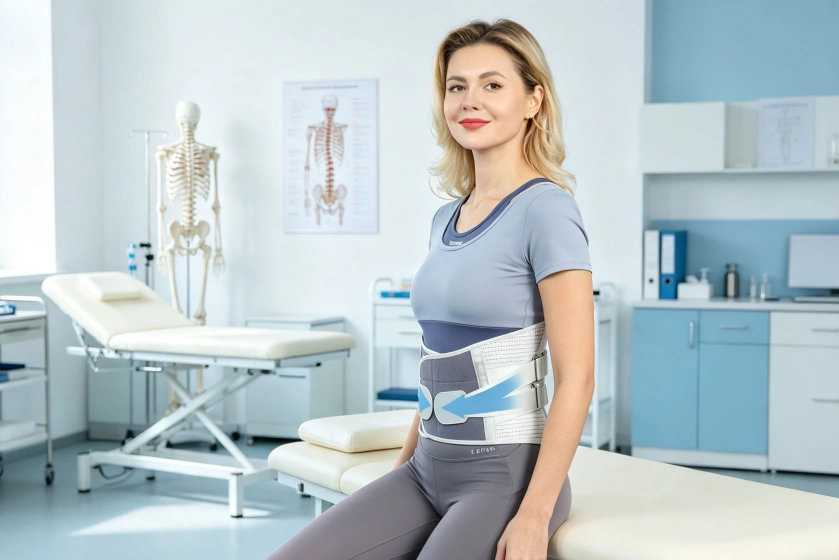
If your back pain is more of a constant low hum than an acute emergency, the AOFIT Back Brace is worth a look. Its 360-degree bionic wrap supports the lumbar spine evenly, and the 3D Duo-Pressure Pulley System lets you crank up compression for a long commute or ease off for an afternoon at your desk. Most rigid designs can’t match that kind of versatility.
Why it works for everyday wear:
– Ultra-light ABS panel — 60% lighter than standard support bars, around 0.5 lb
– Breathable, skin-friendly fabric you can wear all day under clothes
– Brand messaging recommends 3 weeks of 1–2 hours of daily wear to help build better posture habits
Best for: lumbar fatigue, soreness from sitting all day, and general lower back pain relief.
Price: Entry-level, mass-market pricing. Not a premium orthosis, but solid value for a daily-use compression back support belt.
Mueller 255 Heavy Duty Lumbar Support Back Brace: Best Budget Pick
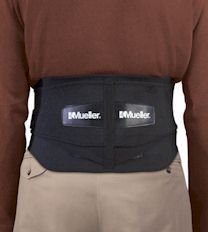
Warehouse crews and weekend movers don’t need bells and whistles. They need something that holds up under real strain without draining the wallet. The Mueller 255 delivers with 4 flexible steel springs, a removable lumbar pad, and an internal molded plastic insert that keeps the brace from rolling or bunching mid-shift.
Key specs:
– Waist fit: 28–50 in (71–127 cm) — one size covers most bodies
– Compression: double-layer design with dual elastic tension straps
– Weight: roughly 453 g, breathable, washable neoprene
Best for: heavy lifting, back strains, sprains, and all-day wear on the job. If you need serious immobilization, look elsewhere. For targeted, adjustable lumbar support at a budget-friendly price, it outperforms basic elastic belts every time.
NEENCA Professional Back Brace: Premium Choice with 8-Strap Bionic Support

The eight independently adjustable straps make the NEENCA back brace feel custom-fitted. Paired with a bionic support system—either two bionic-bone lumbar panels or a combo of memory-aluminum stays and flexible springs, depending on the version—it delivers serious compression through a pulley-style tension design that spreads pressure evenly across your lower back.
What makes it stand out:
Fabric: 72% polyester, 28% latex, with 12–16 hole air mesh and a velvet inner lining for that “baby-skin” feel
Best for: herniated disc, sciatica, lordosis, scoliosis, and chronic lumbar pain
Wear scenarios: lifting, standing, office days, even overnight
Anti-slip design, easy self-installation
Price: $23.98–$79.99 (official), $29.73–$39.46 (Amazon)
FREETOO Back Brace: Runner-Up with 6-Stay Firm Support
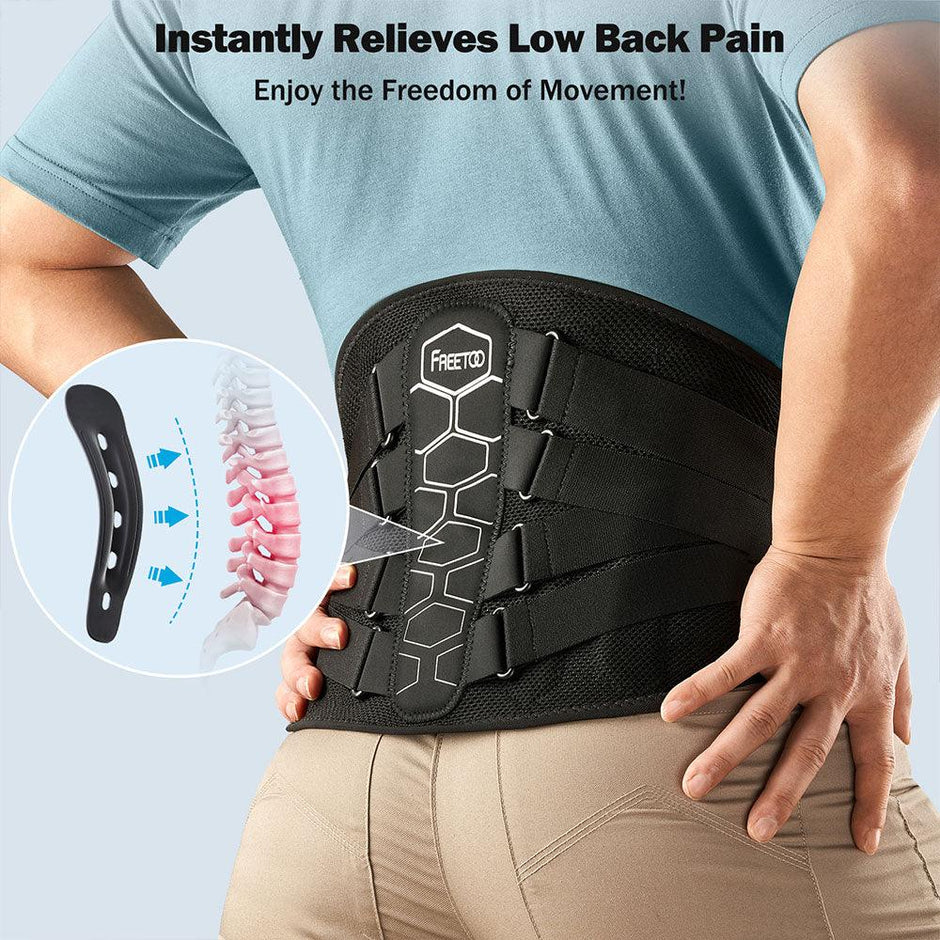
Six support elements, one clear mission: maximum structural stability. FREETOO builds its brace around a bionic bone lumbar panel, four memory-aluminum stays (rated four times stiffer than standard PP strips), and two flexible steel springs along the sides for lateral control. Together they deliver true 360° support—turning pressure from a single point into an even, widespread hold across your lower back.
Best suited for:
– Heavy lifting and physically demanding jobs
– Long stretches of standing, sitting, or housework
– Sciatica, chronic lumbar pain, and posture correction
Comfort meets structure:
– 16-hole mesh plus 3D knit fabric for breathability and cooling
– Dual elastic straps and silicone anti-skid bands stop it from rolling or slipping
Where it stands next to NEENCA: FREETOO’s 6-Stay design consistently ranks at “maximum level lumbar support.” NEENCA sits closer to “moderate.” Choose FREETOO when stability matters more than flexibility.
BraceAbility Work Back Brace: Best for Heavy Lifting and Work
Construction sites, warehouses, bricklaying jobs—this brace was built for the shifts that beat up your back the most. The removable suspenders go on like a backpack, and then dual-pull tension straps let you crank up the compression until it’s snug against your waistline. That combination creates intracavitary pressure, shifting stress away from the spine exactly when you’re bending, hauling, or standing for hours straight.
Reinforced plastic stays and a 9-inch back panel prevent bunching during movement. The latex-free, medical-grade elastic stays comfortable under or over clothing. Sizes run M–4XL, with hip coverage from 24″–64″.
Best for movers, landscapers, nurses, and police officers who need an adjustable back brace that promotes proper lifting form while easing lumbar strains and moderate low back pain.
BAXMAX Back Support: Best Unisex Option for General Support
A 5:1 compound pulley system sets this brace apart from anything else on our list. BAXMAX says it delivers five times the compression of standard elastic braces, and the mechanics back that up. Instead of stretchy material that loosens over time, the shell is a non-elastic, Kevlar-stitched nylon mesh that stays breathable even during long, warm days at work.
Why it earns the unisex label:
Waist-based sizing, not gendered cuts, across five bands: Small 25″–30″, Medium 30″–35″, Large 35″–40″, XL 40″–45″, XXL 45″–50″
A 5″ extension stretches XXL into XXXL (50″–55″) for a broader fit range
Optional anterior stays prevent front rolling, especially useful at XL and XXL sizes
This works best for everyday lumbar support, posture correction, and temporary relief from chronic or acute lower back pain—without the bulk of rigid immobilization. The 5-year warranty adds real durability confidence.
Aspen Evergreen 637 LSO / Aspen Horizon 456 TLSO: Best Medical-Grade Support
Post-surgery patients and clinicians reach for the Aspen Evergreen 637 LSO when soft compression won’t cut it. This lumbar-sacral orthosis uses rigid front, rear, and side panels to restrict flexion, extension, and side bending, not just remind you to sit up straight. A 4:1 mechanical tightening system with two independent drawstrings lets you dial in compression exactly where the pain lives.
Clinical-grade credentials:
– PDAC-approved, coded L0637/L0650
– Fits waists 28–54 in, extending to 64 in
– 12-month warranty backs the mesh-liner construction
Indicated for: lumbar disc herniation, sciatica, spinal stenosis, spondylolisthesis, and post-laminectomy recovery. As Aspen’s own guidance states, only a medical professional can confirm this rigid back brace fits your specific diagnosis, so loop in your doctor first.
SEROLA Sacroiliac Belt: Best for Pregnancy and SI Joint Pain
Pelvic pain follows different rules than lumbar pain, and the Serola belt understands that. Worn low around the hips, not the waist, this 3-inch belt combines a non-elastic layer that works like an external ligament with an elastic layer for compression. Together, they create a stop point at the natural range of motion for the SI joints.
The functional non-elastic loop is 2 inches wide and sits in the notch between the ASIS and trochanter. The small size fits hips 28–33 inches.
Serola stabilizes the pelvis itself, which makes it ideal for SI joint dysfunction, pubic symphysis pain, and pelvic girdle pain during and after pregnancy. Typical pregnancy support belts, including NeoTech Care, lift the belly instead.
Orthopedic Back Brace Comparison Table: Support Level, Use Case & Price
|
Brace |
Support Level |
Best Use Case |
Price |
|---|---|---|---|
|
AOFIT |
Flexible |
Daily wear, mild soreness |
Entry-level |
|
Mueller 255 |
Semi-rigid |
Heavy lifting, budget pick |
$25.99–$32.99 |
|
NEENCA |
Semi-rigid (high) |
Herniated disc, sciatica |
$23.98–$79.99 |
|
FREETOO |
Semi-rigid (max) |
Physically demanding jobs |
$33.99–$34.99 |
|
BraceAbility Work |
Semi-rigid |
Construction, moving |
Mid-range |
|
BAXMAX |
Semi-rigid |
Unisex everyday support |
Mid-range |
|
Aspen Evergreen 637 |
Rigid |
Post-surgical, spinal stenosis |
Medical-grade pricing |
|
Serola SI Belt |
Rigid strap |
SI joint, pregnancy |
Budget-friendly |
Rough guide: flexible braces limit motion 10–30%, semi-rigid 30–50%, rigid up to 70%. OTC options run $20–$150; true medical-grade orthoses can climb toward $200–$800.
Which Orthopedic Back Brace Is Right for You?
Four things decide your pick: where it hurts, how much support you need, how active you are, and why you’re bracing in the first place. Daily fatigue, injury, or post-op recovery all point to different options.
Desk-bound days: the AOFIT or BAXMAX, low-profile and breathable, without weighing you down.
Heavy lifting or warehouse shifts: FREETOO or BraceAbility, built for wide lumbar coverage and anti-migration straps.
Pregnancy or SI joint pain: the Serola belt, which supports without immobilizing.
Post-op, fracture, or spinal stenosis: the Aspen Evergreen 637, rigid and prescribed for real stabilization.
Herniated disc or sciatica flare-ups: NEENCA delivers semi-rigid compression that actually moves with you.
Whatever you choose, treat it as an adjunct. Wear it during the activities that trigger pain, not around the clock.
How to Choose the Best Orthopedic Back Brace?
Match the Orthopedic Back Brace to Your Condition
Flexible or lightweight braces handle daily wear and mild discomfort, like mechanical low back pain or muscle strain. Rigid, stabilizing designs are for more serious conditions or post-surgical recovery.
Sciatica, herniated disc, degenerative disc disease → look for a lumbar or lumbosacral back brace with stronger stabilization
Localized lower back pain → a compression support belt focused on the lumbar zone
Scoliosis → a corrective, contained brace (some cases call for 16–23 hours of daily wear under medical guidance)
Vertebral fractures or high instability → TLSO or Jewett-style rigid brace systems, ideally prescribed by a specialist
A simple rule: flexible is for mild pain, semi-rigid is for moderate pain or extra control, rigid is for instability, post-op, or clinical need.
Get the Fit Right
Measure with a tape: waist, hip, and sometimes torso-to-pelvis height, depending on the design. Market sizing ranges: 60–120 cm waist, 71–123 cm hip, and 33–39 cm height. Stuck between sizes? Go bigger.
Quick fit checklist:
– Measure over a thin shirt at the spot the manufacturer specifies
– Confirm it doesn’t shift when you walk or sit
– Breathe normally—always
– Avoid pressure points at the ribs, abdomen, hips, or armpits
Choose by Scenario
An adjustable brace for office days looks different than one for physical labor. Desk work calls for something light and discreet; heavy lifting needs a lumbar support brace with solid low-back compression. Pregnancy and postpartum support should prioritize breathability and mobility over maximum tightness.
The tell-tale sign of a good orthopedic back brace: firm, breathable, centered support—no marks, no slipping, no “tighter is better” mentality.
Conclusion
The right lumbar support brace understands your body and can be the difference between pushing through pain and moving through your day with confidence again, whether you’re managing a herniated disc, easing sciatic flare-ups, or just need reliable relief after long days on your feet.
Match your orthopedic back brace to your condition. Prioritize adjustable, breathable materials you’ll actually want to wear daily, and don’t underestimate the value of proper compression done right. The best orthopedic back brace is the one that fits your life.