

That dull ache in your wrist after a long day of typing, or the numbness that jolts you awake at 3 AM—it’s your body waving a red flag. So your doctor suggested a wrist splint, and now you’re staring at it, wondering if it does anything besides make your hand look injured.
A wrist splint works through immobilization. That can calm inflamed nerves, protect healing tissue, and take pressure off strained tendons. But it only works if you understand what it’s doing and how to use it right.
We’re breaking down how wrist immobilization works, who needs it, and how to wear one without making things worse.
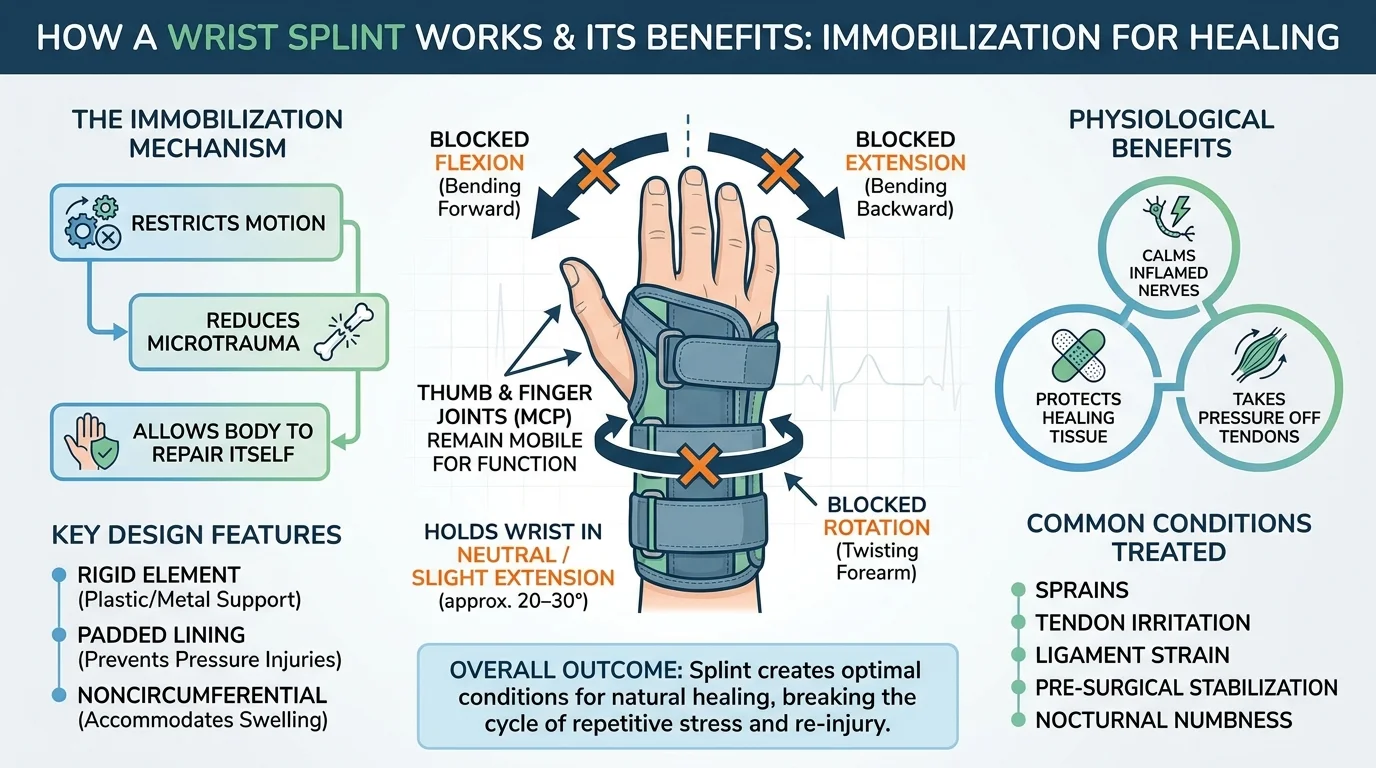
How a Wrist Splint Works: The Immobilization Mechanism
A wrist splint restricts motion so irritated tendons, ligaments, and soft tissue stop absorbing repetitive stress. Less movement means less microtrauma. Less microtrauma means your body gets a chance to heal instead of re-injuring itself every time.
What movement gets blocked:
– Flexion — bending your wrist forward
– Extension — bending it backward (dorsiflexion)
– Rotation — twisting your forearm
Most wrist splints don’t lock your wrist straight. They hold it in a neutral or slightly extended position, typically around 20–30° of extension, with your forearm neutral (palm neither up nor down). This “position of function” keeps your hand usable while taking load off the injured area.
Notice what’s not restricted: your thumb and the joints at the base of your fingers (MCP joints) usually stay mobile. That’s intentional. You can still grip a fork or type a text without loading the injured wrist itself.
The Build: Rigid, Padded, and Purposefully Open
Most wrist splints use a rigid element—plastic or metal—wrapped in padding to prevent pressure injuries while holding position. Unlike a full cast, splints are typically noncircumferential. That gap lets the brace accommodate swelling without cutting off circulation, while still limiting the motion causing your pain.
For fracture-level immobilization, the coverage extends well beyond the wrist itself, often from the palm crease to several centimeters below the elbow, to stabilize the joint above and below the injury.
This mechanism—restricted motion, reduced inflammation, stable positioning—is why wrist splints show up so often in treatment plans for sprains, tendon irritation, ligament strain, and pre-surgical stabilization. The splint is creating the conditions your body needs to repair itself.
Key Benefits: What Wearing a Wrist Splint Can Do for You

The numbers back up what your wrist is telling you. In one clinical study, patients who wore a work-style wrist splint as much as possible for four straight weeks saw wrist pain drop by 32% and grip strength climb by 5%. That’s mechanical load reduction doing its job.
Here’s what a wrist splint delivers, broken down by benefit:
-
Pain reduction. Immobilization cuts the mechanical load on tendons, ligaments, and joint surfaces. Less pulling and grinding means less inflammation, which is the whole point of wrist pain treatment.
-
Nerve decompression. Holding your wrist in a neutral position takes pressure off the median nerve running through your carpal tunnel. This is the core mechanism behind Carpal tunnel syndrome relief: less compression, less tingling, less numbness creeping into your fingers.
-
Better sleep. Your wrist doesn’t stay put while you’re unconscious. It flexes, curls, and presses against the mattress for hours. A night wrist splint blocks that flexion, so you wake up without the pins-and-needles jolt. People who wear one report more restful sleep and noticeably less morning numbness.
-
Post-injury and post-surgical stability. Whether you’re dealing with a sprain, a tendon strain, or recovering from surgery, a wrist stabilizer keeps the joint from shifting while tissue rebuilds. This matters just as much for sprained wrist support as it does for wrist tendonitis brace situations. Both need the same thing: stillness long enough to heal.
Less movement now means more function later, whether that’s grip strength, sleep quality, or straightforward wrist fracture recovery.
When You Should Wear a Wrist Splint: Common Conditions & Use Cases
Not every wrist ache calls for the same fix. The condition you’re dealing with determines when—and how often—you should wear the thing.
-
Carpal Tunnel Syndrome (CTS) tops the list. Your wrist naturally curls while you sleep, squeezing the median nerve and triggering that numb, tingling wake-up call. A night splint blocks that flexion before it starts. Most people with mild-to-moderate CTS wear one nightly for several consecutive weeks until symptoms ease up. If you’re waking up with pins and needles or numbness that’s worse in the morning, that’s your signal.
-
Tendonitis, tenosynovitis, and repetitive strain injuries work differently. You wear the splint during the activity that hurts—typing, gripping, twisting, lifting—not around the clock. For an acute flare, near-continuous wear for 2–4 weeks can help, tapering off as pain settles.
-
Sprains and minor strains call for a different pattern. The first 48–72 hours after injury are when continuous immobilization matters most. After that window, ease off as swelling and pain allow. If you’re looking at a fracture, dislocation, or visible deformity, a splint isn’t enough—that needs professional care.
-
Post-surgical recovery follows whatever timeline your surgeon sets. There’s no universal schedule; when to wear it and when to ditch it is a medical call.
-
Arthritis and joint flare-ups are trickier. Resting splints help with night pain and flare-ups, but wearing one all day can leave joints stiffer, not better. Work-style splints are for daytime use during flare-ups, not overnight, unless a therapist says otherwise.
How Effective Is a Wrist Splint? Setting Realistic Expectations
A wrist splint helps, but it’s not magic. It works best for mild-to-moderate carpal tunnel syndrome and short-term wrist pain treatment, not for severe nerve damage or muscle atrophy.
-
Nighttime splinting for CTS often takes 8 weeks of consistent wear before symptoms noticeably improve. Cochrane reviews found that under 3 months, benefits to hand function are often small.
-
One study found about one-third of CTS patients improve with nighttime splinting alone, no other treatment needed.
-
For chronic wrist pain, splints reduced pain scores with effect sizes of 0.79 and 0.43 in trial comparisons, meaningful but not a cure.
-
Splints with a metacarpal joint component outperformed wrist-only designs, with benefits lasting up to 6 months.
Night numbness, tingling, mild pain, and some grip strength improve. Overall hand function and long-term recurrence risk don’t improve much, especially with less than 3 months of use.
During maximum grip effort, forearm muscle activity increases 7.9–23.9% with a splint on. Splints are built for rest and light tasks, not Heavy Lifting.
How to Wear a Wrist Splint Correctly: Fit, Position & Duration
Fit matters more than the splint itself. A perfectly designed wrist stabilizer does nothing if you strap it on wrong.
Position first. Your wrist should sit in neutral or slightly extended — roughly 10 to 30 degrees. No flexion. No bending backward past that range. The rigid support runs along the palm side of your wrist and forearm.
Placement: the lower edge sits about one centimeter above your palm crease. The upper edge goes to mid-forearm. Strap order varies by brand — some start at the elbow side, others at the wrist side to prevent the splint from sliding down. Check your specific instructions.
The tightness test: fasten it, then slide one finger underneath. You should feel mild resistance. If two or three fingers slip in easily, it’s too loose to do its job. Your fingers should still bend freely at the knuckles, and if there’s a thumb cutout, your thumb should move without restriction.
Circulation check: fingers should stay warm with normal color. No numbness. No tingling. Redness after a short wear means the fit is off — take it off and readjust.
Duration: Start Slow, Build Up
Don’t wear a new splint all day right out of the box. Start with 20 minutes, then inspect your skin. Some guidance suggests 15 minutes twice daily, building to an hour. Others recommend adding 30 minutes per day over a week if there’s no redness.
Once broken in, daytime use often caps at 2 to 4 hours unless a doctor says otherwise. Fractures may require wearing it constantly except during bathing. Soft tissue injuries usually come off at night. Post-injury protocols often use two sessions of up to 3 hours, with at least an hour off between.
When to See a Doctor: Signs a Wrist Splint Isn’t Enough
A wrist splint can help, but it doesn’t replace medical judgment. When certain symptoms appear, you should stop managing on your own and get evaluated.
Call your doctor the same day or go to urgent care if you notice pain that’s getting worse, new numbness, tingling, or weakness in your fingers, fingers turning blue, pale, or noticeably colder than the other hand, swelling that doesn’t ease up with elevation and rest, or the splint suddenly feels too tight, or you can’t move your fingers.
Also see a doctor promptly for persistent pain despite proper splinting, visible deformity after an injury (needs imaging to rule out a fracture or dislocation), drainage, odor, wetness, or a splint that’s cracking or loosening, and fever, especially if it comes with pain or a bad smell.
Each day, do a quick side-by-side check of color, temperature, swelling, movement, and sensation. Any growing difference between your splinted wrist and the other one is your cue to call a clinician.
How to Choose the Right Wrist Splint?
Check the support level first. If you need real wrist immobilization, look for a rigid support, usually a metal bar, running along the palm side. Health guidelines are clear on this: the bar limits wrist motion, but it should never restrict your thumb or fingers.
Match structure to cause. A cock-up or dorsal splint holds your wrist in 10–20° of extension, ideal for carpal tunnel syndrome relief or tendonitis. Fracture-level support needs stronger stabilization without cutting circulation, and different break locations (a boxer’s fracture versus a distal radius injury) call for different builds.
Look at the stay. A volar aluminum stay around 18–22 cm gives you a longer lever to control flexion. If thumb pain is part of the picture, confirm the brace stabilizes the CMC/MCP joint too, while fingers stay free.
Size by two measurements. Measure wrist circumference and the widest part of your palm. Many brands only offer S/M/L; a finer sizing chart usually means a better fit and less bulk or gapping.
Prioritize breathable materials. Neoprene traps heat and can irritate skin during long wear. Lightweight, breathable fabric holds up better for daytime use.
Adjustable straps matter most with swelling. Three to four Velcro straps let you loosen or tighten as inflammation shifts, which is far more practical than a fixed-compression design.
Conclusion
A wrist splint works through mechanics. It keeps your wrist locked in a neutral position, taking pressure off irritated tendons and nerves so your body has the space to actually heal. Less strain, less pain, more recovery.
Whether you’re seeking relief from early carpal tunnel syndrome, nursing a sprain, or bouncing back from surgery, the splint only works if you wear it with the right fit, for the right duration, in the right conditions.
If you’re still not sure which wrist support fits your situation, check out AOFIT‘s wrist splint lineup. Each one is built for a specific use case, from daytime stability to overnight immobilization to post-op recovery, so you’re not stuck adapting your routine to a brace that wasn’t designed for it.