
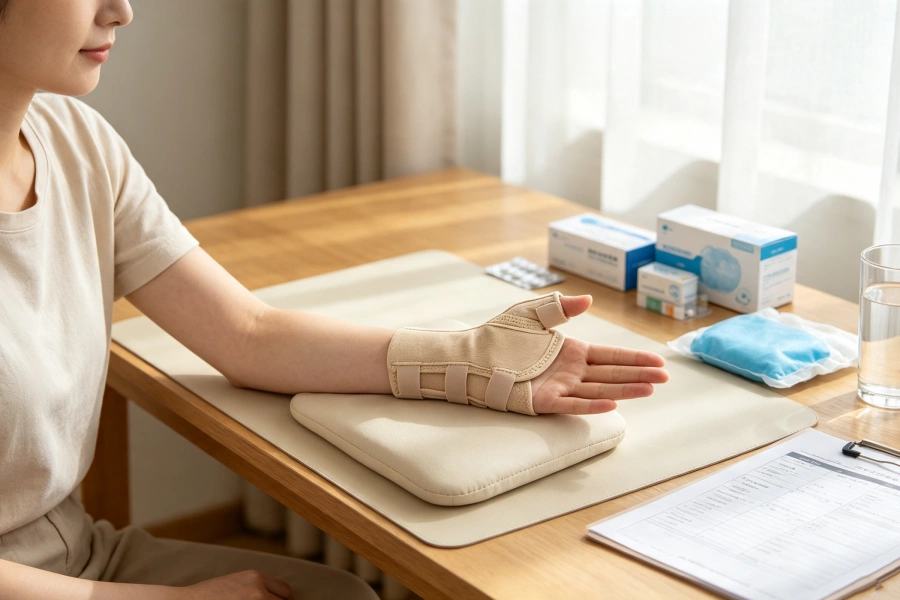
That nagging ache at the base of your thumb is more than annoying. It’s your body telling you that every unguarded twist and grip is slowing your recovery. If you’re managing De Quervain’s tenosynovitis, thumb arthritis, or that telltale carpal tunnel tingle, you’ve probably asked yourself whether a wrist brace with thumb support actually helps, or if it’s just a marketing gimmick wrapped in neoprene.
The healing power is mechanics. A well-designed wrist brace with thumb support reduces tendon friction, improves circulation, and gently corrects the habits that keep re-injuring you. It works with your body’s natural repair process. Below, we break down exactly how it helps and which symptoms benefit most, so you can stop wondering and start healing smarter.
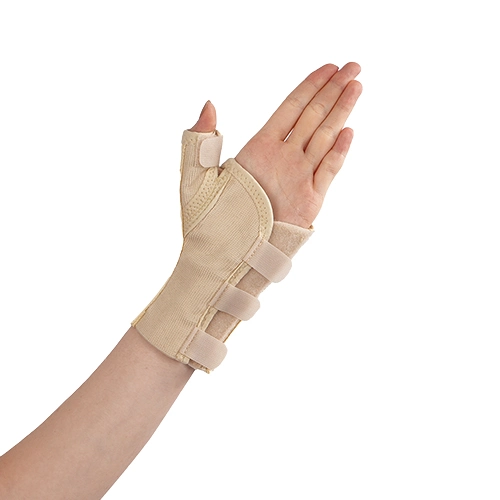
Core Mechanism 1 of Wrist Brace with Thumb Support: Thumb Stabilization
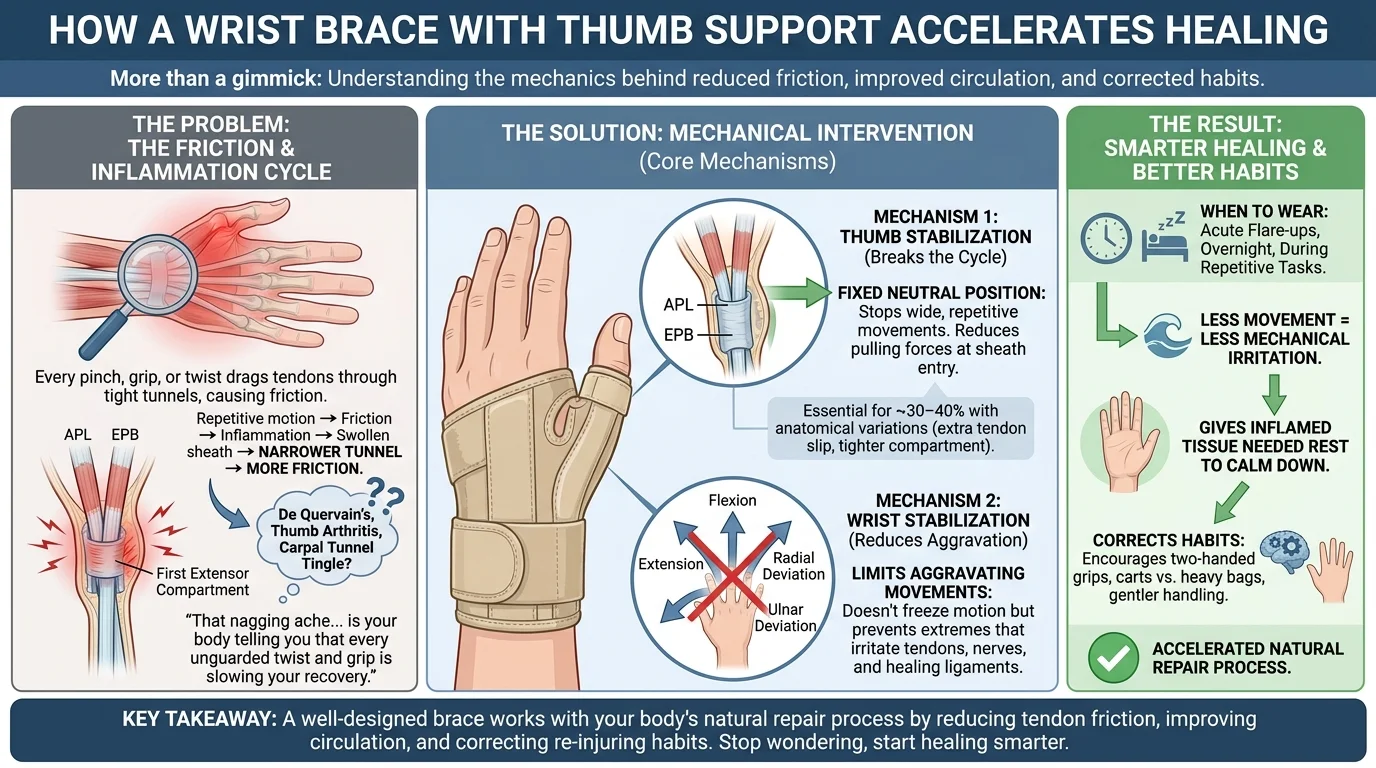
De Quervain’s tenosynovitis starts with a simple mechanical problem. Two tendons — the APL (abductor pollicis longus) and EPB (extensor pollicis brevis) — run through a narrow tunnel called the first extensor compartment, right at the base of your thumb. Every time you pinch, grip, or extend your thumb, those tendons slide back and forth through that tight passage.
Repetitive motion causes friction. Friction triggers inflammation. Inflammation swells the tendon sheath. And a swollen sheath makes the tunnel even narrower, which means more friction next time. That is the cycle a wrist brace with thumb support is designed to break.
Here is how the brace interrupts it. By holding the thumb in a fixed, neutral position, it stops the wide, repetitive movements that drag tendons through the inflamed tunnel. Stabilizing both the thumb and wrist together cuts down the pulling and shifting forces at the tendon sheath’s entry point. And with the thumb immobilized, you naturally shift to two-handed grips, carts instead of heavy bags, and gentler handling patterns.
This matters even more for the roughly 30–40% of patients with anatomical variations — an extra tendon slip or a septum inside the sheath, for example — that make the compartment naturally tighter and more friction-prone. For those individuals, stabilization is essential.
Most clinicians recommend wearing the brace during acute flare-ups, overnight, and during repetitive tasks — exactly when friction risk peaks. Less movement means less mechanical irritation, and that gives the inflamed tissue the rest it needs to calm down.
Core Mechanism 2 of Wrist Brace with Thumb Support: Wrist Stabilization
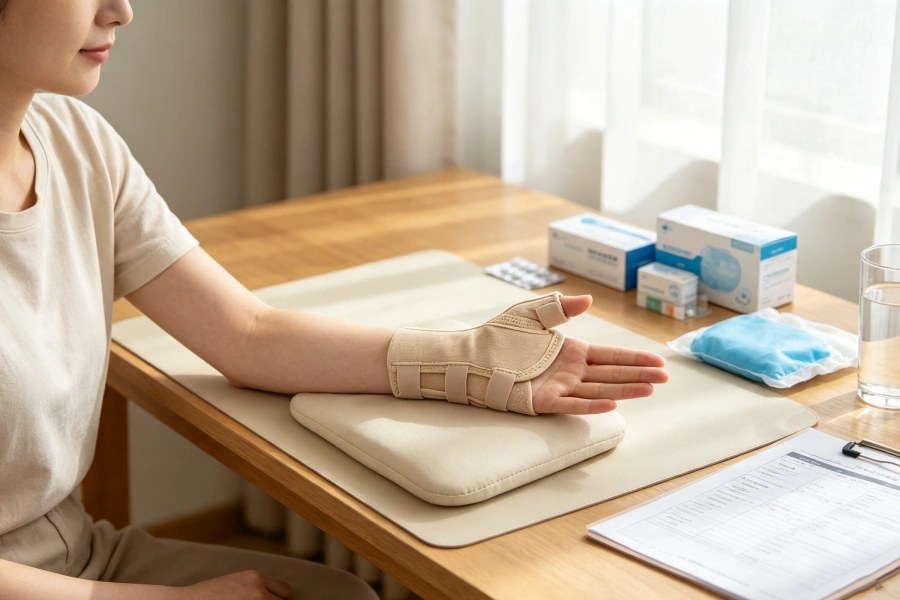
Your wrist moves in four directions: flexion, extension, radial deviation, and ulnar deviation. Every one of these movements can aggravate an injured tendon, an inflamed nerve, or a healing ligament. A wrist brace with thumb support does not freeze your hand. It keeps your wrist locked in a neutral position, or close to it, so those four movements stay controlled.
Why neutral position matters so much
Think of neutral as your wrist’s “safe zone.” The internal splint or rigid support bar in a quality adjustable wrist brace works like a guardrail, physically limiting how far your wrist can bend forward, backward, or tilt sideways. Clinicians use the same principle when evaluating joint restriction. They measure flexion/extension and radial/ulnar deviation together because controlling the angle is the whole point of stabilization.
Immobilization is protective
By limiting excessive movement, the brace reduces repeated stress on healing tissues and creates a more stable environment for recovery.
For anyone dealing with a sprained wrist brace situation or lingering wrist support for tendonitis, this matters. Every time the joint bends or twists without support, ligaments and tendons get stretched again, resetting the micro-damage cycle. Immobilization interrupts that cycle, giving torn or irritated fibers a genuine window to repair without repeated strain.
Carpal tunnel is a special case
This is also where a proper carpal tunnel wrist brace differs from a basic elastic wrist compression sleeve. A compression sleeve offers general support and warmth — helpful, but limited. A true carpal tunnel brace is engineered to hold the wrist in neutral, because wrist posture affects pressure inside the carpal tunnel. Bend the wrist forward or backward, and pressure on the median nerve increases. Keep it neutral, and pressure drops. This is basic anatomy. It’s why neutral-position bracing is considered a first-line conservative approach for nerve-related wrist pain.
Core Mechanism 3 of Wrist Brace with Thumb Support: Compression & Circulation
Light compression shrinks vein diameter. Gentle compression helps control swelling by limiting fluid accumulation around irritated tissues. Better microcirculation clears out fluid and metabolic waste faster. Less fluid buildup means less swelling and quicker recovery.
This matters most for soft-tissue swelling — mild sprains, post-training inflammation, or the puffiness after hours of typing. Gentle compression helps limit swelling and provides a more comfortable recovery experience after repetitive strain or minor injuries. That’s legitimate medical support.
Tissue healing depends on oxygen, nutrients, and immune cells reaching the injury site. Improved circulation delivers those resources faster. Meanwhile, inflammatory byproducts and lactic acid flush out sooner, so swelling goes down, and repair starts earlier.
Core Mechanism 4 of Wrist Brace with Thumb Support: Activity Control
Pain doesn’t stop most people from using their hands. Habit does the damage instead. You’ve probably typed, gripped, or lifted through discomfort without even registering it, and that’s the problem a wrist brace with thumb support is built to interrupt.
Wearing a brace also reminds users to avoid repetitive movements that may delay recovery. By limiting unnecessary motion, it helps reduce repeated stress on healing tissues. A thumb immobilizer brace works the same way by providing a constant visible cue that disrupts the autopilot loop between pain and repetitive motion.
Where push-through-pain happens most: The most common situations are typing or mouse work, household chores, and workouts. In each case, the brace doesn’t stop movement entirely. It limits dangerous angles and reminds your body to slow down. For a de Quervain’s tenosynovitis brace or thumb CMC joint brace, that small pause is often what separates steady healing from a stalled recovery cycle.
Matching Mechanism to Symptoms: How Different Conditions Benefit
Not every hand injury needs the same fix. De Quervain’s tenosynovitis heals differently from a sprained wrist or post-surgery joint protection. Matching the right brace to the right pathology speeds recovery.
-
De Quervain’s tenosynovitis is tendon friction inside the first dorsal compartment. Every time you abduct or extend your thumb, the APL and EPB tendons rub against an already inflamed sheath. A de Quervain’s tenosynovitis brace locks down thumb abduction and opposition, cutting friction at its source. If pain flares with Finkelstein-type movements or gripping, this combined thumb-and-wrist fixation matters more than wrist support alone.
-
Thumb CMC joint arthritis is different. The base joint carries too much load and tends toward subluxation. A thumb CMC joint brace stabilizes the first metacarpal base at a safe angle, protecting against shear stress when you pinch, twist jar lids, or turn keys. Weak grip and pain at the root of the thumb are the telltale signs that this mechanism applies.
-
Wrist sprains and tendonitis involve microdamage and inflammation that worsens with repeated activity. Wrist support for tendonitis immobilizes and compresses to reduce tendon pulling. It helps most when swelling comes with pain after movement.
-
Post-surgical or post-injury cases need bridging support — not full immobilization, not premature loading. Braces protect healing tissue while allowing staged, doctor-guided reintroduction of movement.
Quick-Match Rule
-
Thumb-side pain triggered by movement → De Quervain’s combo fixation
-
Base-of-thumb pain during pinching → CMC-focused brace
-
Wrist pain worsening with activity → compression + immobilization
-
Post-op recovery → transitional bridging support
Three parameters decide fit: immobilization range (wrist only vs. thumb/CMC/compartment), restricted direction (abduction, pinch force, or flexion-extension), and recovery stage (acute pain control vs. gradual activity release).
How Structural Design Serves the Goal of “Faster Healing”?
Four physical components decide whether a wrist support with thumb shortens recovery time or sits on your wrist looking supportive: thumb loop, wrist shell, rigid support panel, and compression strap. Each does a specific mechanical job, and healing speed depends on how well they work together.
The Four Structural Components
-
Thumb loop: Locks the thumb into position, blocking abduction, rotation, and side-pulling. For De Quervain’s, this is the single most important piece: it’s the “thumb support” that protects the inflamed tendon sheath.
-
Wrist shell: Spreads stabilizing force across a wider surface area instead of concentrating stress on one injured spot.
-
Rigid support panel: Provides bending resistance so the joint can’t over-flex or over-extend during daily tasks.
-
Compression strap: Creates pretension against the skin, preventing slippage that would otherwise re-injure tissue mid-motion.
Rigidity vs. Conformity: A Delicate Balance
Too little stiffness, and the brace fails to block rotation. Tissue keeps getting re-stressed. Too much stiffness, and contact pressure rises against skin and soft tissue, choking off local blood supply. The ideal design balances stability, comfort, and anatomical conformity. The winning formula for any wrist support with thumb is rigid support plus adjustable compression plus anatomical conformity: stable enough to protect, flexible enough to heal.
What to Check Before You Buy
-
Press the support panel: it shouldn’t visibly collapse near the thumb base or wrist dorsum
-
Straps should adjust at multiple points, so nothing rotates or slides during use
-
Look for designs that restrict dangerous motion (thumb abduction, wrist hyperextension) while still permitting doctor-approved light movement
-
Wider contact surfaces beat narrow, high-pressure points: comfort and circulation both improve
An adjustable wrist brace built this way lets you tighten it early for more control and loosen it later as you heal, matching your recovery stage to accelerate healing.
How You Wear It Changes Everything
More hours in the wrist support with thumb doesn’t mean faster healing. Wearing a wrist brace too tightly or for longer than necessary may cause discomfort. The goal is controlled support, not complete dependence on immobilization. The lesson for your wrist brace with thumb support is to start short and extend gradually.
Begin with brief wearing periods and watch for pain, numbness, dizziness, or skin indentation. If nothing flares up, extend duration day by day. Pair wearing time with doctor-approved active movement. Adjust the brace first if problems appear, and don’t push through discomfort.
Fit matters as much as duration. Too tight, and you’ll notice deep skin marks, tingling, or a throbbing ache. Those signs mean circulation and soft tissue are being compressed. Too loose, and the adjustable wrist brace slides during movement, leaving your thumb or wrist unstabilized when it needs support most. The target is a secure fit.
-
For office work, keep the brace stable but not compressive and shift position periodically to avoid sustained pressure.
-
For household chores, lifting and twisting shift load on the brace, so anti-slip fit matters more than extra tightness.
-
For gardening, sweat and friction increase, so check edges for skin wear regularly.
-
For sleep, prolonged nighttime pressure is a real risk; prioritize comfort and skin integrity.
How to Choose a Wrist Brace with Thumb Support That Matches Your Symptoms?
Match the brace to the pain location first
If pain sits at the thumb base or radial wrist, worse when lifting a baby or wringing a towel, you need a wrist support with thumb that locks the thumb root and wrist together. A wrist-only sleeve won’t reach the CMC joint or tendon sheath causing the trouble.
Four-step structural check before buying
-
Look for a thumb loop with a rigid bar extending from the wrist to the thumb base, not just stretchy fabric.
-
Confirm coverage includes both the first metacarpal base and the wrist joint.
-
Test movement: make a fist, twist a bottle cap, lift something heavy. If the thumb still swings freely or the brace rotates, support is insufficient.
-
Check pain response: if the tender spot at the thumb base still hurts under the brace, the support panel is misplaced.
Fit beats stiffness
Too loose slips and stops protecting. Too tight cuts circulation. Check skin after wearing: no red marks, no indentation. Walk, grip, and bend; nothing should shift, roll, or bunch.
Choose rigidity by severity
-
Mild discomfort → soft, elastic wrap
-
Diagnosed De Quervain’s or moderate tendonitis → adjustable wrist brace with rigid strips and straps
-
Post-surgical or ligament tears → semi-rigid or hinged design, ideally doctor-confirmed
Breathable material matters too. A brace nobody wears consistently because it traps sweat won’t heal anything.
Conclusion
Healing means giving your tendons and joints the stillness they need to repair themselves. A wrist brace with thumb support locks down unnecessary movement, eases inflammation through gentle compression, and reminds you to stop overusing an injured joint. That creates the conditions your body needs to recover faster.
Whether you have De Quervain’s, CMC joint strain, or lingering tendonitis, the wrist support with thumb is an active part of your recovery plan.
Match your symptoms to the right support, wear it the way your body needs, and give recovery a real chance.
Ready to stop the cycle of pain and re-injury? Explore AOFIT and find the brace built for your exact recovery journey.