
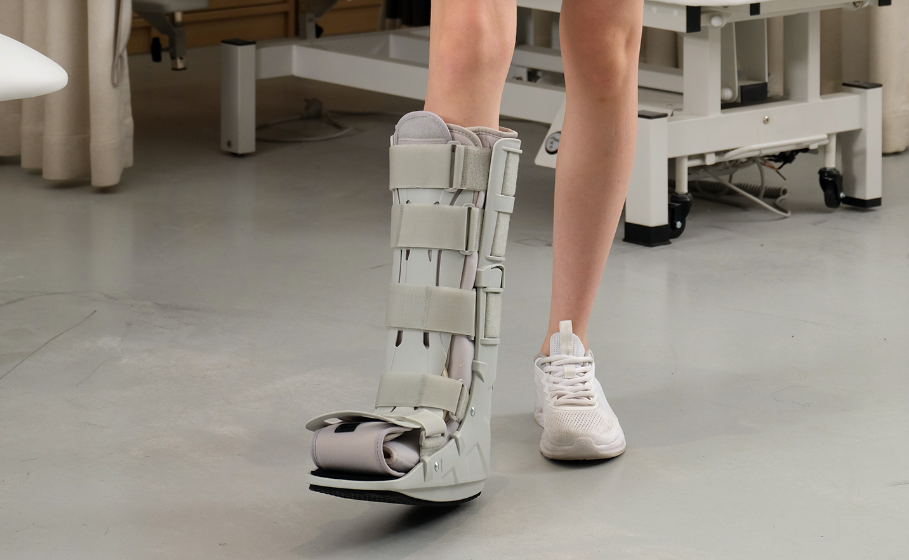
You rolled your ankle three days ago, and now you’re staring at the walking boot your doctor handed you. Is this a two-week inconvenience or a six-week sentence? The answer depends on your ankle sprain grade, and that distinction changes your recovery timeline. A Grade 1 sprain might have you ditching the boot in days, while a Grade 3 ligament tear could keep you in it well past the six-week mark. We’re breaking down what to expect at each stage, the specific signs that tell you it’s safe to transition out of the walking boot, and how the RICE method fits into your healing window. You’ll get clear, grade-by-grade guidance so you know where you stand and what comes next.
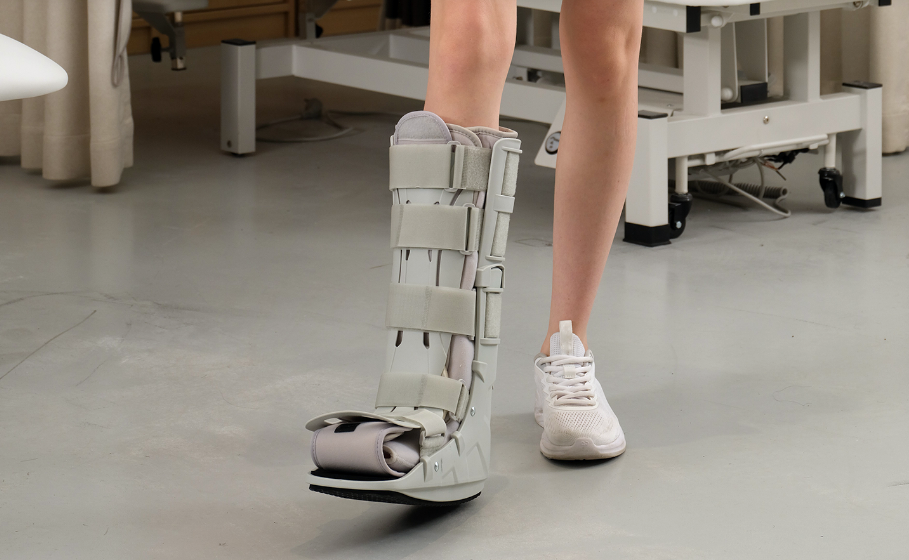
Quick Answer: Walking Boot Duration by Ankle Sprain Grade
Most people wear a walking boot for 2 to 6 weeks. Where you land on that spectrum comes down to your ankle sprain grade. Doctors classify sprains into three tiers based on ligament damage, and each one carries its own realistic timeline.
|
Ankle Sprain Grade |
Typical Boot Duration |
What’s Happening |
|---|---|---|
|
Grade 1 (mild) |
Usually no boot, or 1–2 weeks |
Micro-tears, minimal instability |
|
Grade 2 (moderate) |
3–6 weeks |
Partial tear, noticeable swelling |
|
Grade 3 (severe) |
4–6+ weeks |
Complete tear, significant instability |
People with Grade 1 sprains often skip the boot and use a supportive brace instead. Grade 2 is the classic CAM walker boot scenario. Grade 3 demands patience and often protected weight-bearing before you ease into a brace.
Grade 1 Mild Ankle Sprain: Do You Even Need a Walking Boot?
A Grade 1 sprain probably doesn’t need a walking boot at all. This is the mildest of the three ankle sprain grades, involving only slight stretching or microscopic tearing of the ligament. Swelling stays minor, pain is manageable, and your ankle still feels stable. No wobbling, no giving way, no sharp instability when you shift weight onto it.
Because the ligament damage is minimal, guideline-based care favors functional support over immobilization. Clinics that specialize in foot and ankle injuries reserve walking boots for more serious situations: complete ruptures, high ankle sprains, avulsion fractures, or when someone genuinely can’t bear weight 24 hours post-injury.

For Grade 1, a lace-up ankle brace or stirrup-style brace typically does the job better than a bulky boot. Something like an Aircast Air-Stirrup or a lace-up model gives you side-to-side stability while still letting you walk normally. Combine that with the RICE method for the first few days, and most people see mobility return within a week.
If pain does limit walking early on, short-term immobilization — no more than 10 days — can bridge the gap before transitioning to brace support.
Grade 2 Moderate Ankle Sprain: 1-4 Weeks Walking Boot Guide
Somewhere between “walk it off” and “surgery consult” sits Grade 2 — the sprain that earns you that walking boot by your front door. This is a partial ligament tear, and the timeline reflects that middle ground: 1 to 4 weeks is most common, though some cases stretch to 2–6 weeks depending on how your body responds. Clinical guidelines put the protection window between 2–4 weeks and 3–6 weeks; slower swelling reduction and weight-bearing recovery push you toward the longer end.
Why the Range Is So Wide
Two things drive the variation: how fast your ankle sprain swelling goes down, and how quickly you regain confident weight-bearing. Most guidance splits recovery into two phases:
-
Weeks 0–2: Wear the boot for walking, guided by pain and comfort. A CAM walker boot with crutches (as needed) is the standard pairing — crutches offload weight when limping is obvious, though not everyone needs them. You can remove the boot at night and during rest.
-
Weeks 3–6: Start weaning off the boot and crutches. The goal is unassisted walking indoors first, then outdoors, as the ankle ligament heals.
When to Start Moving Again
You don’t need to wait weeks to move your ankle. Ankle mobility exercises after the boot often start much earlier than people expect — many rehab protocols say stage 1 exercises can begin right away, during the acute phase, as long as they don’t spike your pain. More advanced movement gets added around the 2-week mark, often alongside a referral to physical therapy.
Some clinicians take a more conservative stance, keeping Grade 2 patients in the walking boot for the full 3–6 weeks before switching to a brace. Either way, the RICE method supports you throughout — it doesn’t stop just because the boot is off.
Grade 3 Severe Ankle Sprain: 4-6 Weeks or Longer

A complete ligament tear doesn’t play by the same rules as a sprain that heals in two weeks. Grade 3 means the ATFL, and often the CFL too, has torn all the way through — sometimes the PTFL joins in. The swelling is dramatic, putting weight on it feels impossible, and that ankle just doesn’t want to hold you up anymore.
The standard timeline here is 4 to 6 weeks in a walking boot, with protected weight-bearing the whole time. That’s the baseline. But standard and guaranteed aren’t the same thing — plenty of Grade 3 cases run 6 to 8 weeks or longer, especially when there’s real instability, when the ligament damage is extensive, or when a fracture is hiding underneath the sprain.
Why Some Cases Take Longer
If a doctor suspects a fracture or avulsion injury alongside the ligament tear, that changes everything. An occult fracture, one that doesn’t show up right away, can extend your boot time well past six weeks. Broader soft-tissue damage plays a role too; your ankle isn’t ready to handle early boot removal or aggressive rehab if the tissue underneath is still compromised.
This is where imaging earns its keep. If you couldn’t take four steps right after the injury (and still can’t), or there’s tenderness right over the bone, you should get an X-ray before anyone assumes “just a sprain.” MRI isn’t routine for every Grade 3 case, but if pain lingers past 6-8 weeks, or you’re dealing with deep joint pain or persistent swelling, it’s worth asking about. It can catch things like an osteochondral lesion or peroneal tendon injury that a standard X-ray misses.
The Bigger Picture: Boot Time Isn’t Recovery Time
Getting out of the boot doesn’t mean you’re done. Full functional recovery for a severe sprain typically lands around 8 to 12 weeks, and if you’re hoping to get back to sport, plan for 3 to 6 months. Follow your clinician’s specific plan on weight-bearing progression and the transition into a brace.
When Walking Boot Duration May Extend Beyond 6 Weeks?
Not every ankle injury fits into the Grade 1-3 boxes we just covered. Some sprains take longer, and knowing why helps you set realistic expectations instead of panicking when week six rolls around and you’re still in the boot.
High Ankle Sprains Change the Timeline
If your injury happened from a twisting or outward-rolling motion, and the pain sits higher up — near the shin, above the usual outer-ankle spot — you might be dealing with a syndesmotic (high ankle) sprain rather than a typical lateral one. These take longer because the tissue involved (the ligaments connecting your two lower leg bones) heals more slowly than standard ankle ligaments. Clinical data points to 6–8 weeks for normal activity, sometimes longer, with an average healing window around 45–55 days. Unstable or fully torn syndesmotic injuries can stretch recovery to 3–6 months.
Fracture Concerns Extend Boot Time
When there’s any suspicion of a hidden fracture, doctors lean toward keeping you in the boot until imaging clears things up. Watch for these signals:
-
You still can’t bear weight 24 hours after injury
-
Pain feels concentrated over bone, not soft tissue
-
Swelling and bruising haven’t improved
-
X-rays haven’t ruled out an occult or avulsion fracture
Fracture-related cases commonly land in the 6–8 week range, sometimes with stricter non-weight-bearing protocols.
5 Signs You’re Ready to Stop Wearing the Walking Boot
1. Pain stays manageable during daily movement. You can walk in the boot without discomfort spiking, and everyday activity doesn’t set it off.
2. Weight bearing after ankle sprain feels stable. Your gait inside the boot looks close to normal, and you’re putting more weight on the ankle rather than favoring it.
3. Swelling has gone down. Check morning versus evening, and if the gap has narrowed and your boot no longer feels tight after activity, that’s a real sign of ankle sprain swelling reduction.
4. Range of motion is returning. Gentle ankle pumps, dorsiflexion, and plantarflexion shouldn’t provoke sharp pain, and symptoms shouldn’t rebound the next day. This is also when ankle mobility exercises after the boot start making sense.
5. A clinician has confirmed it. This one matters most. Clinical exams or imaging, paired with physician sign-off, should guide the decision, not just how you feel that morning.
A Simple Test Before You Ditch the Walking Boot
Try short, supervised walks at home without the boot, wearing a supportive shoe or brace instead. If you stay steady and pain doesn’t climb within a few minutes, extend the time gradually. If you feel wobbly or sore fast, you’re not there yet.
Ligaments can still be repairing even when discomfort fades, so jumping out of an ankle immobilization boot too soon raises your risk of re-injury. A safer progression is steady weight-bearing in the boot, then brief boot-free walks indoors, then a transition brace, then normal activity, often guided by physical therapy for ankle sprain recovery along the way.
How to Safely Transition: Walking Boot → Ankle Brace → Normal Shoes
Tissue that’s spent weeks immobilized needs a middle step, and an ankle brace provides it. The standard progression is walking boot → ankle brace → normal shoes. Each phase gives your ankle time to re-adapt to load before you remove support entirely.
A Realistic Wean Schedule
Most rehab protocols wean you out of the boot over about 2 weeks, once you’re tolerating full weight-bearing without pain. A common breakdown looks like this:
-
Days 1–3: 1 hour boot-free in the morning, 1 hour in the afternoon
-
Days 4–7: 2 hours + 2 hours
-
Days 8–11: 3 hours + 3 hours
-
Days 12–15: 4 hours + 4 hours
-
Day 16: boot off completely
From there, switch to a lace-up ankle brace (ASO-style braces show up often in clinical protocols) while returning to shoes. For a Grade 3 sprain, expect to stay in that brace anywhere from 3 weeks to 6 months, depending on stability. A simpler benchmark for uncomplicated cases is roughly 2 weeks of boot weaning plus 3 weeks in a brace before going support-free.
Choosing Your First Shoes
Skip sandals and flip-flops. Start with supportive athletic shoes or hiking boots, indoors first, then short outdoor walks of 10 to 15 minutes, adding 10 minutes daily if pain-free. If pain climbs for two days or more, slow down and stay at your current stage longer.
Warning Signs: When to See a Doctor Immediately?
Some symptoms don’t fit the normal healing timeline and need same-day attention. In orthopedic practice, inability to bear weight, visible deformity, and numbness are signals to rule out fracture, dislocation, or nerve involvement fast.
Get evaluated immediately if you notice:
-
Complete inability to bear weight or take steps
-
Visible deformity, an oddly angled joint, or noticeable shortening
-
Swelling or bruising that worsens dramatically within minutes
-
Numbness, tingling, or persistent weakness in the foot
-
The ankle feels like it’s “giving way” repeatedly
-
Skin that turns cold, pale, or discolored
-
Pain that feels disproportionately severe compared to the visible injury
Pain escalating faster than swelling can indicate compartment syndrome, a rare but serious emergency. Deformity paired with inability to bear weight usually points to fracture or dislocation. If you’re also experiencing bowel/bladder changes or groin numbness, treat it as an emergency and seek care right away.
Conclusion
Listen to your body while giving it the right support at the right time. Reduced swelling, pain-free weight bearing, and restored mobility are the real markers of progress, whether you’re dealing with a Grade 1 sprain that clears up in days or a Grade 3 injury requiring six weeks (or more) in a walking boot. Don’t skip the transition phase. Moving too quickly from boot to bare feet is one of the most common reasons sprains become chronic instability issues.
If you’re in a boot and eyeing the finish line, trust the signs your body is giving you, but confirm with your doctor before ditching support altogether. When you’re ready for that next step down, a quality ankle brace can bridge the gap. Browse our orthopedic support collection to find the right fit for your recovery journey.