

That “pop” you heard when you rolled your ankle was your body telling you exactly what happened. Now you’re standing in the pharmacy aisle staring at a wall of straps, sleeves, and rigid contraptions, facing a second problem. Which ankle brace for sprain actually matches your injury?
A Grade 1 sprain and a Grade 3 sprain need completely different levels of support. Grab the wrong one, and you’re either restricting healing unnecessarily or leaving your ankle exposed to round two.
This guide breaks down what your sprain grade means, which brace type fits it, and how to size and select an ankle brace for sprains with confidence.

Ankle Sprain Grades: Understanding Your Injury Before Choosing an Ankle Brace for Sprains
Doctors sort ankle sprains into three grades. Each one tells you something different about your ligaments—and it points to a different brace for sprained ankle for recovery.
Grade I (Mild). Your ligament stretched. Maybe a few microscopic fibers tore. You’ve got mild, localized pain and minimal swelling. Bruising is barely there. You can still walk, just with some discomfort. No instability. This one heals in 1-3 weeks, sometimes stretching to 2-4 weeks before you’re back to full activity.
Grade II (Moderate). This is a partial tear. Swelling shows up fast. Bruising too. Walking is possible, but you’ll limp—some people need crutches for a few days. Your ankle might feel a little wobbly, a little unstable. Recovery runs 3-6 weeks, sometimes up to 8 weeks depending on how your rehab goes.
Grade III (Severe). The ligament ruptures completely. Pain is intense. Swelling and bruising are dramatic. Weight-bearing is often impossible. Your ankle feels genuinely unstable, like it might give way. Recovery stretches 6-12 weeks, sometimes months if instability lingers.
How to Self-Check Your Grade
Can you walk normally, with mild pain? Probably Grade I.
Can you walk but it hurts, with visible swelling? Likely Grade II.
Can’t bear weight at all and your ankle feels loose? That’s Grade III territory.
Clinicians confirm severity with the anterior drawer test and talar tilt test—checking how much your talus shifts. Skip self-testing here; swelling makes it unreliable.
Red Flags That Need a Doctor
See someone if you notice numbness, a cold or discolored foot, visible deformity, worsening pain after 48 hours, or repeated episodes of your ankle giving way. These are medical problems.
Your grade determines your ankle brace level of support: Grade I calls for compression, Grade II needs lace-up stabilization, and Grade III demands rigid support or immobilization first. Next, I’ll break down exactly which brace for sprained ankle matches each grade.
5 Types of Ankle Braces: From Compression Sleeve to Rigid Walking Boot
Compression ankle brace for sprain / Elastic Wrap
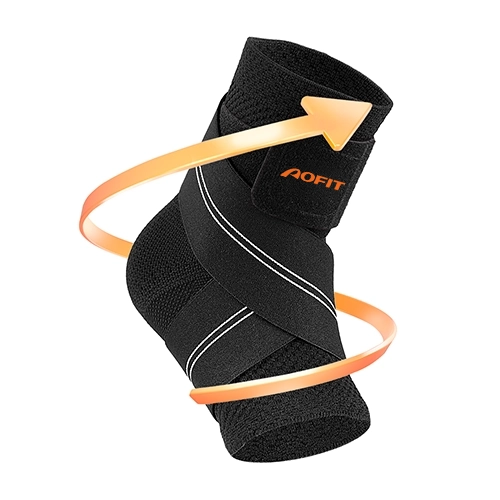
A soft neoprene or elastic sleeve slides over your foot. Sometimes there’s a light figure-8 strap on top. It’s a compression ankle sleeve, plain and simple. It controls swelling. It gives you proprioceptive awareness, or that sense of where your ankle is in space.
It won’t stop your ankle from rolling. There’s minimal mechanical stability here. No real inversion or eversion protection. Some clinicians won’t even call this a true brace for ligament control. Compression. Best for Grade I sprains, mild irritation, and low-impact days.
Lace-up ankle brace for sprain
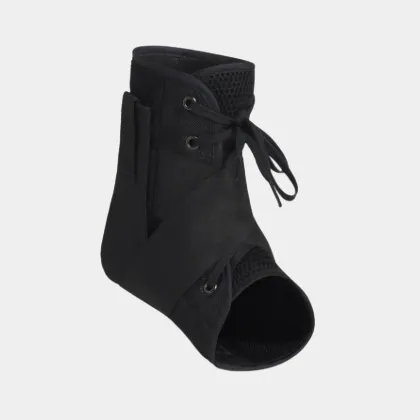
Fabric or neoprene shell, laced tight, often with a figure-8 strap system. This is the classic lace-up ankle brace you see on court and field.
The lacing adds compression that limits excessive motion while letting your foot still flex and point normally. Athletes love it because it fits under most shoes and offers prevention-level support without the bulk.
The downside: laces loosen mid-activity. You’ll retie. Wider ankles sometimes struggle with fit.
Best for Grade I sprains, chronic instability maintenance, and sports prevention.
Semi-Rigid / Stirrup Brace for sprained ankle
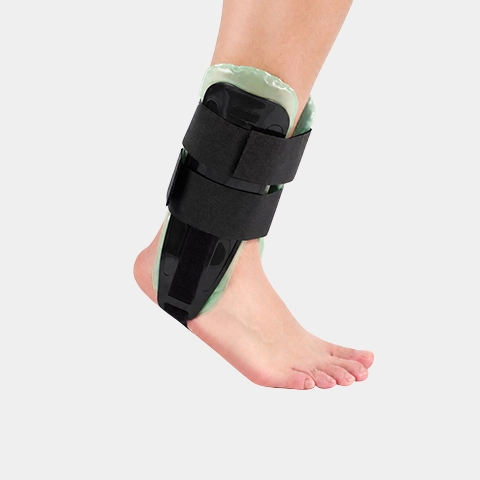
Plastic shells run along both sides of your ankle, medial and lateral. They’re often cushioned with air or gel bladders.
These side struts block inversion and eversion directly while still allowing forward-back ankle motion for walking. More support than a lace-up, less immobilization than a boot.
Best for Grade II sprains, acute injuries, and early return to activity after swelling calms down.
Hinged Rigid Brace for sprain
Rigid uprights plus a hinge. The hinge controls up-down ankle motion. The uprights block side-to-side movement. High lateral protection and a more functional gait than a full immobilizer.
This is the go-to ankle brace for chronic instability, post-surgical recovery, or high-demand return-to-sport cases. Best for Grade II to III sprains.
CAM Walking Boot
It’s not a brace. It’s an immobilization device. Near-complete restriction of ankle motion. The strongest short-term protection on this list, used for Grade III sprains, stable fractures, and post-op cases. Not for training. Protection while healing happens.
Matching grade to device:
Grade I: Compression sleeve or lace-up.
Grade II: Semi-rigid stirrup. Hinged rigid if needed.
Grade III: Rigid stirrup, hinged rigid, or CAM boot.
Matching Your Sprain Grade to the Right Sprained Ankle Brace
Grade I sprains do best with a compression sleeve or lace-up brace, worn for 1–2 weeks as light support, or up to 2–4 weeks if you’re staying active through recovery. Then you wean off as symptoms fade. A rigid brace here does more harm than good—it restricts motion your ankle doesn’t need restricted, slowing down the return of strength and proprioception.
Grade II sprains call for a semi-rigid stirrup or hinged brace first, typically for 3–6 weeks, sometimes longer for sport-specific use. Once swelling and instability settle, you transition to a lace-up for return to activity. It blocks the risky inversion/eversion movements while still letting your ankle walk and rehab normally. Full immobilization is overkill.
Grade III sprains need rigid stirrup or boot immobilization first, 2–8 weeks depending on severity, then step down to semi-rigid or lace-up support during rehab. Priority one is protecting the torn ligament. Priority two, once instability decreases, is regaining function—not staying locked in rigid gear indefinitely.
|
Sprain Grade |
Injury Pattern | Recommended Sprained Ankle Brace |
Support Duration |
Takeaway |
|---|---|---|---|---|
|
Grade I |
Stretch/microtear, no instability |
Compression sleeve or lace-up |
Days to 2–4 weeks |
Use the lowest effective support |
|
Grade II |
Partial tear, mild instability |
Semi-rigid or hinged, then lace-up |
3–6 weeks |
Moderate control beats full immobilization |
|
Grade III |
Complete tear, severe instability |
Rigid stirrup/boot, then step-down |
2–8 weeks initially |
Protect first, mobilize second |
If you’re cutting, jumping, or sprinting, a lace-up ankle brace or semi-rigid stirrup gives you functional stability without killing your dorsiflexion. Many clinicians recommend keeping that brace on for months after a Grade II or higher sprain—even after walking feels normal—because re-injury risk stays elevated longer than the swelling does.
5 Critical Buying Criteria for Ankle Support Brace for Sprain
1. Measure the Right Spot
Grab a soft tape measure and wrap it around your ankle about 1 inch above the ankle bone—that’s the narrowest point. Measure with the sock thickness you’ll actually wear during activity. Shoe size alone runs too loose or too tight, and different brands size compression sleeves, lace-ups, and rigid braces on different scales. Don’t mix the logic across types.
2. Know the Fit Signs
Too tight shows up as numbness, tingling, discoloration, or pinching when you walk. Too loose feels like slipping, a heel that lifts, or sliding after 20-30 steps. Neither is acceptable. A brace that fits right stays centered without pressure pain.
3. Check Shoe Compatibility
Low-profile lace-up or sleeve styles slide into most sneakers fine. Bulkier rigid stirrup or hinged designs need shoes with a wider opening and a tongue that fully unlaces—sock-style, low-collar sneakers won’t work.
4. Consider Material for Wear Time
Breathable mesh suits all-day wear, commuting, or summer sweat. Traditional neoprene compresses harder, but traps heat.
5. Match Adjustability to Your Needs
With a lace-up brace, you tune overall pressure yourself. Figure-8 straps let you target inversion or eversion directly. A hinged rigid brace offers minimal adjustment but maximum structural limitation.
Quick Buying Order
Start with your scenario, then the support level, then ankle circumference, and finally shoe-fit check. For daily walking, choose a light sleeve for comfort over restriction. For sport, pick a lace-up or semi-rigid that fits in your shoes and blocks re-injury. For post-op or chronic instability, go with a hinged rigid for maximum lateral control.
Best Ankle Brace for Sprained Ankle by Use Case
Not everyone with a sprained ankle needs the same fix. A weekend hiker managing residual swelling has different needs than a soccer player returning to cuts and pivots. Match the brace to the scenario, not just the grade.
Scenario 1: Swelling Control Only
If your main issue is lingering puffiness and fluid buildup rather than instability, a compression sleeve does the job. AOFIT’s Ankle Compression Sleeve / ZebraLite Ankle Brace fits this exactly. It’s elastic soft armor with a Y-shaped support structure, sized at 310×190×30mm, built for flexible all-day wear. You keep full range of motion and get proprioceptive feedback. The sleeve gives gentle pressure and awareness with no mechanical restriction.
Scenario 2: Mild Sport Support or Prevention
Runners, ball-sport athletes, and anyone training through a mild-to-moderate sprain should reach for a lace-up brace. Adjustable lacing gives more lateral control than a sleeve without sacrificing mobility. AOFIT’s Custom Ankle Brace line lets you configure adjustable compression levels here, which helps if you’re sourcing at scale or need a specific fit profile.
Scenario 3: Strong Lateral Stability
Semi-rigid stirrup braces step in when you need real mechanical limitation on inversion and eversion. Side support shells restrict the risky sideways motion while still letting you walk and function. This tier fits moderate instability, higher-demand activity, or return-to-sport phases after a Grade II sprain.
Scenario 4: Maximum Immobilization Protection
Severe sprains, post-op recovery, and suspected fractures call for rigid braces or CAM boots. The goal is locking the joint down while healing happens.
High Ankle Sprain & Chronic Instability: Special Brace Considerations
Not all sprains roll the same way, and your brace shouldn’t ignore that. A high ankle sprain (technically a syndesmotic injury) damages the ligaments connecting your tibia and fibula, not the lateral ligaments a typical sprain hits. The fix is different too. You need control over external rotation and tib-fib separation. That’s why braces built for high ankle sprains skip the simple lace-up design entirely and go straight to rigid or semi-rigid uprights with reinforced straps, closer to a functional cast.
Chronic ankle instability plays by its own rules as well. Mild-to-moderate CAI responds well to a lace-up or semi-rigid brace. Semi-rigid designs measurably reduce inversion angle and velocity during cutting movements, which drive repeated rolls. But if your ankle keeps giving way, or you’re dealing with post-surgical protection, step up to a hinged rigid brace. Bracing for at least 6 months after a moderate-to-severe sprain, especially with a prior sprain history, meaningfully lowers recurrence risk.
Conclusion
How fast your ankle heals depends on the choices you make now. Match your ankle brace to your actual injury grade. A Grade I sprain in a rigid brace heals as poorly as a Grade III sprain in a flimsy sleeve.
Browse AOFIT‘s ankle brace collection, find the support level that matches your sprain grade, and give your ankle the structured recovery it needs.