
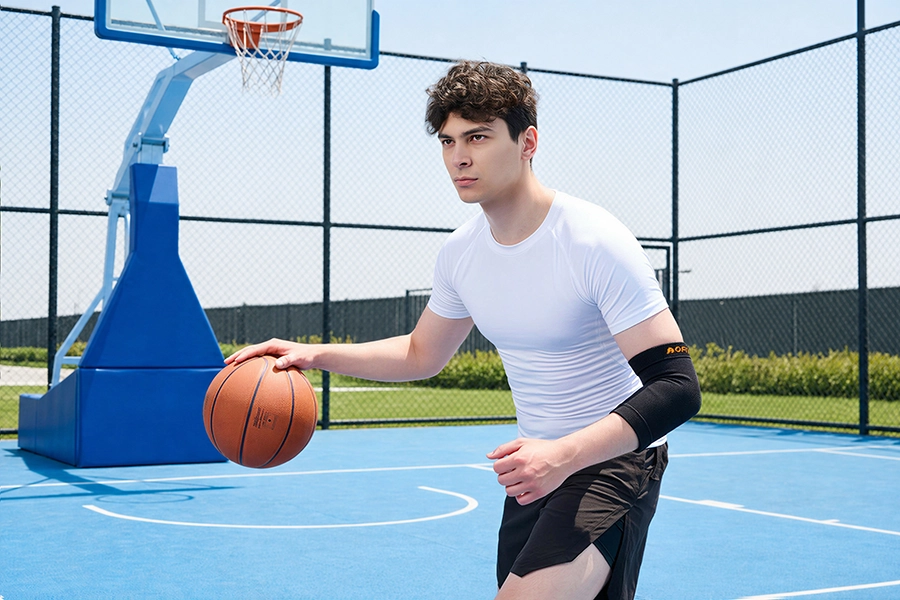
Finding a reliable elbow brace manufacturer in China is harder than it should be. Most sourcing managers and brand owners end up with dozens of browser tabs, conflicting supplier claims, and a nagging feeling they can’t trust who they’re dealing with.
Developing a private-label tennis elbow brace? Scaling an Amazon orthopedic line? Vetting OEM partners for a medical device distributor? Every manufacturer on this list has been evaluated on what counts — certifications, production capability, MOQ flexibility, and real customization depth. This list cuts through that noise.
What Makes a Top Elbow Brace Manufacturer in China?
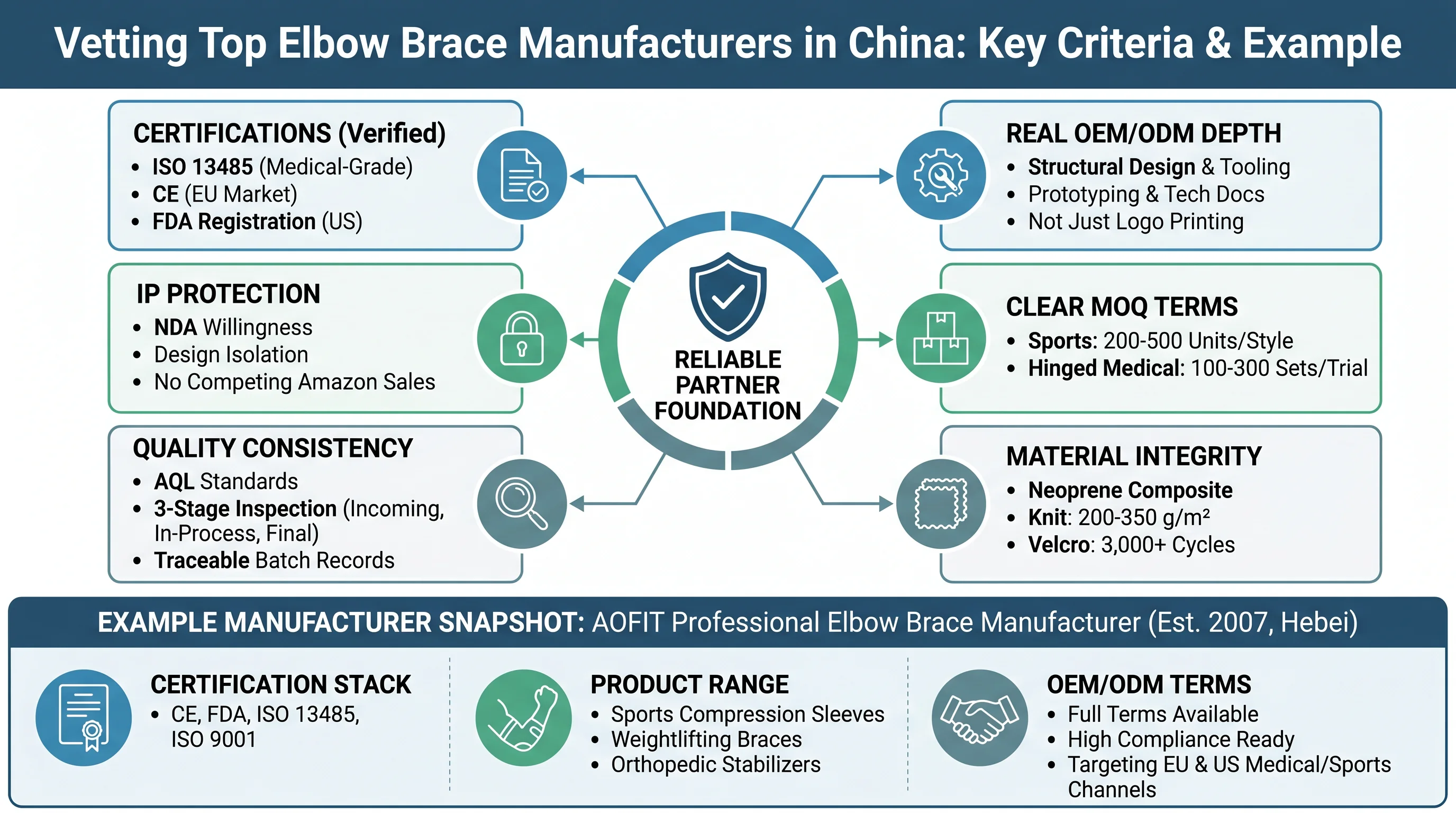
Six things separate the manufacturers worth your time from the ones that will cause you problems:
Certifications that hold up — ISO 13485 for medical-grade production, CE for EU market entry, FDA registration for US-bound orthopedic elbow supports. Good suppliers don’t just claim these. They hand over the documents and numbers.
Real OEM/ODM depth — structural design, tooling, prototyping, and full technical documentation. Logo printing is not customization. Don’t accept it as such.
Clear MOQ terms — quality sports elbow brace factories start at 200–500 units per style. Hinged medical elbow stabilizers run 100–300 sets for trial orders. Ask for this upfront.
Material integrity — neoprene composite construction, 200–350 g/m² knit fabric, Velcro rated for 3,000+ cycles. The numbers tell you what you’re actually getting.
Quality consistency — AQL standards written into contracts, three-stage inspection (incoming, in-process, final), and traceable batch records. Each batch should be accountable.
IP protection — NDA willingness, design isolation between clients, and a straight answer to: “Are you selling my product on Amazon under your own brand?”
1. AOFIT — Professional Custom Elbow Brace Manufacturer
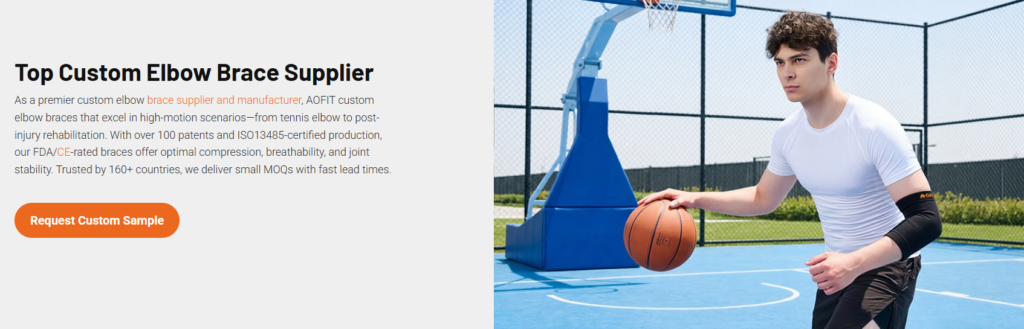
AOFIT has been building export-grade braces from Shijiazhuang, Hebei, since 2007 — well before “OEM elbow brace” turned into a crowded search term.
The certifications alone set them apart: CE, FDA, ISO 13485, ISO 9001. That’s not a brochure flex. It’s what gets you into a hospital tender instead of getting cut at the first document check. Medical distributors targeting EU pharmacies or US DME channels will find this stack cuts through compliance hurdles fast.
Their product range covers sports compression elbow sleeves, weightlifting elbow braces, and orthopedic stabilizers. All are available under full OEM/ODM terms.
Key procurement benchmarks:
Sample lead time: 3–7 days
Bulk production: 25–35 days
MOQ: 500 pcs for custom OEM orders
Medical distributors should focus on SKUs carrying the full ISO 13485 + CE MDR stack. Sports brands get access to the same factory setup, shifted toward design flexibility and performance materials.
Explore AOFIT Elbow Brace OEM Capabilities.
2. Suzhou Sunmed Co., Ltd. — Best for One-Stop Medical & Sports Sourcing
Thirty years in medical manufacturing adds up. For Suzhou Sunmed, that means a product catalog that covers surgical gauze, kinesiology tape, first-aid kits, and elbow compression supports.
Sunmed was founded in 1993 and established its Suzhou base around 2005. Today, it runs production facilities across Jiangsu, Zhejiang, and Anhui. One facility gets tied up in a regulatory inspection or a seasonal rush? Output moves to another. Your container still ships on time.
For buyers looking to consolidate suppliers, here’s the core value: you skip the headache of juggling four separate vendors for sports tapes, wound dressings, hot/cold packs, and first aid kits. Instead, you build a 50–200 SKU private-label portfolio through a single OEM partner.
Certifications: ISO 13485, CE, FDA, BRC
Sample lead time is 7–15 days for standard consumables. Custom first aid kit setups take 15–30 days. Bulk production runs 30–45 days. Large campaign orders can use multi-base staggered shipments to keep things moving.
Best fit: Pharmacy chains, medical distributors, and sports rehab brands that source across multiple product categories at the same time.
3. VIOMED (ChinaMedica) — Best for Certified Elbow Support for Medical Distributors
Yangzhou VIOMED runs under the ChinaMedica brand. For medical distributors, that difference matters more than it looks at first.
Their elbow brace line falls under a Sports Support → Medical Device classification. Every SKU on the category page carries clear CE / ISO / FDA certification markers. The full document package — Technical File, Declaration of Conformity, ISO 13485 QMS records — is ready to go straight into hospital procurement and DME channels.
What this means for distributors in practice:
EU market: CE MDR Class I classification, backed by ISO 14971 risk management documentation
US market: FDA-listed under 21 CFR 890 orthopedic support classifications
Global reach: Export-ready compliance covering EU, US, Southeast Asia, and beyond
Best fit: You supply rehab clinics, hospital outpatient departments, or online DME retailers? VIOMED fits. Their elbow supports come with full documentation from day one, no chasing paperwork after the order lands.
4. JIWEI — Best Neoprene Elbow Brace Manufacturer for Sports & Fitness Brands
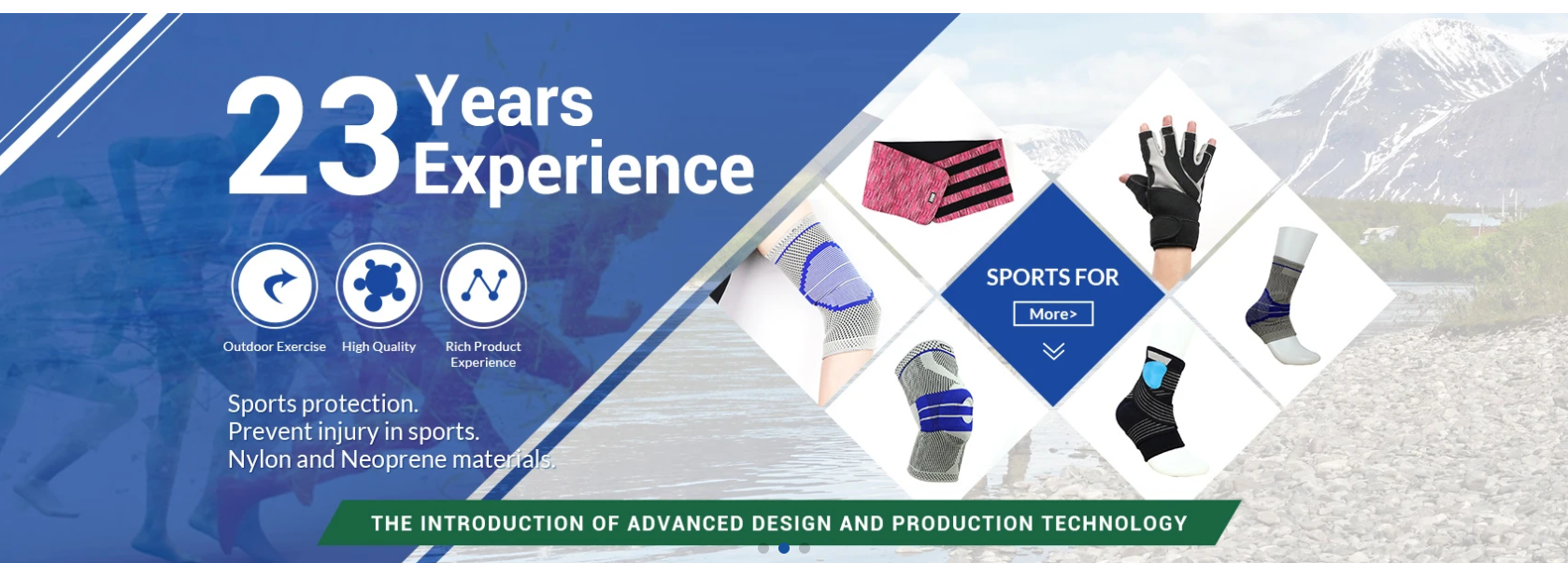
Neoprene rewards specialization. JIWEI built its entire elbow brace line around that idea. For sports and fitness brands, that focus shows up in the product quality you can feel.
Their core lineup uses 3–5 mm foam neoprene with dual-layer fabric bonding. The 3 mm builds work best for high-mobility training. The 5 mm versions focus on warmth retention and rehabilitation support. That’s a real difference worth noting as you position SKUs across different buyer intents on Amazon.
What the material delivers:
Thermal conductivity of 0.054–0.065 W/m·K — 40–60% lower than standard knit nylon. You get real joint warmth, not just marketing claims.
Static compression in the 15–25 mmHg range for 3 mm sleeves; up to 25–35 mmHg with strap-reinforced 5 mm builds
Elastic compression set ≤10–15% after repeated cycling — the sleeve holds its shape through high-frequency training loads
OEM and wholesale terms:
Standard wholesale: 100–200 pcs mixed
Custom color/logo MOQ: 500–1,000 pcs per colorway
Custom packaging (retail box): 1,000–2,000 pcs per print run
Production lead time: 25–35 days for full OEM runs
Best fit: Amazon and AliExpress sellers building a neoprene elbow brace private label around tennis elbow, weightlifting support, or everyday joint protection. The product structure matches what already sells on those platforms. So if that’s your target market, JIWEI is worth a serious look.
5. Xiamen Huakang Orthopedic Co., Ltd. — Best for Full Orthopedic Brace Catalog & Private Label
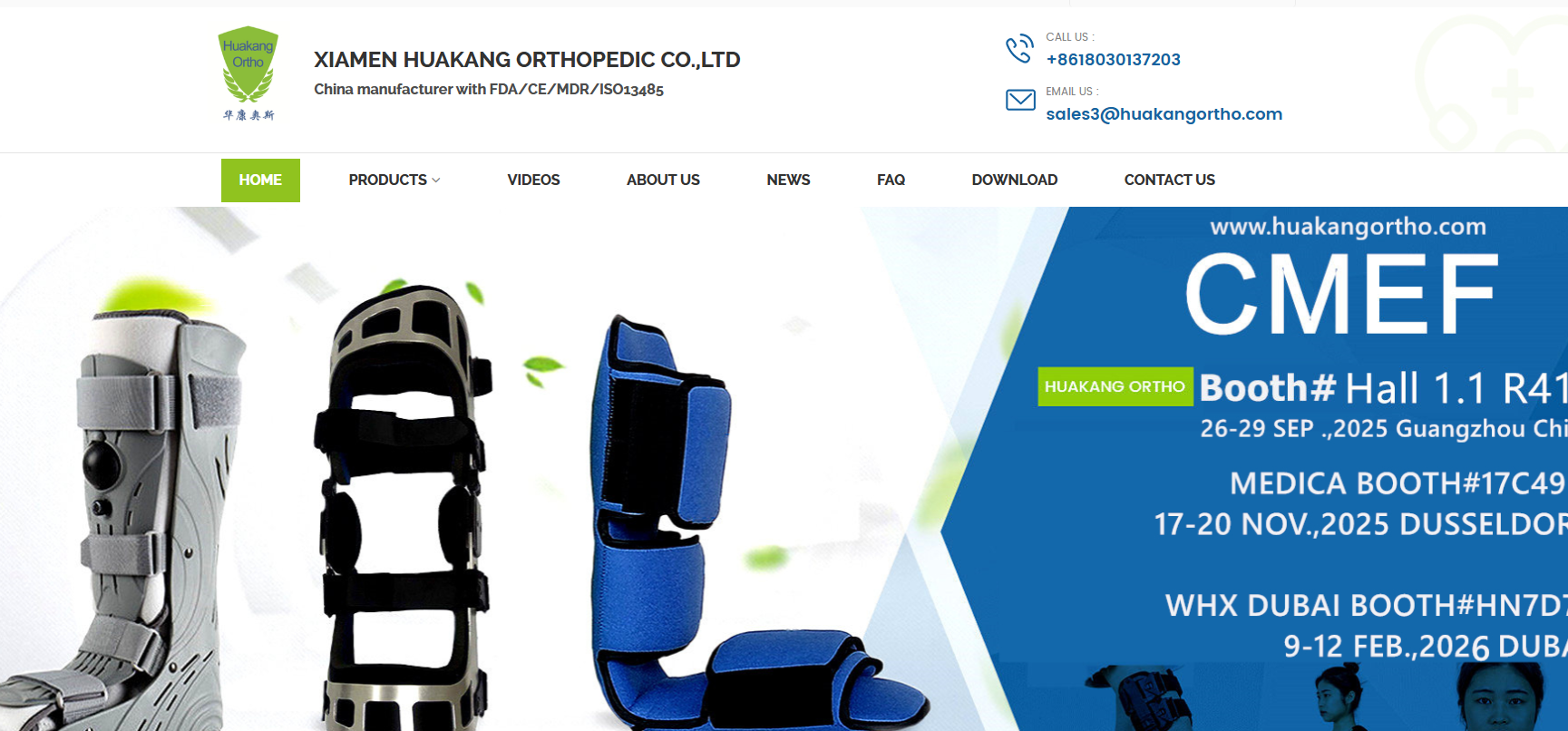
Huakang‘s catalog feels like one factory set out to cover every joint, every need. Ankle braces. ROM knee braces. Walker boots. Cervical collars. Wrist supports. Elbow supports — including a mesh tennis elbow design built for sports-related strain. The list keeps going. Private-label brands that want to build a 20–40 SKU orthopedic portfolio under one roof will find that kind of range hard to match anywhere else.
Behind that range: 122 staff, 3 production lines, 114 machines, and a mold library of 1,000+ designs. You pick from existing molds, add your logo and packaging, and get to market faster than most sourcing timelines allow.
Certifications include CE, FDA, ISO 13485, and EU MDR. That covers what you need to enter medical, DME, and rehab clinic channels.
Best fit: Growing orthopedic brands that want multi-joint SKU coverage — post-op recovery, sports protection, posture correction — all through one OEM partner.
6. Dongguan Yueshun — Best Value-Oriented Neoprene Elbow Brace Supplier for E-Commerce
Founded in 2010 in Tangxia Town, Dongguan, this Guangdong-based neoprene elbow brace manufacturer sits in China’s most productive light-industrial cluster. Over fifteen years in operation.
What the pricing looks like:
Trial runs (300–500 pcs): US$0.60–0.70/pc EXW
Small FBA launch (1,000–3,000 pcs): US$0.50–0.65/pc
Scale reorders (5,000–10,000+ pcs): US$0.45–0.55/pc for standard builds
Check these benchmarks before placing any order:
On-time delivery rate ≥95% (below 90% is a red flag)
Response time ≤4 hours — anything over 12 hours creates real fulfillment risk for FBA replenishment cycles
Trade Assurance coverage with clear ship-by dates and defect tolerance clauses (≤2–3% visible defect rate)
Sample pricing follows standard Dongguan practice: US$5–20 per design, deductible from your first bulk order at ≥1,000 pcs. Get this in writing on the proforma invoice. It’s standard practice — ask for it.
Best fit: E-commerce sellers building a value-tier neoprene elbow compression sleeve private label — tennis elbow, golfer’s elbow, everyday joint support — where unit economics matter just as much as product quality.
7. Yiwushi Tuguan — Best for Copper-Infused Compression Elbow Sleeves
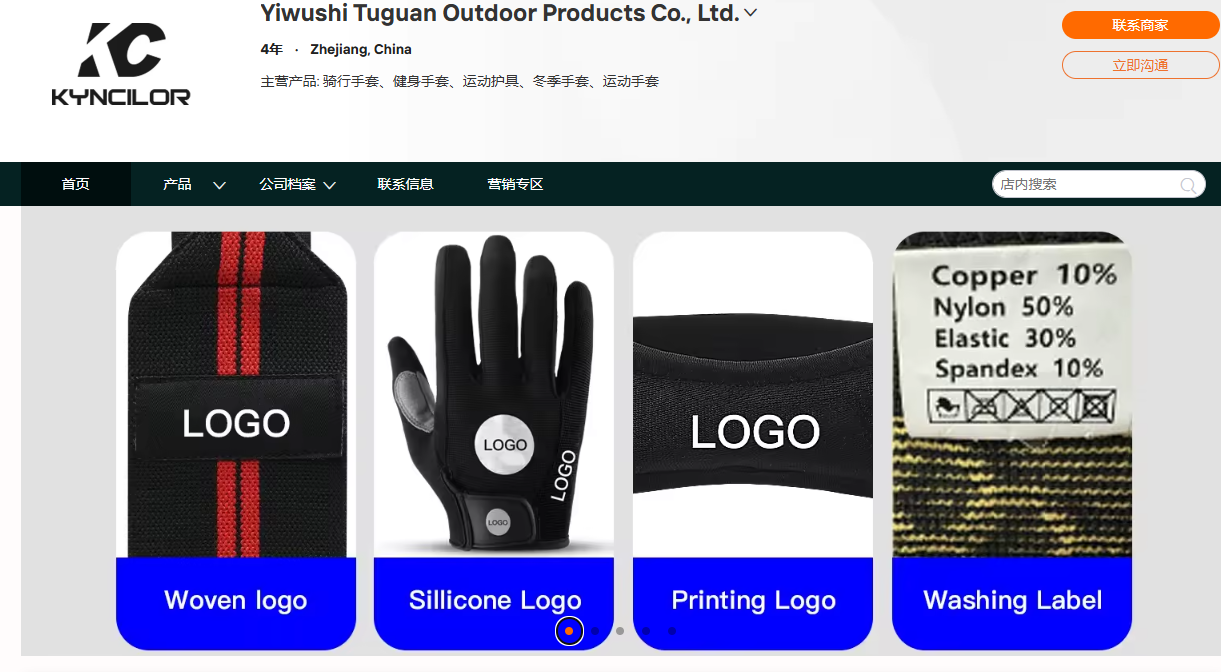
Copper-infused compression is a real category now. Yiwushi Tuguan has built its elbow sleeve line around exactly that.
The copper-knit sleeves blend 10–20% copper-modified fiber with nylon, polyester, and spandex. That combination produces a fabric with 24-hour antibacterial rates exceeding 99% against common bacteria (AATCC 100 standard). It also stays breathable enough for full-day wear. Arthritis sufferers and high-frequency athletes both want that mix.
What sets the construction apart:
Seamless circular-knit structure — no pressure ridges, no friction points after 8–12 hours of wear
Compression range: 10–15 mmHg for arthritis use each day; 15–20 mmHg for sport and recovery
Silicone grip band option for high-movement training — no slipping mid-set
Elastic retention ≥90% after 50 machine washes — the antibacterial function holds up too
Before sampling, request these documents:
OEKO-TEX Standard 100 certificate — covers skin-contact safety and heavy metal limits
Post-wash antibacterial test report — target: ≥90% inhibition rate after repeated laundering
REACH/RoHS compliance if your buyers are EU-based
Best fit: Amazon sellers targeting the Copper Compression Elbow Sleeve category, arthritis-focused wellness brands, and sports recovery labels. Long-wear comfort and odor control are the main purchase drivers here, and this sleeve addresses both directly.
8. Kao Chen Enterprise — Best for Adjustable Two-Piece Elbow Support Design
Founded in 1979, Kao Chen Enterprise has spent four decades focused on one thing: building orthopedic braces that fit well.
Their standout elbow support uses a two-piece adjustable construction, a main wrap paired with a secondary press piece. That press piece applies localized compression to the tendon. That second piece makes all the difference. You set overall joint stabilization with the main wrap. Then you fine-tune tendon pressure with the press piece on its own.
Why the design matters in practice:
Fits variable elbow circumferences
Post-exercise swelling? Release 10–20% tension on the main wrap. Tendon pressure stays intact
Hook-and-loop closure lets you adjust in small, continuous steps
Kao Chen sells this support for exercise, sports, and post-surgical rehabilitation. Those are two very different regulatory markets. Sports buyers focus on strap durability and skin-safe materials. Rehab and hospital buyers require ISO 13485 compliance, biocompatibility documentation, and traceable lot numbers. Know which side you’re buying for before you move forward.
Best fit: Physical therapy brands and orthopedic distributors who need a tendon-targeted, adjustable elbow support that holds up across both active use and recovery.
How to Verify a Chinese Elbow Brace Manufacturer Before Placing an Order?
Check Certifications in the Primary Databases
FDA (for US-bound elbow braces):
Ask the manufacturer for three specific items — their full registered company name in English, their FDA Establishment Registration Number, and the Product Code for elbow supports. Then cross-check all three in the FDA medical device database yourself. The company name, address, and product classification must match.
CE MDR (for EU markets):
Request the current Declaration of Conformity. It must name the manufacturer, list the specific elbow brace models, cite Regulation (EU) 2017/745, and carry a signature with a date. Class IIa or above products need a four-digit Notified Body number. Look that number up in the NANDO database. Confirm the scope covers Medical Devices under MDR.
ISO 13485:
Copy the certificate number and the certification body name. Search both on the certification body’s own website. Check that the certificate scope includes orthopedic supports or medical braces. Also, confirm the address listed matches the actual production site.
Run a Remote Factory Audit Before the First Order
Production capacity:
Count the sewing lines on camera. Ask how many people work each line and what the actual shipment volume was last month. A mid-size elbow brace factory with 2–6 lines runs 50,000–300,000 pcs/month. Numbers that feel off or a factory that can’t show you records on screen are worth noting.
QC process:
Ask to see three specific documents on the call:
– Incoming inspection records (AQL sampling ratios, fabric and Velcro defect logs)
– In-process inspection sheets (frequency, AQL standard — Major 2.5 / Minor 4.0 for soft goods)
– Final inspection reports from the last three months
A healthy factory runs a total defect rate of ≤ 2–3%, with rework of ≤ 1–2%.
Verify Material Safety for Skin-Contact Elbow Braces
Neoprene, spandex, SBR rubber, and Velcro all sit against skin for hours at a time.
OEKO-TEX Standard 100 (Class I or II): Confirm the certificate covers the materials used, knitted fabric, elastic band, and neoprene. Check that the certificate holder is the fabric or component supplier. Ask for the purchase invoice that confirms they’re using that supplier’s batch.
REACH/RoHS third-party test reports: Large EU buyers require these as standard. Ask for SGS, TÜV, or Bureau Veritas reports — issued within the last 1–2 years — covering phthalates and heavy metals.
ISO 10993-10 skin sensitization testing: For anything sold as a medical elbow support, request this report. It should name the product, describe the materials, state a clear conclusion (no irritation / no sensitization), and carry a test date within the past 2–3 years.
OEM vs ODM Elbow Brace: Which Model Fits Your Business?
OEM means you own the design. You define the technical spec: compression grade, fabric GSM, strap width, silicone pad hardness, closure type. The factory builds what you define. Every parameter is yours to control. So is the IP, the pattern, the tooling, the mold. No other brand gets that elbow sleeve.
ODM means the factory has already built the design. You pick from their existing catalog. Add your logo, choose a colorway, and maybe adjust the compression level within their available range. The factory owns the base mold. That same elbow brace may already be selling under three other brand names on Amazon.
Cost & Timeline Reality
|
OEM |
ODM | |
|
Tooling cost |
$800–$3,000/mold |
$0–minimal |
|
Sample cost |
$200–$500+ per round |
$50–$200/style |
|
Development time |
4–12 weeks |
1–2 weeks |
|
First shipment |
3–6 months from brief |
1–2 months from selection |
|
MOQ |
500–2,000 pcs/SKU |
100–500 pcs/SKU |
|
Unit price (FOB) |
$2–$12 depending on spec |
15–30% lower than the equivalent OEM |
Which Stage Are You At?
Early-stage brand (year 0–2): Start with ODM. Pick 3–5 styles from factory catalogs, a compression sleeve, a tennis elbow strap with pad, and an adjustable wraparound. Cover M/L/XL first. Add your logo, a retail box, and a localized insert. Order 100–300 pcs per style. Validate the category before you invest in tooling.
Scaling brand (consistent sales, established channel): A single ODM style hits 5,000–10,000 units per year. That’s your signal to move. Commission an OEM upgrade. Lock in a proprietary compression zone, a custom silicone grip pattern, a better ventilation structure at the elbow pit. Negotiate IP ownership into the contract. Your core SKU becomes exclusive. The factory can’t sell that version to anyone else.
Conclusion
Choosing the right elbow brace manufacturer in China is a strategic decision that directly impacts your product quality, brand reputation, and long-term margins. The factories featured here, from AOFIT’s custom OEM expertise to flexible low-MOQ suppliers, represent China’s most capable and certified partners. To avoid costly mistakes, focus on three essentials: verified credentials, responsive communication, and a supplier committed to your growth. Don’t just bookmark this list. Shortlist 2–3 candidates that match your specs, request samples, and ask clear questions about MOQ, lead time, and quality control. Your ideal OEM partner is ready; the next step is yours.