
Your thumb hurts — and now you’re staring at a wall of products online. You’re wondering: thumb brace support or thumb splint? Is there even a real difference? Yes — and picking the wrong one can mean weeks of frustrating, ineffective recovery.
Whether it’s the nagging ache of thumb arthritis, the sharp morning pain of De Quervain’s, a weekend sports sprain, or too many hours gripping a phone, the right thumb support helps you heal faster. The wrong one? An expensive waste. This guide matches real symptoms to the right level of support, so you’ll walk away knowing what your thumb actually needs — and why.
What Is a Thumb Brace Support?
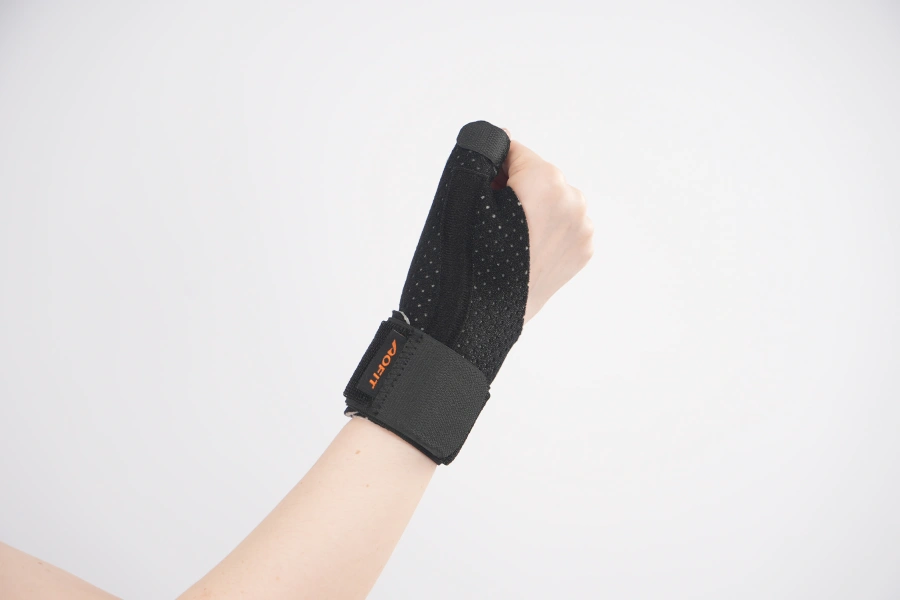
A thumb brace support stabilizes your joint without taking over your life.
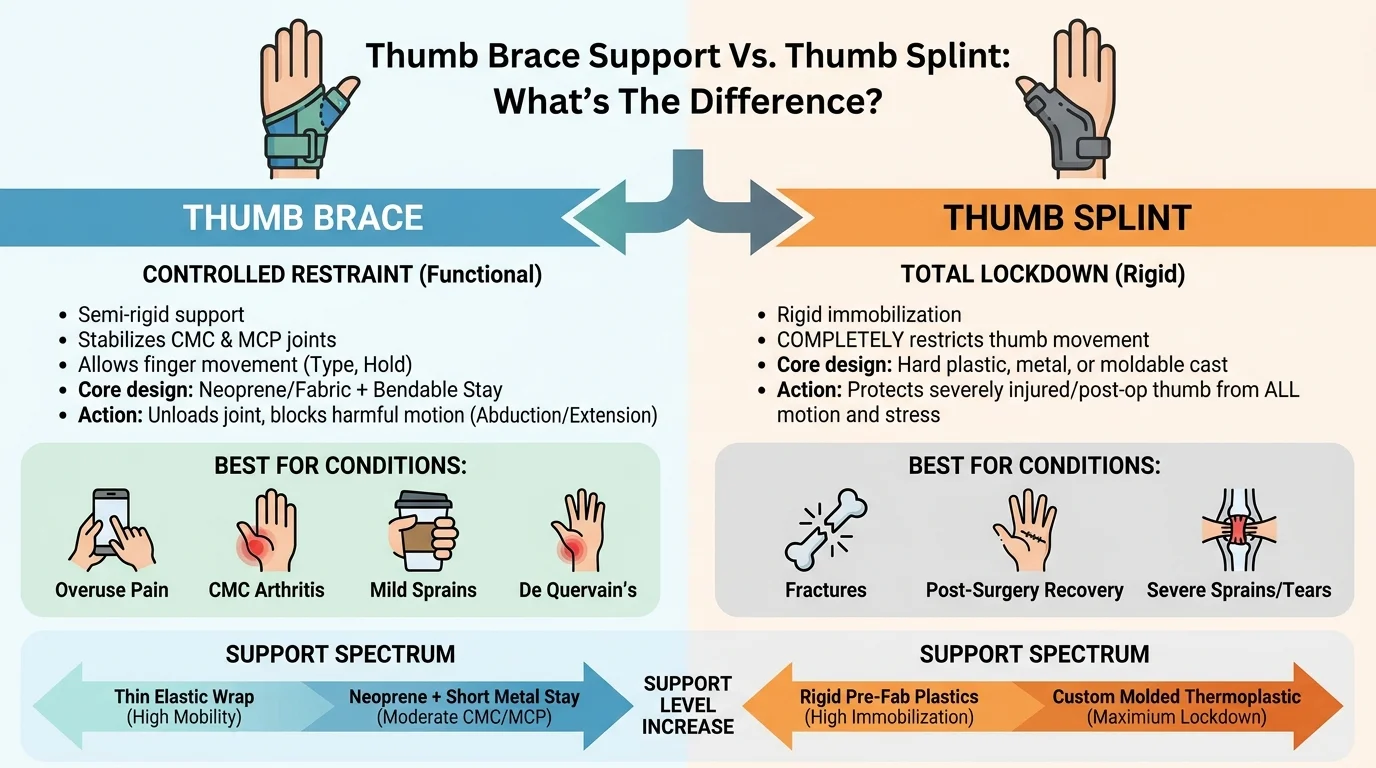
A thumb brace support is a semi-rigid external orthotic. It controls the CMC and MCP joints — the two joints behind most thumb pain — while keeping your fingers free to move. You can still hold a coffee cup. Type a sentence. Cook dinner. The brace takes on the stress so your joint doesn’t have to. The core design idea is controlled restraint, not total lockdown.
How It Works
Most thumb braces use two materials working together:
- Neoprene or breathable fabric — the soft outer shell that delivers compression, mild warmth, and basic stabilization
- A bendable metal stay or plastic frame — the inner piece that blocks harmful motion in specific directions (mainly abduction and extension at the CMC joint)
Who Needs One
Thumb braces work best for conditions where some movement needs to stay:
| Condition | Why a Thumb Brace Fits |
|---|---|
| CMC joint arthritis | Unloads the basal joint; holds thumb in resting position during flares |
| De Quervain’s tenosynovitis | Limits tendon-aggravating abduction while keeping grip in other fingers |
| Typing / phone overuse pain | Worn during painful activity; cuts strain without stopping work |
| Mild thumb sprains | Protects the UCL ligament from valgus stress with a firm but functional stay |
The Support Spectrum
Not all thumb braces offer the same level of restriction. Think of it as a dial:
- Thin elastic wrap only → High mobility, mild stabilization. Best for early overuse symptoms.
- Neoprene + short metal stay → Moderate CMC/MCP control. Handles most daily activities while cutting pain.
- Extended spica design reaching the wrist → Stronger restriction. Better for De Quervain thumb brace needs or moderate ligament injuries.
The right spot on that dial comes down to your symptom level.
The practical test: Put the brace on and do your most painful daily task. Pain drops, and you can still function? You’ve found your fit. Motion itself causes harm? Immobilization may be the better path — and that’s where splints come in.
What Is a Thumb Splint?
A thumb splint stops your thumb from moving.
Torn ligaments, fractured bones, or badly damaged tendons cannot handle any movement. At that stage, partial support fails you. The thumb needs to be locked out completely so the damaged tissue can repair itself without interruption.
The Mechanics of True Immobilization
Most thumb splints — the thumb spica splint being the prime example — extend past the thumb to cover part of the wrist. This matters. The thumb’s base and the wrist share structural territory. Fix one without controlling the other, and the injury stays exposed to stress.
The design logic breaks down like this:
– Thumb + wrist immobilization → thumb spica splint (the go-to for fractures, UCL tears, post-op recovery)
– Near-total motion restriction → rigid thumb splint (acute trauma, suspected fracture, post-procedure protection)
– Support with limited movement → semi-rigid splint (overuse conditions, mild De Quervain’s flares where some function is still needed)
When a Splint Is the Right Call?
| Injury / Condition | Why a Thumb Splint, Not a Thumb Brace? |
|---|---|
| Thumb fracture / metacarpal fracture | Bone healing needs complete immobilization — any motion risks displacement |
| UCL ligament tear (Skier’s / Gamekeeper’s thumb) | A torn ligament needs zero valgus stress to reattach and stabilize |
| Scaphoid fracture | This one heals slowly. Both thumb and wrist immobilization are essential |
| Post-surgical recovery | Repaired tissue cannot tolerate the small movements a brace still allows |
| Severe De Quervain’s tenosynovitis | Acute flares with serious tendon inflammation need full rest |
Thumb Brace Support vs Thumb Splint: Key Differences at a Glance
| Dimension | Thumb Brace Support | Rigid Thumb Splint |
|---|---|---|
| Immobilization Level | Limits 30–70% of range of motion. Blocks harmful directions but preserves light function | Restricts 70–100% of CMC/MCP movement. Near-complete thumb immobilization |
| Material Hardness | Elastic fabric with 1–2 narrow metal or plastic stays (~5–10 mm wide). Bends a little but holds against extreme angles | Molded thermoplastic or aluminum strips. Almost no flex — the “small cast” effect |
| Coverage Area | Wraps the thumb and CMC joint zone. IP joint stays free. Wrist often unrestricted | Classic thumb spica splint extends to the wrist dorsum. Locks CMC, MCP, and limits wrist flex/extension together |
| Best Injury Stage | Chronic to subacute: thumb arthritis support, mild ligament sprains, De Quervain thumb brace use, repetitive strain | Acute and severe: fractures, post-surgical recovery, UCL tears, any stage where tissue needs uninterrupted rest |
| Daily Function Impact | Typing, light gripping, phone use — all still workable. Strong pinching (opening jars, tightening lids) is blocked by design | Precision pinch, writing, driving — all take a hit. Most users wear the splint at rest or overnight |
| Prescription Needed? | OTC for most users. Size charts are enough to pick the right thumb stabilizer or wrist and thumb brace | Custom thermoplastic versions need a hand therapist. Prefab thumb spica options exist OTC, but acute injuries need clinical guidance |
Which One Do You Need? Match Your Symptoms to the Right Product
Choosing between a thumb brace support and a rigid thumb splint isn’t about preference. It’s about what your tissue needs right now.
Match Your Symptom to the Right Product
| Your Symptom Pattern | Right Product | Why |
|---|---|---|
| Chronic dull ache, weakening grip, no injury event | Thumb brace support | Classic CMC arthritis or repetitive strain — needs unloading, not lockdown |
| Wrist-side thumb pain turning keys, lifting a child, or opening bottles | Thumb Brace first (mild) / Thumb Splint (moderate–severe) | De Quervain’s tenosynovitis — severity decides the restriction level |
| Post-fracture, UCL tear, or confirmed ligament damage | Rigid thumb splint | Structural injury needs full thumb immobilization — no exceptions |
| Post-surgical, per doctor’s instructions | Thumb Splint | Repaired tissue can’t handle the small movements that a thumb brace still allows |
Soft vs Rigid: How Material and Structure Affect Your Recovery?
The shell your thumb brace is made from controls how much movement gets through. It also determines how long you’ll wear it — and how well your tissue heals.
What’s Inside Each Type
- Soft and semi-rigid thumb braces use neoprene, stretch knit, or perforated fabric. A narrow metal stay or plastic insert sits inside, 2–4 mm thick. The frame bends a little. The fabric breathes. You can loosen the Velcro on a swollen morning and tighten it again by afternoon.
- Rigid thumb splints work on the opposite principle. A molded thermoplastic shell or aluminum strip — 1.5–3 mm thick — sits against the thumb and wrist. It does not flex. A thin foam liner protects the skin. The structure holds firm. It does not give.
Why “Softer” Often Wins for Long-Term Wear?
A systematic review of 348 CMC joints compared prefabricated soft braces against custom rigid thermoplastic splints. Pain relief and grip strength recovery were equal between the two groups. But functional outcome scores came in higher for the soft prefabricated group.
The reason is compliance, not engineering. A breathable, adjustable thumb compression sleeve or a structured wrist and thumb brace gets worn day after day. A bulky, rigid thumb splint ends up on the nightstand.
The Practical Rule
- Chronic conditions (arthritis, repetitive strain): go soft or semi-rigid. It keeps circulation moving, prevents stiffness, and fits into a full workday.
- Acute injuries (fractures, UCL tears, post-surgical): go rigid. In the first two to six weeks, healing tissue reacts badly to even small movements. A stiff frame cuts that motion down.
Thumb Brace for Specific Conditions: Arthritis, De Quervain’s, Sprains & More
Thumb Arthritis (CMC Joint)
The goal with CMC joint arthritis is unloading. The basal joint needs protection from shear force and compression.
A structured CMC joint brace limits painful abduction and keeps your IP joint free. That’s the clinical standard. Start with an OTC prefabricated option. Research on 348 CMC joints found that prefab braces matched custom splints on pain relief and grip recovery — at one-third to one-fifth the cost.
De Quervain’s Tenosynovitis
- Early/mild: Use a semi-rigid De Quervain thumb brace that limits thumb abduction and extension. Wear it during activity. Partial wrist movement is fine.
- Acute/inflamed: Switch to a wrist and thumb brace with near-complete immobilization. Wear it for four weeks straight — off for washing only.
- Recovery/post-surgical: Step down to a functional brace. Limit around 40–60% of wrist motion. Keep light thumb abduction support to avoid relapse during grip.
Sprains, UCL Injuries & Sports Trauma
Gamekeeper’s thumb and skier’s thumb both hit the ulnar collateral ligament. The severity of the tear decides what support you need.
| Injury Grade | Recommended Support | Thumb Mobility Preserved |
|---|---|---|
| Mild sprain | Soft–semi-rigid thumb stabilizer | MCP flexion 50–70%; abduction restricted |
| Moderate UCL damage | Semi-rigid spica with firm stay | MCP motion 20–40%; valgus stress blocked |
| Severe tear / post-op | Rigid thumb spica splint | Near-complete immobilization |
A good sports brace needs three things: a spica extension from wrist to proximal thumb, adjustable straps for mid-competition tuning, and a low-profile build that fits inside a glove. Wrist flexion-extension of 60–80% needs to stay intact. You still need to generate force and control the ball.
Early in recovery (weeks 1–2), wear the firmer version outside competition. Then shift to a lighter thumb sprain support for high-risk training — once the ligament has had time to stabilize.
Can You Sleep, Type, or Work Out With a Thumb Brace or Splint?
Most people ask this backward: they buy a brace first, then wonder what they can do with it. A better approach: let your daily activities choose the brace for you.
Sleeping
Night is when inflammation peaks. Joints stiffen, tendons tighten, and your thumb often feels worse in the morning. For arthritis, trigger thumb, or De Quervain’s, wearing a brace at night is standard care. The goal is to keep your thumb and wrist in a neutral position — not to restrict you for no reason.
What works for sleep: a padded liner, even straps, and a rigid or semi-rigid palmar stay. Avoid numbness or color change — if you feel those, loosen it. A custom rigid splint at night needs a clinician’s approval (e.g., after fracture or surgery). For most overuse flares, a well-fitted thumb spica brace is safe and effective. Wear it nightly during acute flares, then only as needed.
Typing, Texting, and Desk Work
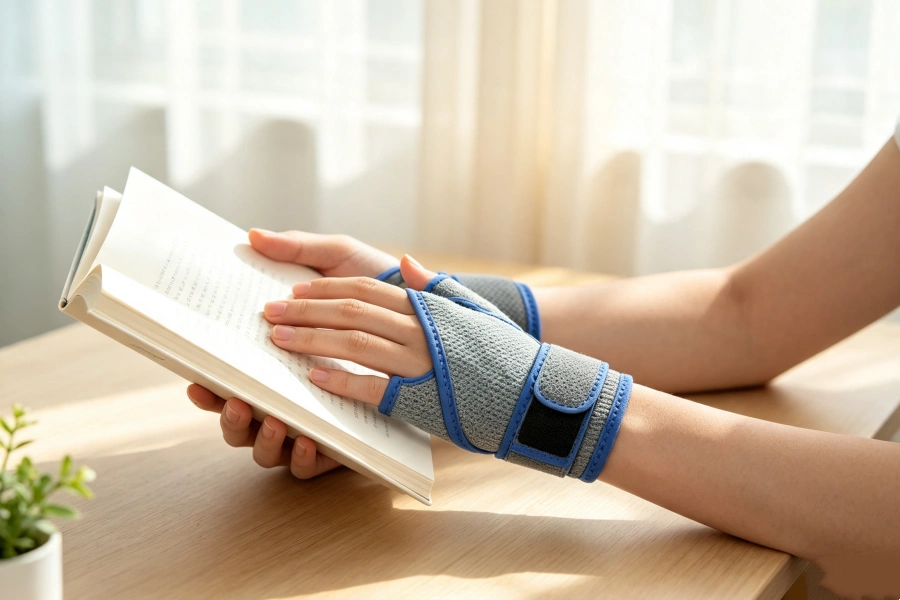
A thumb brace doesn’t have to end your inbox. Choose a low‑profile thumb spica design with minimal palmar coverage and slim radial strapping. It stabilizes the CMC joint without locking your fingers. You can type and swipe normally.
Smart adjustments: wear the brace only during long typing sessions; take hourly breaks to remove it and move your thumb gently; for phones, use two hands or voice input. If the brace forces your wrist into extension at the keyboard, it’s the wrong model.
Working Out and Heavy Labor
You don’t have to stop exercising — just adapt. The rule: match rigidity to the load.
-
Rigid or semi‑rigid stabilizer (metal/plastic stay): for UCL sprain, moderate arthritis, grip‑heavy sports.
-
Compressive neoprene sleeve: for mild overuse or preventive gym use.
-
Palmar‑free design with radial reinforcement: for weight lifting.
In sweaty or wet conditions, use closed‑cell neoprene with plastic stays — metal corrodes. And a critical rule: wear the brace only during the demanding activity. All‑day wear weakens your thumb’s stabilizing muscles. Protect the joint under load; let it move the rest of the time freely.
Bottom line: sleep in it if arthritis or tendinitis keeps you up; type in it with a low‑profile, finger‑free design; train in it if the rigidity matches the load — and take it off after the workout.
Conclusion
Your thumb does more than you think, and so does the right support.
Each pain feels different, and each one needs a different kind of support. Picking the wrong type doesn’t just slow recovery. It can make things worse. Match the support to the injury.
Check out the full range of thumb stabilizers and CMC joint braces at AOFIT. Each option is built for real conditions, real activity levels, and real recovery timelines, not just generic discomfort.