
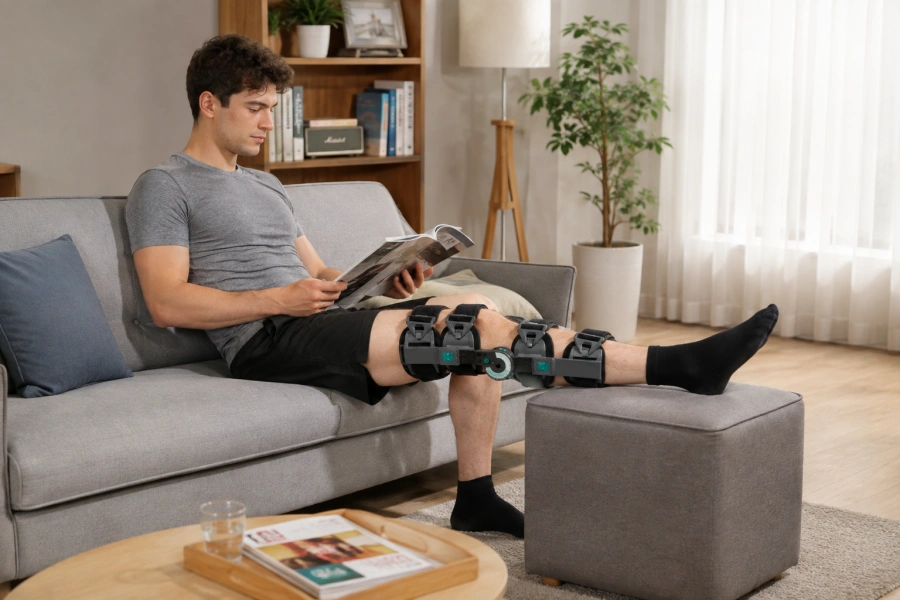
Whether you’re managing arthritis, recovering from a meniscus tear, or easing back into daily movement after ligament surgery, a flimsy knee sleeve won’t cut it. You need a hinged knee brace built to stabilize, not just squeeze.
Not all hinged knee braces are created equal. Some feel like medical-grade armor. Others promise support and deliver discomfort by lunch.
We tested six of the best hinged knee braces on the market—comparing stability, breathability, and all-day wearability—so you don’t have to guess. Below you’ll find honest breakdowns of what works, who each brace is actually for, and how to size yours correctly the first time.
AOFIT Hinged Knee Brace (Post-Surgical Adjustable Range of Motion)
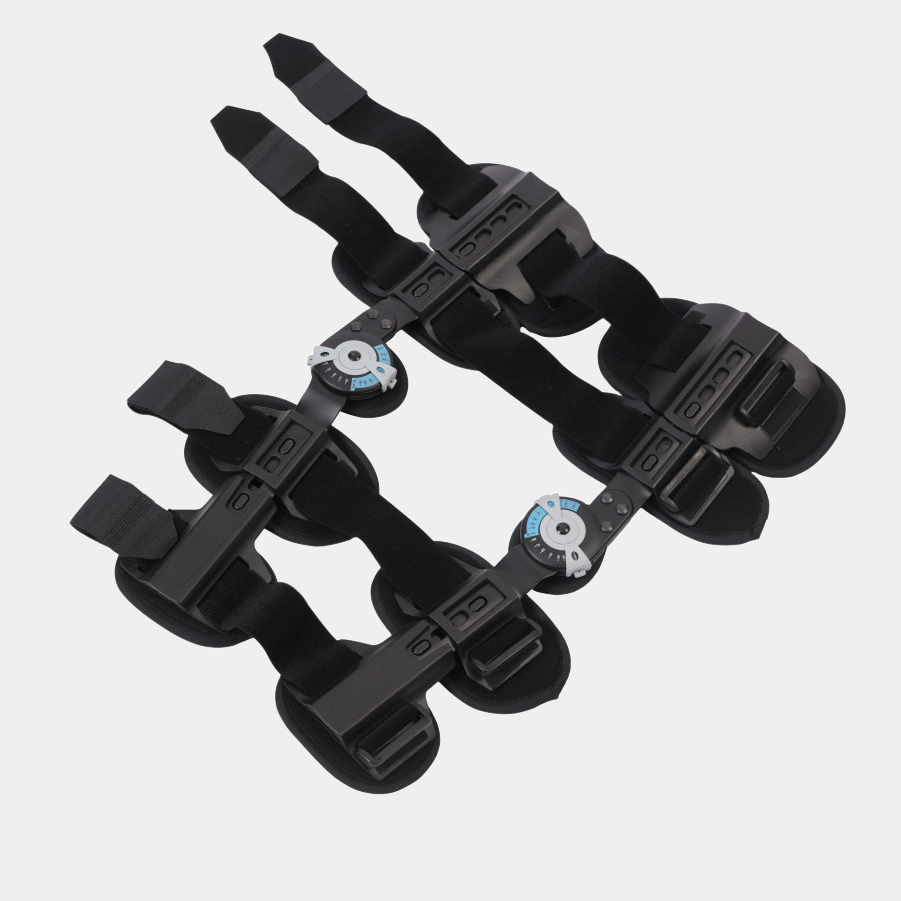
Surgery changes everything about what a knee brace needs to do. The AOFIT hinged knee brace is built for the weeks right after your surgeon closes you up.
This is a post-operative hinged ROM knee brace, and the structure gives it away. Rigid uprights run the length of your leg, connected by polycentric ROM hinges on both sides. Telescoping side bars extend from mid-thigh to upper calf, with an overall length around 19–24 inches (48–60 cm). It’s meant to span two major joint zones and lock your leg in place.
The hinges are the real story. Your surgeon dials in exact flexion and extension limits, typically in 10-degree increments, with common stops at 0°, 15°, 30°, 60°, and 90°. Flexion can range from 0° to 120°. Extension settings run from 0° up to 90°, depending on your recovery timeline.
Typical post-op phasing looks like this:
– Weeks 0–2: locked at 0–30° flexion, limited weight-bearing
– Weeks 2–4: opened to 0–90° flexion
– Weeks 4–6: approaching 0–120° flexion
– Beyond 6–12 weeks: near-full range, still hinge-limited to protect healing tissue
Your surgeon or physical therapist sets the angle based on your specific procedure—ACL reconstruction, meniscus repair, or knee replacement. Bump the flexion too fast, and you risk stretching a graft or reopening a meniscus repair. Both hinges need to match exactly. Uneven settings create uneven stress on a knee that’s still healing.
One more thing: this brace won’t disappear under jeans. The hinge housings alone run 40–60mm wide, and the strap layers add another inch of bulk. Wear it with loose pants or shorts; you’ll thank yourself when it’s time to check the incision.
Sparthos Hinged Knee Brace (Open-Patella Dual Metal Hinge Design)

Sparthos Hinged Knee Brace (Open-Patella Dual Metal Hinge Design): This hinged knee brace actually deserves the name. Two aluminum hinges on either side of your knee do real mechanical work.
The dual metal side stabilizers lock at full extension and block hyperextension before it happens. That’s a real engineering feature. The open-patella design wraps your kneecap in a silicone gel ring that cradles without crushing. Together they give you three-point stabilization across the femur, tibia, and patella.
The shell is 4mm perforated neoprene. Four Velcro straps let you fine-tune compression zone by zone, so it won’t slip during walking or light workouts. It’s ambidextrous so one brace fits either knee.
Review patterns show roughly 30-40% of buyers manage meniscus tears and praise the walking stability. Another 25-35% deal with ACL or MCL instability and love the anti-hyperextension lock. And 20-30% use it for arthritis pain management. Physical therapists have noted in reviews that it is a legitimate brace for ligament support, describing it as “an actual brace”.
Ratings hover between 4.3 and 4.6 stars across major retailers, with prices typically running $25- $ 40 depending on the region.
Neoprene runs warm. Users consistently mention sweating in hot climates or during all-day wear. Use it for daily support.
Fit Geno Hinged Knee Brace (Meniscus & Ligament Recovery Support)
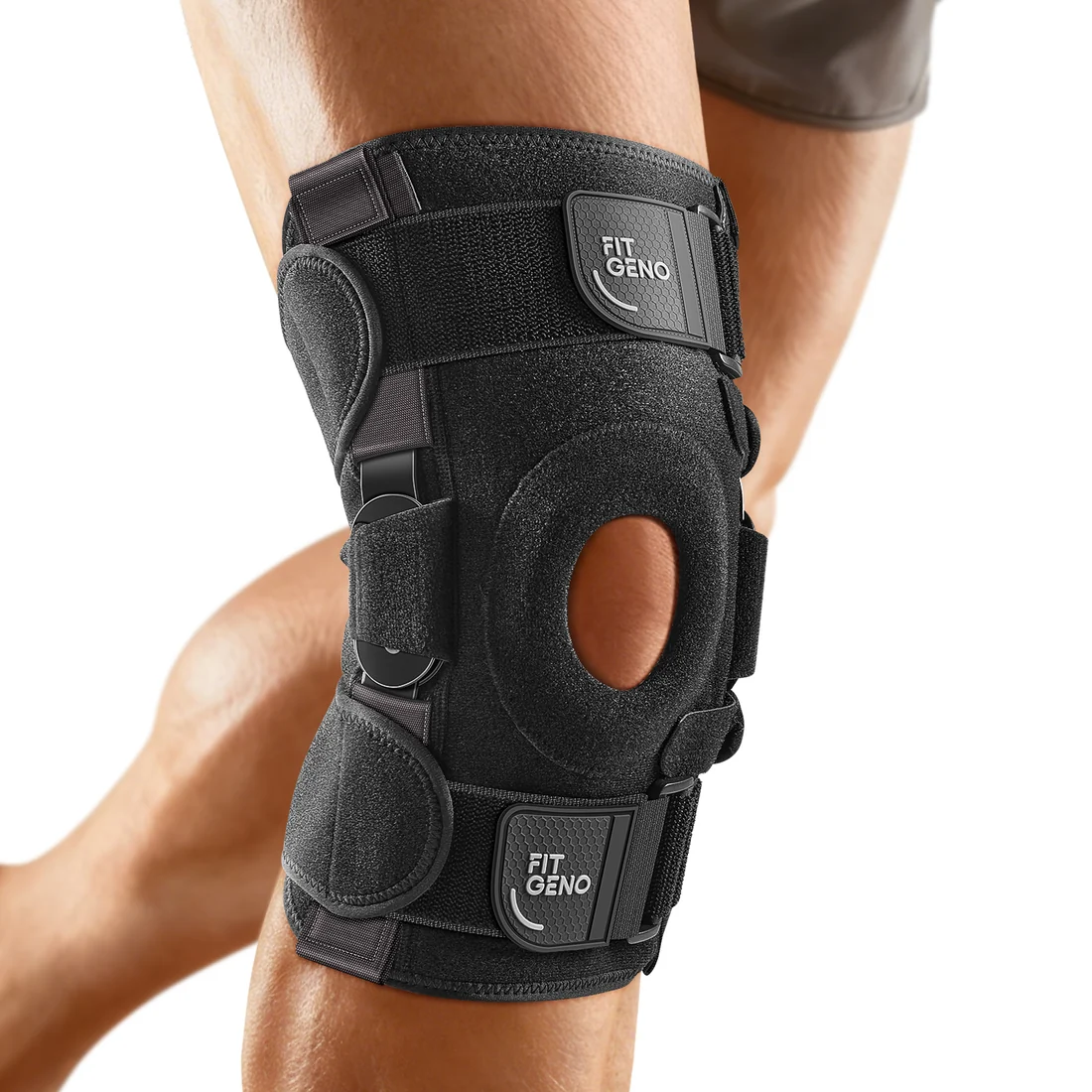
Sports medicine specialists call the Fit Geno ReActive+ the “maximum support pick” for a reason.
It’s built for people dealing with a torn meniscus and ligament instability at the same time. Dual removable aluminum hinges sit on both sides of the knee. Upgraded versions add spring side stabilizers for extra medial-lateral control, and these stabilizers actually do something.
You get four straps (front cinch and back cinch) that let you dial in support zone by zone. One size fits thigh circumferences from 12.9 to 21.6 inches, covering S, M, and L in a single brace. The open-patella design uses a medical-grade gel ring that centers your kneecap without squeezing it.
At 0.5 inches thick and under a pound, it slides under looser pants for workday wear, though tight jeans will show its outline.
Pricing runs from $29.50 to $96.86 depending on edition. Even at the higher end, you’re getting dual hinges, a gel patella pad, and multi-strap adjustability that most competitors split across two separate products.
Tecnomed Hinged Knee Support Brace (Free-Motion Articulation)
“Free-motion” hinges support your knee while you move naturally. They don’t try to control it.
The Tecnomed works the same way. Unlike ROM-limited braces that lock your leg into 10° increments for post-op recovery, it skips the angle-setting entirely. Dual-axis hinges run along both sides of your knee, cutting down on medial-lateral wobble without capping how far you can bend or straighten. You get moderate lateral stability.
This hinged knee brace is for cashiers, warehouse pickers, and kitchen staff—anyone standing for hours and pivoting constantly. It’s also a solid match for daily walkers, light cyclists, or anyone easing back into movement after a mild MCL or LCL strain. It’s not for acute ligament tears or surgical recovery.
Comfort features:
Open-back design with a popliteal opening reduces pressure buildup behind the knee
Breathable mesh padding cuts down on that mid-afternoon “I need to take this off” feeling
Reversible fit works on either leg
Most users comfortably wear it 6–8 hours during a workday. If you notice numbness, indentation marks, or slipping, that’s your cue to loosen the straps and reassess the fit.
Grafgo Professional Hinged Knee Brace (Stabilizing Hinges for High-Demand Use)
Athletes returning to cutting sports need something different from a recovery brace. Grafgo built theirs for exactly that gap.
Dual-side hinged stabilizers sit on both the medial and lateral sides, controlling varus/valgus motion the way comparable dual-hinge designs typically resist 15-20 Nm of torque without deforming. That’s real protection during jump landings and pivots. The hinges also control hyperextension, giving you anterior stability under load.
The patella gets its own treatment. An anatomically shaped gel pad wraps the kneecap, redistributing pressure and improving tracking during deep flexion. Compared to a standard sewn-in buttress ring with no gel, you get less digging and better shock absorption when you’re decelerating hard.
Built from breathable neoprene, ventilated fabric, and memory foam padding, it lands around 300-400g, lighter than rigid post-op ROM braces (450-650g) and heavier than a basic sleeve. The adjustable X-strap system delivers 20-30 mmHg compression while preventing brace migration during sprints.
Grafgo recommends it for basketball, running, soccer, volleyball, and weight training, plus ACL/MCL recovery and arthritis support. You keep full flexion and extension with no dial-locked stops, just added lateral stability.
Break it in gradually:
Days 1-2: 1-2 hours during light activity
Days 3-5: 3-4 hours, add 15-20 minutes of sport drills
Days 6-10: Full 60-90 minute training sessions
After day 10: Full competition use
Orthout Daily-Use Hinged Knee Brace (Everyday Wear-Optimized Models)
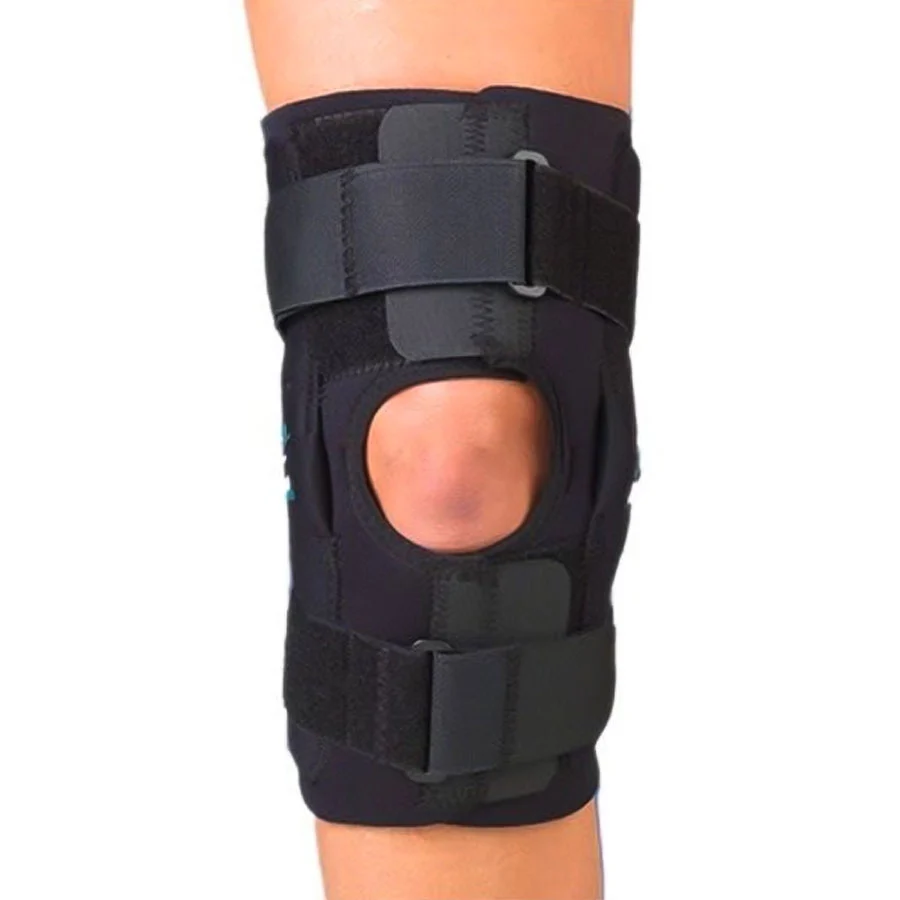
Most knees need help getting through a grocery run, a flight of stairs, or an hour of standing at the sink without buckling.
Orthout built its daily-use line around that gap. The open-patella design uses a silicone ring roughly 5–8cm across and 3–6mm thick, holding your kneecap centered without the pressure point you’d get from a solid pad. Dual side hinges are polycentric and add mild-to-moderate MCL/LCL control. Some models let you dial flexion in 10° increments. This is an adjustable knee brace for people managing arthritis pain or lingering instability.
The shell mixes neoprene and nylon at 2- 4 mm thick, with mesh across the popliteal area to cut down on the sweat-and-fold problem you get behind the knee when you sit for long stretches. Silicone Skinloc strips grip the calf, and user complaints about slipping stay under 20% industry-wide when this feature’s done right.
Sizing runs S to XL, fitting knee circumferences between 30- 55 cm, and the brace works on either leg. Expect 15-25mmHg of compression, enough to feel supported walking to the mailbox without turning your knee into a sauna. This orthopedic knee brace is for walking, chores, and light workouts.
How to Choose the Best Hinged Knee Brace for Your Condition?
Match Support Level to Your Diagnosis
Ligament injuries (ACL/MCL/LCL/PCL) with visible instability need maximum support, including dual metal side stabilizers, rigid frames, and firm compression. Anything softer won’t stop that “giving way” feeling.
Post-surgical recovery needs an adjustable knee brace with ROM hinges, since your surgeon needs to dial in flexion limits over 6‑12 weeks of healing.
Arthritis responds well to moderate support. A knee brace for arthritis doesn’t need rigid framing, just steady compression and mild stabilization for stair‑climbing and standing.
Meniscus tears fall between the two. A knee brace for meniscus tear recovery starts moderate during early weight‑bearing, then transitions to lighter support as pain subsides.
Maximum vs. Standard Support: The Self-Check
Choose maximum support if you’ve felt your knee buckle twice or more in the past month, or if you stand or walk 8+ hours daily with an instability history.
Choose standard support if your main issue is aching or fatigue, not sudden collapse.
Wearing rigid support longer than necessary (3+ months, 6+ hours daily) can weaken quad engagement. Step down support levels as you heal, and don’t get stuck relying on the hardware.
The Sizing Reality Check
Measure both legs at knee center. If numbers differ, size for the larger leg. Use the finger test. One finger should slide in snugly. Two fingers easily? Too loose. Can’t fit any finger, or toes go numb? Too tight, so loosen immediately.
Daily Wearing Guidelines: Balancing Support with Skin & Muscle Health
Preventive vs. functional wear looks different. If you’re using a hinged knee brace for support during runs, sports, or long shifts on your feet, stick to 2–4 hours per activity block. Keep it on another 1–2 hours post-activity to help flush swelling, then take it off. Never sleep in it. Functional braces prescribed after surgery or for severe instability are worn as directed by the doctor, sometimes 8–12 hours daily, but skin checks are non-negotiable throughout.
Watch your skin like it’s telling you something. Indentation marks that linger for more than 30 minutes mean your compression is too tight or you’ve worn it too long. Numbness or tingling past two hours? Take it off. Any blister or broken skin means 24–48 hours brace-free, minimum.
Don’t let the brace do all the work. Quad sets, straight-leg raises, and glute bridges—2–3 sets of 10–15 reps daily—keep your stabilizing muscles engaged instead of dependent on hardware.
Wash after sweaty wear, using cool water under 40°C, mild detergent, air-dry only. Rotate two knee braces if you’re wearing one daily; it doubles the lifespan and keeps skin happier.
Conclusion
Knee pain doesn’t wait for you to figure out the “perfect” hinged knee brace. It shows up on the stairs, during your morning walk, or mid-workday when you least expect it.
Finding the best hinged knee brace means matching real support to your real life. Whether you’re managing arthritis, recovering from an ACL injury, or need a dependable knee brace with side stabilizers for daily wear, the six options above give you a genuine starting point.
Next, measure carefully, consider your activity level, and don’t settle for a hinged knee brace that fights your body instead of working with it.