
A hyperextended elbow can go from “ouch, that’s annoying” to “wait, do I need an ER visit” real quick, and figuring out which one it is in the moment is stressful AF. Maybe you landed wrong during a workout, caught yourself on an outstretched arm, or got tackled a little too hard. Whatever happened, you’re here because you want answers. So let’s break down what’s going on with that joint, how to tell an elbow hyperextension injury from something more serious like a fracture or ligament tear, and the step-by-step plan (RICE, bracing, the whole thing) to get you back to normal without making it worse.
What Is a Hyperextended Elbow?
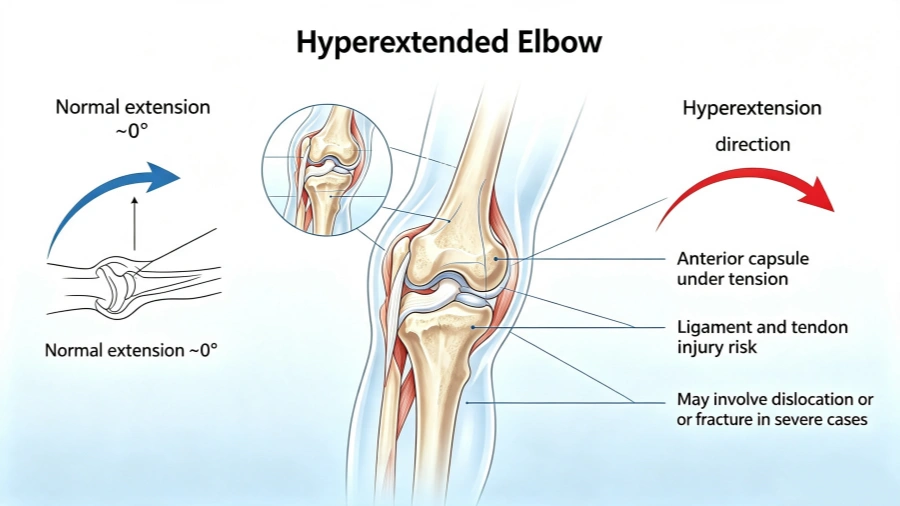
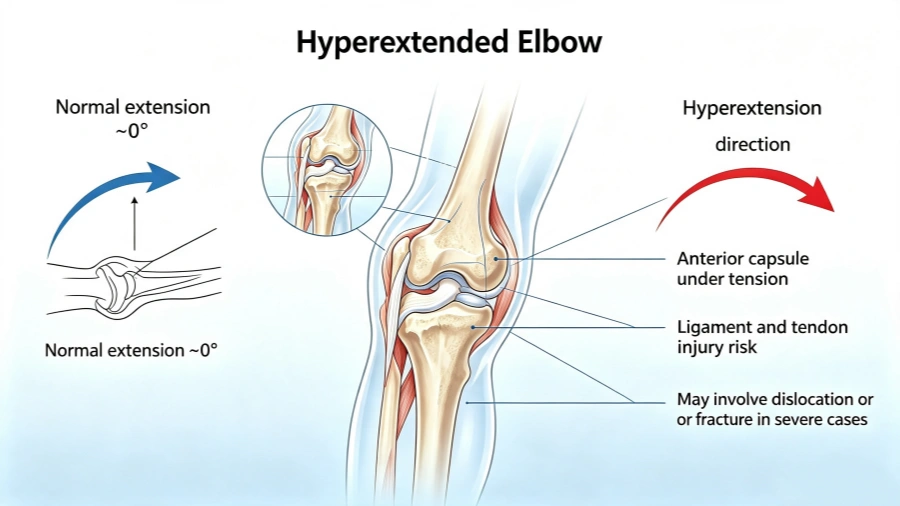
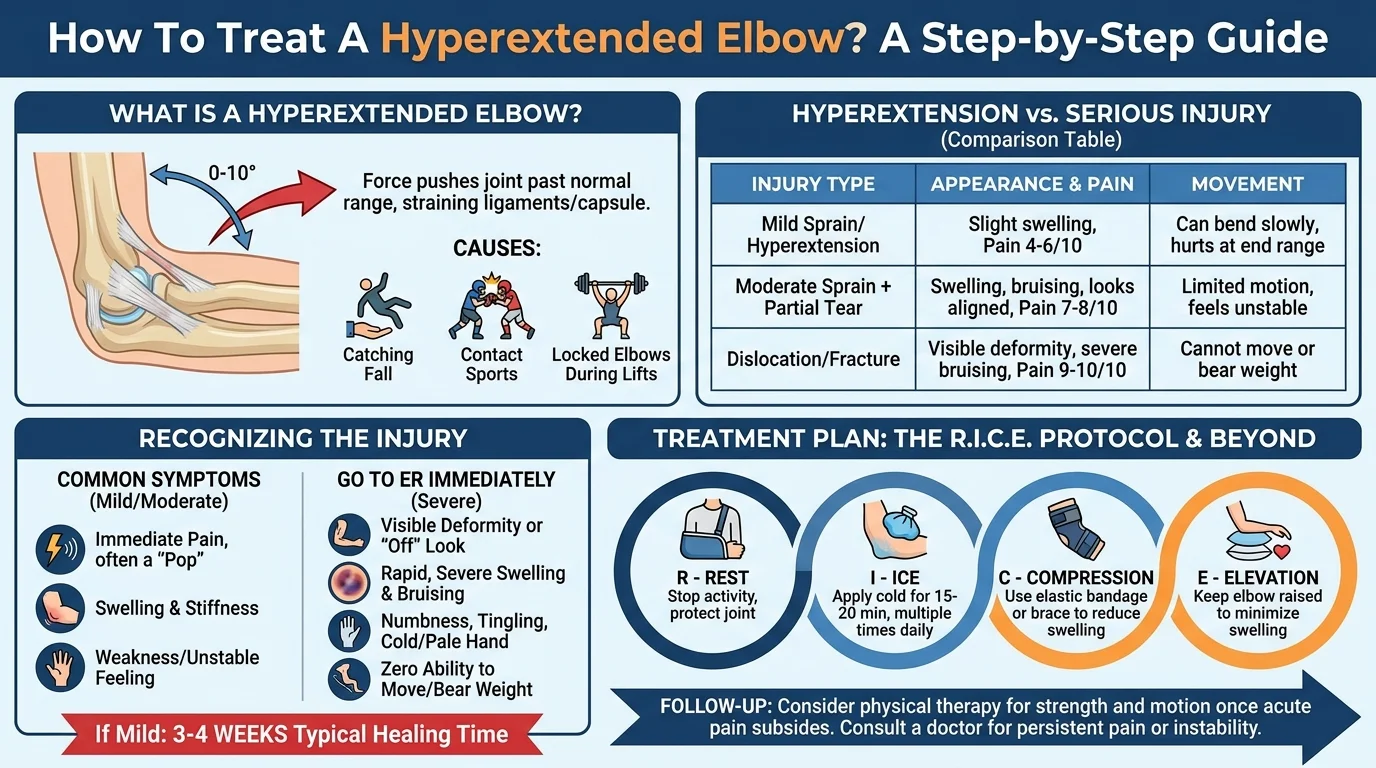
Your elbow is supposed to straighten out to right around 0°—some of us are just naturally bendy and can hit +5° to +10° without issue. A hyperextended elbow occurs when force pushes the joint past your normal range, snapping the anterior capsule, ligaments, and tendons like an overstretched rubber band. In worse cases, you’re looking at a partial tear or even a dislocation/fracture combo.
How a hyperextended elbow usually happens:
– Catching yourself with a flat palm during a fall
– Contact sports (football, rugby, basketball) where someone crashes into your straightened arm
– Lifting with locked elbows during bench press or overhead press
Hyperextended elbow symptoms to watch for:
– Immediate pain, often with a “pop” or crack
– Swelling that builds over hours
– Bruising, redness, or mottled skin
– Stiffness, especially when you try to straighten fully
– Weak grip, a shaky feeling like the joint is “loose” or about to give
– Numbness or tingling in the forearm or hand
Go to the ER immediately if you notice:
– Visible deformity or the arm looks “off”
– Rapid, severe swelling with bad bruising
– Numbness, tingling, or cold, pale, bluish fingers
– Zero ability to move or bear weight
If it’s mild, you’re probably looking at 3-4 weeks to heal.
Hyperextended Elbow vs Dislocation, Fracture & Ligament Tear
|
Injury Type |
Appearance |
Pain Level |
Movement |
|---|---|---|---|
|
Mild hyperextension/sprain |
No visible deformity, slight swelling |
4-6/10 |
Can bend slowly, end-range hurts |
|
Moderate sprain + partial ligament tear |
Swelling, bruising, elbow still looks aligned |
7-8/10 |
Very limited, felt a “pop” |
|
Dislocation |
Visibly deformed, arm looks “off” or shortened |
9-10/10 |
Almost zero active movement |
|
Fracture |
Localized bump/swelling, possible open wound |
8-10/10 |
Severely restricted, painful even passively |
Red flags that mean skip the DIY and go get imaging ASAP:
– Numbness, tingling, or cold/pale fingers
– Zero improvement after 24-48 hours of rest
– Swelling that’s noticeably bigger than your other elbow (measure it, 2cm+ difference is a real signal)
If your elbow ligament damage feels moderate but nothing looks wrong, you’re probably okay to start home treatment. If anything on that list rings a bell, put down the ice pack and call your doctor instead.
When to Seek Urgent Medical Care?
With elbow ligament damage, waiting can turn a fixable injury into a surgical one, so don’t try to ride out these symptoms at home.
Skin that feels tight or shiny, pain that’s worse than the injury looks, or pain from even a light touch all point to compartment syndrome. Any wound still bleeding after 10 straight minutes needs the ER, not urgent care. Fainting, chest pain, or trouble breathing means this has moved past your elbow. Fever, heat, or spreading redness could mean infection rather than simple inflammation.
If none of those apply but you’re still stuck with moderate swelling and pain after 24 hours, book an orthopedic appointment within 72 hours.
Step 1: Acute Phase Care of Hyperextended Elbow (First 24-48 Hours After Injury)
The first 24-48 hours after your injury decide how fast you heal. Follow RICE (Rest, Ice, Compression, Elevation) correctly and you could recover in 3 weeks.
Rest means actually stopping. Don’t test if you can still lift. Pushing through it increases bleeding and swelling internally, which delays everything downstream.
Ice is your best friend right now. Grab an ice pack, wrap it in a damp towel, and apply for 15-20 minutes every 2-3 hours. Never put ice directly on skin; that’s a fast track to frostbite. Keep your elbow slightly bent, like 20-30°, to ease pressure on the joint capsule. Stop the second your skin feels numb or starts burning.
Compression should feel snug, not suffocating. Wrap an elastic bandage from your forearm upward toward your elbow. Check your fingers after 10-15 minutes. If they’re tingling, turning blue, or feel ice-cold, you’ve wrapped it too tight. Loosen it immediately
Elevation just means keeping your elbow above heart level whenever you’re resting. A couple of pillows under your forearm while sitting or lying down does the trick. Pair this with your ice sessions for maximum swelling control.
Step 2: Pain Management of Hyperextended Elbow—OTC Medication Guide and Safety Tips
You don’t need to white-knuckle through this pain while you wait for your appointment. A little OTC medication, used correctly, makes the whole recovery process way more bearable.
Your go-to options:
– Acetaminophen (Tylenol): 500- 1000 mg every 4-6 hours, max 2000mg/day; don’t use it longer than 10 days straight. Gentle on your stomach, great as your “background” pain control.
– Ibuprofen (Advil): 200-400mg every 4-6 hours, max 1200mg/day for OTC use. This one actually tackles the swelling too, not just pain.
– Naproxen (Aleve): 220mg every 8-12 hours, max 660mg/day. Lasts longer, so fewer doses to remember.
– Skip the aspirin—higher bleeding risk, not worth it here.
Alternate acetaminophen and ibuprofen every 3 hours instead of maxing out one drug. Also, take a dose 30-60 minutes before any elbow stretches or PT—it genuinely makes movement less brutal.
Never stack multiple NSAIDs together, and always check cold medicine labels for hidden acetaminophen. If you have stomach issues, kidney problems, or liver concerns, talk to your doctor before any of this.
Step 3: Brace Support of Hyperextended Elbow
How to Choose the Right Elbow Brace to Protect a Hyperextended Elbow?
The brace you need on day one is different from the one on day ten. Two totally different jobs, two totally different products.
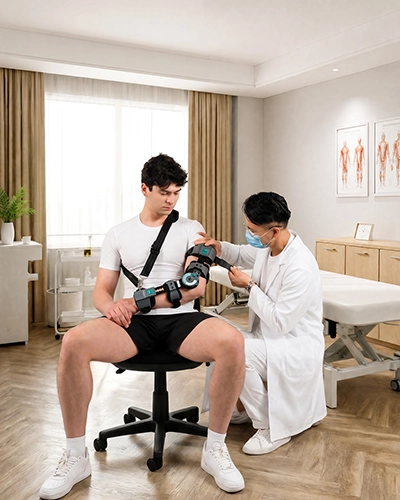
Acute phase (first 48-72 hours): You want a hinged, adjustable elbow brace with metal or hard plastic side supports and a locking hinge. These let you dial in your range from roughly 0° to 120°, which is huge because it physically stops you from re-hyperextending while stuff is still healing. This type cuts joint movement by 20-40%—exactly what an angry ligament needs. Wear it 6-8 hours max per day. Any longer and you risk stiffness.
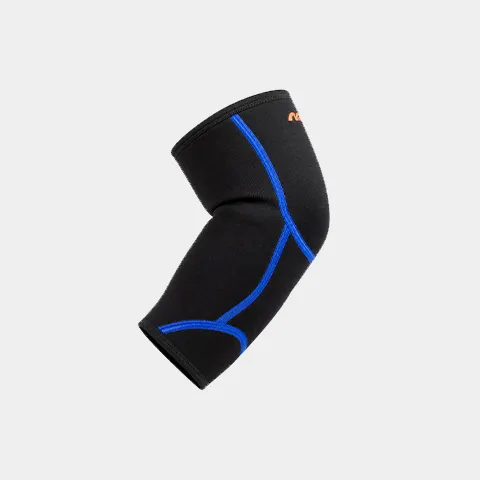
Recovery phase: Switch to an elbow compression sleeve with adjustable straps. It’s less rigid but more supportive and flexible. The even pressure can lower peak tendon strain by 10-30% and, combined with light movement, may shave 1-2 weeks off recovery for mild tendon irritation.
Fit check (do this every time): You should fit one finger width between the brace and your skin. At 90° bend, there shouldn’t be resistance or pinching. During the first hour, check your fingers every 10-15 minutes. If you see any blue, white, numb, or tingling, loosen immediately.
Step 4: The Recovery Phase of Hyperextended Elbow— From Pain Relief to Real Recovery
Mild cases bounce back in 1-2 weeks. Moderate to severe elbow ligament injuries? That can take anywhere from several weeks to a few months, usually paired with physical therapy. But no matter which category you’re in, the goal in this phase shifts from one thing to another: from “just make the pain stop” to “get my arm actually working again.”
Recovery breaks down into four steps:
Start with pain control and protective rest, plus some gentle range-of-motion work (nothing fancy needed)
Once pain is manageable, begin active and passive bending and straightening, along with brief, low-load everyday movements
Gradually wean off the brace and move into functional training — light grip exercises that mimic daily activities
Only wear the brace for high-risk activities, with the focus now on preventing re-injury
Take the brace off gradually; don’t just rip it off all at once. Once the swelling’s gone down and your arm doesn’t feel “unstable” during normal activity, switch to wearing it only during activity instead of round the clock.
The most important rule: Let how you feel guide your progress, not the calendar. Feeling tired or a little sore? That’s fine, keep going. Sharp pain? Stop right away — that’s your body telling you to back off, so don’t push through it. If the pain gets worse after activity, things feel unstable, or the swelling comes back, that’s a sign you’re progressing too fast. Slow down, reassess, and then keep moving forward.
Step 5: Rehab Training of Hyperextended Elbow
Once your doctor or PT gives the green light, hyperextended elbow rehab follows a specific order for a reason—skip steps, and you’re gambling with re-injury.
The progression:
Passive range of motion (PROM): Your therapist or a partner moves the joint for you. This is for the early “it’s still stiff and cranky” stage.
Active-assisted (AAROM): You start doing the work, but with a little help. Training wheels for your elbow.
Active range of motion (AROM): You’re moving it solo now—bending, straightening, gentle rotation—as long as nothing’s screaming in pain.
Resistance band work: Once basic strength comes back, add light bands. Start low and add reps or resistance gradually. Don’t jump straight to the heavy stuff.
Strength rebuilding: Grip squeezes, light functional movements, eventually working back up to normal load.
Full return-to-sport timelines for elbow ligament damage run 8-16 weeks for moderate injuries, but more serious ligament tears can stretch to 7-12 months, especially if you’re getting back into contact sports or lifting.
Your PT should be tracking swelling, pain, and range of motion the whole time. Progress too fast, you risk a setback. Too slow, you’re losing function you don’t need to lose.
Conclusion
A hyperextended elbow feels scary in the moment, but with the right approach, most people bounce back stronger than ever. Ice it early, protect it smart, and don’t rush the comeback. Skipping RICE or ditching your brace too soon turns a minor elbow hyperextension into a nagging, months-long problem.
Your elbow ligaments need support to heal correctly, not just rest. That’s why a quality hyperextended elbow brace is non-negotiable. It stabilizes the joint while you regain strength.
If you’re still favoring that arm or feeling instability after a few days, don’t wait it out. Get evaluated and grab an elbow brace that fits your recovery stage.