
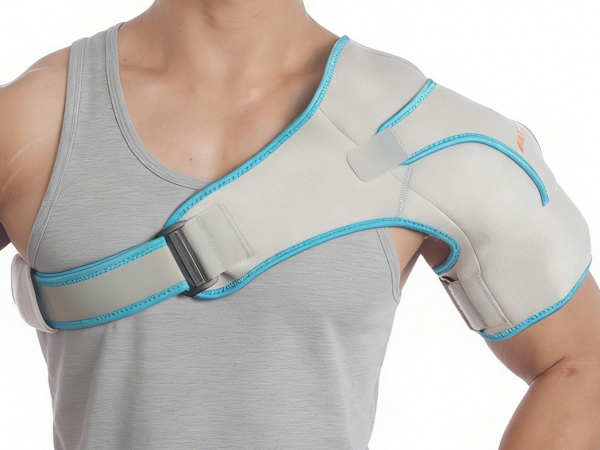
Whether you’re rehabbing a rotator cuff tear, managing arthritis flare-ups, or just trying to keep your shoulder stable through another training cycle, the right shoulder brace makes a measurable difference. The wrong one can set you back weeks.
We tested and compared six of the best shoulder compression sleeves for 2026, from budget-friendly daily wear to a rotator cuff support brace built for serious medical-grade compression. Stick around for the sizing breakdown and compression-level guide. It’ll save you from an expensive return.
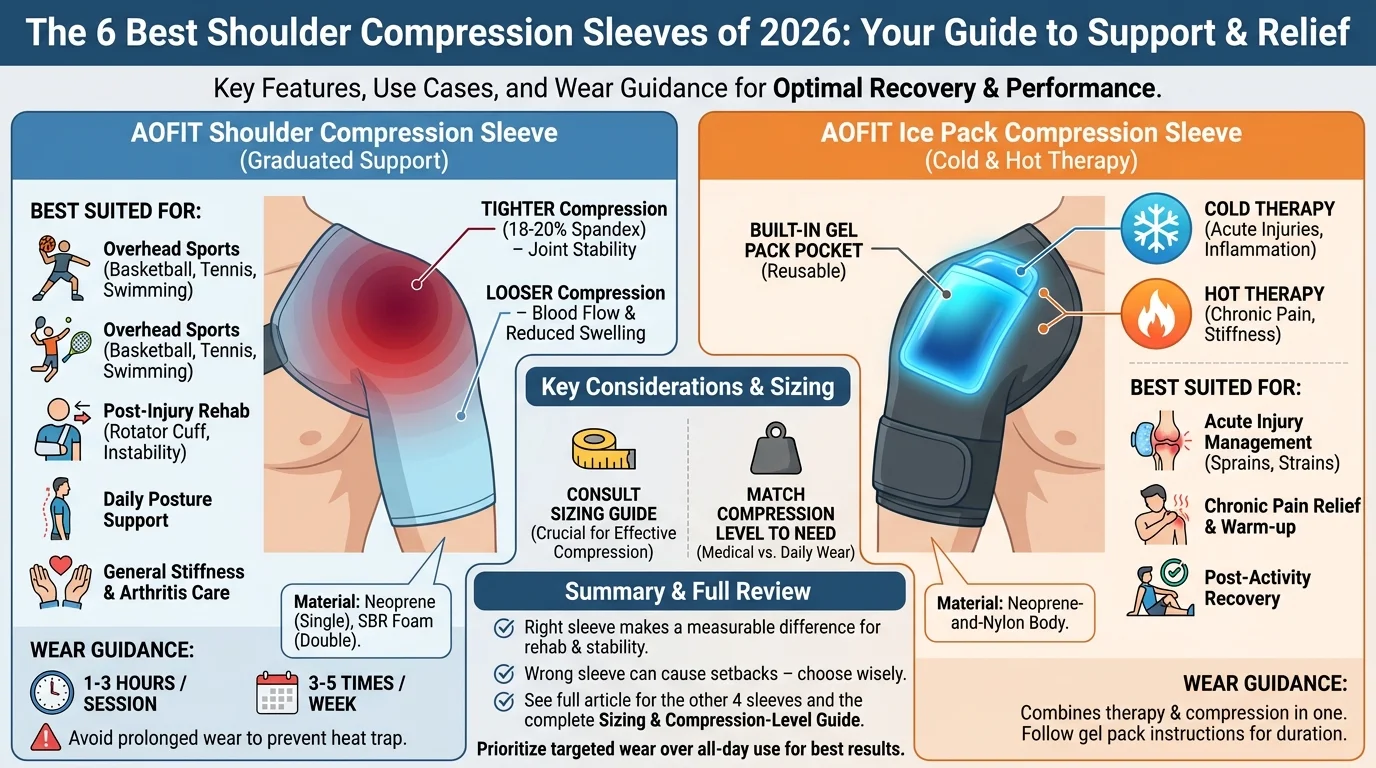
AOFIT Shoulder Compression Sleeve
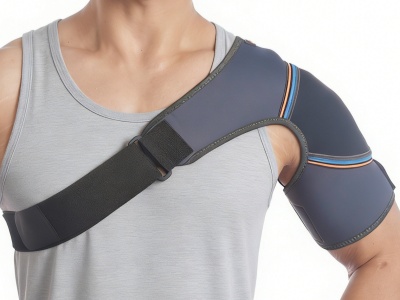
Most compression sleeves apply pressure the same way from top to bottom. AOFIT doesn’t. This shoulder compression sleeve uses a graduated compression build — tighter near the shoulder joint, looser toward the upper arm — so blood flow keeps moving while the joint itself stays locked down.
The single-sleeve version runs on neoprene, while the double-shoulder model switches to SBR foam for a softer, more flexible feel across both sides. Either way, you’re looking at a legitimate rotator cuff support brace rather than a generic arm wrap.
The compression zoning matters more than it sounds. Near the shoulder, the fabric blend leans heavier on spandex — think 18-20% in that region — which tightens the grip exactly where rotator cuff tears, frozen shoulder, and labrum strain need it most. Moving down toward the elbow, that percentage drops, easing pressure and cutting down on swelling during longer wear.
Best suited for:
Basketball, tennis, swimming, and other overhead-motion sports
Post-injury rehab for rotator cuff and shoulder instability
Daily posture support for rounded shoulders or upper-cross issues
Family caregiving situations — arthritic shoulders, general stiffness
Wear guidance:
Stick to 1-3 hour sessions, 3-5 times weekly if you’re training hard. Push past that window, and the neoprene traps heat just like every other neoprene shoulder support on this list. It’s a shoulder pain relief sleeve built for targeted wear, not all-day marathon sessions.
AOFIT Ice Pack Compression Shoulder Sleeve (Cold & Hot Compression Shoulder Support)
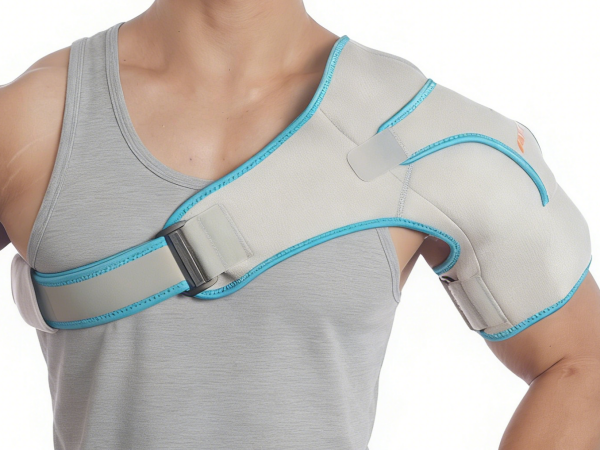
Ice and compression solve two different problems, and this AOFIT shoulder compression sleeve tackles both at once. Instead of juggling a separate ice bag and an elastic wrap, you get a neoprene-and-nylon compression body with a built-in pocket that holds a reusable gel pack. It’s a smarter setup for anyone managing a fresh injury.
The gel pack itself uses a non-toxic, deionized water gel that withstands repeated freezing and microwave heating without splitting. One side is soft Lycra for direct skin contact, the other silky nylon for deeper cold penetration. Frozen at around -18°C, it holds effective low temps for 20–30 minutes, stretching to 30–40 minutes at room temperature. Lab testing on comparable gel packs shows 200–300 freeze/heat cycles before failure, roughly 1–2 years of regular use.
For acute injuries (first 48 hours): freeze the pack at least 2 hours, tuck it into the sleeve, tighten the compression straps to snug-but-not-numbing, and ice for 15–20 minutes every 1–2 hours, 3–5 times daily. After 48 hours, alternate 10–15 minutes cold with 10–15 minutes heat if swelling has settled.
Skip direct cold on open wounds or if you have poor circulation. Shorten sessions to 10–15 minutes instead. Expect to pay $25–45, a 50–75% premium over plain compression sleeves, but the dual cold-and-stability function earns that back fast during acute recovery.
DOACT Adjustable Shoulder Support Brace
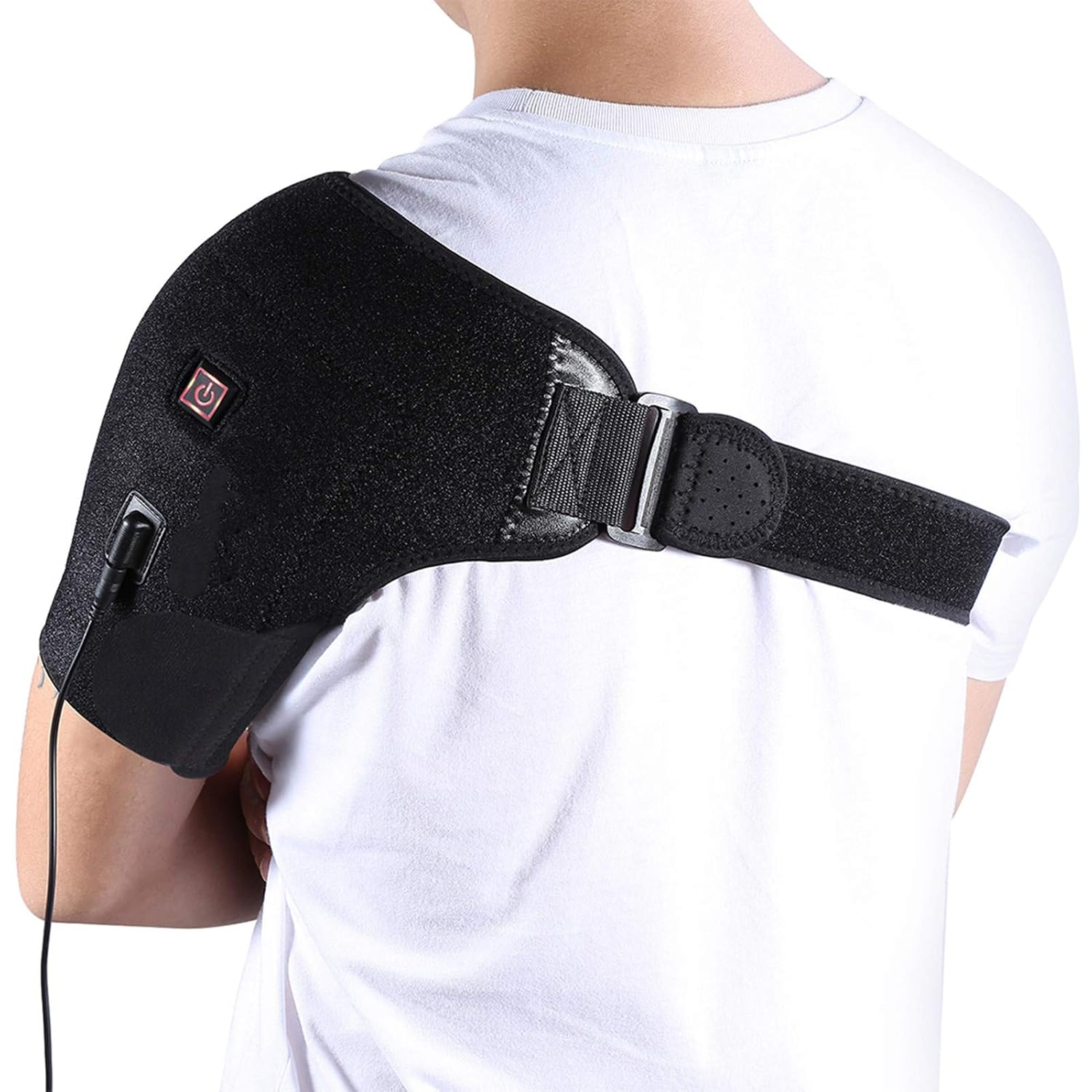
DOACT keeps its braces in the US$19–29 range, and the shoulder compression sleeve follows that same pricing while still delivering genuine compression support. You’re getting a practical shoulder stability brace without spending a fortune.
DOACT Shoulder Brace uses 2–4mm neoprene with a perforated inner layer, so it stretches and breathes better than the stiff, non-adjustable options crowding most listings. Nylon straps with hook-and-loop closures let you dial in tension across the chest and upper arm independently — a setup that works well as an adjustable shoulder support for rotator cuff strain, AC joint bruising, MDI instability, or frozen shoulder.
The symmetric design flips to fit either shoulder, which matters if you’re shopping for a household with more than one recovering joint.
What users report:
Pain relief within minutes of wearing, especially for nighttime discomfort
Solid lockdown on risky ranges of motion during daily tasks
Soft neoprene that doesn’t chafe skin over repeated wear
Where it falls short:
Sizing runs tight for broader shoulders; slimmer arms may see the upper strap slip
Two-handed setup — awkward to adjust solo on the first few tries
Heat builds up past the two-hour mark, so plan for breaks during summer wear
Body Helix Adjustable Shoulder Compression Sleeve
Skip the neoprene entirely, and you get Body Helix. This one uses a proprietary stretch fabric instead, delivering medical-grade compression at 20–30 mmHg, the same range doctors prescribe for compression socks. That’s a meaningful jump from the neoprene sleeves above, and it makes this the closest thing to a clinical-grade rotator cuff support brace on this list.
The fabric uses Form Fit Technology, so the more you sweat, the tighter it grips. One reviewer said, “it moves with me.” That’s the opposite of how most adjustable shoulder support braces behave once they get damp.
It’s built for real overhead stress. A gymnast tested it through 50 consecutive overhead circles with no slipping, no readjusting, and full mobility intact. A pickleball player cut the back strap for a tighter fit and returned to play pain-free within four weeks. The company doubles as an arthritis shoulder brace, treating AC joint pain, frozen shoulder, and bicipital tendonitis alongside rotator cuff strains.
It’s a single, adjustable one-size design with no separate S/M/L options and no plus-size version yet. The hook-and-loop strap does the fitting work, and you can trim it down for a smaller frame. The company recommends rotator cuff surgery patients and shoulder replacement recoveries as ideal daily-wear candidates. Consistent athlete testimonials point toward genuine stability without sacrificing range of motion.
Anaconda Shoulder Compression Sleeve (Lightweight Everyday Compression Sleeve)
Thick neoprene traps heat, so Anaconda built its solution around that problem. The Anaconda shoulder compression sleeve uses a polyester-nylon-spandex blend from the same 3D-knitted line as the brand’s other braces. The sleeve stretches freely, without the stifling effect of dense foam.
The 3D compression knit gives you even, wraparound support without rigid panels, so you can do presses, overhead lifts, and rotational moves without restriction. It fits either shoulder (no left/right version) and is machine washable on a normal cycle and air-dry, low-maintenance for daily wear.
One YouTube reviewer put it bluntly, saying it “breathes really well” and stays “stretchy,” a direct contrast to the “super thick neoprene” they’d worn before. After three weeks of regular use, they called it the most comfortable brace they’d tried.
Anaconda’s own guidance confirms that trapped heat and sweat cause slippage and skin irritation, so the breathable, mesh-lined construction is essential.
Retail is $39.99 solo, $69 for a two-pack. For acute tears, you’d need a heavy-duty rotator cuff support brace. This sleeve is built for extended training sessions and everyday stiffness, where staying cool matters as much as staying supported.
Bauerfeind Medical Shoulder Compression Brace
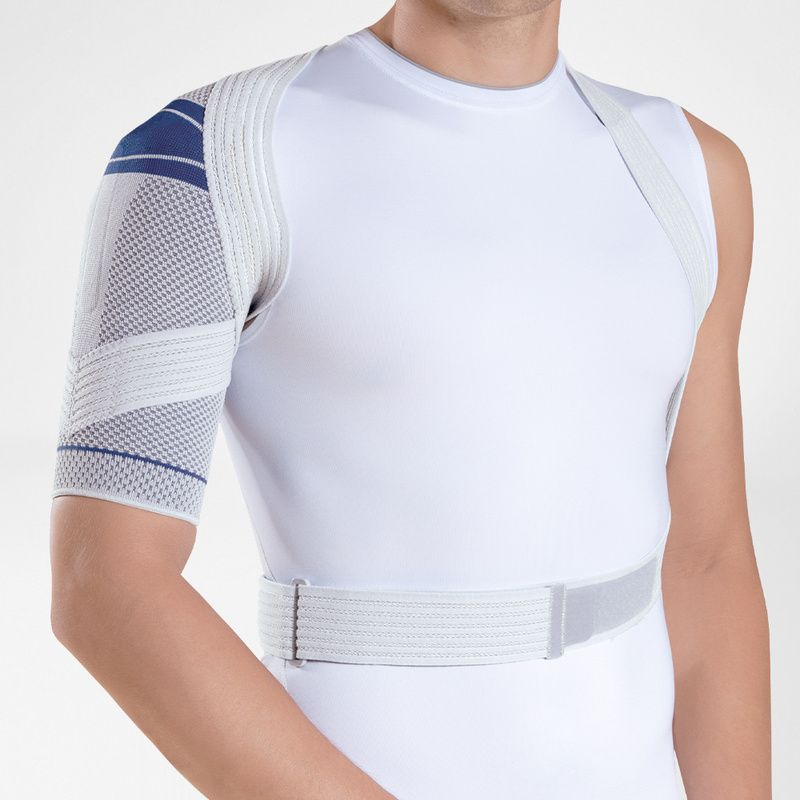
Germany’s Bauerfeind builds orthopedic devices for hospitals — the OmoTrain is a good example. This is a shoulder compression sleeve engineered as a true medical device, sitting at Medical Class 1, the same compression range clinicians use for moderate venous and lymphatic issues. That number matters: Bauerfeind’s own venous compression research shows 18–21 mmHg reduces calf swelling by 7.6% versus 1.5% at 8–10 mmHg, and cuts congestion symptoms by 75–80%. OmoTrain sits right in that effective zone, scaled for the shoulder joint.
The design backs up the number. A viscoelastic insert, repositionable via Velcro, delivers targeted massage-like pressure over the acromion. A rigid D-loop connects to a chest strap, forming a triangulated pull that limits excessive abduction — real mechanical stability, not just fabric tension.
Across Bauerfeind’s Train line, similar structures have driven documented outcomes: ManuTrain wrist braces cut pain scores 43% with zero adverse events; CoxaTrain hip braces reduced pain 47.7%. That’s the clinical pedigree behind this rotator cuff support brace.
Expect to pay $150–300, several times more than neoprene competitors. It’s built for post-surgical recovery, chronic arthritis, and recurrent instability — cases where a doctor’s prescription, not a gym budget, is driving the purchase.
How to Choose the Best Shoulder Compression Sleeve for Your Condition?
Compression Level Selection
Compression is measured in mmHg, and the right range depends on your problem, not your pain tolerance.
The basic tiers:
8–15 mmHg (Light) — muscle fatigue, mild soreness, long flights, everyday light support
15–20 mmHg (Class I) — early venous issues, standing jobs, the standard no-prescription starting point
20–30 mmHg (Class II) — post-surgical support, moderate venous problems, the range most doctors actually prescribe
30–40 mmHg (Class III) — severe cases, usually under specialist supervision
For a rotator cuff support brace, there’s no official mmHg standard like there is for venous compression. The safe rule: start at 8–15 or 15–20 mmHg for swelling control or post-op comfort. Jump straight to high compression on an inflamed joint, and you risk more harm than help.
Same caution applies to a shoulder brace for dislocation. Acute swelling needs light-to-moderate pressure, roughly 8–20 mmHg. Sharp pain, visible deformity, numbness, or discoloration means stop and see a doctor — compression won’t fix that.
Warning signs of overcompression: numbness, tingling, skin discoloration, cold fingers, pain that gets worse. If any of these show up, loosen the shoulder compression sleeve, check the sizing, and restart one level lower once symptoms clear.
Sizing & Fit Guide
Grab a soft tape measure before you buy a shoulder compression sleeve. You need two numbers: your chest circumference and your upper arm circumference. Most sizing charts for a shoulder compression sleeve or rotator cuff support brace are built around these.
Measure the chest standing naturally, tape level across your back and through the fullest point of your chest. Don’t inhale deeply or puff up — that inflates the number by 2-4 cm and leaves you with a sleeve that slides. Take it twice and average the result.
Measure the upper arm at its thickest point, usually 3-5 cm below the shoulder, arm relaxed. Flexing while measuring adds 1-2 cm of false bulk, which means a loose fit once you relax.
Watch for these fit problems:
Too tight: numbness, tingling, skin discoloration, or a groove left after removal
Too loose: sleeve rotates or slides down during arm movement, compression feels inconsistent
Brands vary in sizing by 2-4 cm at the same label size, so check the actual measurement chart. If you’re between sizes on an adjustable shoulder support, size down and use straps to fine-tune.
Material & Use Case Matching
Two materials dominate this category, and they solve opposite problems. Pick based on your actual use case.
Neoprene runs 3–7mm thick with a Shore A hardness of 40–60. That density gives it real structural stiffness, enough to create localized compression equivalent to 20+ mmHg even without a fancy graduated design. It’s also nearly airtight, with moisture vapor transmission often under 5,000 g/m²/24h. So it’s excellent for short, high-intensity sessions where joint restriction matters more than comfort, and terrible for sleeping in.
Nylon/spandex blends flip that equation. Lighter fabric weight (150–350 g/m²), spandex content in the 5–20% range, and moisture transmission that can hit 8,000–15,000 g/m²/24h. You lose some rigid support, but you gain a shoulder brace for sleeping that won’t trap heat against your skin for eight hours straight.
Quick matching rule:
Contact sports, heavy lifting, acute instability → neoprene, accept the heat trade-off
All-day wear, sleep, mild arthritis, humid climates → nylon/spandex, target 10–20 mmHg
Hybrid needs → neoprene shell with a mesh inner lining, keeping skin contact breathable while the outer structure still locks down the joint
Conclusion
The six options we’ve covered here cover every scenario, from Bauerfeind’s medical-grade support for serious rotator cuff issues to AOFIT’s ice pack sleeve for swelling flare-ups. Match your specific situation to the right pick and stop losing sleep over shoulder pain.