
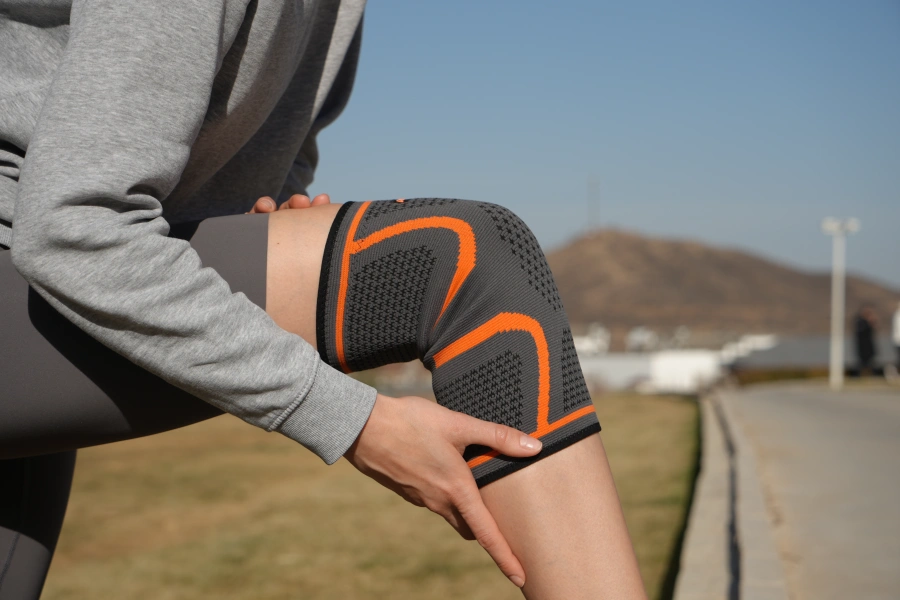
Your knee starts filing strongly worded complaints at mile three of your run and rep forty of your squat set. That’s the moment people start Googling “best knee compression sleeve” at 2 am, hoping some combination of neoprene and copper thread can undo what gravity, cartilage wear, or last week’s pickup basketball game have been doing to their joints. A well-designed knee compression sleeve improves circulation, curbs swelling, and gives a wobbly knee some much-needed proprioceptive backup. You then need to figure out which of the infinite options online matches your specific knee issue—meniscus tear, heavy lifting, or all-day joint pain. We tested eight of the most talked-about knee support sleeves so you don’t have to fall that rabbit hole yourself.
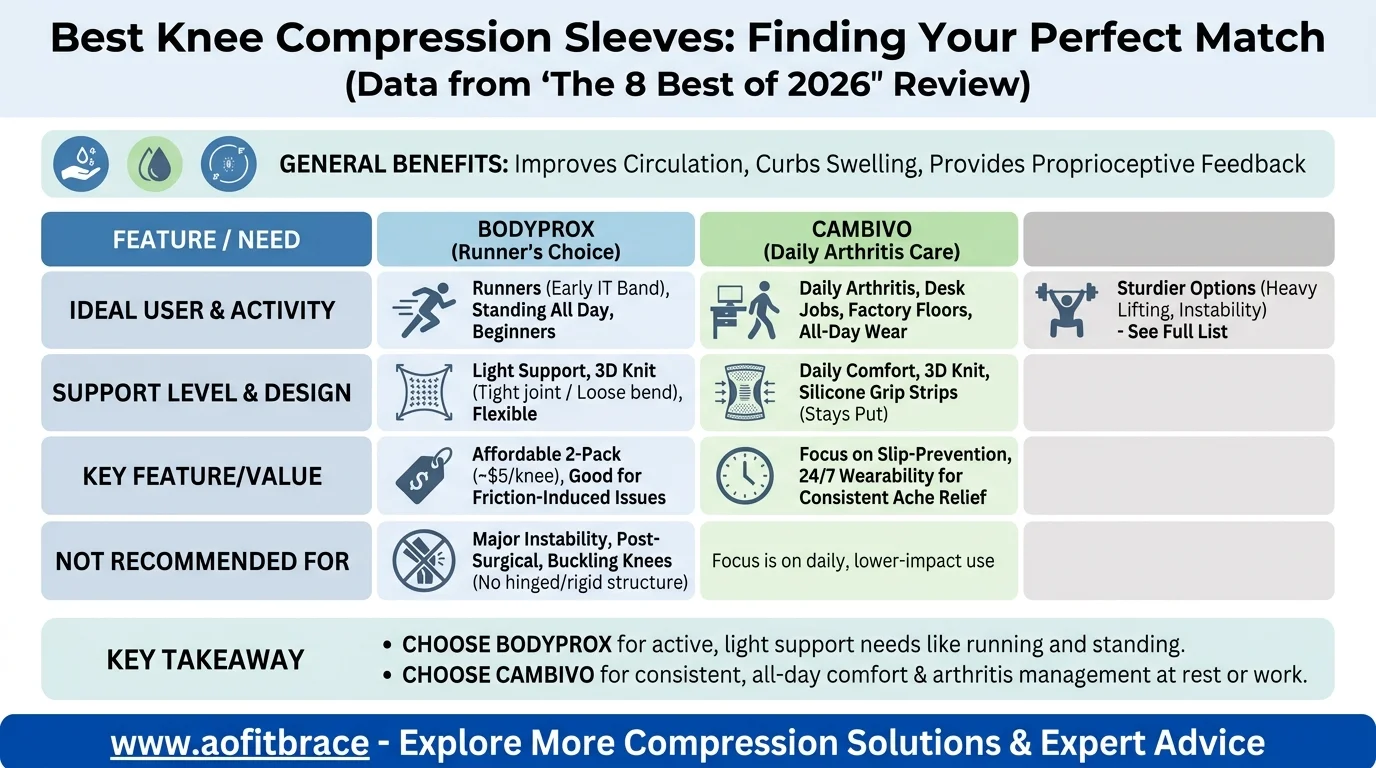
Bodyprox Knee Compression Sleeve——Top choice for runners
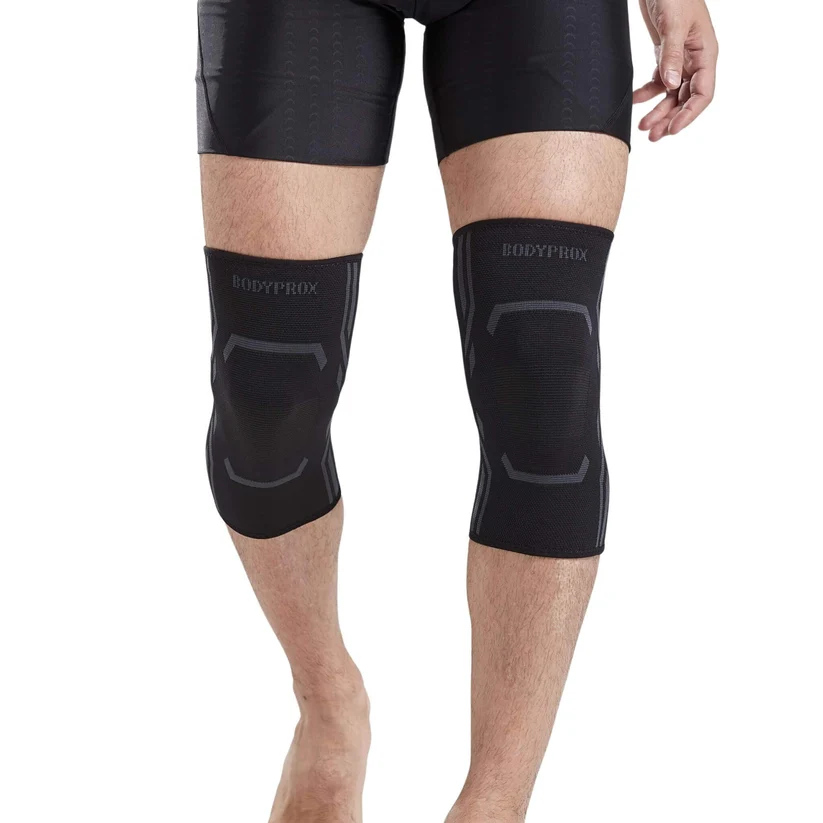
Buy the Bodyprox knee compression sleeve two-pack for $10.10, and you’re paying about $5 per knee, except this actually helps your joints. That’s the whole pitch. This is a light support compression sleeve, not a rigid brace, built with a 3D knit that tightens around the joint and loosens at the bend points so you can run in it without feeling like your leg is in a tube sock fight.
Who it’s for:
- Runners managing early-stage IT band syndrome. The compression won’t fix your biomechanics, but it does dial down the friction-induced grumbling on your outer knee.
- People who stand all day at work and want mild joint support.
- Anyone testing the compression-sleeve waters before committing to something pricier.
Where it falls short: if your knee is doing something dramatic—post-surgical, unstable, buckling mid-stride—this sleeve is the wrong tool. It promotes blood flow and adds mild proprioceptive feedback, but it has zero hinges, zero rigid structure, and zero interest in stopping a knee that wants to give out sideways. For that, you need one of the sturdier options further down this list.
CAMBIVO Knee Compression Sleeve——Daily Arthritis Care, 24/7
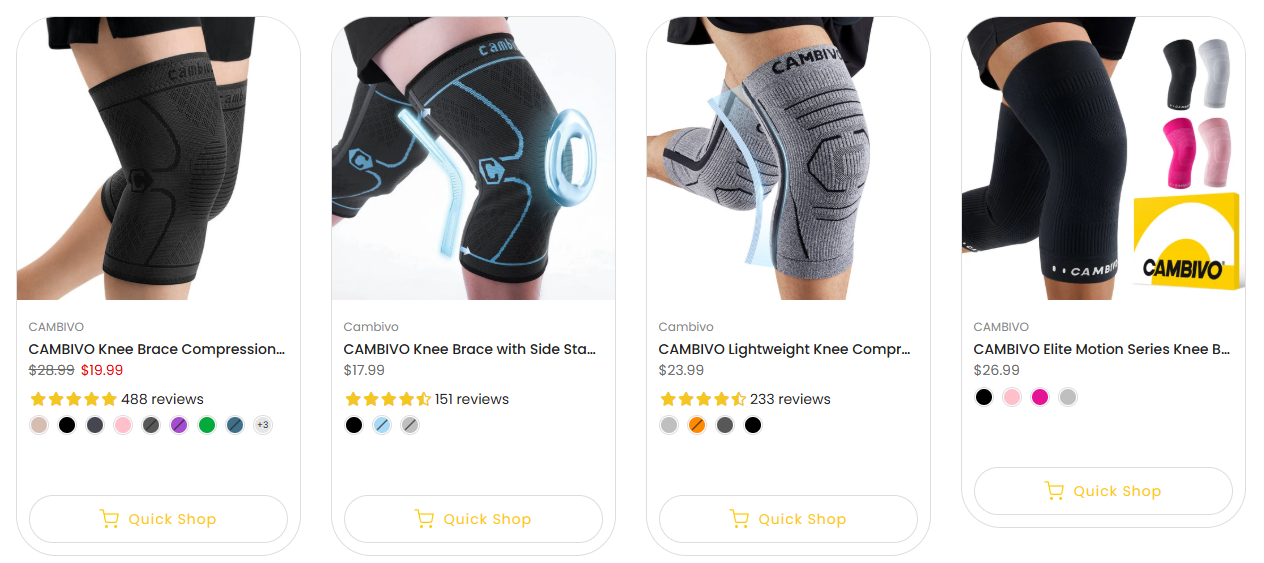
Two silicone strips stay put—that’s their one job. That’s the whole engineering philosophy behind the CAMBIVO knee compression sleeve, and it works surprisingly well if your knee aches by 3 p.m. and again around 9.
This is a knee compression sleeve for joint pain built for people who sit at desks, walk factory floors, or just have arthritis that doesn’t care what you’re doing. The 3D knit fabric (roughly 65% nylon, 20% latex, 15% spandex) is thin enough to disappear under work pants, which matters more than it sounds like it should. A thick neoprene knee sleeve turns into a sweaty tourniquet by hour six. This knee compression sleeve doesn’t.
The silicone-strip trick
– Two gel bands sit at the top and grip your skin.
– They prevent the classic sleeve-slide during stairs, sitting, or long walks.
– No hard bands means no pressure grooves after all-day wear.
CAMBIVO never publishes an mmHg number, but wearers consistently describe it as tighter than a pharmacy sleeve and gentler than a dedicated athletic compression sleeve for swelling, landing somewhere around 15–25 mmHg by inference. That’s the sweet spot for reducing stiffness and inflammation without the numbness that comes from over-squeezing an already unhappy joint.
Sold as a 2-pack in multiple colors and sizes S–XXXL, it is consistently flagged by outlets like Health.com as the budget pick for daily arthritis management. It’s a reliable sleeve for the other 23 hours of your day.
RKN-203 Orlett——The Top Choice of Medical-Grade Compression Support

The RKN-203 Orlett sits in a category most best-of lists skip because it doesn’t fit the usual sporty-or-cozy spectrum. It has metal hinges and a Russian medical device registration number.
Orlett classifies it as “сильная фиксация” (strong fixation), their highest stability tier, for knees that have genuinely failed at their job: post-cast stabilization, secondary rehab after meniscus or ligament surgery, or grade I–II osteoarthritis that needs more than encouragement.
The metal hinges guide flexion and extension, blocking lateral wobble and rotation that fabric sleeves can’t stop. A multi-panel segmented construction lets clinicians dial fixation up or down, partial or full immobilization, as recovery progresses. Front paneling and circumferential compression (estimated 20–30 mmHg) stabilize kneecap tracking to target patellofemoral pain syndrome.
It’s neoprene, which retains heat well—great for chronic stiffness, less great for acute swelling that needs to cool down. The manual explicitly warns against use when “thermal effect is contraindicated.” Pricing reflects the medical-grade positioning: the elastic L-size version runs about 9,073–9,074 rubles, with the hinged pediatric model starting at 6,790 rubles—both comfortably in the mid-to-high end of the orthopedic brace market.
This is a knee brace for pain relief built for prescription-level decisions. Anyone managing post-surgical recovery, diabetic neuropathy, or circulation issues should get a doctor’s input before locking those hinges into place.
Push med Patella Brace——Specific for Patella Tracking and Tendon Pain
The Push Med Patella Brace is a single strap with one specific job: pressing a viscoelastic polymer pad into your patellar tendon, right below the kneecap, until the patella tilts slightly backward. That tiny angle change is the whole trick. Less friction on the cartilage behind your kneecap, less tugging through the quad-tendon-shin chain with every step.
This is a knee stability brace built for patellofemoral pain syndrome, jumper’s knee, patellar tendinitis, and Osgood-Schlatter, not for anything involving actual ligament drama.
Fit and feel:
A semi-rigid front cap spreads pressure evenly instead of digging into one spot. The Velcro strap wraps behind the calf, so you can crank it tighter for runs and loosen it for sitting. No hinges, no full coverage—it sits at roughly 3-5mm thick, thin enough to disappear under running tights with zero sweaty knee-pit syndrome. Sympress™ fiber lining stays dry during long runs or training blocks.
Price: £45-£60 (~¥400-550). That’s mid-to-high for a single-strap patella band, but a third of what its hinged sibling, the Push Med Knee Brace, costs.
Where it stops being enough: if your knee buckles sideways, you’ve got ligament damage, or you’re dealing with a meniscus tear, this strap won’t help. It doesn’t stabilize rotation or lateral movement. It just calms down an angry tendon. For anything beyond soft-tissue overload, you need hinges.
ABYON Elite Knee Sleeve——The Best Choice for High-Intensity Training
Four steel springs, an X-shaped strap system, and a gel pad shaped like a tiny targeting reticle. What happens when you treat knee stability like a mechanical engineering problem instead of a comfort accessory? That’s the thinking behind the ABYON Elite, also sold as the “Knee Support with 4-way Adjustable Non-Slip Strap System and Side Stabilizers.”
The fabric math: Neoprene (25–36.5%) plus Spandex (4.5–8.5%) plus a Nylon/Polyester backbone gives you 20–30 mmHg of compression. That’s well past a gentle hug and into knee-sleeve-for-weightlifting territory. CrossFit athletes use this same tier to keep squats and Olympic lifts from turning into lateral wobble festivals. Side-mounted springs (2–4 per side) resist the inward/outward buckling that can turn a heavy deadlift into an ER visit.
Sizing is the real flex here: S/M starts at 34 cm thigh circumference, and 4XL/5XL stretches to 68 cm. It’s one of the few sleeves explicitly built for larger-bodied lifters, not just average gym-goers.
The tradeoff: Neoprene traps heat. Great for warming up stiff joints before a lifting session, less great if you plan to wear it past hour six. This is a train-then-remove sleeve, not an all-day one.
NativoDex Compression Knee Sleeve——Budget-friendly entry-level model
NativoDex sells single sleeves, not pairs—a pricing choice that doubles as a psychology hack. Buying one lets you test the whole compression premise (“does squeezing my knee actually help?”) without committing to a matched set.
The engineering behind the price tag:
- Fabric: nylon + elastane + rubber (some listings say neoprene + silicone), entry-level, basic support only.
- Structure: single-layer knit with anatomical compression points near the meniscus and ligament zones. No gradient compression, no multi-panel architecture.
- Breathability: described as not very breathable. Lighter colorways exist to offset heat buildup, which tells you everything about the fabric’s ventilation science.
Who it fits: people with mild knee soreness from stairs or commuting, beginner runners or cyclists wanting a basic knee compression sleeve for reassurance, and anyone testing whether knee compression sleeves for swelling actually change how their joint feels before spending more.
The catch: at 3–4 uses a week, expect noticeable compression loss within 3–6 months as the elastane fatigues. Push it into weightlifting or jump training, and that timeline shrinks to 1–3 months. It’s a starter sleeve, not a season-long companion—wash it by hand, skip the machine, and don’t expect it to outlast your actual knee problem.
Full-Leg Compression Sleeve (Ortorex)——Specifically for swelling and circulation issues
If you sit at a desk or stand on concrete for eight hours, your veins start losing that fight. The Ortorex full-leg compression sleeve helps them fight back.
The gradient starts at 100% pressure at the ankle, tapers to about 70% at the calf, 50% at the knee, and 20–40% at the thigh. That gradual decrease pushes venous blood upward through perforator veins into the deep venous system, using your calf muscles as a secondary pump. In sports-recovery terms, that means roughly 18–25 mmHg at the ankle, tapering 3–5 mmHg per 10 cm up the leg.
Desk-bound professionals fighting end-of-day swelling, runners managing post-training fluid buildup, and anyone dealing with varicose-vein aches, tingling, or cramping after standing too long should consider this knee compression sleeve.
This knee compression sleeve handles swelling. It won’t stop lateral wobble or protect a torn meniscus. Pair it with a hinged sleeve if your knee is the actual problem.
AOFIT Compression Knee Sleeve——The All-in-One Choice for Multi-Sport Scenarios
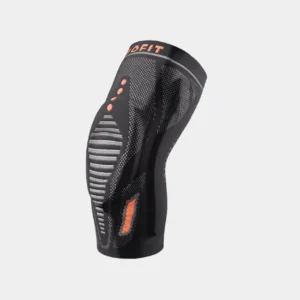
One knee compression sleeve, six sports, zero identity crisis. Check the specs, and you’ll see it works across all six.
The engineering uses a 3D compression knit (nylon/elastic blend) that wraps the joint at roughly 15–20 mmHg—medium compression, the same tier serious runners and gym regulars gravitate toward. A single sleeve weighs about 130 g; the pair comes in around 260 g, light enough that you forget it’s there by mile two. An open-patella design with a silicone gel ring circles the kneecap and keeps it from sliding sideways during cuts, jumps, or awkward lunges. This is useful whether you’re buying a knee sleeve for basketball or managing recovery from a meniscus tear.
AOFIT knee compression sleeve has no rigid hinges or metal stays. The sleeve uses a flexible knit that provides compression without stabilizing severe injuries like ACL tears, heavy effusion, or contact-sport collisions. Priced $10–25, it’s the rare sleeve that’s genuinely fine for basketball on Monday and hiking on Saturday.
The Quick Comparison Table: All 8 Knee Compression Sleeves at a Glance
| Knee Compression Sleeve | Type | Best For | Compression | Price |
|---|---|---|---|---|
| Bodyprox | Knit sleeve | Running, standing all day | Light (10–15 mmHg) | ~$5/knee |
| CAMBIVO | Knit sleeve | Daily arthritis, desk work | Medium (15–25 mmHg) | Budget 2-pack |
| RKN-203 Orlett | Hinged medical brace | Post-surgery, grade I–II OA | Firm (20–30 mmHg) | ~9,073rubles |
| Push med Patella Brace | Strap-style | Patellar tendinitis | N/A (targeted pressure) | £45–£60 |
| ABYON Elite | Spring-supported sleeve | Weightlifting, CrossFit | Firm (20–30 mmHg) | Mid-range |
| NativoDex | Entry sleeve | Mild soreness, testing compression | Basic, no gradient | €7.99–€8.00 |
| Ortorex Full-Leg | Gradient sleeve | Swelling, circulation | Firm, tapered (18–25 mmHg) | Mid-range |
| AOFIT | Multi-sport knee compression sleeve | Basketball, hiking, meniscus recovery | Medium (15–20 mmHg) | $10–$25 |
How to Choose the Best Knee Compression Sleeve?
Compression Level: Three-Tier Logic
| Your Condition | Recommended Compression Level | mmHg Range | Daily Wear Advice |
|---|---|---|---|
| Mild daily soreness, prolonged sitting, beginner running | Mild | 5–15 mmHg | 3–8 hours |
| Running/fitness, old injury, or mild instability | Moderate | 15–20 mmHg | 3–5 hours |
| Post‑surgery, severe degeneration, obvious instability | Strong medical‑grade | 15–30 mmHg | 2–4 hours initially, then adjust gradually |
Choose the Structure by Scenario
-
Running / outdoor: Lightweight knit with silicone anti‑slip strips (approx. 1–2 cm wide), fabric weight 150–250 g/m², prioritize breathability.
-
Arthritis / prolonged sitting: Soft low‑compression style, nylon and spandex material, intermittent wear throughout the day.
-
Post‑surgery / ligament injury: Hinged style with metal or high‑strength plastic hinges, adjustable flexion/extension angles (0°–90° or 0°–120°), weight 300–600 g per piece.
-
Patellar issues: Open patellar ring (diameter 5–8 cm) with lateral guide pads, specifically for patellar maltracking and pain when climbing stairs.
-
Swelling / circulation problems: Full‑leg compression style, covering 30–40 cm or more of leg length, compression approx. 15–20 mmHg.
Material: Breathable Knit vs. Neoprene
| Dimension | Breathable Knit Fabric | Neoprene |
|---|---|---|
| Breathability | High (>5000 g/m²/24h) | Low to moderate, noticeably stuffy |
| Warmth | Moderate | High, suitable for cold‑sensitive joints |
| Thickness | 1–3 mm | 3–5 mm |
| Best for | Running, prolonged sitting, long‑duration wear | Winter outdoor activities, arthritis patients who are sensitive to cold |
Conclusion
Your knees just want to stop hurting, stay stable during a heavy squat, or survive a 5K without filing a complaint. Match the knee compression sleeve to the job. For rehabbing after surgery, medical-grade compression (RKN-203) beats anything with a flashy logo. If you’re chasing PRs, the ABYON or AOFIT sleeve will earn its keep under a barbell. And if swelling is the enemy, the full‑leg design solves problems ankle sleeves never touch.
The best knee compression sleeve is the one built for what you’re doing to your knee. Use the comparison table above, pick the best knee compression sleeve that matches your symptoms and sport, and put it on before your knee sends you another strongly worded memo.