
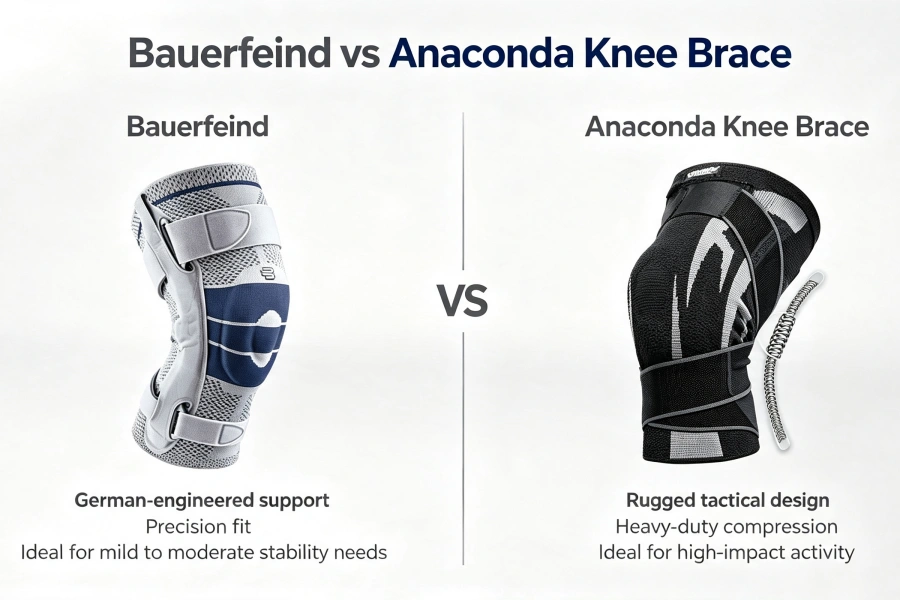
Maybe it’s that dull ache after long runs or the lingering worry from an old ACL scare that flares up every time you hit the mat for BJJ. And once you start researching the best knee brace for sports, two brands keep popping up everywhere: Bauerfeind and Anaconda knee braces. Both promise stability, both have loyal fans, and both come with a price tag that makes you want to get it right the first time.
So Bauerfeind vs Anaconda knee brace: which one actually belongs in your gym bag? The answer comes down to how you move, what you’re recovering from, and whether you need medical-grade compression for arthritis or just solid support for running your next 10K. We’re comparing Bauerfeind vs Anaconda knee brace on materials, support levels, comfort, and real-world performance, so you can stop second-guessing and start moving with confidence again.
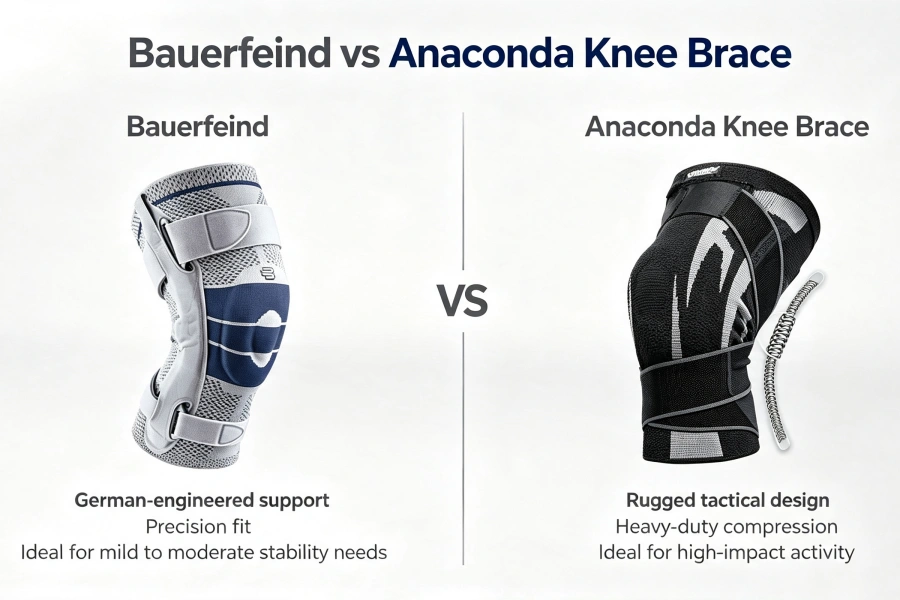
Bauerfeind Vs Anaconda Knee Brace: Core Comparison Overview
These two braces aren’t competing for the same job. Bauerfeind knee brace is medical-grade compression built for serious support; the Anaconda knee brace is a lightweight sleeve built for comfort and mobility. Once you see that, the choice gets a lot easier.
|
Feature |
Bauerfeind (GenuTrain S / Sports) |
Anaconda (BJJ / Active) |
|---|---|---|
|
Price Range |
$80–$200 |
$30–$60 |
|
Material |
AirKnit knit + Omega Pad + rigid sidebars |
3D compression knit, optional stabilizer |
|
Support Level |
Medium to medium-high (medical-grade) |
Light to medium (soft compression) |
|
Best For |
ACL recovery, meniscus tears, high-impact grappling |
Daily wear, light training, BJJ warm-ups |
|
Durability |
Holds up for months of heavy use |
Often wears out in 1–2 months with frequent training |
Bauerfeind Knee Brace
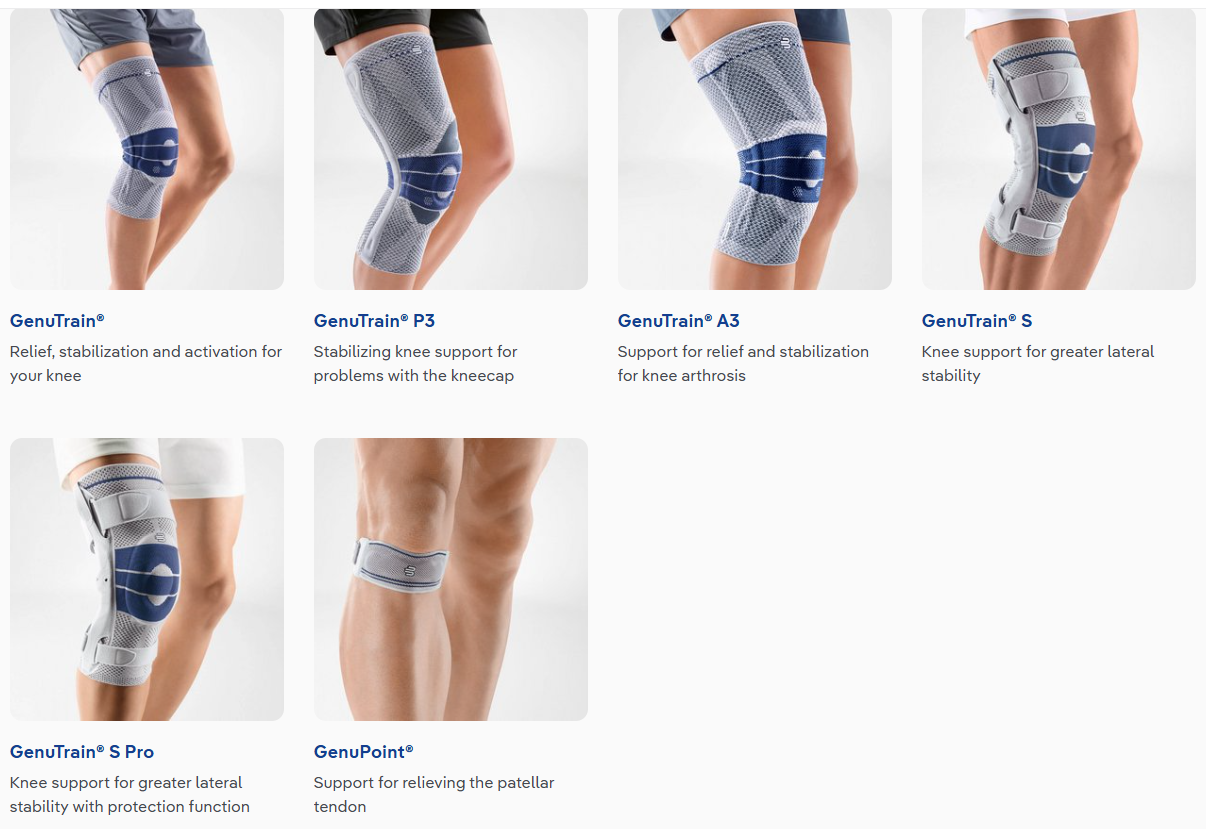
Bauerfeind is rooted in the German engineering tradition. It shows up in the details you don’t notice until you’re three months into hard training and your brace still looks brand new. It’s a German medical-grade brand, and everything about the GenuTrain, GenuTrain S, and GenuTrain OA lines feels as if it were designed by someone who studied how knees fail.
What’s actually happening inside the fabric
The 3D AIRKNIT construction does the real work. Different zones of the knit compress at different strengths—tighter where you need stability, looser where you need to bend—so the whole thing moves with your leg. Then there’s the Omega+ Pad, an anatomically shaped cushion that wraps around your patella. It stabilizes the kneecap, spreads out pressure so no single point takes the hit, and gently massages the surrounding tissue every time you move. Bauerfeind even references stimulation of the Hoffa’s fat pad and meniscus base—small, technical details that matter if you’re dealing with a knee brace for meniscus tear recovery or nagging patella instability.
Silicone dotted bands around the top and bottom keep everything locked in place, which matters more than people expect once you’re mid-squat or scrambling on the mat.
For runners, grapplers, and everyone in between
Bauerfeind classifies it as moderate support, and that’s the point. You get 360° compression and centered patella tracking without losing range of motion, which makes it a solid knee support for running, BJJ, or basketball. If you’re dealing with serious ligament instability, their SecuTec Genu line moves into true orthotic territory. GenuTrain is built for light-to-moderate instability and protective daily wear.
Comfort, sizing, and care
Bauerfeind knee brace stays thin, breathable, and doesn’t bunch or roll—ideal if you’re wearing it under jeans daily. Sizing runs through eight standard measurements (plus custom options), so measure your knee, thigh, and calf circumference. For washing, always defer to the garment tag, but expect a gentle, cool machine wash with air drying.
Bauerfeind knee brace includes an exceptional support-to-comfort ratio, German-made durability, breathable knit, and good mobility for training. On the downside, it’s pricier ($60–$200+), not enough for severe instability, and sizing mistakes noticeably hurt fit.
Anaconda Knee Brace
Anaconda didn’t set out to build the next medical brace. They built something for people who spend their weekends getting choked, swept, and pinned to a mat, and that focus shows in every design choice.
Built for the mat
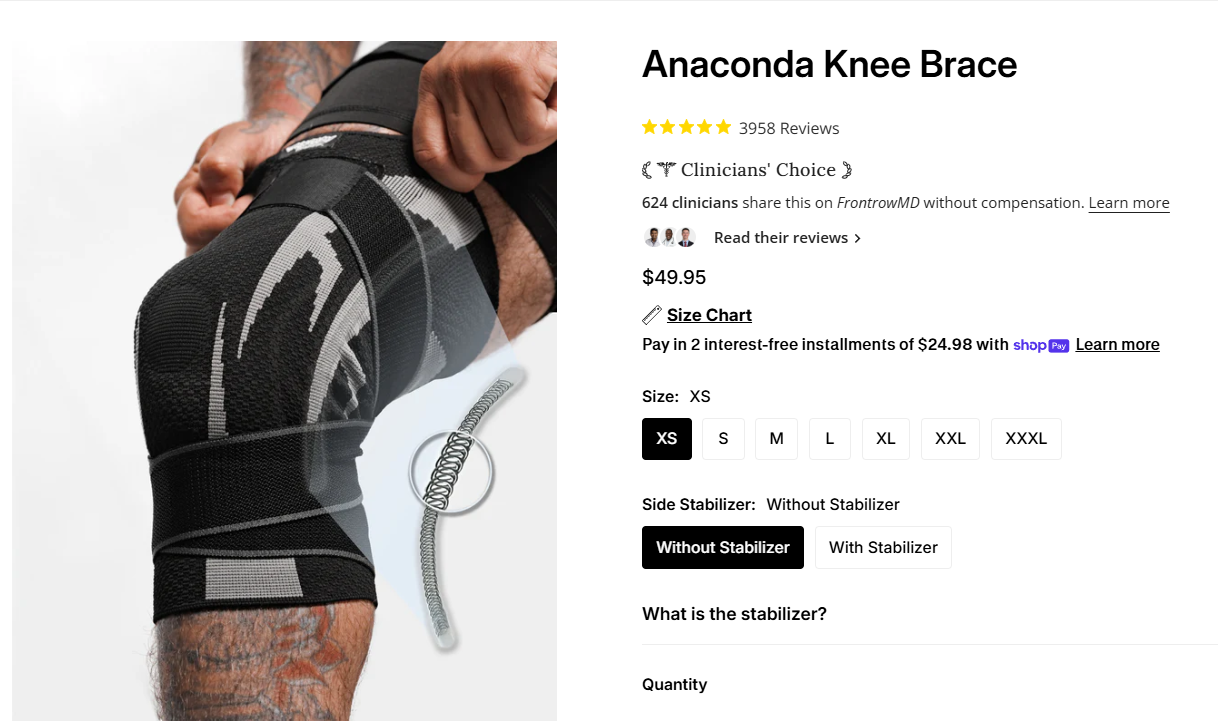
Anaconda Fightwear (also sold as Anaconda Performance) markets its knee brace for BJJ, MMA, and wrestling. The pitch is simple: protect your knee through scrambles and guard passes without turning your leg into a stiff, immobile block. Instead of rigid sidebars, you get a soft compression sleeve wrapped in a Fight Tech strap system—two full wrap-around straps, one above the knee, one below, cinched over the sleeve to keep it from twisting or sliding mid-roll.
Around the kneecap sits a thin gel pad that absorbs impact every time you hit the mat on a knee-cut or get crushed under someone’s hips. It’s not heavy-duty protection. It’s more like a buffer that takes the sting out of repeated ground contact. If you want extra lateral support, Anaconda offers slim metal stabilizer bars that slide into the sides of the sleeve. Just know they’re not competition-legal, so they’re training-only.
How it moves with you?
BJJ practitioners on Reddit consistently praise the flexibility of the Anaconda knee brace here. The sleeve is thin enough that knee-cut passes, closed guard, and technical stand-ups don’t feel restricted. One coach reviewing it called it a “sports-style knee brace”—light compression, moderate feel, built for movement rather than immobilization.
Where it falls short
The durability complaints are hard to ignore. Multiple Reddit threads and Facebook BJJ groups describe stitching failure, worn-out elastic, and Velcro that stops gripping after just 3 to 6 months of frequent training. Trustpilot reviews echo similar frustrations with both product longevity and customer service response times.
On support: independent reviewers are blunt. If you’re dealing with ACL instability or serious meniscus damage, this isn’t your primary brace. Some testers go as far as calling the support effect “placebo,” pointing out there’s no research proving it outperforms standard compression sleeves.
Price, sizing, and upkeep
Price: ~$40 per brace, or $60 for a pair
Sizing: XS–XXL, measured at 10cm above/below the kneecap with knee bent to 30°
Care: Hand wash in cold water, air dry flat—skip the machine wash to protect the gel pad and elastic fibers
Tip: Frequent trainers often rotate two braces to avoid material fatigue from sweat exposure
Core Comparison Dimensions: Price, Material, Support Level, Applicable Scenarios
Four numbers tell you almost everything you need to know before checking out: what you’ll pay, what it’s made of, how much support it gives, and where you plan to wear it. Skip any one of these, and you risk buying a knee brace that looks right on paper but fails the moment you’re mid-workout.
Price isn’t just a sticker number. It’s a cost-per-wear calculation. A $150 medical-grade knee brace that lasts two years of daily training costs less over time than a $40 sleeve that needs replacing every few months. Before you compare Bauerfeind Vs Anaconda knee brace pricing, ask how many training sessions you’ll put it through.
Material determines longevity and feel. Rigid sidebars and anatomically shaped pads (Bauerfeind’s approach) stand up to repeated lateral stress—knee-cut passes, pivoting, sudden direction changes. Soft compression knits with strap systems (Anaconda’s approach) flex and breathe but lose structural integrity under repeated load. Neither material wins on its own; the choice depends on whether you need a patella stabilizer brace for instability or a compression knee sleeve for general comfort.
Support level should match your diagnosis, not your budget. Medical-grade braces work around actual joint mechanics—centered patella tracking, graduated compression zones, targeted stabilization for ligament or meniscus issues. Sport-style sleeves give light-to-moderate compression, good for prevention and mild soreness but not enough if you’re managing ACL recovery or arthritis-related instability.
Scenario is the tiebreaker. Someone looking for the best knee brace for basketball needs different specs than someone wanting a knee brace for daily wear under work clothes. Cross-reference all four dimensions against your actual week: training frequency, injury history, and how discreet the brace needs to be. That combination—not brand loyalty—should drive the final decision.
Sports Scenario Recommendation: Which One Should You Choose—BJJ, MMA, or Combat Training?
If you’re rolling 4-6 times a week—competing, coaching, or just deep in the grind—your knees are taking a beating. Standing takedowns need lateral stability to resist twisting forces. Ground work means hours on your knees, passing guard, absorbing side pressure. This is where Bauerfeind GenuTrain S earns its reputation as what BJJ forums call a “proper brace.” The side stabilizers actually matter here—they resist the valgus/varus stress that comes with wrestling for position. Yes, it costs 3-5x more than a basic sleeve. Spread across 200+ training sessions a year, the math flips in Bauerfeind’s favor.
If you’re training 1-3 times a week as a hobbyist with healthy knees, you don’t need medical-grade engineering. You need light compression, some padding, and something that won’t fall apart after a few months. Anaconda fits here—similar to LP or Bodyprox territory, priced around $30-60. It gives enough support to prevent scrapes and mild swelling without spending on stability you’re not using.
Crossing into basketball or the gym? The pattern holds. Explosive cuts and pivots on the court demand the same lateral support as grappling. A GenuTrain S doubles well as a knee support for running or basketball. For gym work, thickness matters more than brand: 3mm sleeves suit light squats, 5mm handles moderate lifting. Either Bauerfeind or Anaconda-style compression works fine unless you’re chasing serious PRs.
Judo, wrestling, Sambo follow BJJ’s logic exactly. Pros need Bauerfeind’s structure. Amateurs are fine with lighter options. Muay Thai and striking-focused training involve less ground time, so a basic Anaconda-style knee sleeve usually covers it.
Daily Wear and Rehabilitation Scenario Recommendations
Your knee cares about how many hours you wear it and what your body needs that day. Daily wear and recovery are two different games entirely.
For arthritis, daily comfort wins. Soft, breathable knee braces worn 6–8+ hours daily for at least 4 weeks bring real improvement. Look for 20–30 mmHg compression, enough to ease swelling without cutting circulation, paired with fabric rated 6000+ g/m²/24h breathability so you’re not sweating through your pants by lunch. Weight matters too: anything under 150g disappears under clothing. A comfort score of 7/10 or higher is the benchmark. If skin redness or itching shows up on more than 10–15% of wear days, size down or switch to thinner fabric.
ACL recovery follows strict phases. In the first 0–6 weeks post-surgery, you need a rigid, hinged brace limiting flexion to 0–60° or 0–90°. Only once quadriceps strength hits 80–90% of your healthy leg can you transition to a functional support brace like GenuTrain S for running drills.
Meniscus tears split the same way. For mild pain with flexion above 120° and no locking, a soft compression sleeve is fine to use daily. Locking, clicking, or MRI-confirmed displacement means you need rigid support. Skip the knee sleeve entirely until cleared.
Conclusion
No single knee brace is the best for everyone. The right choice depends on your knees. If you’re logging miles as a runner or need serious support after an ACL tear, Bauerfeind knee brace’s medical-grade engineering earns every penny. If you’re rolling on the mats or want a knee brace for daily wear that won’t feel like a hospital visit, Anaconda knee brace’s flexibility and value are hard to beat.
Think about how you actually move through your day (or your workouts), and match that to the best knee brace for sports that fits. Head over to a top custom knee brace manufacturer, and grab the best knee brace for sports that fits.