
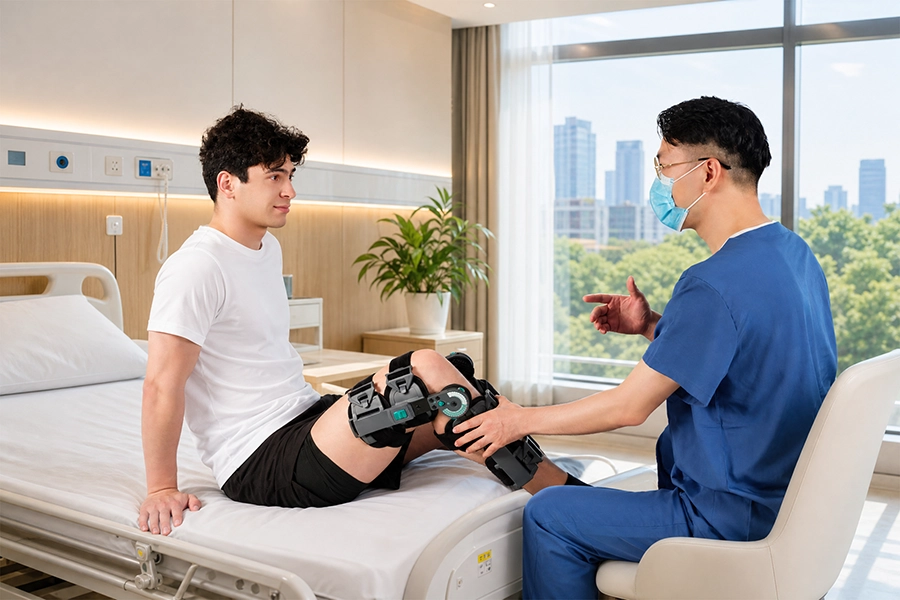
You had ACL surgery. The hard part is over. Now you’re staring at a brace, wondering whether strapping it on matters or whether it’s just an expensive piece of plastic. Here’s the truth: the answer changes depending on where you are in your recovery.
A post-operative knee brace in week two looks nothing like the ACL sports brace an athlete laces up before returning to the field in month nine. Treating them as the same decision is one of the most common mistakes people make after surgery.
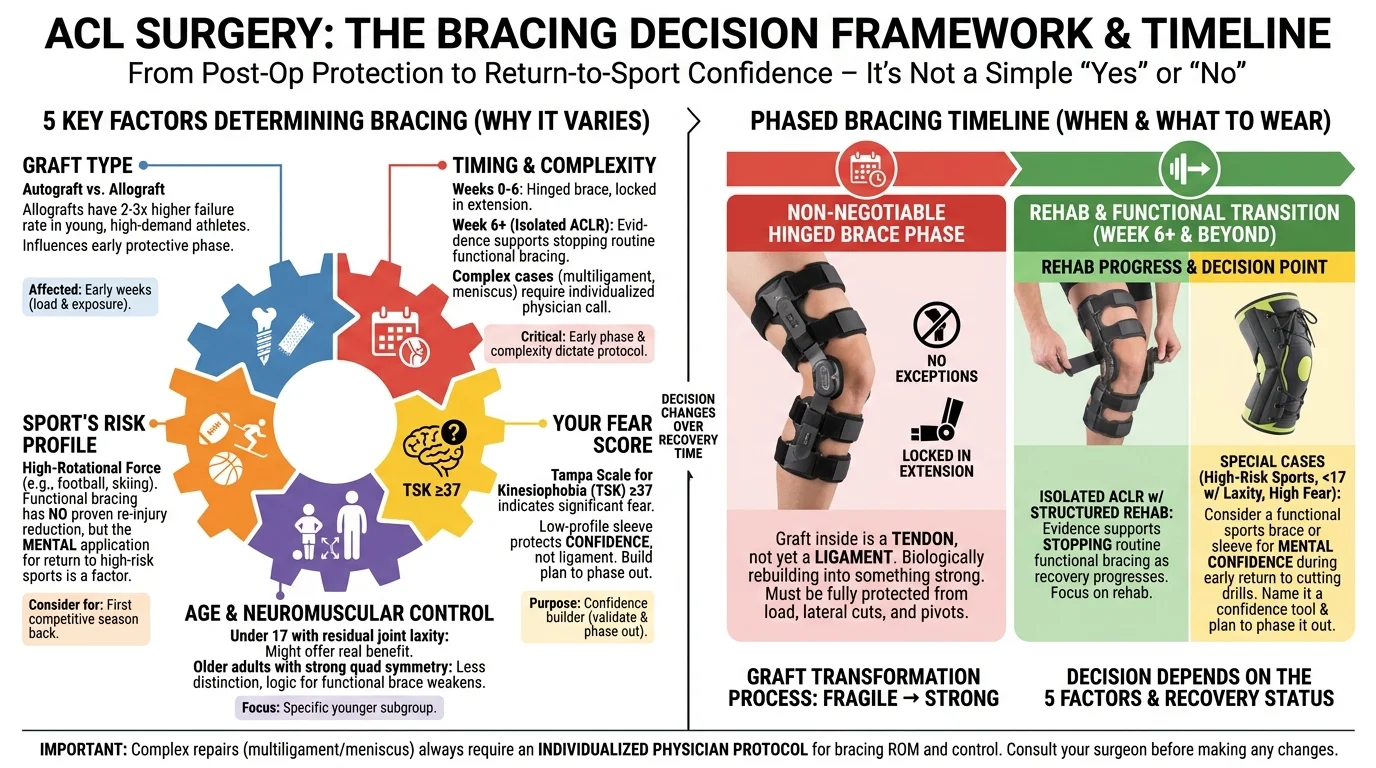
5 Key Factors That Should Determine Your Bracing Decision
1. Your graft type
Allografts fail at 2–3× the rate of autografts in young, high-demand athletes. That doesn’t mean an ACL sports brace protects the graft. But it does point toward a more conservative approach to load and exposure. That affects how long you stay in a protective hinged brace in the early weeks.
2. Your sport’s risk profile
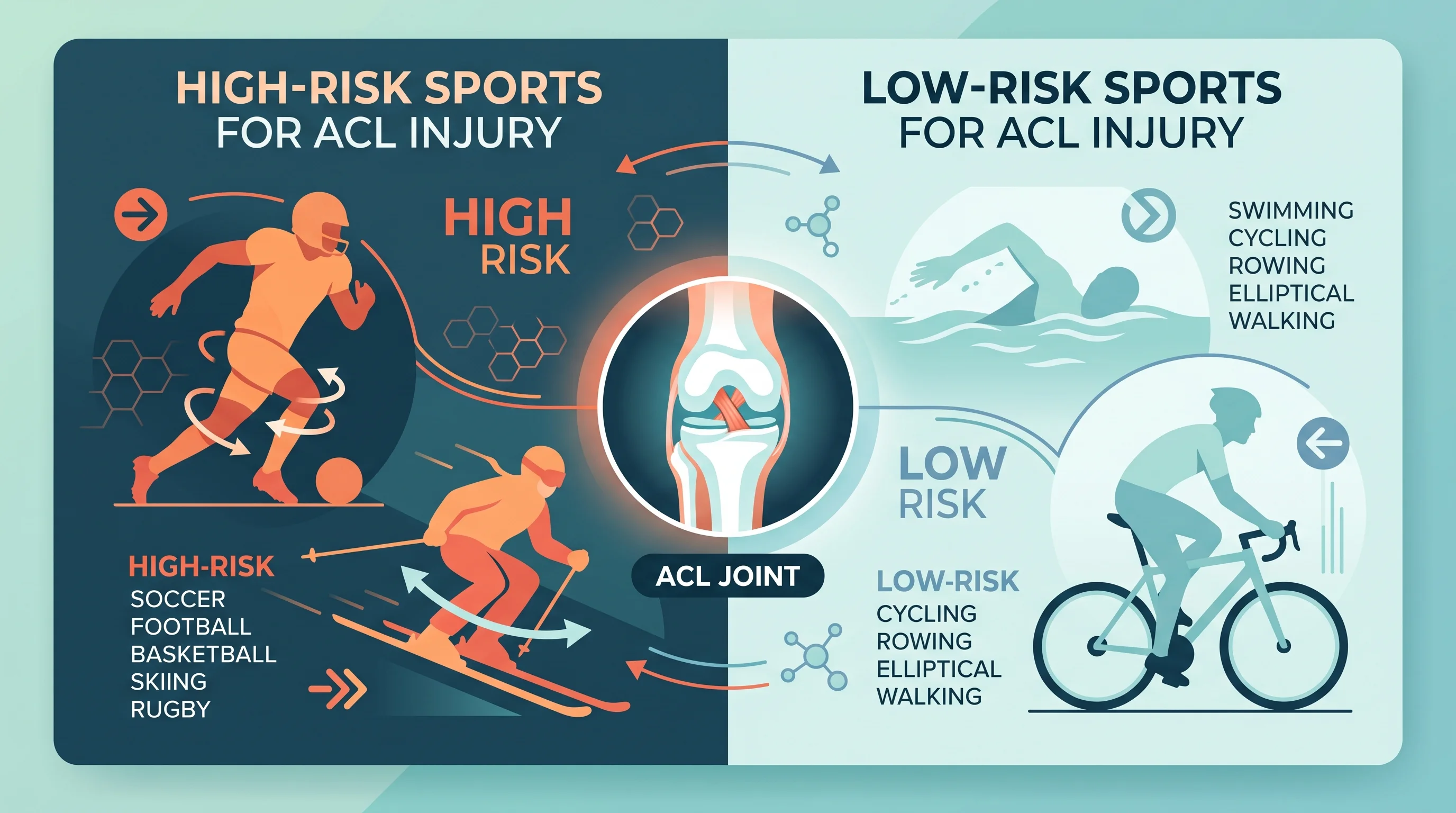
Football, skiing, basketball, and combat sports pile on rotational force in ways that cycling and swimming don’t. Functional bracing still shows no proven re-injury reduction in the data. But the mental case for wearing one during your first competitive season back in a high-risk sport? That’s harder to dismiss.
3. Your age and neuromuscular control
Athletes under 17 with residual joint laxity are the one subgroup where an ACL sports brace might offer real benefit. For older adults who have completed rehab and show strong quad symmetry, that logic doesn’t apply.
4. Your fear score
A Tampa Scale for Kinesiophobia (TSK) score ≥37 is a meaningful marker of fear that affects return to sport. A low-profile sleeve worn during early cutting drills isn’t protecting your ligament. It’s protecting your confidence. That’s a valid reason to wear one — but name it for what it is, and build a plan to phase it out over time.
5. Your timing and complexity
- Weeks 0–6: Hinged brace, locked in extension. No exceptions.
- Week 6+, isolated ACLR, structured rehab: Evidence supports stopping routine functional bracing.
- Multiligament or complex meniscus repair: ROM and varus/valgus control becomes an individualized physician call — not a standard protocol.
These five factors — graft context, sport risk, age and proprioception, psychological readiness, and surgical complexity — form the framework that makes your bracing decision.
Phase 1 (Weeks 0–6): Your Post-Op Hinged Knee Brace Is Non-Negotiable
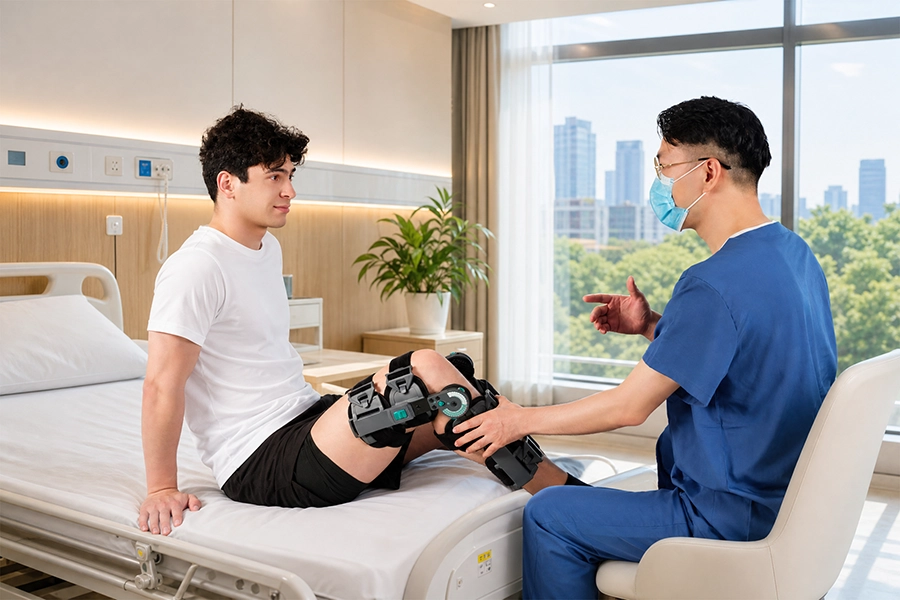
The graft inside your knee right now is not a ligament yet. It’s a tendon — borrowed from another part of your body — being rebuilt by your biology into something strong enough for lateral cuts, pivots, and full athletic load. That process takes months. In weeks zero through six, the graft is at its weakest.
That’s why the post-operative hinged knee brace in Phase 1 is not optional. It’s structural protection, plain and simple.
The brace has one job: stop the tibia from sliding forward and block shear forces that could destroy your fixation before it heals. Every surgical protocol — ACL, PCL, meniscus repair, osteotomy — puts “protect the graft” at the top of the list. The locked brace is the main tool that gets that done.
Here’s what that looks like in practice:
- Weeks 0–4: Brace locked at 0° extension for all walking and sleeping. ROM limited to 0–90°.
- Weeks 4–6: Brace unlocked for walking, but still worn. Your surgeon must approve any removal.
- Removal allowed for: hygiene and supervised physiotherapy sessions.
Graft type changes a few details. BTB autografts need full extension to stop the knee from locking in a bent position. PCL reconstructions are stricter still — brace locked at 0° any time you’re not with a therapist, for all six weeks. Any backward sag in the tibia puts serious stress on the repair and can break down your fixation fast.
The rule is simple: no walking without the brace for six weeks.
Phase 2 (Weeks 6–12): Transitioning to a Functional ACL Sports Brace
By week six, the rigid brace has done its job. The question now is what replaces it and why.
Your physio checks three specific things before clearing you for a functional ACL sports brace:
- No extensor lag — you can perform a straight leg raise with control
- Full or near-full ROM — flexion at 120° or better, full extension
- Non-antalgic gait — you walk without compensation across at least 50 metres
Clear those benchmarks, and the rigid brace comes off around weeks 6–8.
The functional ACL rehabilitation brace is a very different tool. It lets you move through full ROM — cycling, light jogging, step-downs. You wear it during exercise and high-demand sessions, not all day.
Here’s what the evidence supports: the ACL sports brace works as a confidence tool, not a mechanical shield. It gives you proprioceptive feedback and psychological security. That matters most during walk-jog progressions and low-level agility drills on unpredictable surfaces.
By week 12, strength, effusion, and functional control all need to check out. At that point, the brace shifts to one role — sport-specific drills. Routine walking? You won’t need it for that anymore.
Phase 3 (Months 3–12+): Do You Need an ACL Sports Brace to Return to Sport?
The Return-to-Sport Checklist That Matters
Check every box below before you even think about the brace question. For adult pivoting sports, target ≥9 months post-surgery. Faster protocols exist, but the data favor waiting longer.
Strength benchmarks:
– Quadriceps and hamstring LSI ≥90% of your uninjured leg
– Single-leg leg press ≥1.25× bodyweight
– Isometric knee extensor strength >70%
Functional performance benchmarks:
– Single, triple, and crossover hop tests: LSI ≥90%
– Side hop test: 40 cm line, 30 seconds, LSI ≥90%
– Drop vertical jump symmetry: ≥90% in peak force and eccentric impulse
Clinical and psychological readiness:
– Full ROM matching your other leg, zero swelling, no pain during cutting or deceleration
– ACL-RSI score ≥80%, KOS-ADL ≥90%
Hit all of these, and the evidence does not support routine ACL sports brace use.
When a Functional ACL Brace Still Makes Sense
Three situations change the picture:
- Youth athletes under 17 returning to competitive pivoting or contact sports face higher re-injury rates than adults. One study in the review suggested a possible protective effect in this group — the data aren’t definitive, but the risk level calls for caution. Wearing a functional ACL sports brace for the first one to two competitive seasons post-op is a reasonable, evidence-based precaution.
- Skiers are a real exception. Skiing stacks valgus loading, external rotation forces, and binding mechanics together in a way most sports don’t. Clinical guidance points to wearing a functional ACL sports brace for at least the first full postoperative ski season — often ≥1 year post-surgery — no matter whether other return-to-sport criteria are met. The sport-specific risk here is high enough to go against the general “brace not required” position.
- Athletes with leftover joint laxity or ongoing fear — even after hitting strength targets — can use a brace as a short-term support tool. One to two seasons is reasonable. Pair it with continued neuromuscular training.
For everyone else — fully rehabbed adults who’ve cleared the benchmarks — a return-to-sport ACL brace is optional. It may boost your confidence. It will not save your graft. Those are two very different things. Mixing them up is what keeps people stuck relying on gear they no longer need.
ACL Sports Brace Types Explained: Which One Is Right for Your Recovery Stage?
Three brace types exist. Each one is built for a different problem.
Here’s how to tell them apart:
- Post-operative/rehabilitative brace — This is your weeks 0–6 tool. It’s heavier, more rigid, and built to restrict movement on purpose. The key feature is an adjustable ROM stop that controls how far your knee bends and extends. Its job is one thing: protecting the graft while your biology catches up. Not performance. Not comfort. Protection.
- Functional ACL brace — This is your return-to-sport tool. It uses a semi-rigid frame, hinged side bars, and anti-migration straps that stop it from shifting during cuts and pivots. It blocks abnormal knee movement while still giving you enough range to run, jump, and change direction. You lace this one up before stepping back onto a field.
- Prophylactic brace — Built for healthy knees in high-contact sports: football, hockey, rugby. It spreads external impact and resists lateral loading. This brace does not treat or rehab an injured ACL. It prevents damage to a healthy one.
Four Questions That Point You to the Right ACL Sports Brace
- Just had ACL reconstruction? → Post-op hinged brace with adjustable ROM stops.
- Cleared to run and returning to cutting or contact? → Functional ACL sports brace with hinged side bars and anti-migration straps.
- Healthy knee, high-collision sport? → Prophylactic brace.
- Mild swelling, general comfort? → Compression sleeve.
What to Look for When Choosing
Three hardware features separate a well-designed brace from an expensive strap:
- Adjustable ROM stops — non-negotiable for post-op and early rehab stages
- Hinged side bars + anti-migration straps — essential for any functional brace used during sport
- Stage labeling — a quality brace states clearly whether it’s rated for post-op, rehab, or return-to-sport use
On materials: carbon fiber frames are lighter and stiffer — a better fit for competitive return-to-sport, usually priced $300–$800. Aluminum alloy covers most functional and rehab needs at a lower cost. Fabric-only designs give you compression and comfort, but no real structural control.
Red Flags: Skip the ACL Sports Brace, and You’re Taking a Real Risk
Watch for any of these:
- Swelling that won’t settle. Your knee circumference is still 1–1.5 cm larger than the other side. Or it swells again after activity. That joint isn’t ready for unprotected load. Keep the brace on.
- Compensated gait. Limping, a shortened stride, or a knee that “gives way” after brace removal — your dynamic stability hasn’t come back yet. Walking without support at this stage raises re-injury risk.
- Failed single-leg balance. You can’t hold 15 seconds on the surgical leg with eyes closed. That’s a proprioception gap, not a confidence gap. Stay off unpredicted surfaces without support.
- Strength symmetry below 90%. Cutting sports before hitting LSI ≥90% puts re-tear risk in the 10–25% range. A functional ACL sports brace through that first competitive season acts as a reasonable bridge, not a permanent fix.
Quick Reference: ACL Sports Brace Timeline Summary
| Stage | Brace Type | Key Goal |
|---|---|---|
| Weeks 0–6 | Post-op hinged brace (locked 0°) | Protect the graft |
| Weeks 6–12 | Compression sleeve | Restore ROM and gait |
| Months 3–6 | Functional ACL sports brace | Sport-specific prep |
| Months 6–12+ | Functional ACL brace (high-risk sport) | Safe return to competition |
Youth athletes should extend each stage by 4–8 weeks.
Skiers wear a functional ACL sports brace for the full first season after surgery.
Elite athletes can phase out the brace after month nine. First, they must pass objective strength and hop tests. Both tests.
The timeline is a starting point. Your benchmarks decide when you move forward.
Conclusion
Your ACL doesn’t heal on a schedule; it heals based on the decisions you make each day of recovery. In the early weeks, an ACL sports brace protects your graft at its most vulnerable point. A functional ACL brace then takes you from rehab into real athletic demands. For high-pivot, high-contact sports, it may be the one factor that keeps you on the field.
Talk to your surgeon and physio. Know your recovery phase. Match your brace to what your sport actually demands.
Ready to find the right ACL brace for your stage of recovery? Explore our full range of ACL sports braces at AOFIT.