
Your knee gives out on a staircase, or your doctor says “orthopedic knee brace” after reading your MRI, and suddenly you’re scrolling through a wall of online options—hinged, sleeve, wraparound, compression—with no idea which one fits your situation. That confusion is why so many people pick the wrong support: too flimsy for a torn ACL, too restrictive for mild arthritis.
Choosing the right orthopedic knee brace stops being guesswork once you understand a few key differences. We’ll explain how these braces stabilize your joint, walk you through the main types, and cover what to focus on when you’re staring at dozens of “best-rated” options. By the end, you’ll know what to look for and what to skip.
What Is an Orthopedic Knee Brace?
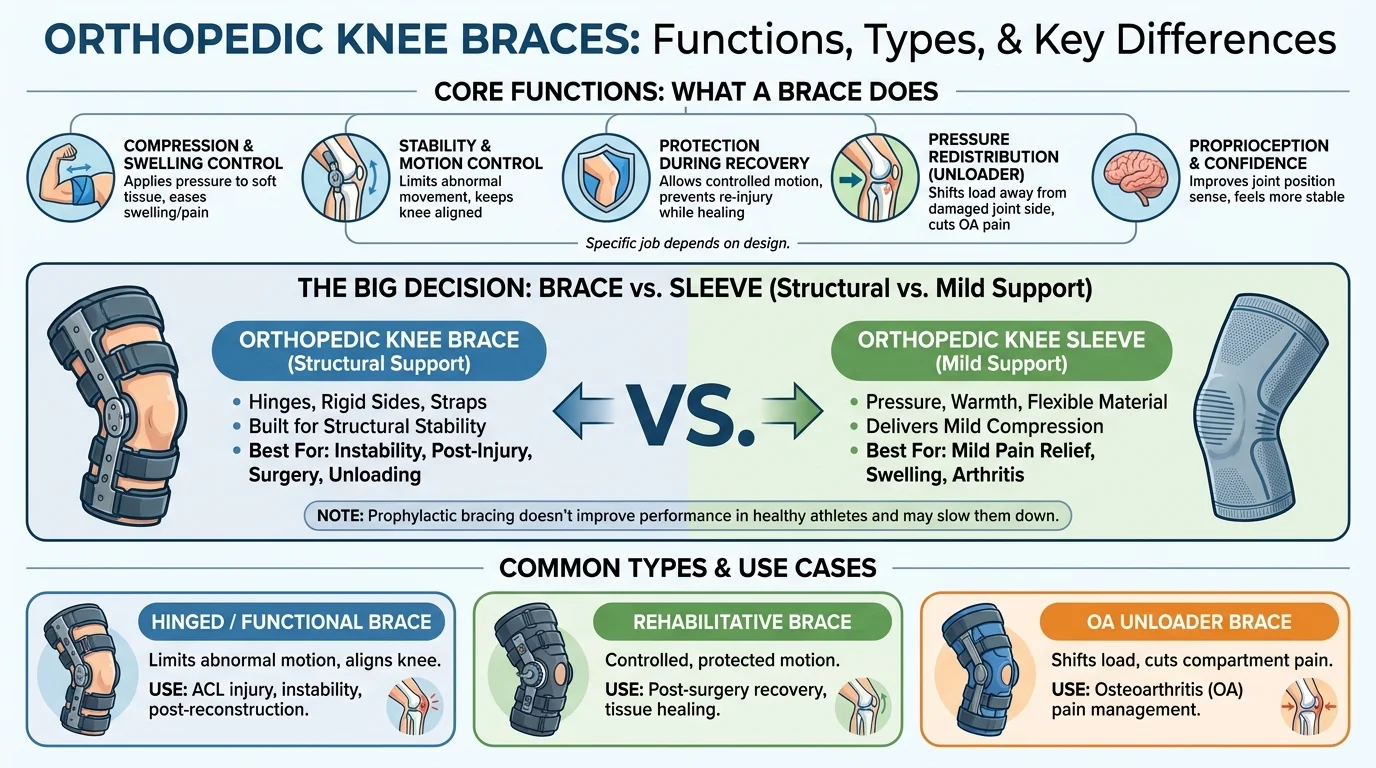
An orthopedic knee brace stabilizes, protects, compresses, or unloads the knee joint. Doctors prescribe them after injury, surgery, or for chronic conditions like osteoarthritis (OA). But the specific job a brace does depends on its design.
Five functions:
Compression and swelling control. A basic sleeve applies pressure to soft tissue, easing swelling and pain. Structural support is minimal—that’s the trade-off.
Stability and motion control. Hinged, functional braces limit abnormal movement and keep the knee aligned. This is what unstable knees need, especially post-ACL injury or after reconstructive surgery.
Protection during recovery. Rehabilitative braces allow controlled, protected motion after injury or surgery. Movement is limited enough to prevent re-injury while tissue heals.
Pressure redistribution. OA “unloader” braces shift load away from the damaged side of the joint through valgus or varus adjustment, cutting pain from compartment overload.
Proprioception and confidence. Compression improves joint position sense. Some patients simply feel more stable wearing one, even when the structural benefit is small.
Orthopedic Knee Brace or Orthopedic Knee Sleeve: A support brace has hinges, rigid sides, or straps built for structural stability. A compression sleeve delivers pressure and warmth, little else. If you need pain relief and mild compression, a sleeve works. If you need stability, unloading, or post-injury protection, you need an actual orthopedic knee brace.
Older clinical research found prophylactic and functional bracing doesn’t improve performance in healthy, asymptomatic athletes. It may even slow them down.
Seven categories cover nearly every orthopedic knee brace on the market. Doctors classify them by function.
|
Type |
Best For |
Structure |
Support Level |
|---|---|---|---|
|
Compression knee sleeve |
Mild swelling, general support |
Elastic/neoprene, no rigid frame |
Low |
|
Functional knee brace (hinged) |
Ligament instability, ACL knee brace needs |
Rigid side supports, hinges |
Moderate–high |
|
Unloader knee brace |
Knee brace for osteoarthritis, unicompartmental OA |
Valgus/varus force frame |
Moderate–high |
|
Patellofemoral brace |
Patella stabilizer needs, kneecap instability |
Front buttress or patella opening |
Low–moderate |
|
Rehabilitative knee brace |
Post-surgery knee brace, protected ROM |
Long hinged frame, adjustable ROM stops |
High, motion-controlled |
|
Knee Immobilizer |
Acute injury, immediate post-op |
Straight, rigid, minimal movement |
Very high |
|
Prophylactic knee brace |
Contact sports, MCL protection |
Semi-rigid, hinged |
Moderate |
How Hinged Knee Braces Work?
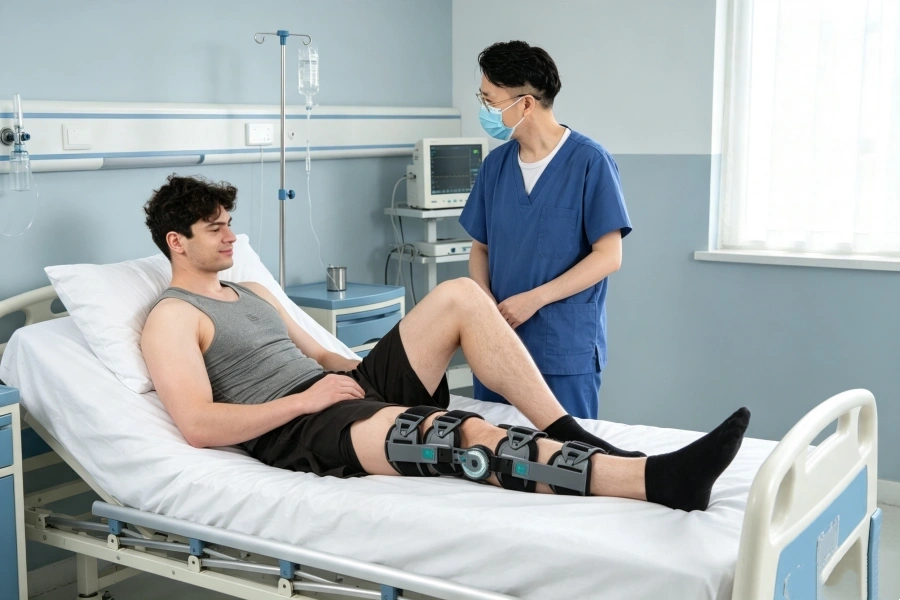
The hinge is the workhorse component. Side pivot joints let your knee bend and straighten normally while blocking the sideways or rotational movement that causes damage. The same mechanism shows up across functional, rehabilitative, and prophylactic braces, just tuned differently. Rehab-focused designs often lock at specific angles so you can’t accidentally overextend during healing. Functional designs pair hinges with rigid uprights for maximum stability after a ligament tear.
Evaluating Stability in Knee Stabilizer Braces
There’s no single universal test for stabilizer performance, so judge these braces by three things: varus/valgus control, rotational restraint, and ROM restriction settings. An adjustable knee brace with dial-in hinges gives you more control than a fixed-setting model, useful as recovery progresses and you need less restriction.
How to Choose the Right Orthopedic Knee Brace: 5 Key Selection Criteria
1. Match the orthopedic knee brace to your diagnosis. Buckling, giving way, or a knee that loses control mid-turn points to a hinged knee brace. Kneecap tracking problems or a dislocation history point to a patella stabilizer. A pinpoint ache right below the kneecap, in patellar tendon territory, calls for a patellar strap instead. Arthritis-type stiffness with mild swelling starts with a knee compression sleeve; if wear is concentrated on one side of the joint, move up to an unloader knee brace. Post-surgical cases follow the surgeon’s protocol, period.
2. Pick a support level before you pick a style. Light activity or general warmth needs Level 1, a basic sleeve with maximum flexibility. Moderate discomfort with some instability needs a semi-rigid hybrid. Real instability or ligament damage during sports needs a rigid hinged brace. Post-op cases needing restricted bend or extension need a motion-limiting design.
3. Fit determines whether the orthopedic knee brace does anything at all. Off-the-shelf models are sized by knee and thigh circumference; custom orthopedic knee braces are molded to your leg. Measure at the center of the kneecap, about 6 inches above it, and about 6 inches below. Stuck between sizes? Size down for stronger compression, size up for comfort.
4. Let your activity dictate the support-versus-mobility tradeoff. Daily walking favors compression or light support that stays out of your way. Sports favor a more stable hinged or wrap-reinforced design, as long as movement isn’t overly restricted. Post-op recovery follows the rehab plan, which often means a locked range-of-motion angle.
5. Material and structure decide whether you’ll actually wear it. Look for breathable, skin-friendly fabric, easy cleaning, and adjustable straps; neoprene and elastic weaves are common choices. A properly fitted orthopedic knee brace should feel snug, never pinching. Slipping, bunching, numbness, tingling, added swelling below the brace, or skin irritation all signal the wrong size or type.
When to check with a doctor or physical therapist first: any post-surgical case, suspected ligament injury, recurring instability, unexplained pain, or a history of dislocation. Diagnose before you buy, because guessing costs more than the brace.
Tips for Wearing and Maintaining Your Orthopedic Knee Brace
An orthopedic knee brace only works when it’s on correctly and holding up over time. Get the fit or care routine wrong, and even the best hinged knee brace or knee stabilizer won’t do its job.
Putting it on right:
Sit down, straighten your leg, and center the hinge over your kneecap, slightly above center, with roughly two finger-widths of space above and below the patella.
Loosen every strap first, then tighten starting with the two closest to your knee before working outward.
Straps should feel snug. You should be able to slip one finger underneath. Numbness, tingling, or skin turning white or purple means it’s too tight.
Break in slowly. Start with 2–3 hours on day one, adding an hour daily. Some clinicians suggest starting at 30 minutes and adding 30-minute increments instead. Either way, work toward full-day wear once your skin tolerates it without red marks.
Daily Care and Cleaning
Hand-wash removable pads and straps in cool or lukewarm water with mild soap. Air-dry only. Skip the dryer, hot cars, and direct heat.
Avoid alcohol, solvents, and oils on hinges or fabric.
Rinse thoroughly if the orthopedic knee brace contacts saltwater, and let it dry completely before wearing again.
Check straps, padding, and hinge joints before every wear for looseness, fraying, or debris caught in the mechanism.
When to Replace an Orthopedic Knee Brace?
Swap out your brace if you notice:
A loose, sticking, or noisy hinge
Straps that no longer grip or snap back
Padding that’s thinned, hardened, or misshapen
Cracks, broken buckles, or a hinge that won’t lock
If it doesn’t hold its position anymore, it’s not protecting your knee. It’s time to replace it.
Skin Checks Matter
Inspect skin before and after wearing for redness, bruising, or pressure marks. Persistent red marks, numbness, or new pain mean it’s too tight or poorly positioned. Adjust or stop wearing until you fix the fit. A thin, seamless liner underneath can cut friction and sweat if your skin’s sensitive. Wear the brace directly against skin, not over thick clothing. Light layers are fine.
Important Cautions: When an Orthopedic Knee Brace Isn’t Enough?
A knee sleeve delivers compression and warmth and nothing more. It won’t stabilize a locked joint or a torn ligament. Non-functional knee braces are for rest and rehab after surgery or serious injury.
Stop bracing and call your doctor when you notice any of these red flags:
Severe swelling that shows up fast
Locking or catching when you bend the knee
Trouble putting weight on the leg
Instability that keeps recurring
Pain that gets worse
Symptoms lasting more than 2–3 weeks
Misuse creates its own problems. A brace worn too tight restricts blood flow and irritates skin. Leaning on a brace instead of building quadriceps, hamstring, and hip strength breeds dependency. Your knee gets weaker and harder to wean off support.
Bracing is one piece of a rehab plan, alongside strength training and physical therapy. It’s not a standalone fix. If symptoms persist despite the orthopedic knee brace, the next move is orthopedic evaluation and imaging.
Conclusion
An orthopedic knee brace only works when its support level, fit, and function match what your knee actually needs.
If you’re still unsure which category fits your situation, don’t guess. Revisit the comparison criteria above, or better yet, run your symptoms by a physical therapist or orthopedic specialist before buying. Once you’ve narrowed down the type, look for adjustable straps, breathable materials, and proper sizing—details that separate an orthopedic knee brace that helps from one that sits in a drawer.
Your knees carry you through everything. Give them support built for the job. Find a top custom knee brace manufacturer and see which orthopedic knee brace suits your situation.