
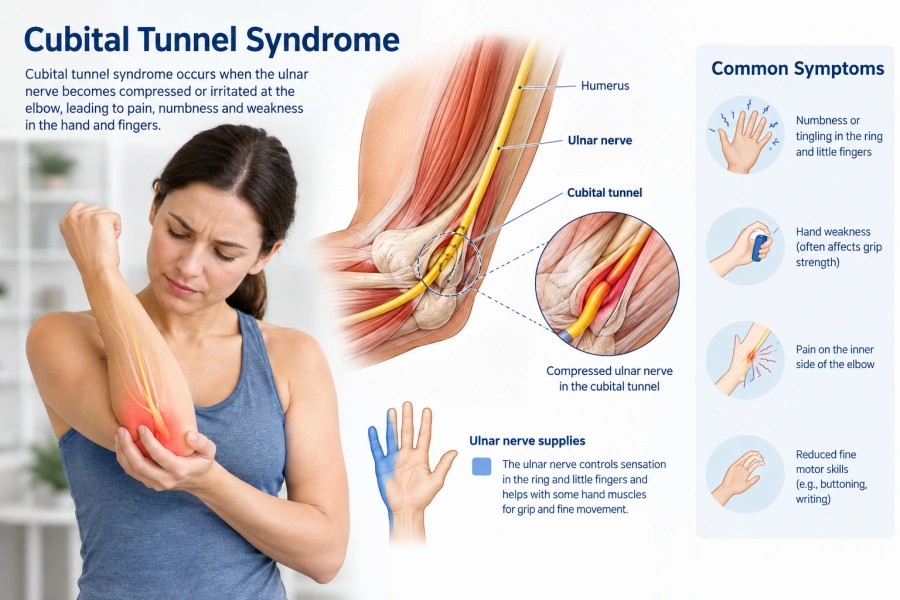
That tingling in your ring and pinky finger isn’t from sleeping on it wrong, especially when it shows up night after night or sticks around into your morning coffee. If you have cubital tunnel syndrome, you know the electric-shock feeling when you bump your elbow and the creeping numbness that makes gripping a pen or typing through a full workday difficult. Most cases respond well to non-surgical treatment, but only if you know which methods work and how to use them correctly.
This guide explains what’s happening with your ulnar nerve compression. It covers treatment options in order of what to try first: smart activity changes, night splinting (the single most effective conservative fix for most people), targeted nerve gliding exercises, and when surgery makes sense. Whether you’re two days into symptoms or two months into frustration, you’ll leave knowing your next move.
Understanding Cubital Tunnel Syndrome: Symptoms & Causes
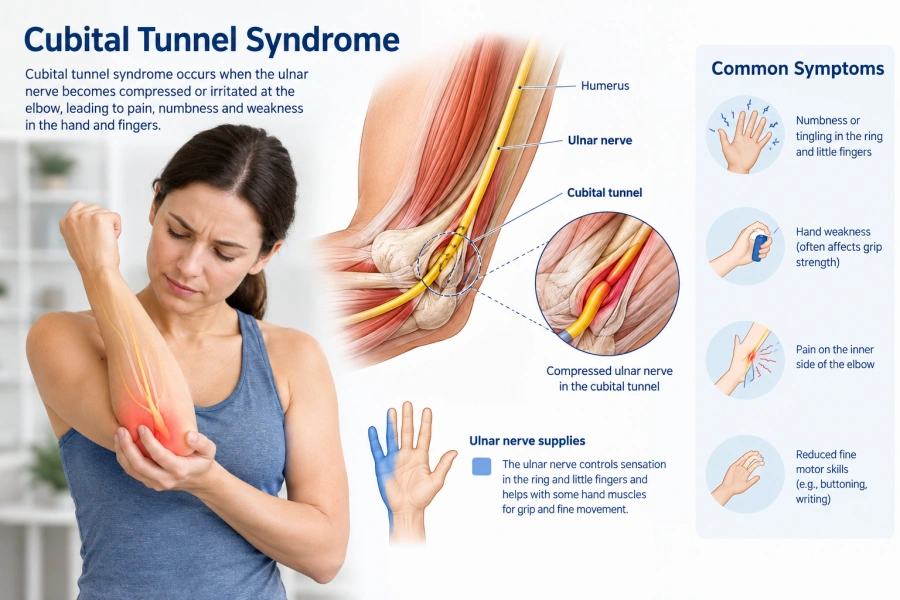
Your ulnar nerve travels down the inside of your upper arm, ducks behind a bony bump called the medial epicondyle, then squeezes through a narrow passage called the cubital tunnel—bordered by that same epicondyle and your olecranon (the tip of your elbow). This is ulnar nerve entrapment at the elbow. Bend your elbow, and the tunnel tightens, stretching and compressing the nerve. That’s the mechanical root of cubital tunnel syndrome symptoms.
What It Feels Like
Numbness in the ring and pinky fingers, often with a tingling or “pins and needles” sensation that can radiate up the inner forearm
Aching or soreness on the inside of the elbow, sometimes the first sign before finger symptoms even start.t
Weaker grip—dropping objects, struggling with jar lids, fumbling small items
Symptoms spike at night or after prolonged elbow bending
In advanced cases, hand muscles weaken enough to affect finger spreading and pinching
What causes cubital tunnel syndrome?
Sustained elbow flexion is the main culprit: phone calls with your arm bent, sleeping curled up, resting elbows on desks or car windows, or repetitive bending from typing, lifting, or throwing sports. Direct pressure or trauma to the elbow can aggravate it too.
Quick Self-Checks
Two clinical tests you can try (or a doctor will use):
Tinel’s sign—tap the “funny bone” area; tingling into your pinky and ring finger suggests nerve irritation
Elbow flexion test—hold your elbow bent for about 60 seconds and see if symptoms worsen
First-Line Non-Surgical Treatment: Activity & Ergonomic Modification
Before elbow splints or exercises, fix what’s feeding the ulnar nerve compression in the first place. This is the cheapest, lowest-risk step and often the fastest to show results.
Stop doing these:
Crossing your arms over your chest, especially while sleeping
Resting your elbow on a desk edge or car armrest for long stretches
Sleeping with your elbow bent past 90° (keep it under 30°)
Sleeping with your arm raised overhead
Adjust these instead:
Keyboard/desk setup: Shoulders relaxed, elbows hanging naturally, not propped or winged out
Driving: Support your forearm on the armrest without pressing your elbow into it
Phone calls: Use a headset or speaker instead of cradling the phone with a bent elbow
Sleep position: On your back, arms at your sides or on a pillow. On your side, forearm resting on a pillow in front of you, elbow and wrist neutral. A rolled towel wrapped around the elbow works as a makeshift night splint to block bending.
Most people notice fewer night wake-ups within a few nights to two weeks. Daytime tingling and grip issues typically take 2–6 weeks to improve once you’ve combined posture fixes with the exercises below. If numbness or weakness keeps worsening despite this, it’s time to escalate treatment.
Night Splinting: The Core Treatment for Cubital Tunnel Syndrome
88% is the number that matters most. That’s how many patients in a prospective study avoided surgery entirely after three months of night splinting combined with activity changes, tracked over an average two-year follow-up. Twenty-five affected limbs entered the study, 24 completed it, and 21 stayed surgery-free. Their QuickDASH scores (a measure of arm disability) dropped from 29 to 11. Physical function scores climbed from 45 to 54, and mental health scores went from 54 to 62. That’s a real, measurable difference.
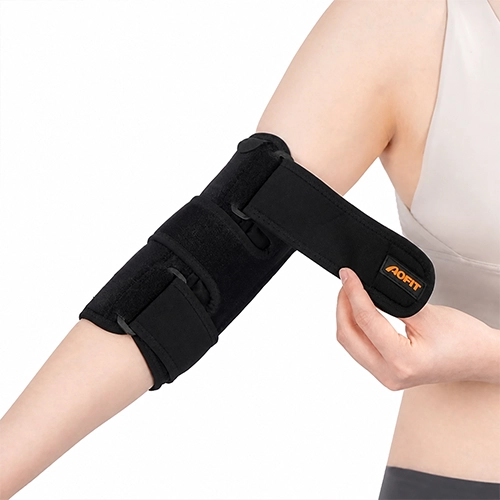
The mechanism is simple. A rigid night splint locks your elbow at roughly 45° flexion, well short of the deep bend that stretches and compresses the ulnar nerve. Since you have zero control over elbow position while asleep, the splint does the job your brain can’t do while unconscious.
The standard protocol is to wear it nightly for about 3 months. Systematic reviews confirm mild-to-moderate cases often improve within 6 months.
What to Look for in an elbow brace for cubital tunnel syndrome?
Adjustable aluminum stay: Lets you dial in the exact angle
Aluminum + plastic + mesh construction: Balances rigidity with breathability for hours-long wear
Stable but ventilated: A brace that shifts overnight defeats the purpose; one that traps heat won’t get worn consistently.
Pain & Inflammation Relief: Ice, Rest, and Medication
Ice and OTC medication won’t fix ulnar nerve compression on their own. They buy you comfort while splinting and posture changes do the real work.
Icing protocol: 15–20 minutes at a time, applied every 2–3 hours during the first 24–48 hours after a flare-up. Always wrap the ice pack in a thin towel. Direct ice-to-skin contact risks frostbite. After the acute window, cap icing at 4 sessions daily, spaced at least 45–60 minutes apart.
Rest means reducing the load, not going motionless. For 48–72 hours, skip activities that bend your elbow over and over. Then ease back in gradually.
NSAIDs (ibuprofen or naproxen) handle short-term pain and swelling. Ibuprofen: 200mg every 4–6 hours, max 1200mg/day. Naproxen sodium: 220mg every 8–12 hours, max 660mg/day. Never combine both. Doing so spikes your risk of GI bleeding and kidney damage. Past 10 days of use, check with a doctor first.
Pair these with your night splint and ergonomic fixes, not instead of them.
Physical Therapy & Ulnar Nerve Gliding Exercises
Nerve gliding exercises move the ulnar nerve through its natural pathway to restore smooth motion and reduce irritation. Research supports this specifically for mild to moderate cubital tunnel syndrome. Severe cases with bony deformity usually need surgery, so check with a doctor first if your symptoms are advanced.
The core sequence: Extend your arm out to the side with your palm facing up. Then bend your elbow toward your body and rotate your palm outward. Next, bend your wrist and fingers so they point back toward you. Then straighten your arm again while holding that wrist position—that tensions the nerve. Hold each position about 5 seconds and repeat 3–5 times.
Two other patterns worth knowing:
Low-irritation variant: Arm at shoulder height, elbow straight, palm up. Tilt your head away, then extend your fingers downward. Return slowly. Repeat 5 times.
OK-sign glide: Arm out to the side, elbow straight, palm up. Make an “OK” sign with your thumb and index finger. Bend your elbow, bringing your hand toward your face until it’s near your ear or eye. Hold for 3 seconds; repeat 5 times.
Move slowly. Stay comfortable. These aren’t meant to hurt.
Dosing and When to Get Help
Start with 5–10 reps once or twice a day, staying below whatever provokes your symptoms. If tingling flares easily, shorten to the 5-second hold style. Once numbness and irritation calm down, add strengthening—not before. If you intentionally increase nerve tension or if weakness persists, see a physical therapist.
Advanced Conservative Options: Injections & Other Therapies
Splinting and exercises fail some people. That’s when doctors reach for injections or adjunct therapies, but these are second-line tools that don’t replace the basics.
Corticosteroid injections offer temporary relief. Doctors typically use around 20mg triamcinolone, similar to doses given for carpal tunnel syndrome or trigger finger. Don’t inject more often than every 3 months, and space repeat doses at least 2-3 weeks apart. Repeated shots risk cartilage loss and tendon damage without improving outcomes. Guidelines pair injections with rehab exercises rather than using them alone.
Ultrasound therapy has weaker evidence for nerve compression specifically. It’s better studied for fracture healing than soft-tissue nerve pain.
Pulsed electromagnetic field therapy shows some promise for neuropathic pain in recent reviews, but it’s not established as first-line care.
If conservative treatment (splinting, exercises, ergonomic fixes) isn’t cutting it after several weeks, talk to a doctor about these options before considering cubital tunnel release surgery.
When Is Cubital Tunnel Syndrome Surgery Necessary?
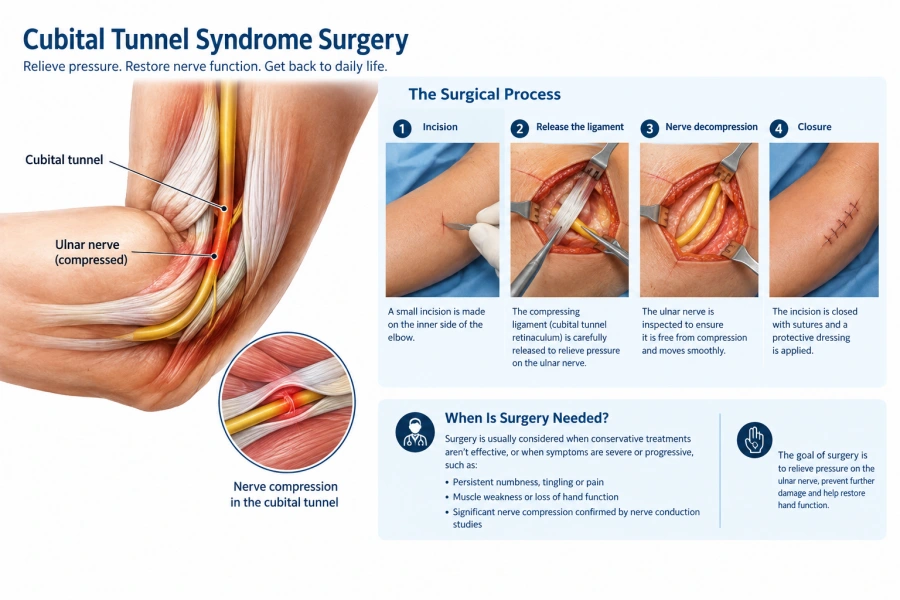
Six weeks of splinting, exercises, and ergonomic changes with zero improvement usually leads to a surgical consult. But several red flags push that timeline up. These include persistent or worsening numbness, night symptoms that won’t quit, progressive grip weakness, and muscle wasting in the hand—especially in the first web space or the base of the pinky. If nerve conduction testing shows reduced amplitude or significant slowing, that’s an objective sign the nerve damage is advancing.
Three surgical approaches, three different recoveries.
In situ decompression is the most common and least invasive option. It works best for nerve compression without instability. Elbow motion often resumes within days to two weeks; heavy lifting waits about 6 weeks.
Ulnar nerve transposition is used when the nerve subluxates or shifts position during elbow bending. Recovery runs slower. Splinting at partial flexion for 1–2 weeks is needed before motion resumes, since more soft tissue gets handled.
Medial epicondylectomy is sometimes paired with decompression to create more room for the nerve. Recovery timing lands between the other two.
Most patients still need short-term bracing and staged physical therapy afterward, particularly following transposition.
How Long Does Recovery Take? Timeline & Practical Tips
Recovery time is a range that shifts based on how mild your case is and whether you need surgery.
Conservative treatment (no surgery)
Most people notice initial improvement within 2–6 weeks. Noticeable relief lands in the 4–12 week window. If you’re relying on night splinting and activity changes, more stable, lasting improvement shows up around 6–12 weeks—that’s also when doctors reassess moderate cases with lingering numbness or grip weakness.
Post-surgery
The first 1–2 weeks are for wound healing with only light movement. Range of motion work ramps up between 2–6 weeks. Strength returns around 2–4 months. Numbness, tingling, and sensory dullness keep fading for 3–12 months. Nerve regeneration is slow, and full sensation can take 12–18 months in some cases.
Daily Care That Helps Recovery
Keep your elbow neutral or slightly extended at night. A night splint works, or you can tape a towel roll around the elbow and wear it under a loose long sleeve. Wear your brace nightly for at least 6–8 weeks. Stretch that to 12 weeks if symptoms have improved but haven’t fully cleared. Stop resting your elbow on hard surfaces—desks, armrests, car windows. Favor light grip and light lifting. Skip heavy twisting, pushing, or pulling motions.
When to See a Doctor Again
If you’re 6–12 weeks in with no real change—especially persistent numbness, tingling, or weakening grip—book a follow-up. Worsening weakness, visible muscle wasting, or new sensory changes need faster action. After surgery, any sudden pain spike, wound issues, or functional setback means calling your surgical team immediately.
Mild-to-moderate cases often resolve within weeks to a few months. But nerve tissue heals slowly, so numbness and weakness usually lag behind pain relief. The earlier you fix your posture and start night splinting, the better your odds of seeing change within that 2–12 week window instead of waiting 3–6 months or longer.
FAQs About Treating Cubital Tunnel Syndrome
Can cubital tunnel syndrome be treated without surgery?
Often, yes. Success rates for nonsurgical care range from 50–88% across studies. One large retrospective series of 53,401 patients found 58.7% recovered fully without surgery. Mild cases respond best—roughly 90% improve with conservative treatment. Moderate cases drop to about 38%.
What’s the best night splint angle?
45° elbow flexion is the most-cited target, though some protocols use 40–50°, and a few recommend 35°. Rigid or semi-rigid splints outperform soft sleeves—they physically block deep bending.
How long should I wear a night splint?
Nightly for 3 months is standard. Some cases need 3–6 months. Check progress at the 6–12 week mark.
Symptoms getting worse?
Stop all prolonged elbow flexion immediately and get reassessed—worsening numbness or new weakness signals it’s time to escalate treatment.
Conclusion
Cubital tunnel syndrome doesn’t have to mean surgery. For most people, relief comes down to three things—protecting the ulnar nerve from pressure at night, doing consistent ulnar nerve stretches, and giving inflamed tissue time to heal. Consistency is what works.
The night splint is your best tool. It works while you sleep, when you have zero control over how your elbow bends. Pair it with daytime ergonomic tweaks and gliding exercises, and you improve your odds before surgery ever comes up.
Don’t wait for the numbness to spread. Get a well-fitted elbow brace, start your stretching routine tonight, and give your ulnar nerve the rest it needs.