
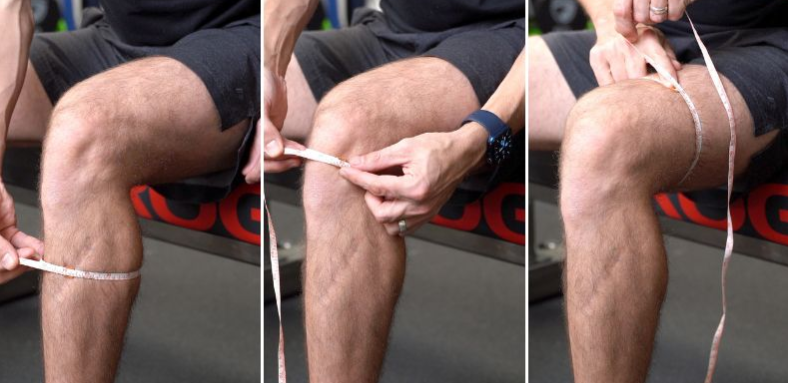
This guide covers what you need to know. You’ll learn how to measure your circumference, how to read a size chart, and how to match your fit to your activity. Squatting heavy, logging miles, or recovering from an injury — the right fit looks different for each.
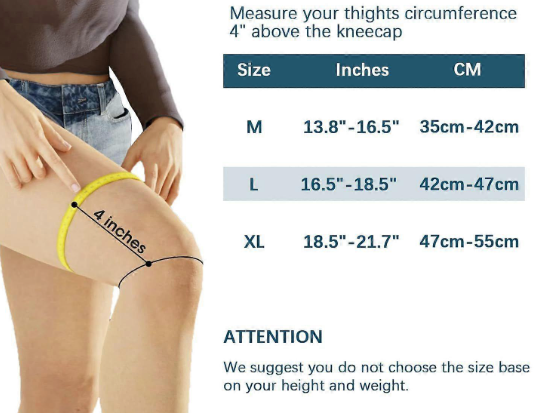
How To Size Knee Sleeves: Step-by-Step Guide
Measuring your knee for a sleeve is easier than most people think. Here’s what to do.
What You’ll Need
- A flexible cloth or plastic tape measure
- A pen and paper or your phone to record measurements
The Three Measurements That Count
1. Knee circumference (your main measurement)
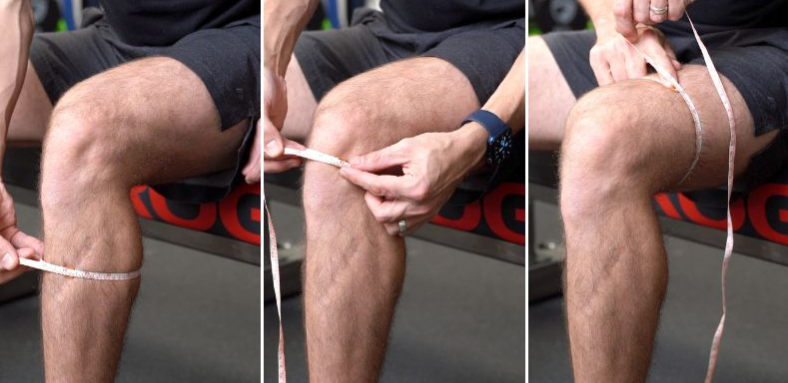
This number drives your entire sizing decision. Wrap the tape around the center of your kneecap with your leg bent at about 30 degrees. Keep the tape snug against your skin — firm contact, not tight compression. Note: Some brands want your leg straight. Check the brand’s instructions before measuring.
2. Thigh circumference — 4 inches (10 cm) above the kneecap
A sleeve that fits your knee but clamps your thigh will cut circulation and slip during movement. Take this measurement at the same leg angle you used for your knee.
3. Calf circumference — 4 inches (10 cm) below the kneecap
This keeps the bottom edge of the sleeve from flaring out or riding up. Same rule: match the leg angle.
Read Knee Sleeve Size Chart: Match Your Measurement to the Right Size
Cross-reference your measurements with the sizing chart provided by the knee brace manufacturer. Typically, a knee sleeve size chart links measurements of the knee (and occasionally the thigh or calf) to sizes such as S, M, and L. Keep in mind that sizing standards can vary slightly between brands, so always consult the specific chart for the product you’re interested in.
Below is a basic sample size chart, shown for illustrative purposes only.
| Suggested size | Knee circumference (inches) | Typical user notes |
| XS | 11–12 | Very small knees; suitable for youth or petite users |
| S | 12–13 | Smaller adult knees |
| M | 13–14 | Average adult knees |
| L | 14–15 | Larger knees or intended for strong lifters |
| XL | 15–16 | Very muscular knees or plus-size build |
| 2XL | 16–17 | Strong power athletes; notably large thighs and calves |
Stuck Between Sizes?
If you find yourself between sizes, think about how you plan to use the product. For high-intensity activities, choosing the smaller size will give you firmer compression. For recovery wear, the larger size will likely feel more comfortable. Many brands, including Nike, also suggest sizing down for a tighter fit or sizing up for a more relaxed feel. If you’re unsure, reach out to our customer service for personalized guidance.
One more thing: some brands like Fortex tell you to size from the calf if your calf measurement is bigger than your knee measurement. Take 30 seconds to check that brand’s guidance. It can save you a return shipment.
What Size Knee Sleeve Do I Need for My Activity?
Your measurement puts you in the right size range while your activity tells you where to land within it. Here’s how to match your fit to your training.
Powerlifting and Heavy Squats
Go smaller. Sitting between two sizes? Size down.
Heavy lifting needs maximum knee stabilization and rebound support. A tighter sleeve creates the compression that drives you out of the hole on a squat. Loose neoprene at the bottom of a max-effort lift isn’t just unhelpful — it’s wasted equipment. Pair the snug fit with 7mm thick neoprene for full structural support.
Running and Cardio
Go larger, or stay at the top of your current size.
Long-distance wear changes the equation fast. Tightness that feels fine during a warm-up turns into circulation-restricting misery by mile four. You want snug, not constricting — enough compression to support the joint without cutting off blood flow or limiting your stride. A sleeve that feels good at rest should still feel good 45 minutes in.
CrossFit and Mixed Training
Stay in the middle. A 5mm sleeve at a standard fit — not sized down, not sized up — gives you the balance CrossFit demands. You need enough support for loaded movements. You also need enough mobility to hit a full knee bend without the sleeve fighting you.
Rehab and Everyday Wear
Size up. Swelling present? That makes sizing up non-negotiable.
Knees in recovery often change size throughout the day. A sleeve that fits well in the morning can compress too hard by afternoon. Measure your thigh 4 inches above the kneecap and your calf 4 inches below. Either measurement runs large? Let that push your size choice up. Reinforced side panels add lateral stability without needing a tighter overall fit.
The short version: Lift heavy → size down. Run long or recover → size up. Train mixed → split the difference.
How a Well-Sized Knee Sleeve Should Feel
The right fit isn’t complicated — but it is specific. A good knee sleeve should feel firm and compressive the moment you pull it on. Not painful. Not numb. Supported. Here’s the clearest way to check your fit.
The Two-Finger Test
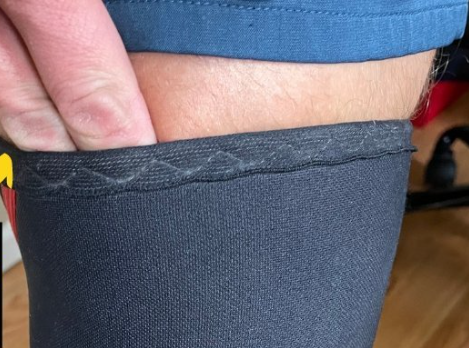
After putting on the sleeve correctly, slide two fingers under the edge. They should fit — with mild resistance, not loose. Fingers glide right under? The sleeve is too loose to do its job. Can’t get them under at all? You’re cutting off circulation. Size up.
What “Snug” Really Means
A lot of people pull on a knee sleeve, feel the compression, and assume it’s too small. It isn’t. Snug is the point. A sleeve that feels loose at rest won’t hold position once you start moving. It slides down, bunches behind the knee, or loses contact with the joint.
What you’re feeling for:
- Firm, even pressure around the kneecap — no pinching, no gaps
- Full range of motion — bend your knee all the way without the sleeve fighting you
- No numbness, tingling, or swelling — these are circulation warnings, not signs of a good fit
- Stays put during movement — no rolling, no riding down mid-set or mid-stride
Signs the Fit Is Off
Too tight: The sleeve restricts your bend. Numbness or swelling shows up after wearing it. Squatting, running, or jumping feels limited by the sleeve itself — not your body.
Too loose: The sleeve shifts during movement. You feel little to no compression. It folds or bunches instead of lying flat against the joint.
The goal is the middle ground — compression that supports the joint without strangling it.
It’s normal to see light lines on your skin after taking off the sleeve. But if you notice deep grooves, redness that sticks around for more than half an hour, or any numbness in your foot, that’s a sign the sleeve is likely too tight or not the right size for you.
Common Knee Sleeve Sizing Mistakes (And How to Fix Them)
Sizing problems aren’t random. They follow predictable patterns. The same five mistakes come up over and over, and each one has a clear fix.
Mistake 1: Sizing Down for “Extra Support”
The logic seems fair: tighter equals more support. In practice, a too-small sleeve cuts blood flow, throws off your kneecap tracking, and puts you at real risk of runner’s knee. A sleeve that’s too small doesn’t stabilize your knee. It twists it.
The fix: Size to your actual measurement. Want more compression? Go with thicker neoprene — 7mm instead of 5mm. Don’t force a smaller size.
Mistake 2: Measuring Over Clothing
A layer of fabric pushes your circumference reading up — sometimes by half an inch or more. That extra half-inch moves you into a larger size. The sleeve slides down by your third set and gives you zero compression right when you need it.
The fix: Measure on bare skin. Every time.
Mistake 3: Buying Large for “Room to Grow”
A 15″ knee in an XL sleeve feels comfortable. It also does nothing useful. No compression means no fluid control, no joint support, and no stability under load. Comfortable and effective are two different things.
The fix: Use the Gymreapers benchmark as a reference. A 15″ knee fits a Large for standard compression, or a Medium for a tighter support fit. Comfort alone is not a sizing goal.
Mistake 4: Guessing Instead of Measuring
Wide calves. Thick thighs. Body proportions that don’t match the “average” a size chart was built around. Guessing by feel ignores all of that. One runner with wider calves went by feel alone. She ended up with a sleeve that dug into her kneecap and caused pain within a mile.
The fix: Take three measurements — knee circumference at the center of the kneecap, thigh 4 inches above, calf 4 inches below.
- Your thigh or calf runs large compared to your knee? Let those numbers pick your size, not the knee measurement alone.
- For maximum support, size from your thickest calf measurement.
- For light compression, the calf-below number is your starting point.
FAQ: Knee Sleeve Sizing Questions Answered
Q: Do knee sleeves stretch out over time?
Yes. Liberte’s sizing notes confirm sleeves loosen after a few wears. A sleeve that feels tight at first will relax into a snug fit over time. That’s the right starting point — not a problem to fix.
Q: Do I need to measure both knees?
Yes. This is especially important following an injury. Measure each leg individually and record any discrepancies. Iron Bull explicitly highlights this step. Use the larger measurement to determine your size.
Q: How often should I measure knee sleeves?
Repeat the measurement every 6 to 12 months, or sooner if you experience significant weight changes, noticeable muscle gain or loss, or if your current sleeves no longer seem to fit as they used to.
Q: Do compression levels affect sizing?
Yes. Even if the size is the same, higher compression can result in a tighter feel. Be sure to see if the manufacturer’s size charts vary by compression level.
Q: Can I wear knee sleeves over compression tights?
Yes, but measure with the tights on if you plan to layer them. Layering may require sizing up to accommodate both garments comfortably.
Conclusion
Getting your knee sleeve size right isn’t complicated — but getting it wrong costs you more than just comfort.
A sleeve that’s too tight cuts off circulation. Too loose, and you’ve got a glorified sock sliding down your leg mid-squat. Neither one protects your knee the way it should.
Three things matter most. Measure your knee circumference. Match it against your brand’s specific size chart. Factor in your activity — the right fit for heavy squats is different from the right fit for a long run.
Do those three things, and you’ll feel the difference from rep one.
Ready to find your perfect fit? Browse AOFIT‘s full lineup of compression knee sleeves. Each size is built for real movement. The sizing guide takes the guesswork out of your decision, so you pick right the first time.