
Your wrist straps are sabotaging your training and you don’t even know it. Most lifters grab whatever’s nearby, slap it on before a deadlift, then wonder why their grip fails at 80% or their wrists ache after overhead work. The problem isn’t effort.
Wrist straps lifting is not one-size-fits-all. The right choice shifts based on your training phase, your sport, and even the season. Cotton behaves nothing like nylon under a loaded bar. A lasso strap built for powerlifting peaking has no business on a snatch.
This guide gives you a practical, phase-by-phase framework for choosing wrist support for weightlifting that fits how — and when — you train.
Wrist Straps vs. Wrist Wraps: What is the difference, and why does it matter?
Wrist straps (lifting straps) transfer load away from your fingers and forearms. They fix grip failure on pulling movements: deadlifts, rows, shrugs.
Wrist wraps add compression around the wrist joint itself. They build stability on pressing movements: bench press, overhead press, heavy dips.
The Wrong Tool Costs You Real Sets
Using straps on a bench press does nothing for your wrist. It adds zero joint compression. The wrist still bends under load. Wearing wraps on a heavy deadlift won’t help your grip either. Research points to grip as the limiting factor at 80–90% 1RM for most recreational lifters. Wraps won’t change that number.
Get this wrong, and you lose 1–3 heavy sets per session on back and hamstring work.
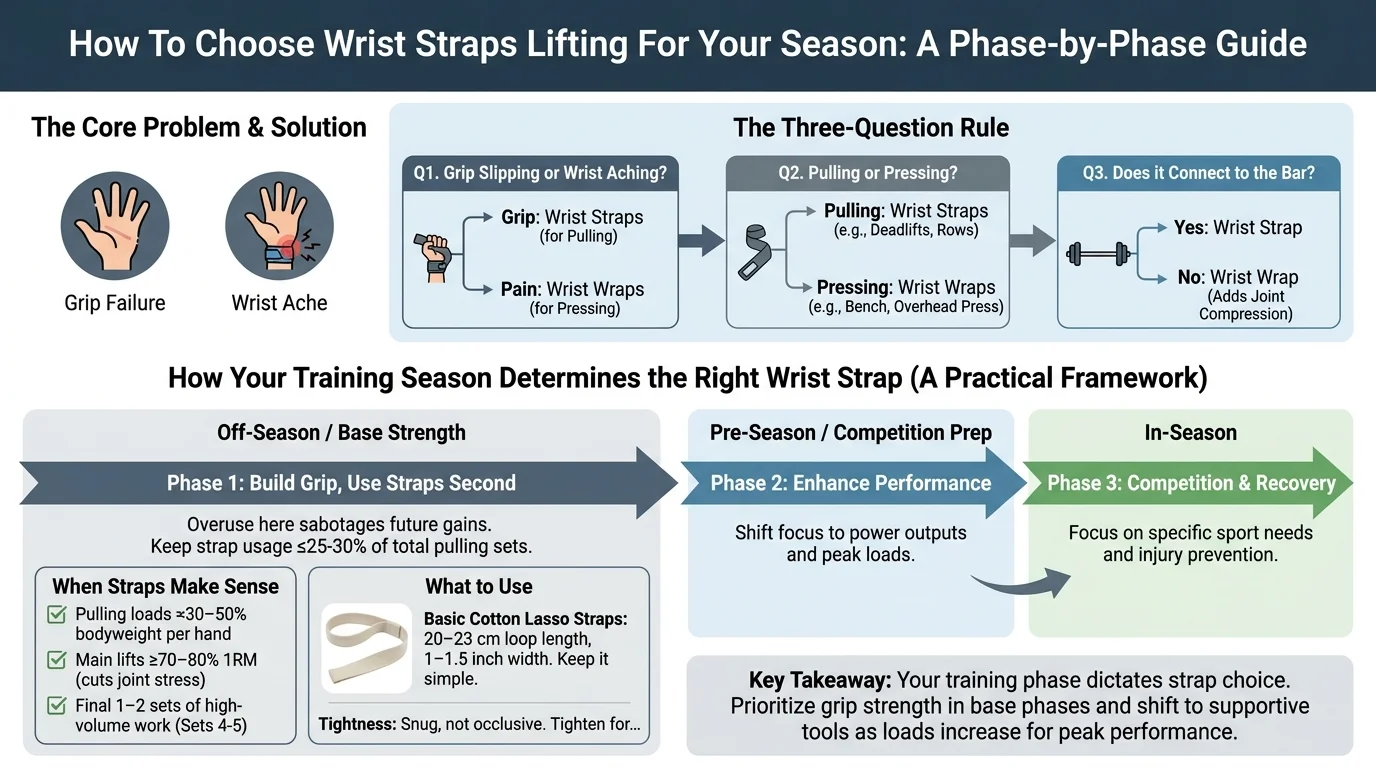
The Three-Question Rule
Ask these three questions before grabbing either piece of gear:
Grip slipping or wrist aching? → Grip: wrist straps. Pain: wrist wraps.
Pulling or pressing? → Pulling: wrist straps. Pressing: wrist wraps.
Does it connect to the bar? → Yes: wrist strap. No: wrist wrap.
How Your Training Season Determines the Right Wrist Strap?
Phase 1 — Off-Season / Base Strength: Build Grip First, Use Wrist Straps Second
Base training is where grip strength develops. Overuse wrist straps here and you’re spending future gains now. Keep wrist strap usage to ≤25–30% of total pulling sets for the first three months of a new cycle. Train the rest raw.
When wrist straps make sense in base phase:
Pulling loads hitting ≈30–50% of your bodyweight per hand
Main lifts at ≥70–80% 1RM — wrist straps here cut joint stress without killing grip development
Final 1–2 sets of high-volume work: sets 4–5 of deadlifts, heavy rows, rack pulls
What to use: Basic cotton wrist straps, 20–23 cm loop length, 1–1.5 inch width, lasso style. Keep it simple. The load doesn’t justify anything more yet.
Tightness rule: Snug but not occlusive. Tighten for the work set, loosen between sets. Blood flow and mobility matter here as much as support.
Phase 2 — Hypertrophy / Volume Peak: Protect the Joints, Keep One Set Raw
Eight-to-twelve rep sets above 80–90 kg pile on joint stress fast. Grip fails before muscles do. That’s your signal to scale up support, but don’t drop grip training from your program.
Wrist strap usage target: Cover 50–60% of heavy pulling sets with straps. Keep at least one or two lighter sets per exercise strap-free. Warm-ups stay raw.
Wrist Wrap usage target: Add performance-level wrist wraps for bench and overhead press sessions. Use them once top sets hit ≥70–80% 1RM or RPE 8–9. Loosen between sets so stiffness doesn’t carry over into accessory work.
|
Exercise |
Hypertrophy Phase Support |
|---|---|
|
Heavy deadlift / rack pull (8–10 reps) |
Wrist Straps on sets above 80% of target load |
|
High-rep shrugs (12–15 reps) |
Wrist Straps to keep grip from limiting trap output |
|
Bench / OHP at 70–85% 1RM |
Medium-stiff wrist wraps for stability |
|
Dips, bar work, calisthenics |
Light wrist wraps if wrist pain or instability appears |
Phase 3 — Strength / Intensification: Go Heavier on Both Counts
This is where heavy-duty lifting wrist straps earn their keep — thick cotton or leather, around 23 inches. For pressing, move to 18–24 inch wrist wraps with strong elastic. Working in the 80–90% 1RM range on bench or overhead press? The 24+-inch option gives you a margin of rigidity that shorter wrist wraps can’t match.
Set-by-set protocol:
Warm-up and technique sets: minimal wrist straps, lighter wrist wraps or nothing
Top sets at ≥85% 1RM: full tightening, no slack in wrist straps or wrist wraps
Strap application for heavy loads:
1. Palm up, strap against wrist, pull tight and choke around wrist
2. Palm down, wrap under-over-under-over around the bar
3. Push the first wrap as close to the wrist as possible with your thumb
4. Use thumb–fingers–thumb–fingers sequence, then grab and twist until your hand locks to the bar
Cinch tight for the working set. Not so tight it cuts off circulation.
Phase 4 — Peaking / Competition Prep: Sport Rules Now Dictate Your Setup
Four weeks out, the rules change. Your federation decides what you can use, so check before you train.
Powerlifters: Competition deadlifts are often wrist strap-free, depending on federation rules. Save wrist straps for heavy-assistance work to protect your grip on meet day. For bench and overhead press, use the longest, stiffest wrist wraps your federation allows (24+ in). In the final peaking block, wrist wraps go on 100% of top singles and doubles at ≥90% 1RM.
Olympic lifters: Wrist Strap use is limited in competition. In training, restrict wrist straps to heavy pulling variations — snatch pulls, clean pulls. Hold total wrist strap volume to ≤50% of total pulling work in the peaking block.
Positioning rule that most lifters skip: Place the wrist wrap as high and close to the hand as possible. This limits wrist extension at the joint. Tighten right before the attempt. Remove or loosen right after to restore circulation.
Phase 5 — Deload / Transition: Strip It Back
The target: Straps on ≤10–20% of sets, and only if grip is truly compromised. Wraps only for persistent pain at ≤70% 1RM and even then, ask whether that movement belongs in your deload at all.
This phase resets joint proprioception. Train without support wherever you can. It pays dividends in the next base phase.
The Full-Cycle Summary
|
Phase |
Wrist Straps |
Wrist Wraps |
|---|---|---|
|
Off-Season / Base |
Basic cotton, ≤25–30% of pulling sets |
Short/medium, for pressing ≥70–80% 1RM |
|
Hypertrophy |
Medium (~23 in), 50–60% of heavy pulling |
Performance level, pressing at 70–85% 1RM |
|
Strength |
Heavy-duty, all top sets ≥85% 1RM |
18–24 in standard; 24+ in for max rigidity |
|
Peaking |
Assistance work only; none on meet-style pulls |
Longest/stiffest allowed; 100% on heavy singles |
|
Deload |
≤10–20% of sets, pain management only |
Minimal; only for active discomfort |
Off-Season & Hypertrophy Phase: Best Wrist Straps for High-Volume Training
For 8–20 rep work at 60–80% 1RM, a 35–45 cm wrist wrap gives you enough support to keep the joint stacked. It won’t choke blood flow across a long session either. Longer wraps (50–60 cm) have their place but save them for top sets near 80% 1RM. Drop back to something more pliable for the volume work that follows.
Tightness rule: one finger under the wrap.
What to Use and What to Skip
|
Scenario |
Recommendation |
|---|---|
|
Bench / OHP, 8–12 reps at 70–75% 1RM |
45 cm wrap, moderate tightness |
|
Incline DB press, 10–15 reps |
45 cm, a touch looser for wrist angle variation |
|
Accessory triceps work, 12–20 reps |
Wraps only if discomfort shows up in the final third of the set |
|
Top sets near 80% 1RM |
50–60 cm, stiffest option in your kit |
Strength & Powerlifting Peaking Phase: Wrist Straps Built for Maximum Deadlift Load
One controlled study on conventional deadlift mechanics found that lifters using belt and wrist straps together completed reps faster and posted lower RPE than those pulling without any aid.
The rule most coaches settle on: belt and wrist straps together, or neither. Not wrist straps alone on your heaviest sets.
Strap Use in a Peaking Block
≥6 reps per set → wrist straps are appropriate
≤5 reps per set → pull without wrist straps, except some tempo work
Singles → never use wrist straps
Warm-ups and lighter technique work → no wrist straps
Olympic Weightlifting Season: Choosing Wrist Straps That Won’t Get You Killed on the Snatch
The default rule for Olympic lifting season: no straps on maximal snatches from the floor.
Wrist Straps belong in a narrow window here:
Snatch pulls and snatch deadlifts — load the posterior chain without grip becoming the ceiling
High-rep hang snatches during volume cycles — spare the hands when skin is the limiting factor
Torn hands during a peak — use wrist straps to keep training
The Setup That Keeps You Safe
Wrist Strap position is where most Olympic lifters make a critical mistake. The strap goes over the hand. It’s a safety requirement.
What to Use and What to Leave at the Powerlifting Rack
|
Strap Type |
Snatch-Safe? |
|---|---|
|
Chinese-style cloth / Olympic webbing straps |
✅ Yes — auto-release design |
|
Standard lasso cotton straps |
✅ With correct hand placement |
|
Figure-8 deadlift straps |
❌ No — designed for max attachment |
|
Thick leather powerlifting straps |
❌ No — too stiff, too slow to unwrap |
|
Any strap used on cleans |
❌ Never — blocks turnover, serious wrist injury risk |
Length: 20–23 inches is the standard range for Olympic-specific straps. That gives you enough wrap for security on pulls, plus a fast release on a miss.
CrossFit & Mixed-Modal Season: Wrist Straps for Speed, Sweat, and Variety
Wrist Wraps aren’t here to make you stronger. In CrossFit, they’re here to protect your joints across dozens of transitions.
Length Decides Everything
12–18 inches — faster on/off, better for WODs with movement changes every 60 seconds or less
18–24 inches — more support for heavy front squats, cleans, and jerks
24–36 inches — save these for max-effort complexes and PR attempts
For most mixed-modal training, stay in the 18–24 inch range. This handles barbell work without costing you time on the rig.
Material for Sweat and Duration
|
Scenario |
Material |
|---|---|
|
WODs >15 min, high sweat |
Cotton or cotton-blend — absorbs moisture, maintains grip tension |
|
Short, heavy events <10 min |
Elastic polyester/nylon — stiffer, more support at max loads |
|
Gymnastics-heavy days |
Flexible cotton — preserves range of motion at the wrist |
The practical target for CrossFit season: one pair, elastic-cotton blend, 18–24 inches, Velcro closure, 3-inch width. Keep them on between movements — loosen for gymnastics, tighten before the barbell.
One last thing: lifting straps don’t belong here. Many CrossFit events ban them outright. They add nothing for overhead work, thrusters, or gymnastics transitions. Wrist wraps — not lifting straps — are the right tool for this season.
The 4 Key Selection Criteria: Material, Width, Length & Strap Type Explained
Here’s what each one means for wrist support for weightlifting.
Material: The Variable That Changes Everything Else
Cotton wrist straps lifting setups dominate base and volume phases for a reason. Cotton absorbs sweat, holds friction under load, and breathes through long sessions.
Nylon runs stiffer — better for max-effort work, worse across 20-rep sets in a warm gym.
Leather is durable but rigid. It doesn’t compress or conform. That makes it useful for deadlift wrist straps at near-maximal loads. For anything dynamic, it falls short.
Heavy sweat or long sessions? Cotton or cotton-blend wins. Pulling singles? Leather or nylon wrist straps gym setups give you the stiffness feedback that matters at the top end.
Width: 1 to 1.5 Inches Covers Most Lifters
Wider spreads pressure across the joint. Narrower stays clear of the way. For most powerlifting wrist support work, 1.5 inches handles heavy loads without interference. For Olympic lifting wrist straps and mixed-modal training, narrower options keep full range of motion at the joint.
Length: Match It to the Movement
Wrist strap length for lifting follows a simple rule — longer means more wraps around the bar, which means more lock. For pulling work, 22–24 inches is the practical range. For overhead or dynamic movements, stay under 23 inches.
Strap Type: Lasso vs. Figure-8 vs. Hook and Loop
Lifting straps vs wrist wraps is one distinction. Within lifting straps, construction matters too.
|
Type |
Best For |
Avoid When |
|---|---|---|
|
Lasso |
Deadlifts, rows, general pulling |
Competition snatches |
|
Figure-8 |
Max deadlift singles |
Any overhead work |
|
Hook and loop wrist straps |
Mixed sessions, quick adjustments |
Near-maximal pulls needing full lock |
Use and Skip Wrist Straps for Lifting
Grip fails before muscles do. That’s the signal. Your deadlift stalls because your fingers open, not because your back gave out. That’s when straps belong on your wrists.
Use straps when:
– The exercise is a pulling movement — deadlifts, rows, shrugs, lat pulldowns, pull-ups
– Load hits ≥80% 1RM or rep ranges push into high-volume territory where forearm fatigue builds up
– Your grip quits before your target muscles get enough stimulus
– Skin breakdown or hand fatigue is hurting set quality across multiple sessions
Skip straps when:
– You’re a beginner
– The movement is a press
– It’s a warm-up set or technique drill
– The exercise is a clean
One rule clears up most confusion: no straps on sets below 80% 1RM where grip isn’t failing. Early sets build your grip strength. Straps step in for the heavy work your grip can no longer handle on its own.
Conclusion
Your season changes. Your lifts change. Your wrists are not one-size-fits-all.
Stop matching generic charts; start matching your own training phase, movement, and load. Get a wrist strap built precisely for you.
Visit our custom wrist strap solution at aofitbrace.com and design yours now.