
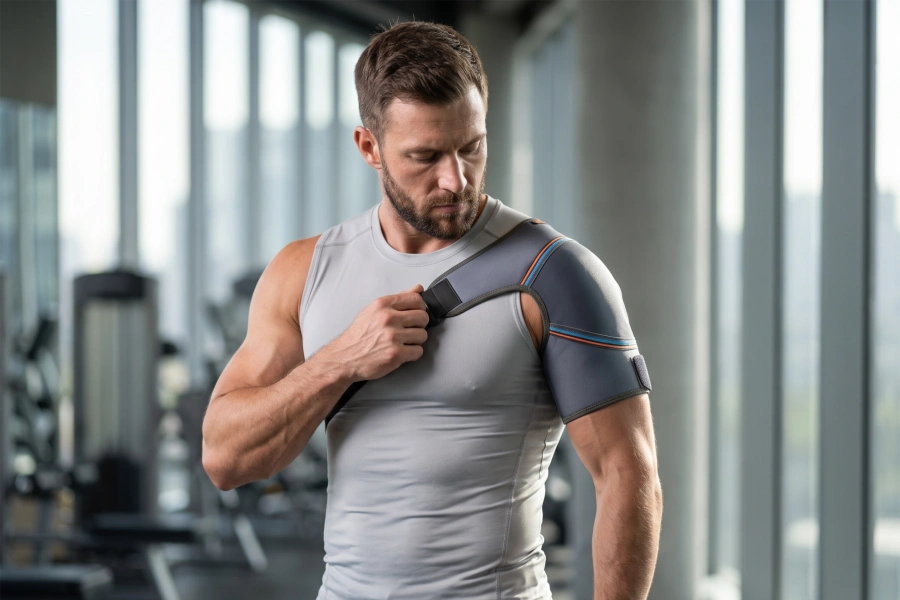
For clinics, sports teams, and rehabilitation centers, the choice between stocking off-the-shelf shoulder braces and investing in custom shoulder brace solutions directly impacts patient outcomes, operational efficiency, and your bottom line. This guide breaks down the clinical data, procurement logistics, and cost-benefit analysis from a buyer’s perspective.
What Is a Custom Shoulder Brace?
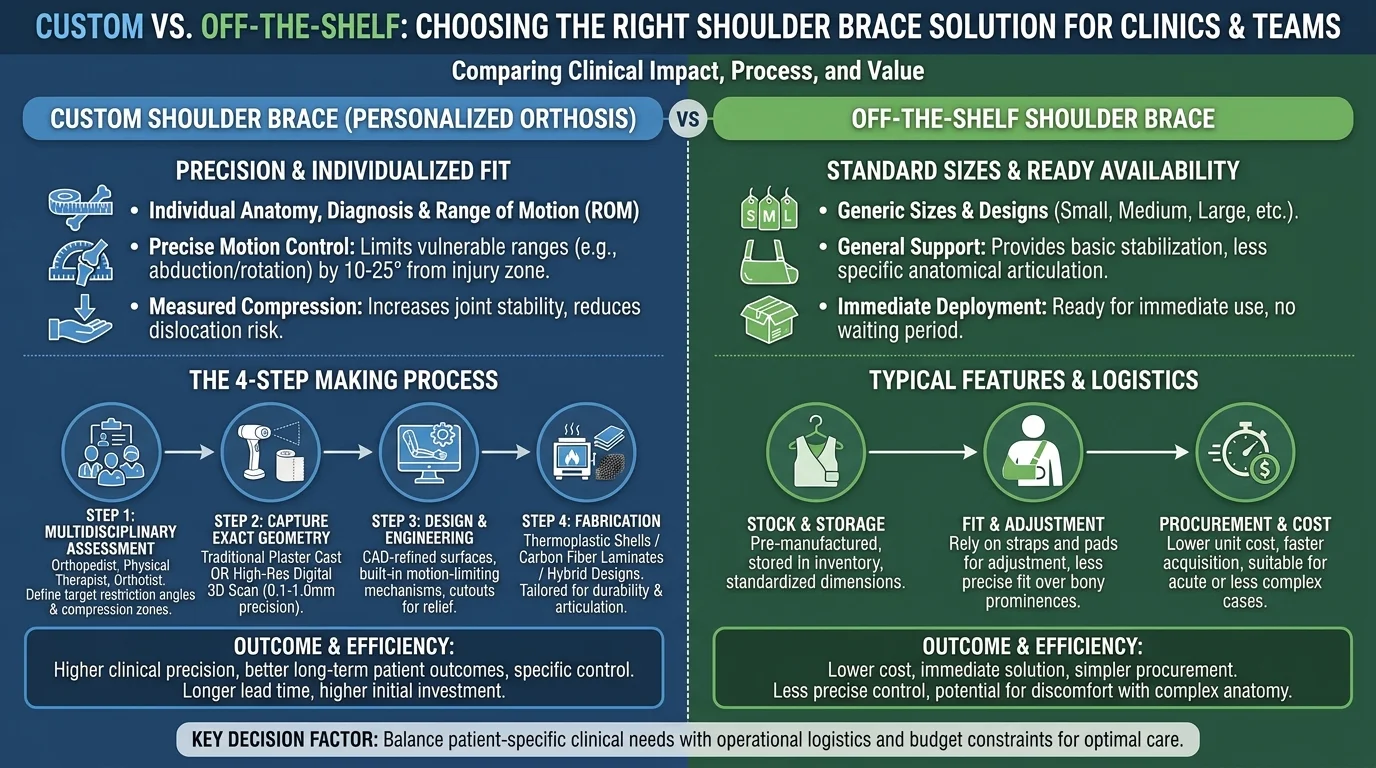
A custom shoulder brace is a device constructed around the patient’s individual anatomy, diagnosis, and specific range of motion, with precision down to the millimeter. The technical term is personalized shoulder orthosis. It controls shoulder movement with real precision, limiting vulnerable ranges like abduction or external rotation by 10 to 25 degrees from the injury zone. It also applies measured compression to increase joint stability and reduce dislocation risk.
The Making Process: From the Patient’s Shoulder to a Finished Shoulder Brace
Step 1: Assessment — A Multidisciplinary Input
The orthopedist, physical therapist, and a certified orthotist each contribute to the initial evaluation. The orthopedist confirms the diagnosis. The physical therapist records active range of motion and pain thresholds. The orthotist takes precise measurements: shoulder circumference, chest circumference, humeral length, and acromion positioning. Together, they build a formal design prescription that specifies target restriction angles and identifies areas requiring compression or relief.
Step 2: Capturing Exact Geometry
-
Traditional method: Plaster bandages wrap around the patient’s shoulder and upper arm. Once hardened, the negative mold is filled to create a positive cast, a physical replica of the anatomy.
-
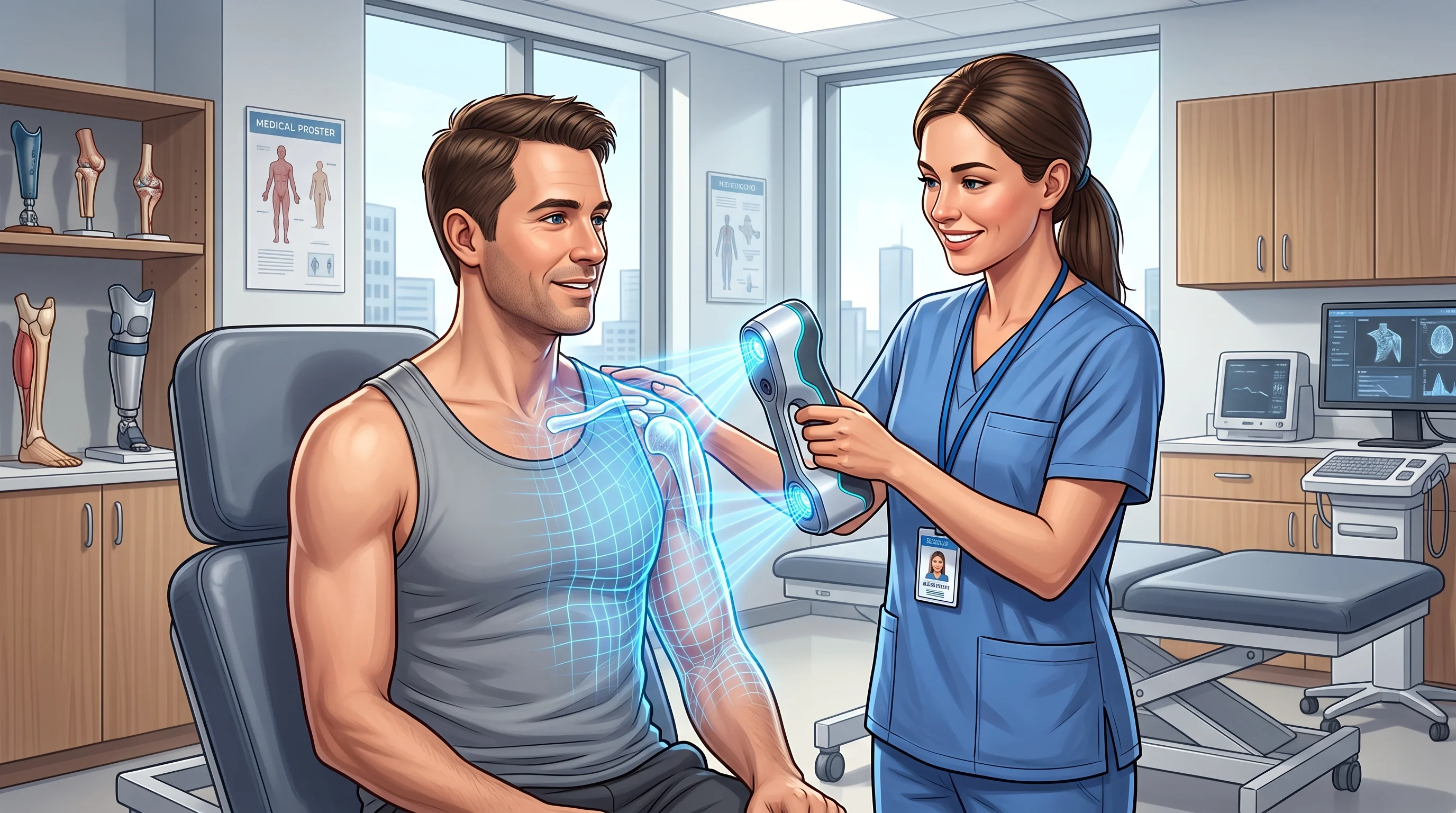
Digital method: A handheld 3D scanner maps the full surface of the shoulder, chest, back, and upper arm, capturing resolution at 0.1 to 1.0 mm, precise enough to detect bone prominences and muscle volume.
Step 3: Design and Engineering
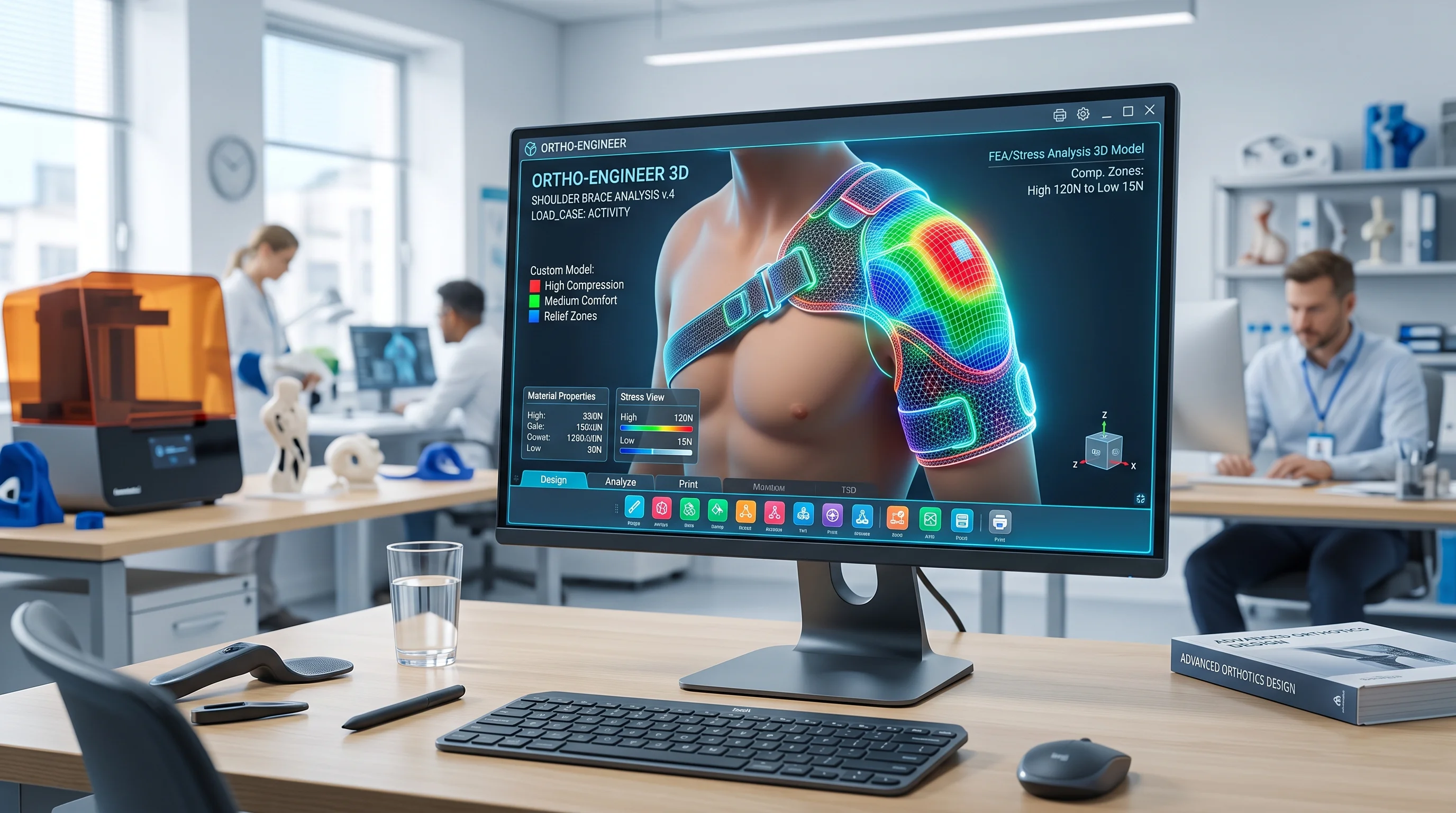
The scan data is imported into CAD software. The orthotist refines the surface, builds compression and relief zones, thickens areas around the anterior shoulder, and adds cutouts near neurovascular pathways. Motion-limiting mechanisms are designed in software before any material is cut.
Step 4: Fabrication — Three Material Paths
-
Thermoplastic shells: Heated to 150–180°C, hand formed over a custom mold, then trimmed and finished. Durable, affordable, and easy to adjust.
-
Carbon fiber laminates: Layers of carbon cloth are laid over a foam model, vacuum-bagged, and cured under heat and pressure. The result is a lightweight, high modulus shell, ideal for athletes requiring maximum protection at minimal weight.
-
3D printed structures: Biocompatible materials like PA12 nylon or TPU print directly from the CAD file. No mold is needed.
Step 5: Fitting, Adjustments, and Follow-Up
The orthotist and physical therapist check range of motion against the prescription using a goniometer. They scan for pressure points after 15 to 30 minutes of wear and make physical changes such as grinding inner surfaces, repositioning straps, and adjusting padding thickness until the fit is correct. Follow-up appointments align with rehabilitation milestones: two weeks, six weeks, and three months post-surgery.
What Is an Off-The-Shelf Shoulder Brace?
A patient can walk into a pharmacy, find the device hanging on a rack, and purchase it without an appointment or prescription. There is no need to wait weeks for a fitting. The patient selects it based on a size chart on the packaging and leaves within minutes. This accessibility is useful, but it comes with trade-offs.
Off-the-shelf braces are prefabricated devices built around standard sizing, from S through XL, and adjusted through Velcro straps, buckles, and extender bands. There is no anatomical contouring. They fall into four functional categories.
Four Types, Four Different Jobs
-
Immobilization braces (like Thuasne’s shoulder immobilizers) hold the arm close to the body after dislocation or surgery, limiting glenohumeral motion to near zero.
-
Compression braces (like the Mueller Shoulder Support, made from neoprene) wrap the shoulder in consistent pressure. Neoprene retains body heat, raises local skin temperature by several degrees, and reduces low-level vibration that aggravates soreness.
-
Stabilizing braces (like the Vive Rotator Cuff Support) use directional compression to limit extreme ranges of abduction and external rotation, the exact positions that trigger anterior instability.
-
Sports focused supports (like the OPTP PRO Shoulder Support, built for overhead athletes) prioritize proprioceptive feedback, reducing peak strain and helping the nervous system track shoulder position in space.
Where the Sizing System Shows Its Limits
A single off-the-shelf size typically covers a 4 to 6 inch range of chest or arm circumference. A patient at the upper end of a medium size may also qualify for a large, yet neither option will compress the shoulder with precise, calibrated fit. Wide range models attempt to solve this with strap tension alone, covering a 19-inch spread from 30 to 49 inches. On a smaller frame, straps run loose; on a broader frame, they pull tight. The shoulder brace remains the same, but the fit is not.
How the Patient Obtains One — and What It Costs
-
Pharmacy: No prescription needed. Compression and light-stabilizing styles are available. Price range: $20 to $60. The patient sizes using the chart on the packaging.
-
E-commerce: The widest selection, detailed measuring guides, and video tutorials. The patient still self-diagnoses and self fits. Returns are possible but add friction.
-
Clinic: A physician or physical therapist selects and sometimes adjusts the brace on site. Post operative immobilizers and advanced stabilizers range from $80 to $300+. Insurance may cover them as durable medical equipment.
For mild sprains, short-term post-activity soreness, or early return to sport support, an off-the-shelf shoulder stabilizer can work well. It is built to be accessible. What it cannot do is replicate the patient’s anatomy.
Head-to-Head Comparison: Custom vs. Off-The-Shelf Shoulder Brace
| Feature | Off‑the‑Shelf Shoulder Brace | Custom Shoulder Brace |
|---|---|---|
| Fit Accuracy | Standard S/M/L sizing; covers a 4–6 inch range; uses elastic fabric and adjustable straps. | Built from precise measurements or 3D scans; anatomical fit with 1–3 mm tolerance. |
| Support & Stability | Broad compression over a fixed resistance range; general directional coverage. | Targeted resistance at specific weak points (e.g., 90° abduction, terminal external rotation); superior for labrum tear or dislocation. |
| Long‑Term Comfort | Pressure points and shifting occur in 30–50% of users when worn >6 hours/day. | Relief zones around bony areas; problem rate <10–20% for extended wear; improves functional scores and reduces stiffness. |
| Cost (Upfront) | $30–$300 depending on type (basic to advanced stabilizing). | $600–$1,500+ (complex structures up to $2,000+); typical total with assessment $800–$2,000. |
| Insurance Coverage | Rarely covered or only minimal reimbursement. | Often covered when prescribed as medically necessary; can substantially lower out‑of‑pocket expenses. |
| Availability | Same day purchase. | 1–3 weeks for standard thermoplastic or 3D‑printed designs; 3–6 weeks for carbon fiber or multi‑hinge builds. |
| Durability | 6–12 months under moderate use. | 1–3 years of heavy daily wear; made of carbon fiber laminates, reinforced plastics, or PA12 nylon; longer warranty included. |
| Adjustment | Minimal self‑adjustment via straps. | Professional modification by a certified orthotist. |
| Best For | Mild, temporary conditions; occasional use. | Complex injuries, post‑surgical recovery, chronic instability; daily extended wear. |
| Wear Duration | Short‑term or intermittent use. | Daily, prolonged wear (more than 6 hours per day). |
Is an Off-The-Shelf Shoulder Brace Right for the Patient?
For mild to moderate sprains, rotator cuff tendinopathy, shoulder impingement, or post-activity soreness that resolves within 48 to 72 hours, an off-the-shelf brace is the appropriate tool. A patient is a strong candidate if:
-
Imaging rules out fracture, full dislocation, or complete rotator cuff tear.
-
Passive range of motion is normal or near normal.
-
There is no gross structural deformity.
-
The patient needs to remain functional during healing.
-
Support is needed today, not three weeks from now.
An off-the-shelf brace works best in the two to eight week window after a mild to moderate soft tissue injury. At two weeks, the goal is at least 30% pain reduction and improving function. If progress stalls or instability persists at four weeks, that is the signal to escalate to custom bracing, imaging review, or surgical consultation.
Clinical Indications for a Custom Shoulder Brace
When a prefabricated shoulder brace fails to hold in place, or a surgeon prescribes a custom orthotic shoulder support, the decision moves from convenience to medical necessity. The following clinical scenarios warrant a custom shoulder brace.
-
Upper extremity surgery occurred within 21 days and precise sustained motion restriction is required.
-
Documented recurrent dislocations or chronic instability with failed rehabilitation exist.
-
Standard braces cause pressure points or shift out of place due to the patient’s anatomy.
-
The brace is needed daily for more than three months.
-
At least one off-the-shelf brace has been tried and failed.
The Real Cost Breakdown: Is a Custom Shoulder Brace Worth the Investment?
While the unit price of a custom shoulder brace is notably higher, a B2B buyer must look beyond the invoice. The Total Cost of Ownership (TCO) tells a different story.
-
Off-the-shelf shoulder braces typically require replacement every 6 to 12 months, incurring repeat purchasing costs and patient complaints about poor fit.
-
Custom shoulder braces, built with carbon fiber or high-grade thermoplastics, last 1 to 3 years of heavy use, reducing long-term procurement frequency.
More importantly, poor fit leads to low patient adherence, with 30% to 50% of reported issues related to standard sizing. Custom shoulder braces reduce adjustment-related chair time by over 60%.
How to Choose the Right Shoulder Brace for the Patient’s Specific Injury?
The patient’s injury type is the single most important variable. Not budget, not recommendations, not online reviews. The diagnosis guides everything else.
Rotator Cuff Injuries
-
Mild tendinitis or minor strain, pain ≤4/10, no full tear on imaging: A neoprene compression sleeve is the starting point.
-
Partial tear or mid stage conservative rehab: An adjustable stabilizing brace with at least three adjustment points is recommended to block extreme abduction and outward rotation.
-
Full thickness tear or post surgical repair: An abduction sling with pillow, set to 30 to 45 degrees of abduction, is required for the first four to six weeks.
Shoulder Instability, Recurrent Dislocation, and Labral Tears
An unstable anterior shoulder requires a stabilizer that blocks the danger position, combined abduction above 60 to 70 degrees plus strong outward rotation. After Bankart or Latarjet procedures, the surgical team sets both the restriction angle and wear duration. A custom shoulder brace can hold those two axis limits consistently.
AC Joint Injuries
-
Grade I to II: A sling or strap style support holds the arm close to the body at 90 degrees of elbow flexion to offload the joint.
-
Grade III or post reconstruction: A purpose built AC stabilizer with full chest anchoring is needed.
Impingement, Bursitis, and Tendinitis
A warm neoprene support with moderate compression raises local tissue temperature by 1 to 2°C, reducing stiffness and boosting blood flow. Some models include a pocket for a cold or heat pack.
Matching the Brace to Daily Wear Time
-
≤2 hours daily: Easy on and off, light compression is acceptable.
-
2 to 8 hours daily: Breathable, moisture wicking fabric and multiple adjustment points are required.
-
8+ hours or overnight: Total weight under 500g, daily skin inspection, and short decompression breaks every 2 to 3 hours are recommended.
Custom Orthotic Shoulder Support for Post-Surgical Recovery: What to Expect
Surgery changes the clinical picture completely. The goal shifts from symptom management to protecting a repair that requires time, precision, and a brace that progresses with the patient.
Weeks 0 to 3: Maximum Protection
The custom shoulder brace locks in surgeon defined limits: forward flexion below 60 to 90 degrees and external rotation no more than 20 degrees. Mechanical stops hold those angles. The patient wears it all day, every day.
Weeks 3 to 6: Gradual Release
At follow-up visits, the orthotist adjusts angle settings. Flexion moves toward 120 degrees. External rotation opens slightly. The custom orthotic shoulder support shifts from full time fixture to activity based support, allowing passive and assisted movement within expanding limits.
Weeks 6 to 12: From Protection to Function
The custom orthotic shoulder support is used for outdoor activity, high-effort moments, and sleep, not all-day wear. Active movement and light resistance training begin.
What sets this apart from a standard shoulder sling is staged, angle-specific control. Off-the-shelf immobilizers offer one setting. A custom fit shoulder support gives the surgeon a tool that can be adjusted as recovery advances, holding the repair firm at week one and releasing it with control at week six.
Top Features to Look for in a High-Quality Custom Shoulder Brace
Not all custom shoulder braces are equal. Here’s what separates a well-engineered custom fit shoulder support from one that just costs more.
- Precise fit architecture: Look for 3D scanning and CAD modeling. XO Armor uses this approach to map the acromion, chest wall, and upper arm with true anatomical accuracy. Multiple independent adjustment points matter more than a single main strap.
- Adjustable range-of-motion control: A quality personalized shoulder orthosis blocks unsafe positions while keeping safe movement intact. You can dial that balance tighter or looser as recovery moves forward.
- Breathable, layered materials: Three-layer neoprene — smooth inner, perforated middle, medical fabric outer — cuts heat buildup during long wear. Moisture-wicking fabric isn’t a bonus. Past six hours of daily use, it’s a must.
- Swelling-responsive adjustability: Tension should reset without tools and one-handed works best. Your shoulder at week two looks nothing like your shoulder at week six. The custom shoulder brace needs to keep up.
- Anti-slip construction: Rubber-backed panels and reinforced stress points hold the shoulder brace in place. This matters most during sleep or overhead movement, when shifting is most likely.
Conclusion
The choice between a custom shoulder brace and an off-the-shelf shoulder brace is not about which is absolutely better; it is about which aligns with your clinical standards, operational workflow, and financial model.
As a B2B partner, AOFIT provides a comprehensive custom shoulder brace solution backed by regulatory expertise, dependable supply chains, and ongoing clinical education. Review our technical specifications and certification documents, or request a sample kit to evaluate the build quality firsthand. Partner with us to deliver the standard of care that your patients deserve and your practitioners can trust.