
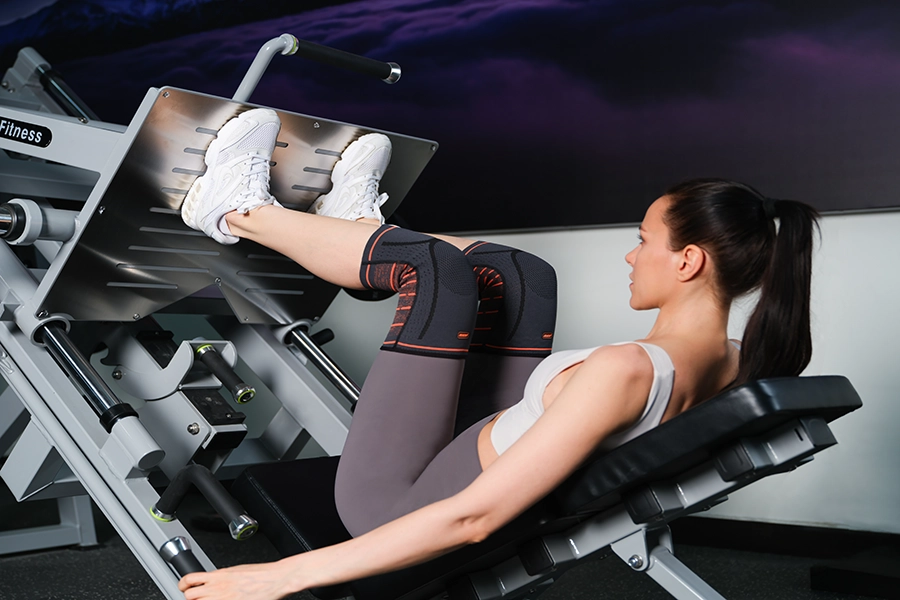
Do users complain about slipping knee pads during dynamic movement? The incessant need to pull them back up wastes time, breaks concentration, and often chafes the skin. It’s a persistent defect that damages customer loyalty and inflates your return rates. In this piece, we’ll show how a specialized knee pad manufacturer can help your brand stop knee pads from slipping.
Friction is a friend of Slipping Knee Pads
The most direct way to stop knee pads from slipping is to increase the friction between the pad and the wearer’s leg.
Optimize Silicone Grippers: Many sleeve-style pads already use silicone bands or dots at the top and bottom. A key design insight is to treat these with care. To extend their life, knee brace manufacturers can advise users to roll the silicone section away from the inside when putting the pad on, and only roll it into place against the skin once the pad is positioned correctly. This prevents the silicone from rubbing against skin and hair during donning and doffing, which can quickly degrade its grip.
Innovate with Materials: Some manufacturers are already developing solutions for users with sensitive skin who cannot tolerate silicone. They are using specially formulated “anti-slip yarns” in the fabric itself to provide friction directly, removing the need for silicone strips. This is a novel approach that tackles the problem at a material level.
Straps are crucial for Slipping Knee Pads
Straps are actually one of the most critical design elements to stop knee pads from slipping. The biggest issue is that many straps are placed behind the knee, which can cause them to pinch, bunch up, or loosen as the leg bends. From a design and manufacturing standpoint, AOFIT, as a professional custom brace manufacturer has three main strategies to re-think straps:
Outsmart the “Behind-the-Knee” Problem
Connect the Pad to Clothing: A patented design uses long, stretchable straps to attach the knee pad to clips on the user’s pants, rather than wrapping around the leg. This keeps the straps—and pressure—away from the sensitive back of the knee, allowing for a full range of motion.
Leverage the Thigh: Instead of a single strap, some systems use an upper strap that wraps above the knee and connects to a belt or waistband. This effectively uses the user’s entire leg as an anchor point, which is much more secure.
Design for a Customizable, Yet Secure, Fit
A “one-size-fits-all” strap is a recipe for slipping. The most effective designs give users control over the fit.
Locking Buckles and High-Friction Materials: Some designs feature locking plastic buckles that firmly secure the strap and prevent it from sliding loose. Pairing these with elastic straps made of materials like neoprene can provide a balance of a snug fit and some flexibility.
Dual-Strap Systems: Using two independent straps (one above and one below the knee cap) is a common and effective method. This allows the user to tailor the pressure distribution and prevents the pad from twisting or migrating up and down.
Quick-Release for Easy Adjustment: Consider using quick-release buckles. They not only make the pads easier to take on and off but also encourage users to adjust the fit more frequently throughout the day, ensuring the pads are always at their optimal tightness.
Refine Strap Construction and Material
The strap itself is a component that can be optimized for comfort and durability.
Engineered Breathability: A common complaint with straps is sweating. Using perforated neoprene straps can significantly improve airflow behind the knee, making the pad more comfortable for long-term wear and reducing the urge to loosen or readjust them.
Durable and Secure Closures: Hook-and-loop (Velcro-type) closures are the standard for adjustability, but they can wear out. Using a tough buckle system in conjunction with the hook-and-loop can provide an extra layer of security, especially in rugged job site conditions.
Targeted Upper Support: Some designs add a dedicated strap that wraps high on the thigh (quadriceps support). This strap provides additional anchoring and helps prevent the entire pad from sliding downwards.
Padding helps stability to stop knee pads from slipping
While it seems counterintuitive, the shape, thickness, and internal structure of the impact foam are major culprits in slippage. A poorly designed pad acts like a stiff sled; when you bend your knee, the rigid foam pushes against your skin and forces the whole pad downward.
Reshape the Foam for Anatomical Bending
The knee isn’t a perfect circle—it changes shape dynamically. Traditional dome-shaped pads are often too rigid and flat on the backside.
Split or Hinged Padding: Instead of one solid piece of foam over the kneecap, knee pad manufacturers can design the padding with horizontal or vertical splits (living hinges) that allow the foam to flex and compress as the knee bends. When the pad flexes with the joint rather than fighting against it, there is less upward force exerted on the top edge of the sleeve or straps, which dramatically reduces the “creep” downward.
Pre-Curved Anatomical Shells: Rather than molding a flat sheet of foam into a curve, manufacturers can use injection-molded foam that has a built-in 3D anatomical curvature. This matches the natural “O” shape of the bent leg, ensuring the pad hugs the knee evenly at all angles, eliminating the pressure points that cause shifting.
Vary the Thickness (Zoned Protection)
A pad that is uniformly thick is heavy, hot, and prone to gravity pulling it down.
Tapered Edges (Feathering): Instead of a blunt, squared-off edge where the pad meets the sleeve, manufacturers should feather or taper the outer perimeter of the foam down to a very thin edge. This creates a smooth transition between the fabric and the armor. Thick, blunt edges act like hooks that catch on the sleeve and drag it down; tapered edges glide with the fabric.
Strategic Sculpting: Remove foam from areas that don’t need impact protection (like the sides of the kneecap or the back of the joint) and concentrate the thickest foam strictly over the patella. Reducing overall weight and bulk directly reduces the gravitational pull that causes slippage over time.
Change the Material Physics (Beyond EVA)
Most budget pads use solid EVA or rubber foams, which are “closed-cell” and don’t breathe. Moving to advanced materials offers dual benefits: better shock absorption and less slippage.
D3O and Non-Newtonian Fluids: This material is soft and flexible during normal movement but hardens upon impact. By using D3O, the pad remains flat and pliable when you are walking or kneeling gently, allowing it to conform to the changing shape of your leg. It only rigidifies during a crash. A flexible pad that conforms to the leg in real-time naturally experiences less “prying” force than a permanently rigid one.
Mechanical Stretch Foams (Auxetic Materials): As mentioned briefly earlier, materials like Koroyd use a structured pattern (peanut-shaped holes). When you bend your knee and the pad stretches in length, the material physically thins out to accommodate the stretch. Because the material is doing the work of expanding, it doesn’t need to slide over your skin to find extra length.
Perforation for Weight Reduction: Drilling small, strategic holes (perforations) through the foam reduces the overall weight of the pad without sacrificing structural integrity. Reducing mass means less inertial force pulling the pad downward with every step or jump.
Integrate Padding with Textile Mechanics
Instead of treating the foam and the fabric sleeve as separate entities, manufacturers can fuse them biomechanically:
“Floating” or “Suspended” Padding: Instead of stitching the foam directly onto the stretchy sleeve, the foam is only attached at a few key anchor points (e.g., top and bottom). The stretchy sleeve can move freely underneath the hard shell. This means when the fabric stretches to accommodate your muscle contractions, it slides underneath the pad, so the pad itself stays perfectly centered over the kneecap.
Breathable 3D Spacer Fabrics under Foam: Using a thick, open-weave “spacer” fabric between the skin and the foam acts like a shock absorber and provides micro-grip against leg hair and skin, while also wicking sweat away. Keeping the skin dry is crucial; sweat acts as a lubricant, making even the best-shaped foam slip.
Proper sizing matters while Knee Pads Sliding
Sizing is arguably the most overlooked yet most critical factor in preventing knee pads from slipping. You can have the best grippers, the smartest straps, and the most flexible foam on the market, but if the sizing is off, the pad will slide down.
Abandon “One-Size-Fits-All” (S/M/L is not enough)
The biggest industry mistake is offering just Small, Medium, and Large based solely on thigh circumference. Human legs vary dramatically in taper, muscle density, and fat distribution.
Offer “Short” and “Tall” Variations: Two people can have the exact same thigh circumference but completely different femur lengths. A pad that is too long for a shorter leg will have the bottom edge digging into the shin, forcing the pad upward. Conversely, a pad that is too short for a taller leg will leave gaps and shift. Manufacturers should offer length variations (e.g., Medium-Short, Medium-Regular, Medium-Tall) alongside circumference sizing.
Implement “Tiered” Sizing Matrices: Instead of guessing the fit, provide a comprehensive sizing chart that requires two measurements: (1) Thigh circumference 6 inches above the kneecap, and (2) Calf circumference 6 inches below the kneecap. This ensures the top and bottom openings both fit securely, preventing the “squeeze-and-slide” effect.
Introduce Active Adjustment Zones
A passive sleeve that relies on a single piece of elastic will always degrade and slip over time. The pad needs to adapt to the user’s changing leg shape as muscles swell and contract throughout the day.
Dual-Zone Tension Systems: Instead of one uniform elastic band at the top and bottom, incorporate separate, independently adjustable tension panels on the medial (inner) and lateral (outer) sides of the sleeve. This allows users with muscular calves but thinner thighs to customize the tension in each specific zone, anchoring the pad securely against their unique anatomy.
Progressive Closure Systems: For wrap-style pads, use a Y-shaped strap that cinches the pad from three angles simultaneously. This pulls the pad backward and inward against the knee’s contours, rather than just squeezing it inward like a standard strap, which often causes vertical slippage.
Design for Specific Genders and Body Types
Anatomy is not uniform. The quadriceps-to-knee ratio and fat distribution differ significantly between average male and female athletes or workers.
Gender-Specific Molds: Female legs typically have a wider hip-to-knee angle (Q-angle) and a different fat-to-muscle distribution around the patella. A unisex pad often gaps at the inner knee, creating a pivot point that forces the pad to twist and slide down. Manufacturing specifically contoured left-leg and right-leg pads (instead of universal ones), as well as gender-specific profiles, ensures the pad locks into the natural bony landmarks of the knee, preventing rotational slippage.
Combat Sizing Degradation (The “Stretch-Out” Effect)
Fabrics and elastic straps stretch out over time. A pad that fits perfectly on Day 1 will be loose and slipping by Day 30 if this isn’t addressed.
Use Nylon/Spandex Blends with High Memory: Designers must specify high-retention elastane (e.g., Lycra with a higher denier) that has a recovery rate of 95% or higher. This ensures the sleeve snaps back to its original size after stretching, rather than permanently deforming to a larger size.
Incorporate a Secondary Cinch: Within the sizing itself, add a subtle internal bungee cord or drawstring at the very top hem of the sleeve. This allows the user to tighten the opening by an extra inch as the fabric ages, effectively “rescuing” the fit and extending the life of the anti-slip properties.
Smart Sizing Tools for the Consumer
A design is only as good as the consumer’s ability to choose the right one. Sizing errors often happen at the point of purchase, not in the factory.
Invest in AR (Augmented Reality) Fitment Apps: Allow users to scan their leg with their smartphone camera to get a precise size recommendation based on 3D mapping, rather than relying on a shaky tape measure.
Sizing Stickers inside the Pad: Print the sizing range and a “fit test” diagram directly on the inside lining of the pad. This guides the user to check if the top and bottom hems are lying flat against the skin with no gaps after donning, teaching them what a “correct” fit should feel like.
Conclusion
To ensure the knee pad stays securely in place without bunching or slipping, the design relies on a synergy of high-performance fabrics, ergonomic patterning, and precise sizing protocols. This construction allows the sleeve to move in harmony with the joint, rather than resisting natural motion. Ready to integrate proven anti-slip performance into your product range? Reach out to AOFIT today to request a complimentary design mockup or a physical sample.