
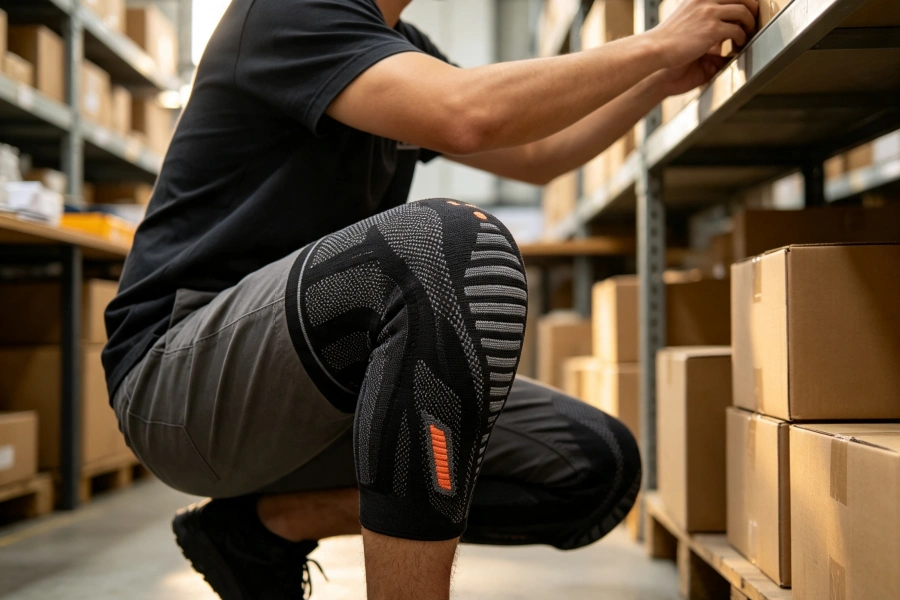
Your knees don’t send warning shots — by the time the aching starts, the damage is already done. You’re spending hours crouched on concrete, tile, or hardwood floors. The knee pads you pick today shape how your joints feel five years from now. Not all knee pads for work are built the same. Grabbing the cheapest pair off the shelf is one of the most costly mistakes a tradesperson can make.
The right choice comes down to three things: what you’re doing, how long you’re doing it, and what surface you’re on. This guide matches real work scenarios to the right knee pad type, cushioning, and fit. You’ll walk away knowing what your job needs — and what to buy.
The 4 Main Types of Work Knee Pads Explained
Walk into any trade supply store and you’ll find a wall of knee pads that all look the same. They’re not. What’s inside — and how it’s built — determines whether you’re protected or just wearing something that feels like protection.
Here’s how the five main types break down.
1. Strap-Free Kneeling Pads ($10–$40)
These aren’t worn — you place them on the ground. They’re thick EVA or rubber foam boards, 20–40mm deep, that you kneel onto. No buckles, no straps, no adjusting.
Their strength is simplicity. For fixed-position tasks — floor-level pipe fitting, appliance repair, maintenance bench work — a kneeling mat takes pressure off your knees better than most worn pads. The contact surface is larger, and there’s no strap system causing the foam to compress unevenly.
The limitation is obvious. The pad stays where you put it. Move more than a step, and it’s useless.
Best for: Fixed-position work indoors. Not suitable for jobs where you’re moving across a site.
2. Soft-Shell Foam Knee Pads ($10–$40)
The most common type on the market. The core is EVA, PU, or polyethylene foam — materials that absorb impact through cell compression. They’re lightweight and flexible. That makes them easy to wear for finish work, painting, or hardwood floor installation.
The catch: foam creeps. Under continuous kneeling pressure, mid-density EVA can lose 15–30% of its thickness within 30–60 minutes. Most of that comes back once you stand up — but not all of it. After months of regular use, you’ll see a permanent dent where your kneecap sits. At that point, the pad is done.
Best for: Light to moderate work on smooth surfaces. Not built for full-day concrete shifts.
3. Hard-Shell Knee Pads ($20–$100)
Hard-shell pads add a rigid outer cap — HDPE, PVC, or TPR plastic — over an interior foam layer. The shell does something foam alone can’t. It spreads impact across the entire cap surface before the foam even starts to compress. It also blocks sharp debris like rebar, gravel, or broken tile from punching through.
HDPE registers a Shore D hardness of 70–80. Compare that to EVA foam at Shore A 25–45. That gap is what stops a jagged edge from driving straight into your kneecap.
Hard caps are rated for 2+ years of shell life under heavy use. Keep in mind the interior foam may soften within the first year.
Best for: Roofing, masonry, concrete work, outdoor construction sites — anywhere the ground is rough and unpredictable.
4. Heavy-Duty Industrial Knee Pads ($40–$120+)
These are multi-layer systems. You get a hard outer shell, high-density foam, a gel insert, and often a hinged or segmented cap that flexes with your knee. Some models add Cordura or Kevlar reinforcement on the highest-wear contact points.
The core idea is staged energy absorption. Each layer handles a different part of the load:
The hard shell takes the initial impact
The foam layer absorbs sustained compression
The gel spreads whatever pressure is left
The hinged cap reduces shear force as your knee bends — so the pad stays in full contact instead of shifting out of place
Many industrial models meet EN 14404 Level 2 — the standard for full-shift construction kneeling. Higher-end versions come with replaceable inserts. That pushes the functional lifespan well past two years.
Best for: Full-day construction, roofing crews, infrastructure work — any job where your knees are down for most of the shift.
Best Knee Pads for Flooring, Tiling & Carpentry Work
Flooring and tiling work is hard on knees in a very specific way. It’s not about single hard impacts. It’s about hours of static kneeling plus constant sideways shuffling across hard surfaces.
A professional floor installer can spend 6–8 hours per day on their knees. That’s not the same as general construction kneeling. It’s a different kind of demand entirely, and most standard hard-shell pads aren’t built for it.
What This Work Really Requires
Two problems define this category:
Pad migration. Every time you shuffle sideways to set the next tile, a bad-fitting pad rotates or rides up your leg. You end up repositioning your pads instead of getting work done.
Pressure concentration. A small-footprint shell on a 90 kg worker can push 18–21 N/cm² of localized pressure onto the kneecap. Expand that contact area to 100 cm², and that number drops to 5–6 N/cm² — a 70% reduction from geometry alone.
What to Look For
Wide, flat base: Minimum 120 × 120 mm contact footprint, extending into the lower shin area works best
Non-marring cap: Soft PU or TPR shell rated below Shore A 80 — won’t scratch tile, hardwood, or polished concrete
Cushioning depth: ≥16 mm high-density foam as a baseline; go for a 20–25 mm gel-plus-foam combination for full-day shifts
Multi-point strapping: Two to three wide straps spread across the calf — not a single band behind the knee that cuts off circulation
The top professional option is the ProKnee AP16 (~$200–$300/pair). Its wide-platform shell runs from the knee to the upper shin. This spreads the load across the full surface area. Floor workers with 20–40 years on tile say the same thing — they forget knee pain exists while wearing it. That’s the standard to measure everything else against.
Best Knee Pads for Construction, Concrete & Masonry Jobs
Concrete doesn’t forgive mistakes — and it won’t forgive cheap knee pads either.
This surface type is the most punishing in trade work. You’re dealing with sharp aggregate, rebar ends, rough masonry edges, and wet alkaline mortar — all at once. Standard foam pads fail here fast. Workers report stone points punching straight through soft-shell pads within weeks. The foam compresses, the grit wins.
The damage pattern is clear. Repeated kneel-and-rise cycles on broken concrete push sharp aggregate into the infrapatellar fat pad — the soft tissue just below your kneecap. That injury won’t show up on an X-ray. It builds up over time. A tile setter with 20 years on concrete one day can’t kneel without swelling.
What Construction Work Demands From a Knee Pad
Three failure modes define this category:
Puncture — sharp aggregate at a single contact point cuts through foam with no resistance
Impact fatigue — hundreds of kneel-and-rise cycles per day on hard surfaces break down cushioning fast
Chemical exposure — cement slurry is alkaline. Prolonged skin contact causes contact dermatitis. Your shell needs to be water-resistant, not just water-repellent
That’s why the hard cap knee pads category exists. A 2.5–4 mm thick ABS or modified nylon shell spreads the load before foam compression starts. ABS offers 15–40 kJ/m² impact strength — enough to hold shape against rebar ends. Modified nylon adds flex fatigue resistance so hinge points survive thousands of bend cycles.
Strap width matters more than most buyers expect. Straps narrower than 25 mm cut into the leg under sweat and shift during crawling. Construction-grade knee pads need 38–50 mm strap width at minimum, with 50–80 mm of adjustment range per strap. That keeps them locked across different leg sizes.
Top Picks for This Category
ToughBuilt TB-KP-3 Thigh Support Stabilization Knee Pads — Working tile setters rate this best overall for masonry and concrete. The thigh support structure is what sets it apart. It spreads load up into the quadriceps, which cuts point pressure on the kneecap during long kneeling sessions. Rated 4.5/5 stars across trade review channels.
KneePro Ultra Flex III (Sellstrom Hybrid) — BobVila’s hands-on testing named this the best overall knee pad. The hybrid hard shell tackles sharp-rock and construction debris head-on. The EVA foam core holds its shape under repeated impact better than gel in high-frequency use.
Milwaukee Stabilizer Knee Pads — Built for multi-surface construction sites. The widened base and stabilizer wings cut lateral tipping on uneven ground. That’s a real problem on broken substrate, and this pad handles it well.
Klein Tools Heavy-Duty Hinged Knee Pads — Best for heavy concrete work where you move between kneeling, crawling, and standing all day. The articulated shell tracks with your knee joint rather than resisting it. This stops the downward creep that fixed-shell designs are known for.
Best Knee Pads for Plumbing, Electrical & HVAC Technicians
Plumbers, electricians, and HVAC techs kneel in a completely different way than flooring installers — and that gap matters more than most people think.
A floor installer stays down for hours at a stretch. A service tech is up and down dozens to hundreds of times a day, often in 10–60 second bursts. That constant in-and-out motion changes everything your knee pad needs to do. Bulk becomes the enemy. Straps that need re-adjusting every twenty minutes eat up time you don’t have.
The Core Problem: Tight Spaces and Constant Movement
Crawlspaces, cabinet toe-kicks, under-sink access points, mechanical rooms — these environments destroy oversized pads fast. A hard-shell pad with 40 mm of lateral overhang catches on every copper line and PVC elbow you pass. Hinged designs like the Klein Tools Heavy-Duty Hinged Knee Pads fix this problem head-on. Their segmented caps cut side protrusion by 10–15 mm compared to one-piece rigid shells. That’s the difference between sliding through a pipe run clean and getting snagged on every fitting.
For the tightest spaces, hit these target specs:
– Total stack height: ≤25–30 mm while kneeling
– Lateral overhang: ≤20–25 mm per side
– Rounded or chamfered side edges with at least 10 mm radius — the pad slides past pipes instead of hooking them
Buckle vs. Velcro: Pick Based on Your Actual Work Pattern
This isn’t a preference question. It’s a workflow question.
Buckled or hinged pads — Sellstrom Hybrid Ultra Flex III, Klein Tools — hold tension better during crawling and rough-in work. Concrete, gravel, and outdoor HVAC unit installs benefit most from this. Buckles also shrug off debris that tears up Velcro fast. The tradeoff is fixed adjustment steps of 5–10 mm instead of a continuous fit dial.
Velcro adjustable pads suit residential electrical and service calls better. You’re on and off ladders all day. You need a pad that loosens in under 10 seconds at the base of a ladder, not one you wrestle with at the top. Velcro gives you sub-3 mm micro-adjustments as your legs swell through the shift. The weak point: metal shavings and insulation fibers shred Velcro fast — straps may need re-tightening after every 1–2 hours of active crawling.
Pant-insert low-profile pads — like the Duluth Trading low-profile knee pads — cut the strap issue out of the picture. One HVAC tech called them his “perfect everyday pad” for one simple reason: they disappear under work pants and need zero adjustment between tasks. Target thickness for this format: 6–12 mm compressed. Go past 15 mm and you’ll feel it bind at the knee flex point on ladders or in tight cabinet bases.
Best Knee Pads for Gardening, Landscaping & DIY Projects
Garden work is harder on your knees than most people expect. You’re not pouring concrete or setting tile — but you’re still kneeling on wet soil, gravel paths, and uneven ground for hours. Most people don’t think about it until their knees start to ache.
Knee pad use in this context falls into two clear groups.
Casual home gardeners (1–3 hours per session, a few times a week) do well with a strapless EVA kneeling pad. Look for one that’s 25–30 mm thick, costs around £10, and resists moisture well enough for damp grass. It’s easy to store — just toss it in a shed after use. The Husky 16×24 in foam pad is a popular pick in this category. Most users say it feels more comfortable than a strapped pad for open-ground work.
Professional landscapers working full days need a pad that stays in place as they move. A strapless pad slips out of position. Across a long row of shrubs, repositioning it dozens of times burns through your afternoon fast. Strapped options solve that problem — they stay on your knee and move with you. Two solid choices:
Tommyco Garden Mini All-Terrain Foam Knee Pads (~$12)
Garden Works Super Soft Heavy Duty Knee Protectors
One more thing for summer work: heat above 30°C for more than two hours makes sweat buildup a real issue. A pad with a mesh or breathable inner lining cuts down on that noticeably. There’s no hard data on exact temperature drops, but the user feedback is clear — less sticking, less heat, fewer reasons to pull them off.
Best Knee Pads for Mechanics, Crawl Spaces & Warehouse Work
Three jobs. Three different ways to destroy your knees.
A mechanic crawls under a vehicle. Sustained pressure hits the front edge of the kneecap. Every push forward drags the shell across concrete. A warehouse picker walks kilometers under load, then drops to one knee dozens of times per shift. A crawlspace tech spends an hour in a 60 cm gap — half-crawling, half-shuffling, with no room to stand and reset.
Each scenario needs a different pad. Here’s how to match them.
Mechanics & Crawl Spaces
Go with a hinged hard-shell design. The Sellstrom Hybrid Ultra Flex III and KneePro III both fit this profile. The hinge tracks your knee through a full 0–120° range. The shell stays in contact with your knee instead of digging into your kneecap mid-crawl. Check the front shell thickness — you want at least 2.5 mm over the first 40–50 mm of the leading edge. That’s where abrasion concentrates as you push forward on concrete.
Warehouse Workers
The main tradeoff here is protection vs. fatigue. A 700 g pair of knee pads feels fine at 9 AM. By hour six, after 8 km of walking under a 15 kg load, they feel like ankle weights. For high-walk, high-pick roles, stay at ≤400–450 g per pair.
Kneel more than you walk? The Milwaukee Stabilizer Knee Pads are a solid pick. The wide stabilizer base spreads load across epoxy and smooth concrete floors.
Move around more than you kneel? Switch to a low-profile gel insert worn inside your work pants. Less bulk, less drag.
Shell Grip on Smooth Floors
This detail gets overlooked. Hard plastic shells slide on epoxy-coated warehouse floors. Shift your weight or pivot on one knee, and the pad moves with you — in the wrong direction. Look for pads with textured rubber covering 60–70% of the contact surface. Tread grooves should run at least 1.5 mm deep. That gap in grip is the difference between a stable kneel and a slip mid-shift.
6 Critical Selection Criteria: The Complete Knee Pads for Work Buying Checklist
Six numbers. That’s what separates a pad that protects your knees from one that just covers them.
1. Cushioning Thickness & Material Density
Thickness without density means nothing. A 30 mm foam pad that compresses to 8 mm under load gives you 8 mm of protection — nothing more.
The working benchmark:
– Intermittent kneeling (under 2 hours): 10–15 mm total cushioning depth
– Full-shift kneeling on concrete or tile: ≥15–20 mm, with a gel primary layer of at least 15 mm backed by high-density EVA support
Shore hardness tells you what you’re getting:
– Comfort liner: Shore 00 20–40 (soft gel or foam — prevents edge bruising)
– Support layer: Shore A 20–35 (holds shape under sustained load)
– Hard outer cap: Shore D 55–70 (impact and abrasion resistance)
The replacement trigger: After a 30-minute kneel by an 80–90 kg user, the cushion should recover ≥90% of its original thickness within 5 minutes. Below 80% recovery after extended use — replace it. Snickers Workwear says it straight: no spring-back means it’s done.
2. Strap Width, Position & Popliteal Clearance
Strap design is where cheap knee pads fail you — and you won’t notice until it’s too late.
Width: Primary straps (upper and lower) should be ≥50 mm for construction and heavy-duty work. Go narrower and pressure concentrates into a tight band across the calf. You’ll feel it within an hour.
Placement: Upper strap center sits 50–70 mm above the top of your kneecap. The lower strap center sits 40–60 mm below it. That two-point anchor stops rotation and downward creep.
The back of the pad matters as much as the front. A straight horizontal band across the back of the knee squeezes the popliteal vessels. Long kneeling sessions with that design end in numbness and tingling. Look for a curved or swallowtail cutout at the rear. It leaves a 20–30 mm strap-free zone right behind the knee joint. The lower strap should be snug enough to prevent slipping — no tighter.
3. Sizing: Measure Three Points, Not One
Most knee pad returns happen because buyers measured one circumference — or none at all.
Measure these three, with your knee bent at about 30°:
1. Knee circumference — around the center of your kneecap
2. Lower thigh — 10 cm above the top of your kneecap
3. Upper calf — 10 cm below the bottom of your kneecap
Sizing reference:
|
Size |
Knee Circ. |
Lower Thigh |
Upper Calf |
|
S |
30–34 cm |
32–38 cm |
28–34 cm |
|
M |
34–38 cm |
36–42 cm |
32–38 cm |
|
L |
38–42 cm |
40–46 cm |
36–42 cm |
|
XL |
42–48 cm |
44–52 cm |
40–48 cm |
Key rule: Any one of your three measurements lands in the upper range of a size — go up. The pad should feel snug. Not tight enough to leave marks or cut blood flow when you crouch.
For construction workers in cold weather: Wearing knee pads over work pants adds bulk. Add one full size to account for fabric thickness.
4. Material Priority by Work Environment
Not every pad needs to do everything well. Match your material stack to your conditions.
Construction / concrete / tiling (hard, rough surfaces):
Priority order: abrasion resistance → water resistance → breathability
Go with a hard cap (Shore D 60–70) + high-density EVA (10–15 mm) + gel comfort layer (≥15 mm) + breathable inner liner.
Indoor flooring / finish work (smooth, appearance-sensitive surfaces):
Priority order: surface compatibility → breathability → water resistance
Use a soft PU or heavy-fabric outer shell that won’t scratch finished floors. Add ventilation channels or perforated foam to control heat buildup on long interior shifts.
High-movement service work (HVAC, electrical, medical, cleaning):
Priority order: flexibility → breathability → light abrasion resistance
Thin segmented caps or low-profile gel inserts work best here. Breathable mesh backing helps. Keep total pad weight under 350 g per pair — on a high-rep day, every gram adds up.
5. Hard Cap vs. Soft Cap vs. Hybrid
This is the one decision most buyers get wrong.
-Soft cap (foam or gel only): Right for finished interior surfaces. Wrong for any site with gravel, rebar, or broken aggregate — sharp points punch straight through.
-Hard cap (HDPE, ABS, PP shell): Spreads impact before the foam layer starts working. Use this for construction, masonry, roofing, and any outdoor ground surface.
-Hybrid shell (hard outer cap + segmented flex zones): Tracks knee movement better than a one-piece rigid cap. Best for trades that go back and forth between kneeling and crawling — mechanics, plumbers, HVAC techs.
The hybrid design cuts lateral bulk by 10–15 mm per side compared to fixed rigid shells. In a 60 cm crawlspace, that gap is the difference between moving clean and catching on every pipe fitting.
6. Durability Indicators Worth Checking Before You Buy
Most durability failures show signs before they happen — you just need to know where to look.
Shell life: A quality hard cap holds its shape for 2+ years under heavy use. The interior foam layer tends to soften within the first 12 months of daily work. Products with replaceable inserts last much longer — factor that into your cost comparison.
Strap attachment points: Pull each strap away from the pad body before buying. The stitching or rivet anchor should show zero flex or separation. Strap failure on a construction site gives you no warning.
Seam construction on the outer shell: Double-stitched or reinforced seam lines at the shell edge hold up against concrete drag. Single-stitch perimeter seams on budget pads unravel within weeks of crawling work.
EN 14404 compliance: For commercial procurement or sites with written PPE programs, Level 1 covers light to moderate kneeling. Level 2 is the minimum for full-shift construction use. Ask vendors for third-party test documentation — large general contractors are now requiring it at the procurement stage.
Conclusion
Your knees don’t get a second chance — and neither does a workday lost to pain that was preventable.
The right knee pads for work aren’t a luxury or an afterthought. They’re the difference between a career that lasts decades and one cut short by chronic joint damage. Most workers don’t feel that damage is coming until it’s already done. You now know the types, the tradeoffs, the fit mistakes, and the job-specific picks that hold up on concrete for eight hours straight.
So here’s your next move: go back to your specific work scenario. Flooring, construction, crawl spaces — whatever puts you on your knees. Match it to the selection criteria in this guide.
If you are reviewing materials, structures, or private label knee pad options, it may also help to look at broader OEM and ODM knee support.