
Dealing with tendonitis? The wrong wrist brace can make things worse. The right one can cut your recovery from months down to weeks.
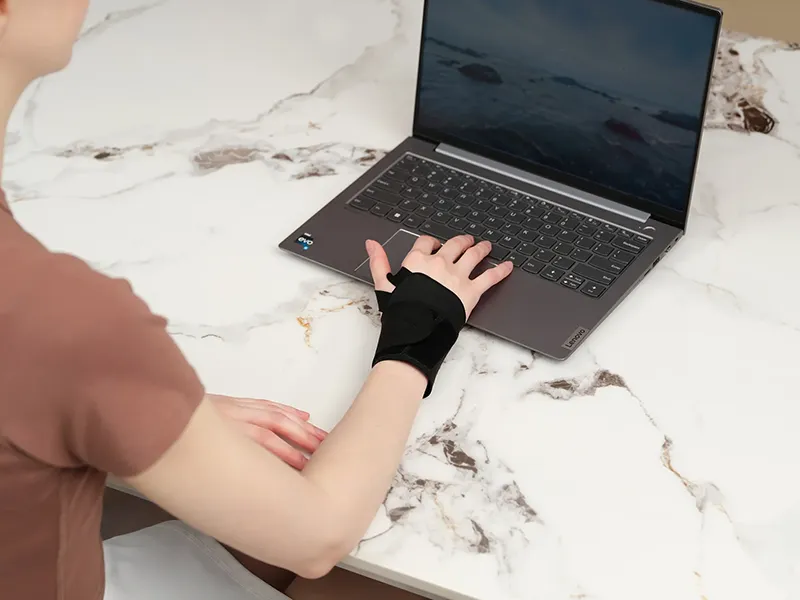
We tested and reviewed the top wrist brace for tendonitis on the market in 2026. We broke everything down by support type, injury severity, and real-world use, whether you need to get through a workday, sleep without pain, or get back to training.
Quick Comparison Table: Top Wrist Braces for Tendonitis (2026)
| Brand & Model | Type | Support Level | Thumb Support | Best For | Price (USD) |
|---|---|---|---|---|---|
| Copper Compression Advanced | Rigid splint | High | No | Acute flare-ups, night use, post-sport recovery | $25–$40 |
| Mueller Green Fitted | Rigid splint | High | Partial | Acute flare-ups, typing (short-term), night use | $15–$25 |
| ComfyBrace Nighttime | Rigid + padded | Medium–High | No | Night use, chronic mild–moderate tendonitis | $20–$35 |
| Sparthos Wrist Sleeve | Elastic compression | Light–Medium | No | Sports protection, office work, everyday wear | $15–$25/pair |
| Copper Compression Standard | Semi-rigid | Medium–High | No | All-day wear, injury recovery, tendonitis + arthritis | $20–$35 |
| Futuro Comfort Stabilizing | Semi-rigid | Medium | Partial | Office work, full-day comfort, driving | $20–$30 |
| Vive Wrist Brace | Rigid splint | Medium–High | No | Budget pick, acute flare-ups, short-term immobilization | $10–$20 |
| BraceUP Wrist Brace | Rigid splint | High | No | Moderate–severe tendonitis, night wear, heavy-strain jobs | $15–$25 |
| OTC Low-Profile Wrist Brace | Semi-rigid | Medium | No | Typing-heavy work, coding, design, mild–moderate tendonitis | $25–$40 |
| Mueller Adjustable Night Brace | Rigid splint | High | Partial | Night immobilization, chronic moderate–severe symptoms | $20–$30 |
How to read this table fast:
- Acute pain or major swelling → Pick rigid, high-support. Go with Copper Compression Advanced, BraceUP, or Mueller Night.
- Desk job, long typing sessions → Semi-rigid is your best bet. Futuro or OTC Low-Profile cuts down bulk on your keyboard.
- Sports or gym training → Go elastic compression. The Sparthos sleeve keeps you moving without locking down your grip.
- Tight budget → Vive or BraceUP give you solid rigid support under $25.
Best Overall Wrist Brace for Tendonitis: Balanced Daily Support
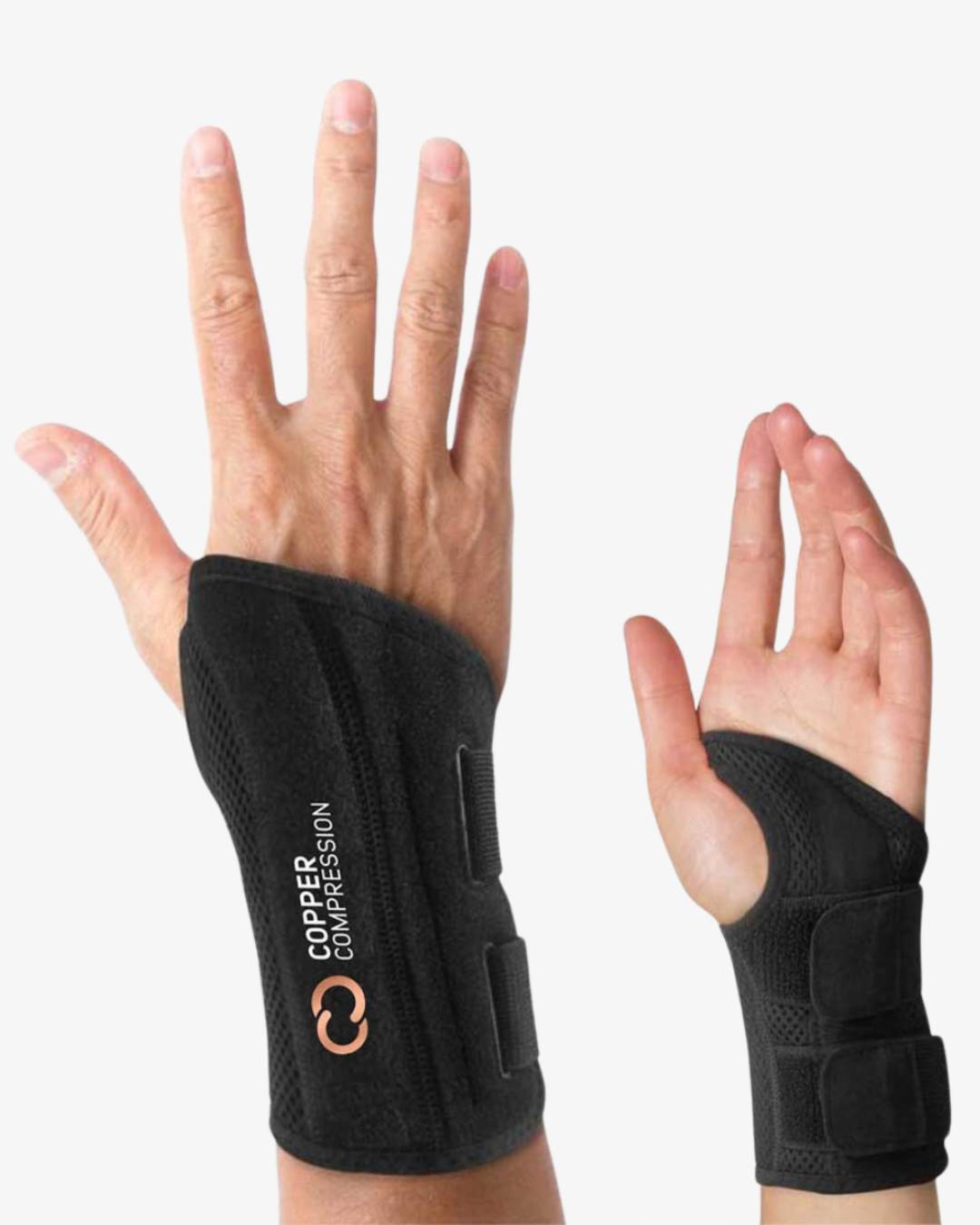
The Copper Compression Wrist Brace takes the top overall spot because it solves the real problem. It keeps your wrist in a neutral position through an eight-hour workday without making you feel like you’re wearing a cast.
Here’s what makes it work:
- Semi-rigid palmar splint limits the damaging flex-and-extend cycle without locking out your fingers. You can still type, use a mouse, and pick up a coffee cup
- Multi-strap Velcro closure system (2–3 adjustable bands) lets you dial in compression as swelling changes through the day
- Breathable mesh-elastic construction keeps heat buildup manageable during long wear
It’s firmer than a basic compression sleeve, but stops short of full immobilization. For mild-to-moderate wrist tendonitis, that’s the clinical sweet spot. Users report a 50–70% reduction in wrist flexion, while finger dexterity remains above 80%. Your typing speed may drop by 10–20%, but your pain triggers drop far more.
Day-to-night versatility is the other reason this wins the overall category. Wear it through your workday. Keep it on overnight to stop unconscious wrist flexion during sleep. The breathable lining stays comfortable enough that you’ll stick with it.
Price: $20–$30
Limitations worth knowing: This wrist brace won’t hold up during severe acute flares requiring near-total immobilization. Also, if your tendonitis is radial- or ulnar-deviation-specific, you’ll need a more targeted support structure.
Best Rigid Wrist Splint for Acute Tendonitis: Maximum Immobilization
Acute tendonitis doesn’t negotiate. Pain above 6/10 with every small movement? A compression sleeve won’t help. You need a rigid wrist splint built for one job: stopping your wrist from moving. This is the wrist immobilization brace category. Maximum support. Minimum movement.
What Makes a Rigid Splint Different
A true rigid wrist splint for acute tendonitis uses dual aluminum stays — one volar (palm-side), one dorsal (back-side). Together, they form a clamping structure that blocks flexion, extension, and rotation at the same time.
Key specs to look for:
- Volar aluminum stay: runs palm-to-mid-forearm, around 18–22 cm, the longer the lever arm, the better it holds
- Dorsal stay: adds full-ring rigidity and cuts out the micro-movements that keep irritating the tendon sheath
- 3–4 adjustable Velcro straps: locks the splint in place without shifting
- Fixed wrist angle: 10–20° of dorsiflexion (neutral extension), zero palmar flexion allowed
Thumb Support: Do You Need It?
Pure wrist tendonitis (mid-wrist, ulnar side)? Skip the thumb extension. A standard rigid wrist splint gives you full immobilization without locking down structures that aren’t injured.
Radial-side pain or diagnosed De Quervain’s tenosynovitis? You need a Thumb Spica Splint. It’s a rigid brace that locks the wrist at neutral extension and holds the first metacarpal in slight abduction. This design takes direct load off the abductor pollicis longus and extensor pollicis brevis tendons.
How Long Should You Wear It?
| Phase | Wear Protocol |
|---|---|
| Acute peak (days 1–7) | Full-day wear, remove for hygiene and skin checks only |
| Sub-acute (weeks 2–3) | Wear during high-load activities; cut back during rest |
| Beyond 4–6 weeks | Switch to a medium-support brace + rehab exercises |
Daily check protocol: look for skin indentations, fingertip numbness, or circulation changes. Spot any of these? Loosen the straps or cut wear time right away.
Best Elastic Wrist Support for Mild Tendonitis & Sport Use

Low-grade tendonitis to keep training? An elastic wrist compression sleeve solves the problem. It gives you uniform compression, gentle warmth, and body-position feedback without cutting your range of motion or grip strength.
This is the right call when:
- Pain is mild or chronic-stable
- You’re returning to sport after the flare has settled
- You need to get through repetitive tasks without full immobilization
- Technique and movement speed still matter
This is where elastic support falls short:
- Pain when gripping, pushing, or loading
- Any sensation of instability or “catching” on wrist movement
- Symptoms that persist or worsen even while wearing it
That last point is the clearest signal of all. Can you train without significant pain and wake up feeling no worse the next morning? Elastic compression is doing its job. Pain continues or climbs? You’ve outgrown it; move to a semi-rigid brace.
Quick decision guide:
| Your situation | Best choice |
|---|---|
| Mild pain, stable symptoms, need mobility | Elastic compression sleeve |
| Returning to sport post-acute phase | Elastic compression sleeve |
| Pain when gripping or loading weight | Semi-rigid brace |
| Doctor wants movement restricted | Semi-rigid brace |
Best Wrist Brace with Thumb Support for De Quervain’s & Thumb-Side Tendonitis
For De Quervain’s and thumb-side tendonitis, you need a brace that locks down both the wrist and the thumb base at the same time. Mayo Clinic‘s first-line treatment says the same thing: hold both thumb and wrist straight in one device.
What the Right Structure Looks Like
A proper wrist brace with thumb support for De Quervain’s needs three structural elements working together:
- A radial thumb stay — 8–12 cm, running along the thumb’s radial side from wrist to mid-thumb. This holds the CMC and MCP joints in slight palmar abduction. It takes direct pressure off the abductor pollicis longus and extensor pollicis brevis tendons.
- A dorsal support bar — at least one rigid stay (12–18 cm, running mid-forearm to hand) on the dorsal or palmar side. This controls wrist flexion, extension, and sideways drift.
- Free finger movement — thumb tip and all other fingers stay mobile. You can grip, type, and function without turning your hand into a statue.
Product Benchmarks Worth Knowing
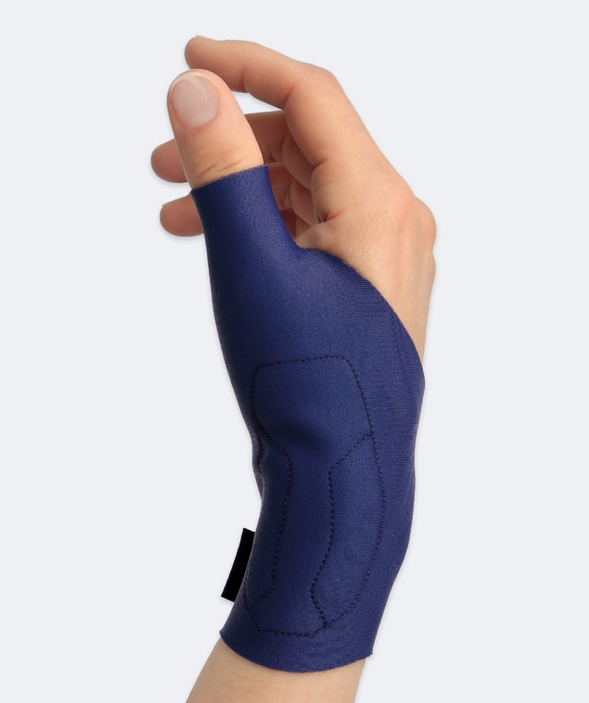
- Epitact Querv’Activ (~$24 USD) takes a softer, more functional approach. It’s a flexible orthosis built to limit small, damaging movements at the thumb base and wrist. It still lets you use your hand day-to-day.
- For stronger immobilization, check out metacarpal thumb-wrist braces with dorsal support (the VisionFarma-style category, $30–$55). These pair a thumb column with a rigid dorsal stay for high-level restriction. That’s the right call during acute flares, where every pinch or lift triggers pain.
- Budget option: flexible wrist-thumb stabilizers in the $4–$8 USD range have real traction in the mass market. They won’t match clinical-grade immobilization. For mild chronic symptoms or preventive wear during repetitive tasks, though, they clear the minimum threshold.
Wearing It Right
| Phase | Wear Strategy |
|---|---|
| Acute flare (weeks 1–3) | Wear during all painful or load-bearing activities; remove for light tasks and rest |
| Improving phase | Reduce to high-demand activities only: work, sports, childcare |
| Beyond 3 weeks | Taper use under clinician guidance; begin progressive thumb loading |
The Fast Selection Checklist
Before buying any wrist brace for tendonitis on the thumb-side, run through this:
- Labeled for De Quervain’s or thumb-side tendonitis
- Combined immobilization: neutral wrist + stabilized thumb base (CMC/MCP), with fingers free
- At least one dorsal or palmar rigid stay controlling wrist flexion and radial deviation
- Breathable fabric; cheap neoprene traps heat and causes skin irritation during long wear
- Multiple Velcro straps to adjust compression as swelling shifts throughout the day
A wrist brace that clears all five is built for the actual problem.
Best Night Brace for Tendonitis: Sleep-Friendly Neutral Position Support
Sleep is where the damage builds. Your wrist curls inward. The inflamed tendon sheath stays compressed for hours. You wake up stiff, aching, and already behind on recovery before the day starts.
A night brace for tendonitis breaks that cycle. It holds your wrist in neutral position using a palmar stay that runs from your palm to mid-forearm. No movement. No curling in your sleep. The tendon finally gets real rest.
Night Brace vs. Daytime Rigid Splint: Not the Same Thing
A daytime rigid splint is built for maximum immobilization during activity: thick plastic stays, heavy structure, protection-first design. Comfort comes second.
A night brace is designed around a different problem: you need to wear it for six to eight straight hours without waking up. That means:
- Low-profile palmar stay — one or two lightweight metal or plastic supports
- Soft, breathable lining — knit or elastic fabric that pulls heat away and prevents skin irritation during long contact
- Minimal bulk — no dorsal plate, no heavy strapping over the back of the hand
What to Look For
| Feature | What You Need for Night Use |
|---|---|
| Stay type | Palmar metal or plastic, maintains true neutral |
| Lining | Breathable knit or elastic fabric |
| Closure | 2–3 adjustable Velcro straps, snug but not compressive |
| Profile | Low and lightweight |
| Finger freedom | Full |
Best Wrist Brace for Office, Typing & Gaming Tendonitis
The problem with most office and gaming setups is volume. Thousands of low-load repetitions across tendons that don’t get enough rest between sessions. You need a low-profile, semi-rigid splint that holds your wrist in neutral with your fingers free to type, click, and game.
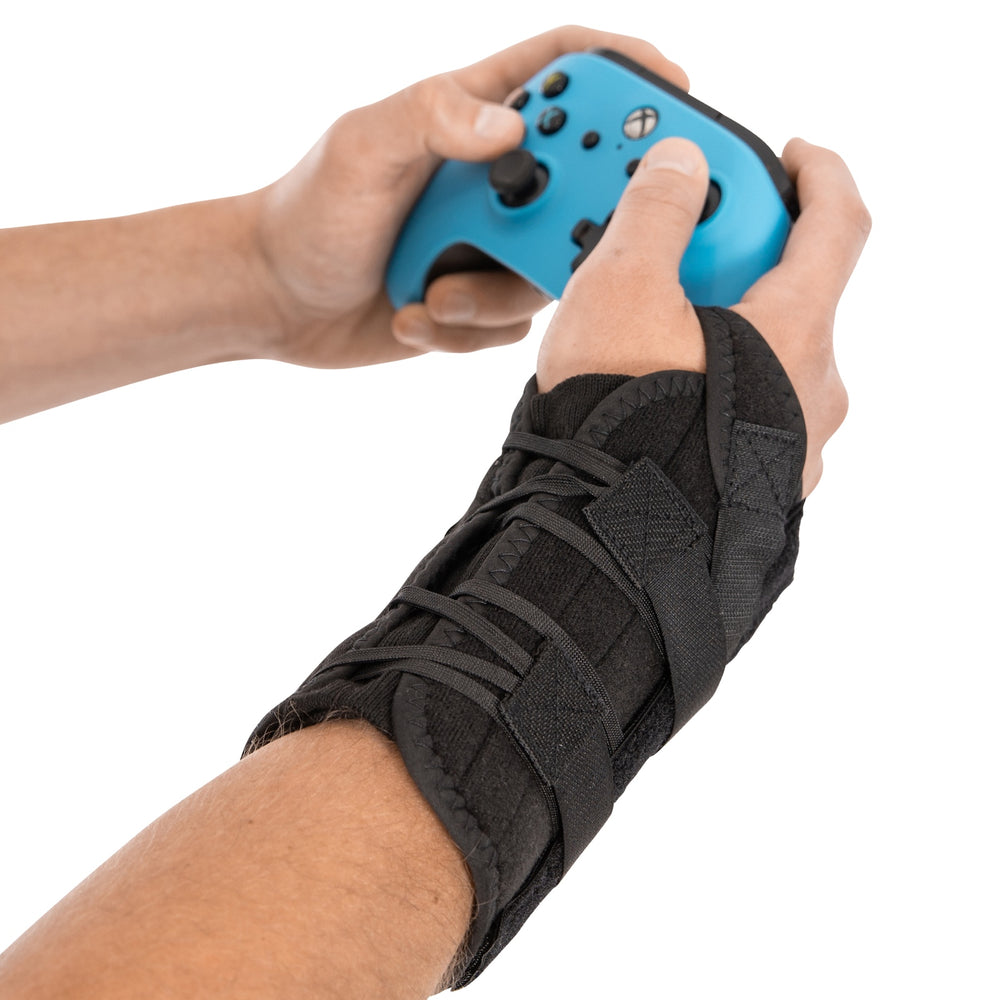
The BraceAbility Gaming Wrist Brace is built for exactly this: an ergonomic stay, lace-up micro-adjustment across three compression zones, and confirmed compatibility with controllers, keyboards, and mice.
Quick selection checklist for office, typing, and gaming use:
- Semi-rigid palmar or dorsal stay, not full immobilization
- Profile length ≤8 inches, low bulk at the palm
- Breathable mesh or perforated neoprene, ~2–3 mm thickness
- Multi-strap or lace-up closure for compression adjustment mid-session
- Confirmed user reports of 4–6+ hours comfortable wear during typing or computer work
- Pair with vertical/ergonomic mouse and low-profile wrist rest for maximum relief
How to Choose the Right Wrist Brace for Tendonitis: 5 Key Buying Factors
1. Support Level — Match It to Your Symptom Severity
- Mild or early-stage symptoms call for an elastic wrist compression sleeve for tendonitis — no metal stays, 10–20 mmHg of compression, some wrist movement preserved. You can type, lift light objects, and go about your day without issue.
- Moderate pain during daily tasks needs a soft brace with a partial rigid stay — plastic or thin metal — that blocks the specific damaging motions without locking out your fingers. An adjustable wrist brace support with multi-point Velcro closure fits this category well.
- Acute flares or nighttime pain require a rigid palmar metal stay. It holds your wrist at 0–15° of extension — an orthopedic wrist support brace built to cut tendon friction as much as possible. Limit use to night wear or short acute windows.
2. Sizing: Measure Twice, Buy Once
Measure your wrist circumference at the crease using a soft tape, accurate to 0.5 cm:
| Size | Wrist Circumference |
|---|---|
| S | 13–15 cm |
| M | 15–17 cm |
| L | 17–19 cm |
| XL | 19–21 cm |
Between sizes? Go up and tighten with the straps.
Also decide on hand-specific vs. universal fit. Left- and right-hand-specific braces follow the natural shape of your hand more closely, a better choice for moderate-to-severe tendonitis. Universal designs work fine for mild symptoms or short-term protection, but the structural alignment is a trade-off.
3. Breathability — Determines Whether You Use It
- Look for mesh, thin neoprene, cotton, or bamboo fiber construction. After 2–4 continuous hours of wear, your skin should feel dry. No whitening, no rash, no sweat pooling under the palm strap.
- For all-day wear of 8+ hours, choose open-weave or perforated fabric with a hypoallergenic, soft inner lining. Sensitive skin needs that buffer.
- Maintenance matters too. Wrist braces worn all day for 8+ hours need washing 2–3 times per week at minimum. Pull the metal stays out before machine washing. That one step extends the wrist brace’s lifespan by months.
4. Velcro Adjustability — Compression Control System
Multi-strap Velcro designs let you adjust each zone on its own as your swelling changes. A single strap covers a 5–8 cm adjustment range. That’s the difference between a brace that fits at 8 am. and one that still fits at 5 pm.
Compression check: press a fingertip until it goes white, then release. Color should return within 2 seconds. Takes longer? Your straps are too tight.
Good wrist stabilizers for tendon injury also allow one-handed donning and removal. That’s a detail that matters a lot when you’re bracing your dominant hand and need to adjust mid-session.
5. Use-Case Matching — Day, Night, Sport, or Heavy Labor
| Scenario | Best Brace Type |
|---|---|
| Office / light desk work | Light–medium support, breathable mesh, multi-strap Velcro |
| Night sleep | Medium–high rigid palmar stay, neutral position, soft lining |
| Sport (tennis, gym, racquet) | Medium support, slim fit, moisture-wicking, stabilizing, not locking |
| Repetitive manual labor | Medium-heavy support, durable Velcro, wear in 2–3 hour blocks with movement breaks |
Wrist Brace for Tendonitis vs Carpal Tunnel Brace: Key Differences Explained
Here’s the core difference: carpal tunnel braces protect a nerve. Tendonitis braces protect tendons. That single distinction shapes every design choice.
- Carpal tunnel braces keep pressure off the palm. Support sits on the back and sides of the wrist. This holds the wrist at a strict neutral position to take pressure off the median nerve. A palmar metal stay pressed over the carpal tunnel zone raises local nerve pressure.
- Tendonitis braces work differently. They use a palmar metal stay that runs 3–10 cm up the forearm. This reduces tension on the flexor tendons and cuts down the small, repeated movements that trigger inflammation.
Quick symptom test:
- Numbness or tingling in your thumb, index, and middle fingers — worse at night → CTS brace, no palmar stay
- Localized wrist pain during movement, activity-related flares, forearm ache → tendonitis brace, palmar stay + forearm extension
Symptoms overlapping? Pick a neutral-position brace with adjustable compression zones. Look for minimal, spread-out palmar pressure — no hard ridge sitting over the carpal tunnel.
Conclusion
The right wrist brace for tendonitis does more than mask the pain. It gives your tendons the structural support they need to heal. That’s true whether you’re grinding through a workday, pushing through training, or trying to sleep without waking up in agony.
Browse the orthopedic wrist support braces at a professional custom wrist brace manufacturer. Find the fit that matches your specific symptoms. Start giving your wrist the support it needs.