
The custom knee brace cost is one of the first considerations for sports brands, distributors, wholesalers, and medical equipment buyers planning to develop their own knee support products. However, there is no fixed price for a custom knee brace. The final cost depends on product structure, material selection, customization requirements, order quantity, and manufacturing processes.
For businesses sourcing sports knee braces, the difference between a basic compression knee sleeve and a reinforced knee brace with adjustable straps can be significant. Additional features such as silicone grip zones, gel padding, patella support, and metal hinges also influence the overall production cost.
Understanding these pricing factors helps purchasing teams compare suppliers, estimate product margins, and select specifications that fit their target markets. This guide explains the main factors that affect custom knee brace pricing, provides indicative wholesale cost ranges, and outlines how to get an accurate OEM quotation.
What Is the Average Custom Knee Brace Cost?
The average custom knee brace cost varies considerably depending on the type of product and its intended application. For B2B purchasing, it is important to distinguish between the factory cost of a standard product, the cost of adding private-label features, and the development cost of a fully customized design.
| Knee Brace Type | Indicative Price (USD/Unit) | Typical Applications |
| Basic Compression Knee Sleeve | $5.00–$15.00 | Running, fitness, daily sports |
| Neoprene Knee Support | $15.00-$20.00 | Weightlifting, training, general sports |
| Padded Sports Knee Brace | $15.00-$20.00 | Volleyball, basketball, wrestling |
| Adjustable Knee Brace | $20.00–$26.00 | Sports protection, active support |
| Hinged Knee Brace | $25.00–$40.00+ | Sports injury support, rehabilitation |
Actual prices may fall outside these ranges depending on fabric quality, dimensions, construction, order quantity, and customization requirements. Advanced medical-grade orthoses with specialized frames or complex adjustment mechanisms require separate evaluation.
Custom Knee Brace Price by Product Type
Different sports require different levels of knee support and protection, which directly affects product specifications and manufacturing costs.

- Compression Knee Sleeves: Commonly used for running, gym training, and general fitness. Their relatively simple knitted construction makes them suitable for cost-effective, high-volume production.
- Weightlifting Knee Sleeves: Often developed with thicker neoprene or elastic materials, such as 5 mm or 7 mm constructions, to provide a firmer fit during squats and strength training.
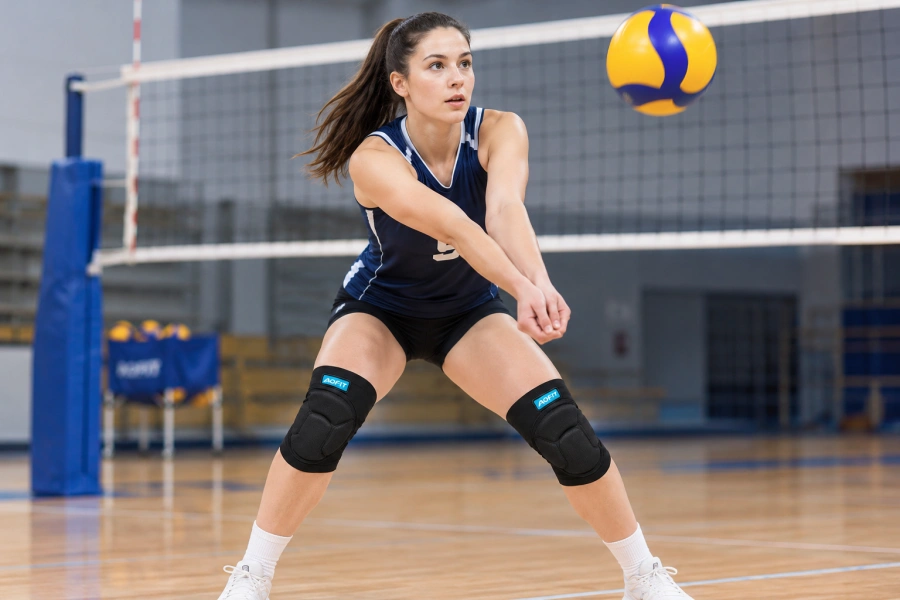
- Volleyball and Basketball Knee Pads: Typically include EVA or other foam padding to improve impact protection during jumping, diving, and floor contact. Padding thickness, shape, and coverage affect the final price.
- Adjustable Knee Braces: Use hook-and-loop straps, patella openings, or side stabilizers to provide adjustable support. Additional components and assembly operations increase production costs.
- Hinged Knee Braces: Incorporate metal or polymer hinges and reinforced support structures. Their more complex construction generally results in a higher unit cost.

For buyers developing multiple product lines, selecting the right structure for each sports application is more effective than applying the same specifications to every knee brace.
What Factors Affect Custom Knee Brace Cost?
Understanding the cost structure of a custom knee brace helps buyers identify where their budgets are allocated. In most OEM projects, the final product price is influenced by several interconnected factors rather than a single material or manufacturing expense.
Material Selection and Custom Knee Brace Pricing
Material selection is one of the most important factors affecting custom knee brace pricing. Different fabrics offer different levels of elasticity, compression, breathability, durability, and comfort.

Common material options include:
- Neoprene: Provides stretch, cushioning, and a close-fitting construction. It is commonly used in weightlifting supports, adjustable knee braces, and sports protection products.
- Nylon and Spandex: Often used in knitted compression sleeves because of their elasticity, lightweight construction, and ability to maintain a close fit.
- Polyester Blends: Suitable for sports knee pads and compression supports requiring durability, color consistency, and flexible fabric configurations.
- Bamboo Fiber Fabrics: Can be incorporated into knitted products to create a differentiated material offering for brands developing comfort-oriented support collections.
- Copper-Infused Fabrics: Provide an additional material feature for brands seeking to differentiate their compression support product lines.
Material thickness, yarn specifications, fabric density, and lamination processes also affect the cost. For example, a 7 mm neoprene knee sleeve generally requires more material than a lightweight knitted compression sleeve.
Design Complexity and Manufacturing Processes
The complexity of a knee brace design determines how many components, production steps, and assembly operations are required.
A basic pull-on knee sleeve may only require fabric cutting, knitting, stitching, and edge finishing. However, a sports knee brace with additional support features may involve:
- Silicone anti-slip strips to reduce slipping during exercise.
- EVA or gel padding for impact absorption.
- Reinforced stitching around high-stress areas.
- Adjustable hook-and-loop straps for a more secure fit.
- Patella openings or gel rings for targeted kneecap support.
- Metal or polymer side stays for additional stability.
Each additional component may introduce material costs, labor requirements, or extra quality-control procedures.
Custom Branding and OEM Knee Brace Cost
Branding requirements are another consideration when calculating OEM knee brace cost. Buyers can choose different logo application methods depending on their product positioning, budget, and fabric characteristics.

Common options include:
- Heat-transfer printing
- Silicone logo printing
- Embroidered logos
- Woven labels
- Custom packaging and retail boxes
Simple logo printing may add relatively little to the unit price, while embroidery, custom molds, specialized logo materials, or individually designed packaging can increase the overall cost.
For distributors and sports brands, private labeling can help create a consistent product identity across different knee support models. However, buyers should evaluate the total cost of customization, including any one-time setup or tooling fees, rather than focusing only on the per-unit price.
Custom Knee Brace Cost Comparison: OEM vs. Standard Products
When evaluating the cost of a custom knee brace, buyers should compare more than the initial unit price. Standard catalog products and OEM products serve different sourcing purposes.
| Comparison Factor | Standard Products | OEM Custom Knee Braces |
| Product Design | Existing designs | Buyer-defined or jointly developed |
| Materials | Standard configurations | Flexible material selection |
| Logo | Supplier branding or no logo | Custom branding |
| Colors | Available stock colors | Customized color options |
| Packaging | Standard packaging | Private-label packaging |
| Development | Usually not required | May involve sample or tooling fees |
| Unit Cost | Generally lower | Depends on customization |
Standard products are suitable for buyers who need to enter the market quickly or test demand with limited investment. OEM products are more appropriate for brands and distributors seeking differentiated designs, consistent product specifications, and long-term brand development.
However, OEM does not automatically mean expensive. If buyers select an existing manufacturer design and customize only the logo, colors, or packaging, the additional cost can be relatively limited compared with developing an entirely new knee brace structure.
How Does Order Quantity Affect Custom Knee Brace Pricing?
Order quantity is a major factor in determining custom knee brace pricing. In most manufacturing arrangements, larger orders allow manufacturers to distribute setup costs, material purchasing expenses, and production overhead across more units.
For example, a supplier may need to arrange fabric purchasing, cutting preparation, production scheduling, and packaging setup before manufacturing begins. These activities create costs that are not always directly proportional to the number of units produced.
Small Orders vs. Bulk Custom Knee Brace Pricing
For small trial orders, the unit price may be relatively high because setup and preparation expenses are spread across fewer products. Larger orders may benefit from better material purchasing terms, more efficient production scheduling, and reduced packaging costs per unit.
| Cost Item | Small Trial Order | Larger Bulk Order |
| Material Purchasing | Limited purchasing volume | Better purchasing efficiency may be available |
| Production Setup | Spread across fewer units | Spread across more units |
| Unit Cost | Generally higher | Potentially lower |
| Inventory Risk | Lower initial commitment | Higher stock commitment |
| Market Testing | Easier to test | Requires more demand forecasting |
The actual savings depend on the product and supplier. Buyers should request quotations at several quantity levels, such as 500, 1,000, and 3,000 pieces, to understand how the unit price changes with order volume.
How MOQ Affects Knee Brace Wholesale Price
MOQ, or Minimum Order Quantity, is the minimum number of units a supplier is willing to manufacture or accept for a specific product configuration.
MOQ can vary depending on fabric availability, color requirements, logo processes, packaging specifications, and production arrangements. A standard black compression knee sleeve may have a different MOQ from a fully customized volleyball knee pad with special padding and retail packaging.
For buyers managing multiple product lines, it is worth discussing whether different sizes can be combined within one order or whether several colors can share the same production run. These arrangements may help reduce inventory pressure while maintaining reasonable manufacturing efficiency.
How to Reduce Custom Knee Brace Cost Without Compromising Quality?
Reducing the custom knee brace cost does not necessarily mean choosing cheaper materials or removing important product features. A more effective approach is to optimize product specifications, production planning, and customization requirements.
1. Select Materials Based on the Target Market
Choose materials according to the intended application rather than automatically selecting the most expensive option. For example, a lightweight knitted compression sleeve may be sufficient for general fitness, while a thick neoprene construction may be more suitable for weightlifting products.
2. Simplify Unnecessary Design Features
Additional straps, decorative elements, and complex stitching can increase manufacturing expenses. Keep the features that contribute directly to the product’s intended function and market positioning.
3. Standardize Specifications Across Product Lines
Using shared fabrics, colors, packaging dimensions, or components across several knee brace models may improve purchasing efficiency and reduce material waste.
4. Plan Order Quantities Carefully
Instead of placing frequent small orders, buyers can forecast demand and consolidate purchasing where practical. This may improve production efficiency and provide better opportunities for volume pricing.
5. Work with an Experienced Knee Brace Manufacturer
A professional knee brace manufacturer with established production processes can help evaluate material alternatives, product structures, and customization methods. This allows buyers to control costs while maintaining consistent product specifications and quality standards.
How to Get an Accurate Custom Knee Brace Price Quote
To receive an accurate quotation, buyers should provide manufacturers with as much product information as possible. A clear specification helps reduce communication delays, prevents misunderstandings, and makes supplier quotations easier to compare.
Before requesting a custom knee brace price, prepare the following information:
| Information Required | Details to Provide |
| Product Type | Compression sleeve, weightlifting sleeve, volleyball knee pad, hinged brace, etc. |
| Material | Neoprene, nylon, polyester, spandex, bamboo fiber, or other fabrics |
| Product Structure | Padding, patella opening, straps, hinges, side stays |
| Size Range | S, M, L, XL, or custom measurements |
| Branding | Logo method, color, label, and packaging |
| Order Quantity | Estimated quantity per model and color |
| Quality Requirements | Material standards, performance requirements, and applicable certifications |
| Shipping Terms | FOB, CIF, or other agreed terms |
If the buyer already has a product sample, technical drawing, or reference image, sharing it with the manufacturer can make the evaluation process more efficient. For a new product concept, it is also useful to discuss sample development, testing, and approval before confirming mass production.
At AOFIT, buyers can explore different sports and medical knee brace configurations and discuss OEM/ODM requirements covering materials, product structures, colors, logos, and packaging. The final quotation can then be prepared according to the confirmed specifications and order quantity.
Get a Custom Knee Brace Quote for Your Product Line
Choosing the right custom knee brace is not simply about finding the lowest unit price. For sports brands, distributors, and medical equipment suppliers, the right sourcing decision should consider product functionality, material quality, production consistency, customization flexibility, and long-term supply capacity.
Whether you are developing compression knee sleeves for fitness brands, padded knee pads for volleyball and basketball, weightlifting knee sleeves, or adjustable medical knee braces, working with an experienced manufacturer can help turn your product requirements into a practical sourcing solution.
AOFIT provides OEM/ODM manufacturing solutions for sports and medical braces and supports. Contact our team to discuss your product specifications, customization requirements, and wholesale pricing.