

That nagging ache just below your elbow has sent you searching for answers. Now you’re staring down two of the most recommended options: the counterforce elbow brace and the elbow compression sleeve. They look similar, but they work in completely different ways. Picking the wrong one could mean weeks of extra discomfort. The good news? This guide gives you a clear, honest breakdown of both — so you can stop guessing and get back to doing the things that matter.
What Is a Counterforce Elbow Brace and How Does It Work?
Think of it like clamping a frayed rope an inch below the fray. The rope doesn’t snap — because the stress never reaches the weak spot.
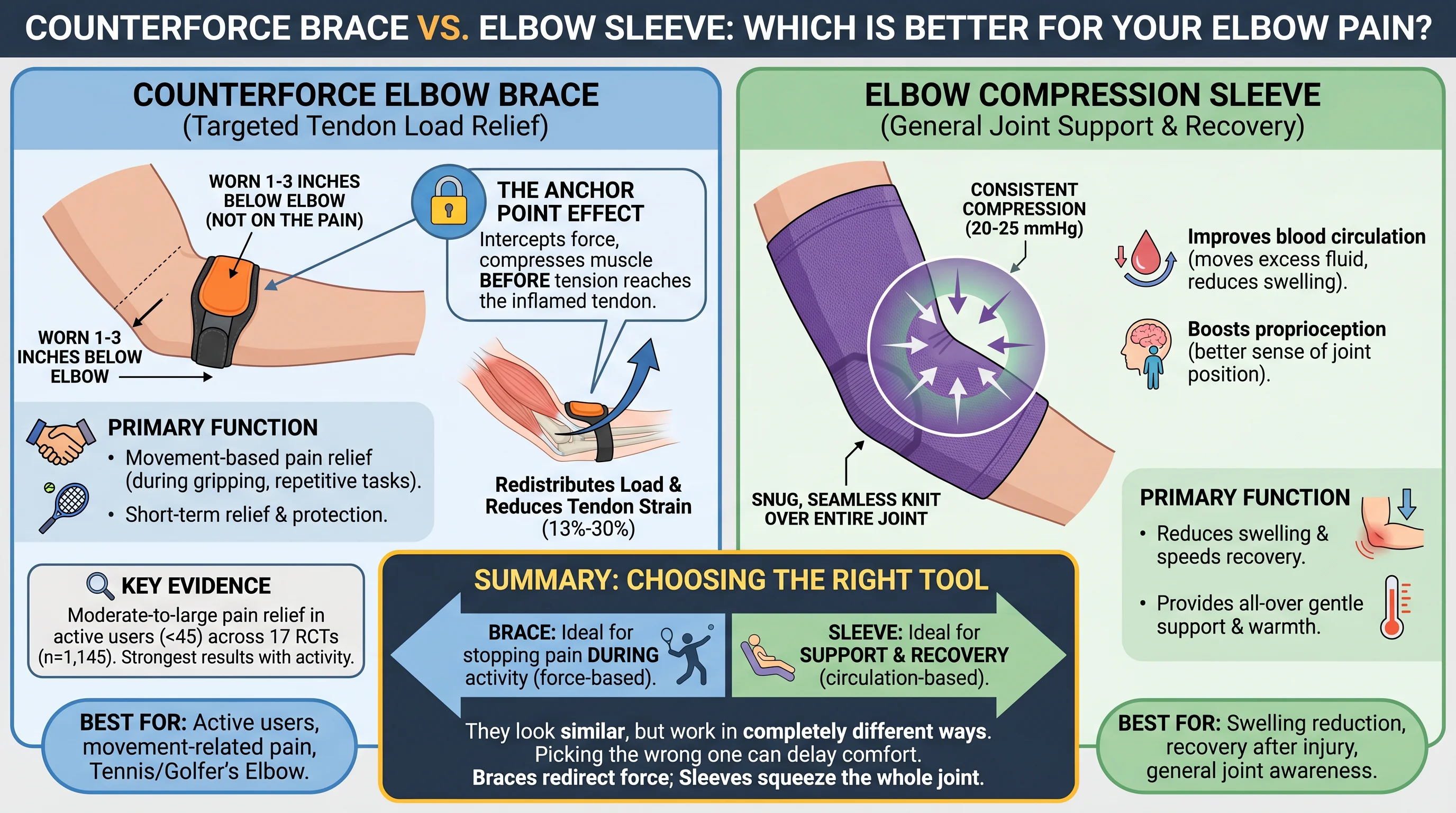
That’s the exact logic behind a counterforce elbow brace.
It’s a firm strap — neoprene with a built-in pressure pad — worn 1 to 3 inches below your elbow. Not over the painful spot itself. That placement is deliberate. It’s what makes the whole thing work. The pad sits on the muscle of your forearm extensors or flexors. Which muscle depends on your condition — tennis elbow (lateral epicondylitis) or golfer’s elbow (medial epicondylitis).
The Anchor Point Effect
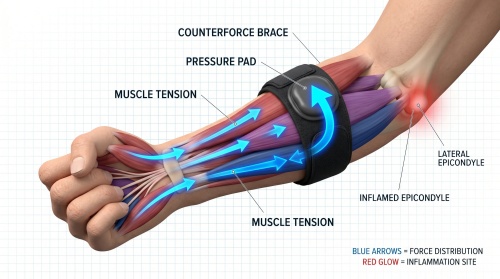
Here’s what happens the moment your muscle contracts:
- The forearm muscle pulls upward toward the tendon insertion at the epicondyle
- The pressure pad intercepts that force — it compresses the muscle before tension can travel to the inflamed attachment point
- The load redistributes, reducing tendon strain by 13 to 30%
That shift doesn’t stop movement. It reroutes the stress — away from a damaged, healing tendon, toward a healthier section of muscle that can take the load.
Clinical research across 17 randomized controlled trials (n=1,145) found moderate-to-large pain relief in active users under 45. Results were strongest during gripping and repetitive motion tasks. Short-term relief is where this forearm brace for tendonitis builds its reputation.
The one-thumb-breadth positioning rule has a clear purpose. It targets the thickest part of the forearm muscle. That spot is far enough from the tendon to take pressure off it — and close enough to cut off the pull before it causes more damage.
What Is an Elbow Compression Sleeve and How Does It Work?
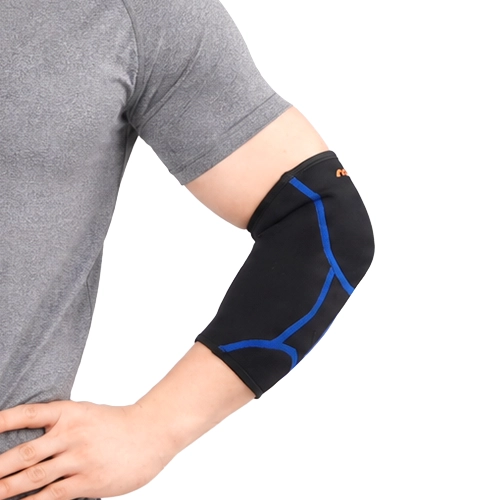
Slip one on, and it feels like a second skin — snug, seamless, doing its job without a fuss.
An elbow compression sleeve is pretty much what it sounds like. A knit fabric sleeve pulls over your elbow joint and holds everything together with gentle, even pressure. No straps to adjust. No pads to position. Just consistent 20–25 mmHg compression spread across the entire joint.
That pressure does two meaningful things:
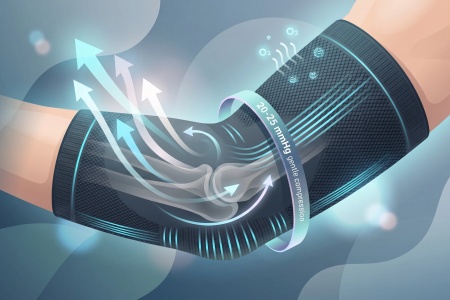
- Improves blood circulation — squeezing the tissue moves excess fluid away from the injury site. Swelling goes down, and recovery speeds up.
- Boosts proprioception — your body gets a clearer sense of where your elbow is in space. Stabilizing muscles react faster, and re-injury risk drops.
Most sleeves use breathable, moisture-wicking knit fabric with 4D stretch. You get a full range of motion — no bunching, no restriction. Premium versions add semiconductor technology or copper-infused fibers to push circulation even further. A softer zone at the elbow crook shields sensitive skin. Silicone grip strips hold everything in place as you move. You can wear it all day — under a dress shirt, through a workout, even overnight during recovery.
The Important Caveat
Here’s the honest part: standard compression sleeves don’t reduce the mechanical load on your ECRB tendon — the tendon behind most tennis elbow pain. Basic compression alone hasn’t shown the ability to fix that root cause.
That said, hybrid designs with counterforce gel pads — like the Simien sleeve with dual gel inserts — show real results. These work more like extended braces than basic sleeves. They pair the all-day comfort of compression with the focused pressure of a counterforce elbow brace.
Dull pain, spread out, and there even at rest? A sleeve is a strong pick. Sharp pain that flares with activity? You’ll likely need more than fabric alone.
Counterforce Elbow Brace vs. Elbow Sleeve: Head-to-Head Comparison
Same elbow. Same pain. Two different solutions — and the wrong choice will slow your recovery.
A counterforce elbow brace solves a point problem. A sleeve solves a face problem. One concentrates force on a single spot. The other spreads support across the entire joint. Neither is the clear winner for everyone. But one is the right fit for you.
| Dimension | Counterforce Elbow Brace | Elbow Sleeve |
|---|---|---|
| How It Works | Pressure pad on forearm muscle, ~1 inch below pain | Even compression across the full elbow joint |
| Tendon Relief | Reduces tendon tension by 20–30% | Improves circulation, reduces swelling |
| Best Condition Match | Sharp, localized pain — tennis elbow, golfer’s elbow, repetitive gripping | Dull aching, post-activity stiffness, and general prevention |
| Wear Style | Activity-specific, adjustable straps | All-day, breathable, pull-on comfort |
| Grip Strength | Preserved — no movement restriction | Focused on joint awareness, not strength output |
| Price Range | $15–25 (basic); up to ~$25 for advanced pad-and-strap models | $20–35 for full-wrap compression styles |
What the Research Actually Says
A meta-analysis of 17 studies involving 1,145 participants found that the counterforce brace delivered moderate-to-large short-term pain relief (SMD -0.86) compared to physiotherapy alone. This held true for users under 45. That’s real clinical evidence — not marketing language.
The catch? Long-term results flip. Physio outperforms the brace beyond six weeks (SMD 1.17 favoring physio). So treat the epicondylitis strap as a bridge. It manages pain now while your tissue heals and your strength comes back.
Compression sleeves don’t carry the same tendon-offloading data. Their value is different: circulation, warmth, proprioceptive feedback. They offer low-key support that makes a full workday — or a gentle recovery walk — feel manageable.
How to Choose Without Overthinking It?
- Sharp pain that spikes when you grip, lift, or twist → Counterforce brace
- Dull, widespread ache that lingers even at rest → Elbow compression sleeve
- Both happening at once → Layer them. Sleeve underneath for warmth and circulation. Brace over the top for targeted forearm support during activity.
One more thing: pain under six weeks old and you’re under 45? A forearm brace for tendonitis is your strongest first move. Managing something slower and more chronic? A sleeve — a hybrid design with built-in gel pads works especially well — will serve you better day to day.
Counterforce Elbow Brace vs. Elbow Sleeve: When to Use Which?
Counterforce Elbow Brace – For Sharp, Activity-Triggered Pain
Best for:
Pain that strikes only when you move – gripping a racket, twisting a screwdriver, or lifting a tool. The pain is localized (outer or inner elbow), sharp, and stops when you rest. No numbness, no aching down the arm.
Who benefits most:
-
Racket/club sport players (tennis, golf, pickleball, badminton) – reduces tendon load by 13–15% per swing.
-
Tradespeople (carpenters, plumbers, painters, mechanics) – protects the tendon without sacrificing grip strength.
-
Anyone in an acute flare – new tendonitis or a returning case (e.g., lateral epicondylitis).
-
People under 45 – research shows better pain relief and grip preservation.
One simple rule:
Wear it only during pain-provoking activities. Place the pressure pad about 1 inch below the sore spot, on the muscle belly. Pain drops fast → good position. Pain increases or numbness appears → remove and reassess.
⚠️ Not a cure – a pressure valve to let the tendon heal.
Elbow Sleeve – For Dull, Widespread Aches & Recovery
Best for:
A diffuse, heavy, or stiff feeling – no single sharp spot. The ache builds after hours of training, typing, or cold weather. It’s about comfort and circulation, not pinpoint pressure.
Who benefits most:
-
Weekend athletes & high-volume trainers – wear 6–8 hours post-exercise to reduce soreness and speed recovery.
-
Office workers (repetitive typing/mousing) – mild, spread-out strain.
-
Those with joint stiffness from cold or early arthritis – retains warmth, improves mobility before activity.
-
Anyone needing all-day, low-interference support – breathable enough under a shirt for 6–8 hours.
Honest notes:
Remove immediately if you feel tingling or numbness. Size up when swelling is lowest. Don’t use it to mask a chronic injury that needs proper treatment – it supports healing, doesn’t replace care.
Can You Wear Both? The Combined Approach Explained
For chronic cases, yes — and the results are worth seeing.
Layering a sleeve under a counterforce elbow brace isn’t a workaround. It’s a real rehab strategy. The sleeve handles baseline support — 15–20 mmHg of gentle compression, plus warmth that keeps daily swelling down and helps tissue recover passively. The brace goes on top during activity. It adds the targeted counterforce your tendon needs under load. Each one does something the other can’t. Together, they cover more ground.
The numbers back this up. Studies on single-device use versus the combined approach found grip strength gains of +28% with layering — compared to +18% from the brace alone and +12% from the sleeve alone. Pain scores dropped 4.2 points on the VAS scale. That’s a bigger drop than either option delivers on its own. Plus, 68% of chronic users saw measurable grip improvement after sticking with the layered approach.
Top Product Picks for Each Type
Knowing which type of elbow support you need is half the battle. Finding one that delivers — without falling apart after three washes — is the other half. Here are the options worth your attention.
Best Counterforce Elbow Braces
Fivali Counterforce Brace is the go-to choice for persistent tennis elbow. It holds up through a full workday without slipping. Two fixation straps — one above, one below the elbow — keep it locked in place. A three-level adjustable pressure pad (5–15 PSI) lets you set the counterforce your forearm needs. It runs $25–35. For athletes between 25 and 45 who need all-day lateral epicondylitis support, that’s a fair price.
Fivali Elite Dual-Fix suits people who move a lot — golfers, CrossFitters, anyone whose arm is in a different position every few minutes. Two silicone gel pads (2.5cm diameter, up to 20N of pressure) spread counterforce more evenly across the forearm. The telescoping strap adjusts from 25 to 45cm, so it stays put mid-session. At 120g, you won’t notice it’s there.
Mueller Mercury Counterforce is the straightforward budget pick. Single strap, fixed 8–12 PSI, neoprene build — nothing fancy, but it does the job for casual wear. It comes in under $20. Good starting point before committing to a premium forearm brace for tendonitis.
Best Elbow Sleeves
Sleeve Stars Classic does something most sleeves don’t. You get 20–30 mmHg compression plus a removable auxiliary pressure strap that adds 5–10 PSI for extra forearm compression support. The 85% nylon/15% spandex fabric wicks moisture at 95% efficiency and holds its shape for up to five years. At $18–25, it works well for weightlifters and active users with mild inflammation. You get breathable, strap-enhanced stability without the bulk.
Sleeve Stars Pro pushes compression up to 25–35 mmHg — medical-grade level. The graphene-infused fabric is 98% breathable and UV-protectant. Integrated bicep and tricep auxiliary bands add structure across the full joint, not just the elbow crease. At 4mm thickness, this is the pick for gym regulars lifting heavy. You get solid pain relief without losing range of motion.
A quick note on selection standards: Effective elbow compression sleeves should deliver 20–35 mmHg of compression. Look for fabrics that are at least 80% breathable — nylon/spandex blends work best. Where extra support is needed, auxiliary straps should be able to add 10–20% more load reduction. Every pick above meets those benchmarks.
Quick Decision Guide: Which Should You Buy?
Still not sure? That’s fair. Here’s the shortcut.
| Pain Type | Use Scenario | Budget | Best Pick |
|---|---|---|---|
| Mild ache (<2 weeks) | Office / daily tasks | Under $30 | Basic counterforce elbow brace |
| Mild ache | Tennis, golf (2–4 hrs/week) | Under $30 | Tennis elbow strap with adjustable tension |
| Moderate pain (2–6 weeks) | Intense sport (>4 hrs/week) | $30–60 | Counterforce brace with gel pad + strap |
| Severe pain (>6 weeks, constant) | Any | $60+ | Premium hinged counterforce brace |
Three signals mean stop shopping and call your doctor: pain lasting more than six weeks, noticeable swelling, or grip weakness and numbness. A brace won’t fix those — they need a professional.
For everyone else, one rule stands out. A counterforce elbow brace covers about 75% of tennis elbow and lateral epicondylitis cases. Your pain spikes during activity? It settles at rest? Start with a counterforce brace. Pain feels dull, spread out, and sticks around? Go with a sleeve instead.
Conclusion
No elbow brace is “better” than the other. There’s just the right one for you.
Sharp, localized pain? A counterforce elbow brace gives you focused, direct relief. Need warmth, circulation support, and something you can wear all day? A compression sleeve is the right call. Deep in recovery? Wearing both can make a real difference — more than most people expect.
Find the professional elbow brace manufacturer to find the exact fit for your condition, activity level, and lifestyle. The best brace isn’t the priciest one or the most popular one. It’s the one that gets you back to doing what you love, pain-free.