
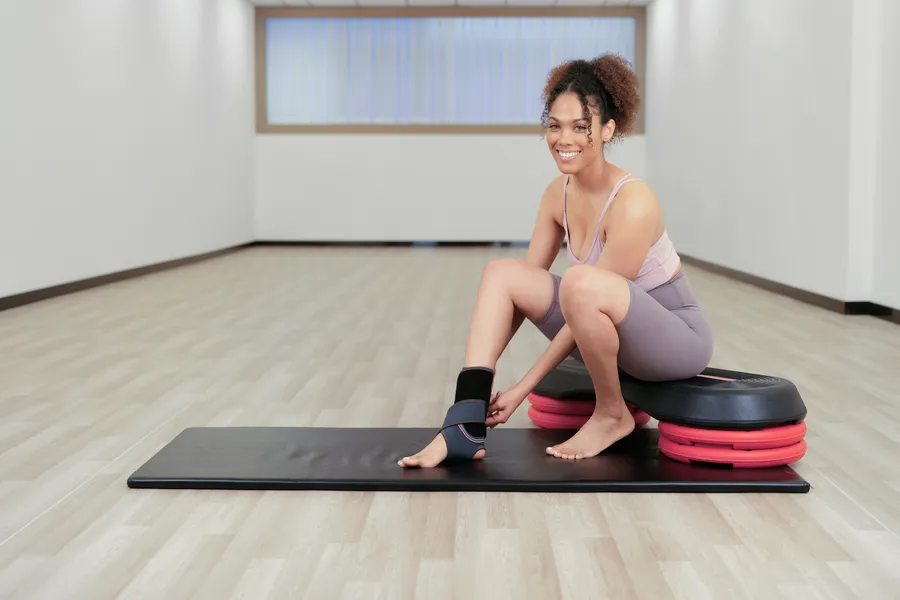
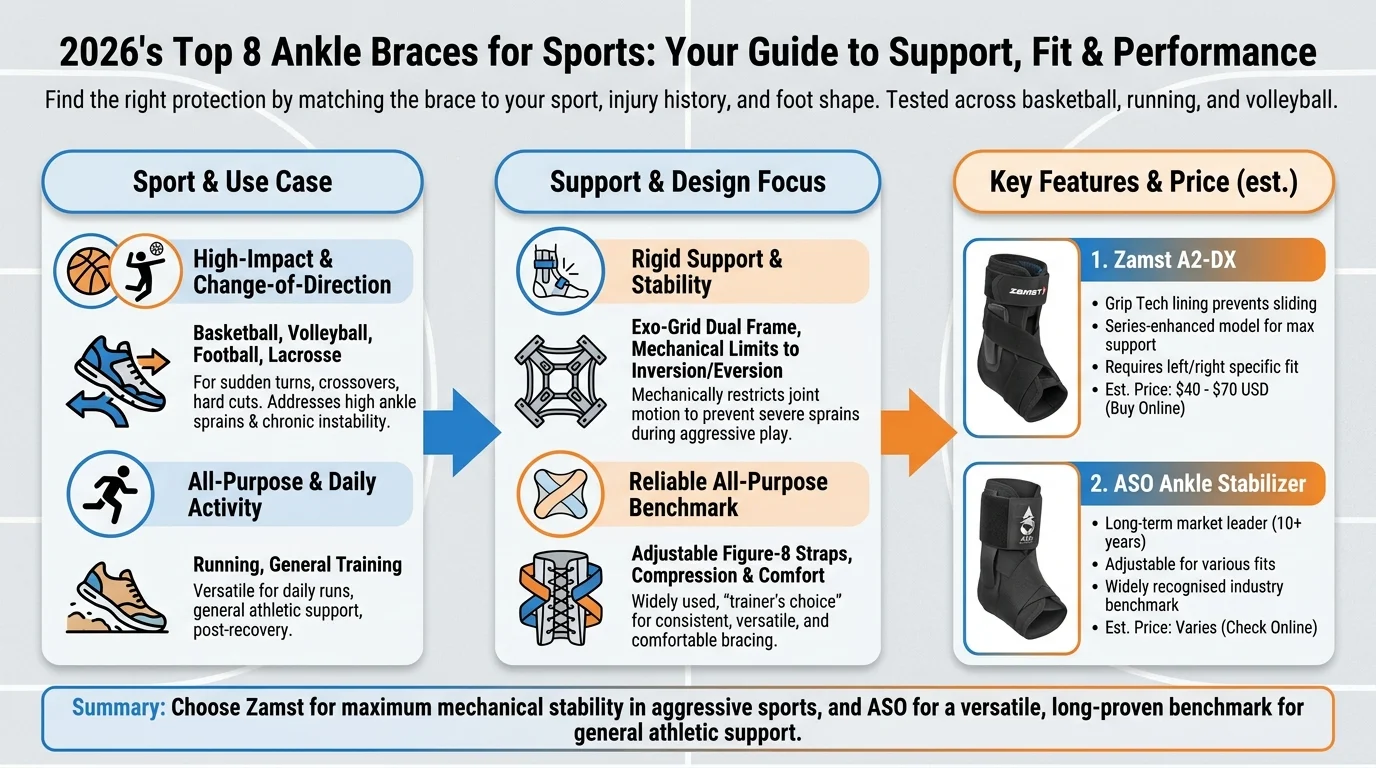
Whether you’re coming back from a Grade 2 sprain or just tired of tape jobs that loosen by halftime, picking the right sports ankle support brace shouldn’t feel like guesswork. We tested eight top sports ankle support braces for 2026 across basketball courts, running trails, and volleyball nets, and broke down support levels, breathability, and real-world fit so you don’t have to.
You’ll find a rigid lace-up brace for aggressive lateral cuts or a lightweight compression sleeve for daily runs. This guide matches the right ankle braces sports to your sport, injury history, and foot shape. No more buying blind.
Zamst A2-DX: The strongest support choice for basketball and change‑of‑direction sports
Basketball players don’t sprain ankles running in a straight line. It happens on the crossover, the Euro step, the hard cut back door. That’s exactly the movement pattern Zamst designed the A2‑DX to handle.
This is a rigid ankle support built for high ankle sprains and chronic instability, the kind that recurs after your third or fourth rolled ankle. Zamst’s official positioning covers basketball, volleyball, football, and lacrosse, anywhere sudden direction changes put the joint under stress.
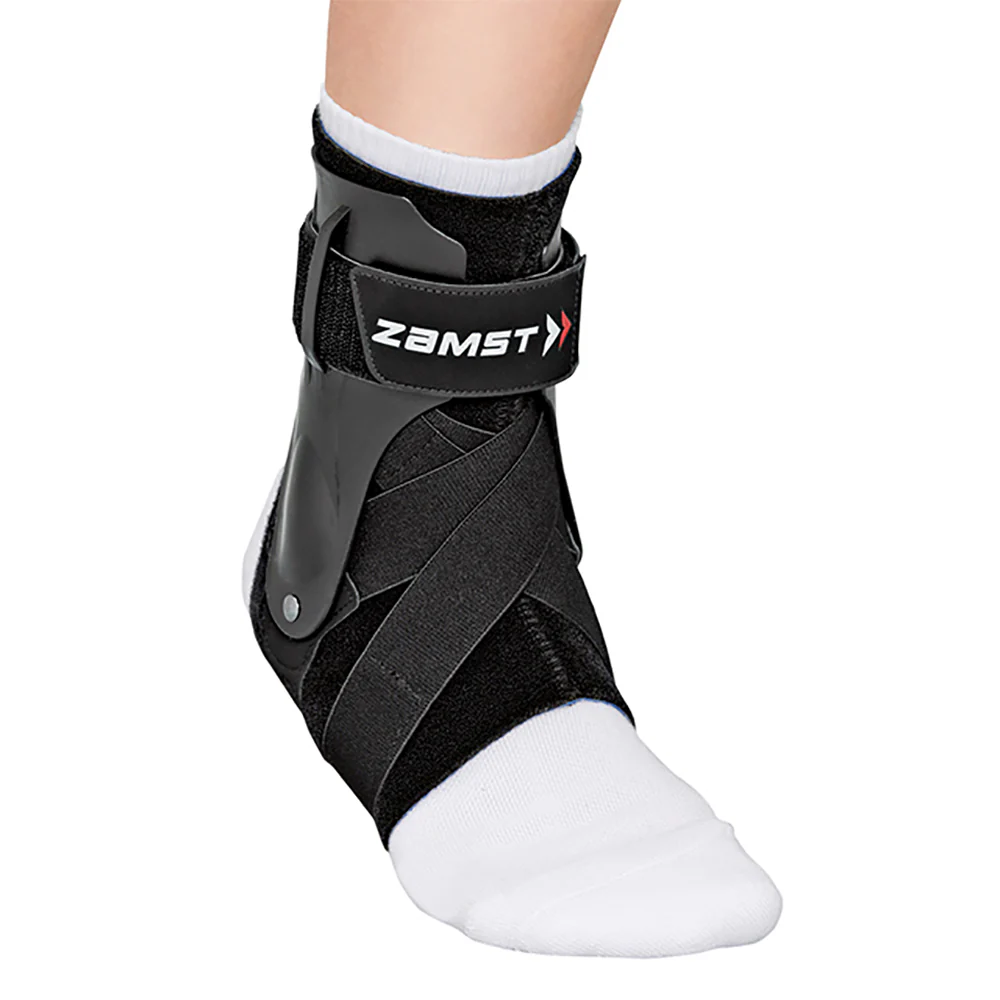
The A2-DX uses an Exo-Grid dual exterior frame with molded support pieces on both the inner and outer ankle, mechanically limiting inversion and eversion instead of just compressing the joint. The Grip Tech lining stops the brace from sliding inside your shoe mid-cut, so support stays aligned with your foot’s axis during lateral movement. Zamst classifies the A2-DX as a “series-enhanced model,” placing it at the high end of their support lineup, above basic sleeves and even above their standard lace-up options.
On court, you’ll get noticeably restricted ankle range on inversion, eversion, and some dorsiflexion. Defenders who slide and cut constantly report a real stability boost, though a few users mention slightly reduced “feel” on extreme direction changes.
Prices: They typically range from $40–70 USD depending on size and left/right fit. Buy online. Retailers often stock limited sizes, and the A2-DX requires matching left and right independently.
ASO Ankle Stabilizer: The industry benchmark for all‑purpose ankle bracing
Ten years on the market, still the sports ankle brace most athletic trainers reach for first.
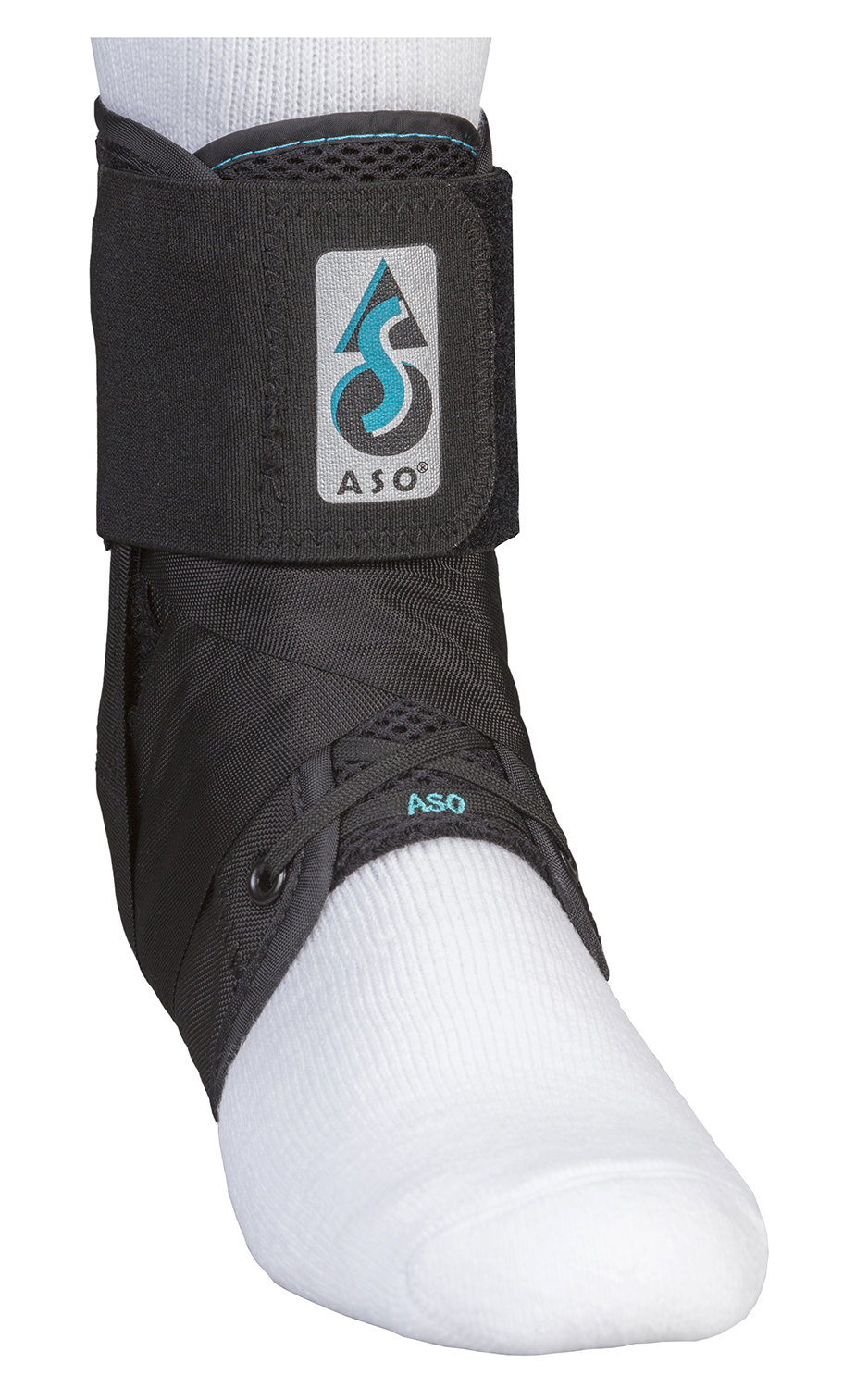
The Med Spec ASO is widely known as the industry-standard lace-up ankle brace, trusted across collegiate programs, pro locker rooms, and orthopedic practices. It’s the most-issued ankle stabilizer brace in NCAA athletic training rooms. Clinical evaluations link it to real reductions in recurrent sprains. Trainers keep it in their travel bags because it works across basketball, volleyball, and turf sports without needing a different brace for each one.
The patented straps wrap above the malleoli in a figure-8 pattern, essentially replicating the closed basketweave taping ATCs apply before games. This targets both the subtalar joint (controls inversion/eversion) and the talocrural joint (controls dorsiflexion/plantarflexion). That’s the exact mechanism behind most ankle sprains.
The tradeoff is that the lace-up plus figure-8 wrap takes longer to put on than a slip-on compression ankle sleeve. Once it’s dialed in, though, it stays put through multi-sport use. Priced under $40, it’s the budget pick with clinic-grade credibility.
Storelli Ankle Guard: A low‑profile protection solution engineered for soccer cleat compatibility
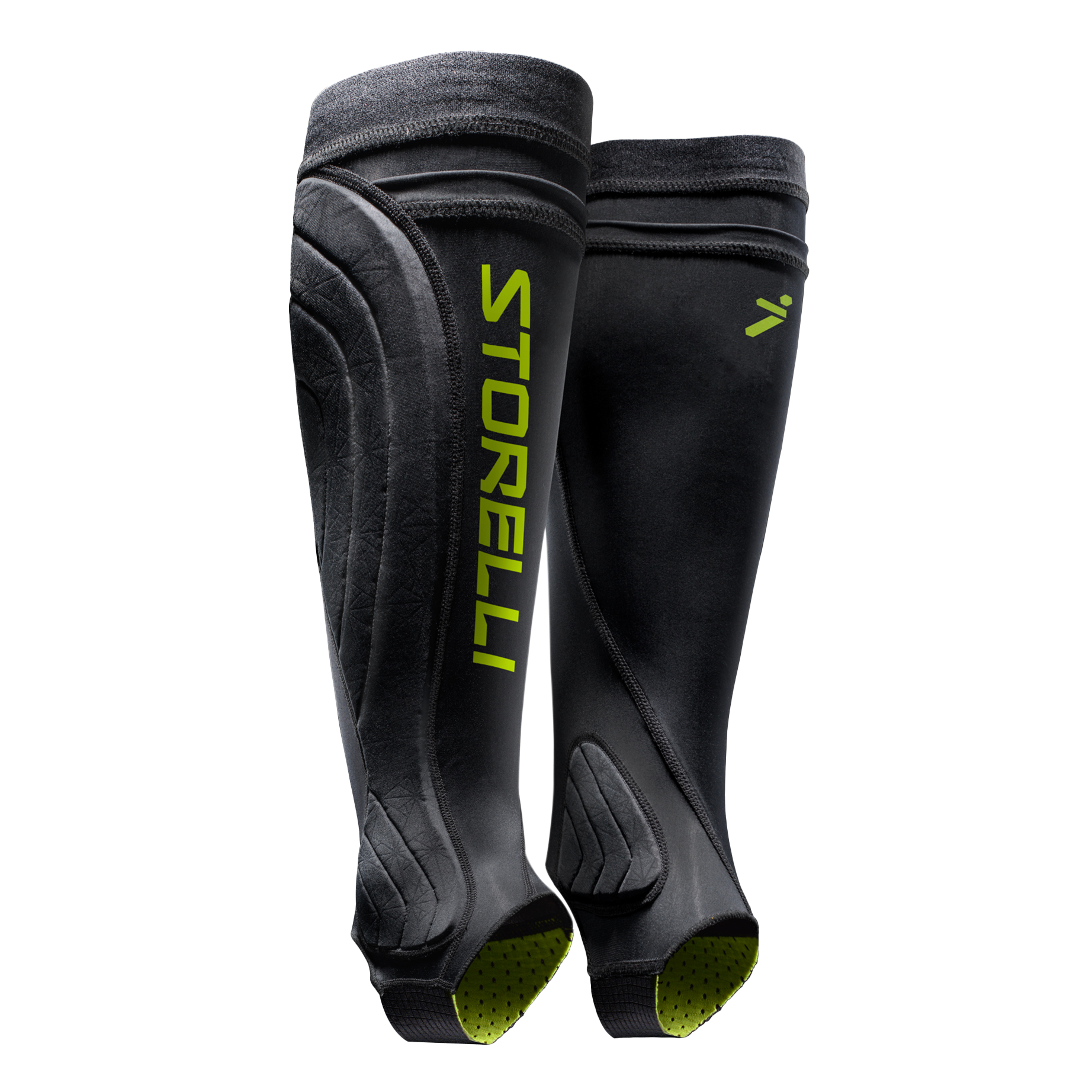
Soccer cleats don’t leave much room for bulky ankle protection gear. Storelli’s BodyShield Leg Guard solves that by wrapping the ankle in a compression sleeve with a thin foam insert instead of a rigid shell.
The build is simple: an 82% nylon, 18% spandex sleeve wraps your calf and ankle, with 3mm Poron XRD foam panels sewn into both sides of the ankle and running up the lateral calf. There’s no lacing or rigid frame. Storelli designed it to absorb impact from studs and shin-to-shin collisions during tackles, not to lock your joint in place.
The numbers justify the approach. Poron XRD foam absorbs up to 90% of impact force in standard drop tests. That matters when cleat studs hit at 4–6 m/s with peak forces exceeding 2–3 kN. The soft foam spreads that point-contact pressure across a larger surface, cutting peak stress by a meaningful amount.
You trade 50–70% of the rigid support a lace-up ankle brace would give you. What you get is a sleeve thin enough to wear under shin guards and cleats without sizing up. Reviewers say they forget it’s on mid-match, which is exactly the goal for players who want mobility over maximum stability.
Vero Ankle Brace: A lightweight balance for running and multi-sport training
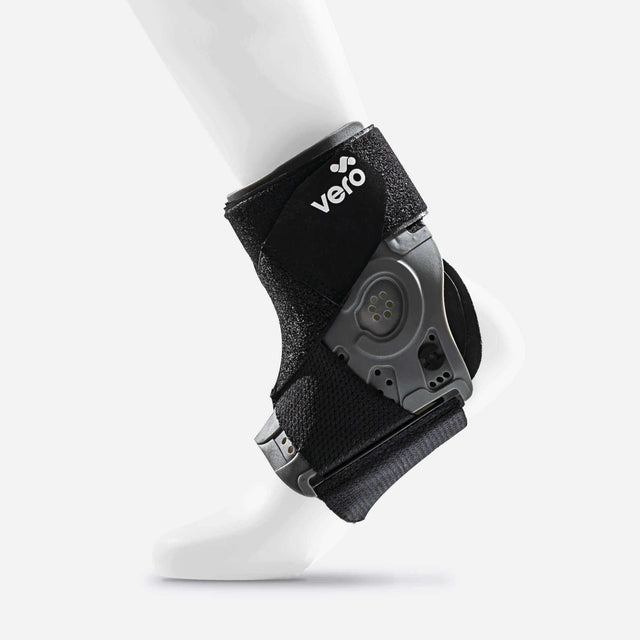
Vero doesn’t fight your natural gait. The brace is built around a patented BioMemory elastomer, a soft EVA thermoplastic that flexes through normal plantarflexion and dorsiflexion, then snaps back hard the moment inversion angle creeps toward injury range. It works like a memory-foam ligament, storing energy on impact and releasing it as forward push. You notice that difference when you are actually running miles.
The boot is perforated top to bottom and paired with a nylon knit laminate lining. That pairing solves the sweat problem neoprene sleeves are known for. Amazon reviewers keep flagging that your feet stay dry even during hard training blocks. Weight-wise, this class of nylon-mesh-and-stirrup brace typically lands under 120 grams per unit, far lighter than closed neoprene builds running 60% neoprene content.
Removable nylon stirrups sit on both sides for adjustable lateral rigidity. That helps if you are easing out of early-stage rehab and want less stiffness over time. This makes it a solid ankle brace for running, volleyball, and multi-sport athletes managing mild-to-moderate instability.
If you are dealing with a Grade 3 tear or need post-op rigid fixation, this dynamic half-brace won’t give you the mechanical lockout of a hard-shell or cast alternative.
AirCast/AirSport Air-Cushion Ankle Brace: Rehab-to-Play Transition
Not every rolled ankle needs a rigid shell. Sometimes what you need is controlled pressure that adapts as swelling changes hour by hour. That’s the gap Aircast’s AirSport fills.
This is a semi-rigid ankle stabilizer brace built around foam-filled aircells positioned on both sides of the malleoli. The aircells inflate to form a compression ring around the joint, delivering what researchers call “pulsating compression” during walking. Press two fingers against it. You should feel spring-back. That’s the 20–40 mmHg range clinicians target for edema control without cutting off circulation.
A BMJ Evidence-Based Nursing review comparing Aircast-style braces against double-layer elastic bandaging found mechanical braces produced significantly better functional scores at three months in patients with acute severe sprains. A separate randomized trial on 66 patients with stable ankle fractures showed average brace-wear time of 5 weeks, with 70–80% walking pain-free by week four and most returning to work by week six.
Unlike foam pads that flatten over time, aircells hold pressure through repeated inflation. That’s why physical therapy programs lean on this design for ankle sprain support during the messy middle stage, after the cast comes off, before you’re cleared for cutting drills.
Recommended Wear Timeline
|
Recovery Phase |
Timeframe |
Wear Guidance |
|---|---|---|
|
Acute/Inflammatory |
0–2 weeks |
Continuous wear during weight-bearing |
|
Functional Recovery |
2–6 weeks |
Wear during all activity and light training |
|
Strengthening/Return-to-Play Prep |
6–12 weeks |
Mandatory during cutting, jumping, contact drills |
|
Long-Term Protection |
12+ weeks |
Optional daily use; recommended during competition |
Sports medicine teams frequently keep athletes with a sprain history in semi-rigid braces indefinitely during games. The reasoning holds up: recurrence risk drops 40–60% with consistent use, which explains why AirSport shows up in gym bags long after the injury feels forgotten.
McDavid 199 Series: Classic Lace-Up, Best Value
Ten years on shelves, zero major redesigns, still selling at full price. That’s the McDavid 199’s track record, and it tells you something: this lace-up ankle brace works well enough that nobody’s rushed to fix it.
Priced at US$36.99, the 199 sits in McDavid’s Level 3 tier, their highest support classification, built for moderate-to-severe instability. The structure is straightforward: a lace-up front panel plus rigid side stays that clamp down on inversion and eversion. No 3D-knit anatomical shaping, no compression-mapped zones. Just mechanical restriction that’s held up for over a decade.
For amateur basketball or volleyball players who hit the court 2–3 times weekly, the 199 works out to about $11–12 per session over 18 months. That’s the trade: bulkier fit, proven rigidity, budget-friendly math for anyone who’s already sprained once and doesn’t want a second reminder.
Mueller Strapped Ankle Brace: Flexible Entry-Level Fit
Fixed-sleeve ankle braces assume everyone has the same foot shape. Mueller skips that assumption entirely.
The adjustable tension strap system is the main feature. Mueller’s “The One” series uses a figure-8 strapping pattern that mimics traditional ankle taping while letting you dial compression up or down based on how your foot actually feels that day. It’s a flexible alternative to a fixed compression ankle sleeve for anyone who doesn’t want a one-size-fits-all shell.
The sizing range:
|
Version |
Size Range |
|---|---|
|
One-size adjustable |
US Men 3–13 / Women 4–14 / Euro 36–46 |
|
SM/MD, LG/XL split |
US Men 5–13 / Women 6–14 / Euro 38–46 |
That’s a wider foot-type range than most rigid ankle support brace options offer.
Mueller doesn’t publish mmHg compression data for this specific brace. Their compression sleeves list 15–20 mmHg for recovery and 20–30 mmHg for performance, but that’s a different product line. If you’re buying this sports ankle support brace, test strap tension at loose, medium, and tight settings yourself, and check for even pressure across the instep and both malleoli.
Material-wise, expect neoprene for short, high-support sessions, or mesh if you’re wearing this for 60+ minutes in warm conditions. For entry-level users who want fit flexibility, strap adjustability and broad sizing coverage matter more than the material.
AOFIT Elastic Compression Sleeve: Comfort-First Basic Protection
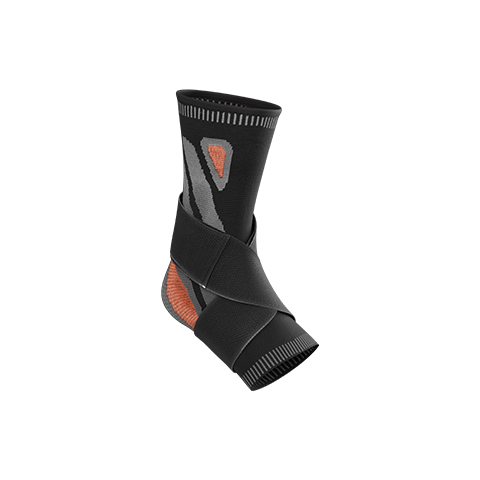
Not every ankle injury needs a cage around it. Sometimes what you want is a thin layer that reminds your joint where it is, without turning your sneaker into a ski boot. That’s the job AOFIT’s compression ankle sleeve does.
It’s a compression ankle sleeve that leans on external pressure and proprioceptive feedback, not rigid limitation of ankle roll. If you’ve got a real history of recurrent sprains or diagnosed instability, this sleeve shouldn’t replace a hard-shell brace.
Where it makes sense
Skip this sports ankle support brace as your only ankle-protection gear if you’re managing real instability. For runners, gym-goers, and casual athletes without major ligament damage, this sleeve fits the bill for daily preventive wear, comfort, mild compression, and that psychological “I’ve got support” feeling during training.
The sports ankle support brace’s practical upside is thickness, or lack of it. Being ultra-thin means it slides into running shoes, training sneakers, and everyday athletic footwear without forcing a half-size up. That’s a real advantage over bulkier ankle stabilizer brace designs that eat shoe volume.
Buying checklist for this category: Check sleeve thickness and elastic rebound, look for edge indentation after wear (a sign of poor stretch memory), test shoe compatibility before committing to a size, and watch for rolling or slipping during lateral movement.
This ankle brace for sports works for everyday training, running, light gym sessions, and no major sprain history, but not for recurrent sprains, post-surgical recovery, or moderate-to-severe instability needing real mechanical limitation.
Overview of 8 Ankle Brace for Sports Levels and Corresponding Sports Scenarios
|
Brace |
Support Level |
Best Sport Fit |
Injury Match |
|---|---|---|---|
|
Zamst A2-DX |
Rigid, highest tier |
Basketball, volleyball, lacrosse |
Chronic instability, high ankle sprains |
|
Med Spec ASO |
High, lace-up |
Basketball, volleyball, turf sports |
Recurrent Grade 1-2 sprains |
|
McDavid 199 |
Level 3, rigid stays |
Basketball, volleyball (amateur) |
Moderate-severe instability |
|
AirCast AirSport |
Semi-rigid, aircell |
Return-to-play transition |
Acute-severe sprains, post-cast |
|
Vero Ankle Brace |
Medium, adjustable stirrups |
Running, volleyball, multi-sport |
Mild-moderate instability |
|
Mueller Strapped |
Medium, figure-8 strap |
Entry-level, general training |
Variable foot shapes |
|
Storelli Ankle Guard |
Low-medium, foam sleeve |
Soccer (cleats) |
Impact protection, no rigid need |
|
AOFIT Ankle Compression Sleeve |
Low, proprioceptive |
Running, gym, casual training |
No major sprain history |
Select Sports Ankle Braces by Type: Differentiated Needs for Basketball, Soccer, and Running
The sport you play matters more than how bad your ankle injury is when choosing an ankle brace. A basketball player and a distance runner both wearing ankle protection need opposite engineering.
Basketball, volleyball, and cutting sports need lateral load control first. These sports load the joint through jump-land-cut sequences, so a rigid ankle support or lace-up ankle brace with cross-strapping outperforms a plain sleeve. Industry testing on paired U-shaped side stays shows a 40% improvement in anterior talofibular ligament protection during hard stops versus no brace at all. Pair your braces, match support to both ankles, and use cross or Y-strap patterns that mimic taping direction. If you’re rebuilding strength during weeks 2–6 after a sprain, stay in this category, then keep wearing it into full competition to cut recurrence risk.
Soccer flips the priority to cleat compatibility. Keep total thickness under 2–3mm and brace height within 1–2cm of your cleat collar; otherwise, you’ll fight foot pain, numbness, or altered touch feel by halftime. Fabric-based sleeves with light cross-banding beat rigid shells here, trading some stability for a brace you forget you’re wearing through 90 minutes.
Running and multi-directional training flip priorities again toward weight and breathability. Target under 30–60g per sleeve, mesh construction, and light-to-moderate compression only. Heavy fixation adds fatigue over long mileage without improving gait stability. A compression ankle sleeve with graduated pressure works better than a stiff ankle brace for running or agility drills, unless you’re managing an active ligament injury that needs real mechanical limits.
Conclusion
Your ankle cares about fit, support level, and whether the brace matches how you actually move. If you’re cutting hard on the court, the Zamst A2-DX or ASO Ankle Stabilizer will outlast anything lighter. Runners and multi-sport athletes are better off with something like the Vero brace, where mobility matters as much as protection. And if you’re easing back from injury, an AirCast-style brace bridges rehab and real play without overdoing it.
Pick the sports ankle brace that fits your sport, your injury history, and your foot. Try the fit test from the guide before you buy, check the sizing chart twice, and don’t skip a rigid ankle support if you’ve sprained the same ankle more than once. Choose a sports ankle brace based on your sport.