
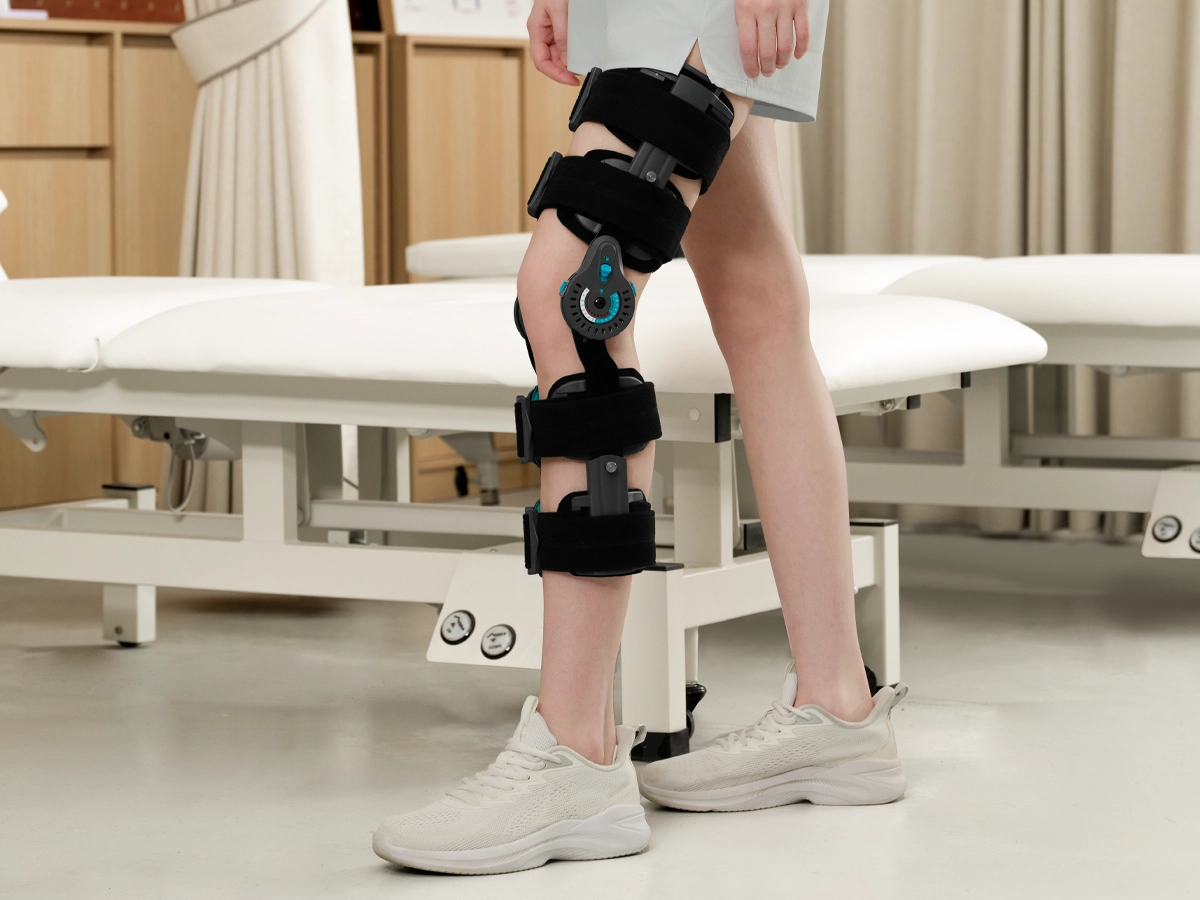
That twinge in your knee when you pivot to grab something off the shelf, or the way it locks up mid-stride on a jog, sends most of us straight to Google, half-hoping for reassurance and half-bracing for bad news. If a doctor has mentioned “meniscus tear”, you’ve probably already discovered that knee brace options are far messier than they should be. Hinged, compression, rigid, prophylactic: the choices multiply fast, and picking wrong can mean wasted money or a setback in your recovery.
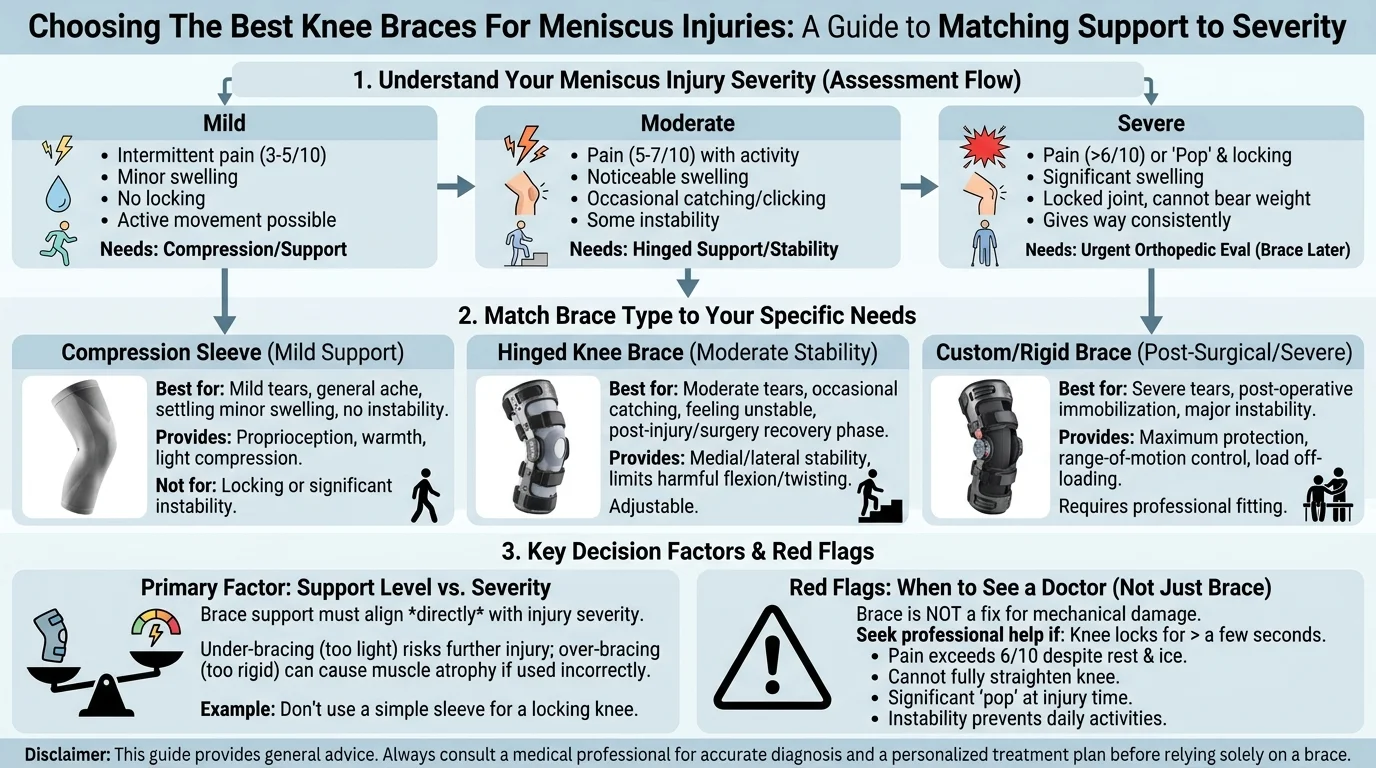
This guide cuts through the noise. We’ll walk through how to match the right knee braces for meniscus injuries to your specific situation, whether you’re newly injured, recovering from surgery, or working your way back to full activity, so you can decide with confidence.
Understanding Meniscus Tear Symptoms and When You Need Knee Braces for Meniscus Injuries
Doctors see this pattern constantly. A patient describes knee pain along the joint line, worse with twisting or squatting, and within minutes they’ve self-diagnosed a meniscus tear before any imaging is done. Meniscus tear symptoms follow fairly predictable patterns, and recognizing them tells you a lot about what kind of support your knee actually needs.
The core symptoms include joint-line pain that’s sharper with pivoting, stairs, or getting out of a car; swelling and stiffness that appear within hours for traumatic tears and more gradually for degenerative ones; locking, catching, or clicking that may mean the tear is displaced; instability or that “giving way” sensation during weight-bearing; and limited range of motion, especially difficulty fully straightening the knee.
Severity roughly falls into three buckets.
Mild tears bring intermittent pain (around 3–5/10), minor swelling, and no locking. A knee compression sleeve often handles these well.
Moderate tears push pain to 5–7/10 with noticeable swelling and occasional catching. This is where a hinged knee brace starts making sense, particularly one adjustable enough to limit provocative flexion.
Severe tears announce themselves with a pop, real locking, and inability to bear weight. Brace or not, you need an orthopedic evaluation.
A knee brace for meniscus injuries supports knee stability during conservative treatment or post-surgical recovery, but it doesn’t fix mechanical damage. If your knee locks for more than a few seconds, or pain exceeds 6/10 despite rest and ice, that’s your body telling you it’s time for a doctor’s exam before a knee brace for meniscus injury becomes your long-term plan.
6 Key Factors When Choosing a Meniscus Injury Brace
1. Support Level Matched to Injury Severity
Mild pain with minor swelling and no instability calls for a compression sleeve with no hinges—near-full range of motion (0–130°) and mild rotational limiting.
Moderate injuries where the knee “gives way” need structured support with side stays or a light hinge, restricting valgus/varus movement while preserving daily flexion (0–120°).
Severe tears, post-surgical recovery, or early return to sport require hinged ROM-adjustable braces with metal or high-strength polymer hinges, typically locking in 10–15° increments across a 0°–120° range.
2. Compression: Enough to Control Swelling, Not Enough to Cut Circulation
Therapeutic compression sits at 20–30 mmHg; anything above 40 mmHg risks venous return problems. Run the one-finger test—you should slide a finger comfortably between brace and skin. Wear it ten minutes; if you feel numbness, tingling, or discoloration below the brace, loosen it.
3. Motion Control Across Three Planes
Flexion and extension limits protect healing tissue (post-op often locks at 0–30° initially). Lateral stability comes from HDPE or TPE frames with at least three adjustable straps that prevent shear forces. Rotational control—critical during pivoting and cutting—depends on dual hinges with snug thigh and calf wrapping.
4. Material and Breathability
Neoprene traps heat and moisture. Fine for short workouts, rough for all-day wear. Air-mesh or Drytex fabrics reduce rash and blister rates for anyone wearing a brace four or more hours daily.
5. Sizing Precision
Measure two inches above the center of your kneecap with the knee bent 20–30°. Match it against the brand’s sizing guide. When in doubt, size up and tighten straps.
6. Multi-Point Adjustability
Three straps or more let you fine-tune compression as swelling changes from morning to evening. This is non-negotiable for consistent knee stability throughout recovery.
Compression Sleeve vs Hinged Brace vs Rigid Brace: Which One Fits Your Injury?
Three knee braces for meniscus injuries, three very different jobs. Get this match wrong, and you’re either overpaying for support you don’t need or under-protecting a knee that needs real stabilization.
A knee compression sleeve is the simplest of the three. No metal, no hinges, just snug elastic fabric. It controls mild swelling, offers warmth, and gives you that “held together” feeling during runs or long days on your feet. What it won’t do is stop lateral or rotational movement. If your knee structure is sound and you’re just dealing with soreness or early-stage wear, this is your starting point. Price-wise, expect $10–20 for basic versions, $20–60 for sturdier medical-grade options.
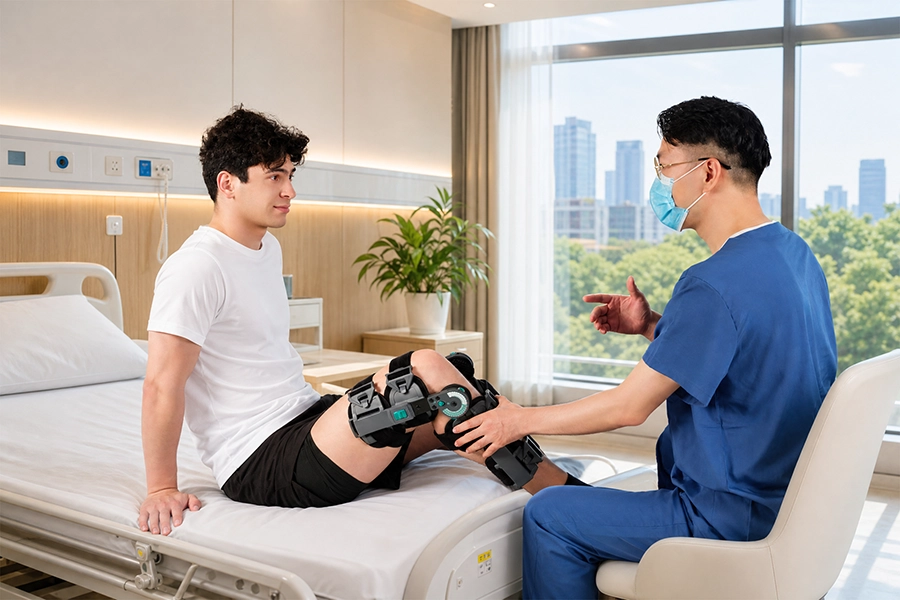
A hinged knee brace steps up considerably. Metal or rigid plastic side supports paired with an actual hinge mechanism restrict the sideways buckling and twisting that happens with ligament damage. This is the go-to for confirmed MCL, LCL, ACL, or PCL injuries, or post-surgical recovery where you need controlled range of motion. It’s bulkier and costs more, typically $40–100 for basic adjustable models and $80–200 for branded rehab-grade versions.
Rigid braces occupy the top tier. Built with carbon fiber or heavy metal frames and multiple straps, they’re prescribed for severe multi-ligament injuries or early post-op protection where doctors want near-total joint immobilization. Prices climb to $200–600+, and these are usually physician-directed purchases.
|
Type |
Best For |
Strength |
Trade-off |
|---|---|---|---|
|
Compression Sleeve |
Mild pain, minor swelling |
Lightweight, near-full mobility |
No mechanical stability |
|
Hinged Brace |
Ligament instability, “giving way” |
Controls lateral/rotational forces |
Bulkier, less flexible |
|
Rigid Brace |
Severe injury, early post-op |
Maximum stabilization |
Heaviest, most restrictive |
Also consider an open-patella design, a cutout ring around the kneecap. It provides targeted pressure relief for anterior knee pain, such as the pain you’d feel when climbing stairs. If your discomfort centers on the kneecap itself rather than overall joint looseness, this feature matters more than the hinge question entirely.
Choosing the Right Brace for Meniscus Injuries by Injury Stage: Acute, Conservative Treatment, Post-Surgery, Return to Sport
Your knee doesn’t need the same brace on day one that it needs on day ninety. Recovery isn’t static, and neither should your knee brace be.
Acute Stage (First 1–2 Weeks)
Swelling is at its peak, pain is sharp, and your knee feels like it might buckle under you. You need maximum control: a hinged brace with adjustable ROM locks set at 0°, 30°, 60°, or 90°, running from mid-thigh to upper calf. Wide cross-strapping resists slippage, and a rigid frame with soft padding accommodates swelling without choking circulation. To size during this phase, measure 15 cm above the kneecap, at the kneecap’s widest point, and 10 cm below it—then size up if you’re between options. Swollen tissue doesn’t compress evenly.
Conservative Treatment
Once acute pain settles, the goal shifts. You need moderate knee stability support that allows active rehab—walking drills, closed-chain exercises, balance work—without the muscle atrophy that comes from prolonged rigid immobilization. A soft-hinge sleeve or compression brace with adjustable straps works here. Wear it during training sessions; skip it at rest. Check skin after each session. Redness lasting past 20 minutes means loosen the straps.
Post-Surgery
Meniscus surgery recovery follows a predictable arc. Weeks 0–2: locked at 0–30° flexion, partial weight-bearing (25–50% body weight) with crutches. Weeks 2–4: ROM opens to 0–90°, progressing toward full weight-bearing. Weeks 4–6 and beyond: near-full flexion returns as strength training ramps up. Your surgeon adjusts hinge settings every 1–2 weeks based on healing.
Return to Sport
Now flexibility matters as much as stability. Functional sports braces run 300–600g per side, lightweight enough not to sabotage running economy. ROM should approach 0–120°+, with hinges controlling rotation and lateral shift rather than restricting normal bending.
What Knee Braces for Meniscus Injuries Can and Cannot Do?
A knee brace won’t heal your torn cartilage. Not the $20 sleeve, not the $200 hinged model. Bracing is a supportive tool, and understanding that now saves you from disappointment later.
What Bracing Delivers
Pain and swelling control. Compression limits fluid buildup around the joint, which takes the edge off that sharp, pinching pain during stairs and pivots.
Confidence in motion. A brace makes walking feel more controlled, even when the underlying structure hasn’t changed.
Load management. One lab study found unloader-style braces reduced medial meniscus strain during dynamic activity—but only when the ACL was intact.
Rehab support. Braces assist post-op or conservative care as an adjunct, though evidence for routine use remains mixed.
What It Won’t Fix
The meniscus has poor blood supply, especially in the inner “white zone,” so it doesn’t regenerate just because you’re wearing support. A 2025 AAOS guideline makes no recommendation for routine bracing in acute isolated meniscal tears. And if your ACL is deficient, that same unloader study showed no meniscus-strain benefit at all.
When to See a Doctor Instead
Locking, worsening symptoms despite rest, inability to bear weight, or numbness persisting 10 minutes after removing the brace—these aren’t brace problems. They’re medical ones.
Practical Buying Checklist: Fit, Adjustability, and Professional Guidance
Any knee compression sleeve or hinged knee brace labeled “one size fits most” with no actual measurements is a red flag. The math backs this up. The same brace on a 40 cm thigh versus a 55 cm thigh can produce a compression difference of 30–50%, based on how elastic materials behave under stress. What feels supportive to one person might barely register with another, or, worse, cut off circulation entirely.
Measure Before You Buy
Grab a soft tape measure. You need three numbers: thigh circumference 10–15 cm above the kneecap, knee circumference around the patella’s center, and calf circumference 10–15 cm below. Record each to the nearest 0.5 cm. Measure in the afternoon or after light activity—your leg swells slightly by then, giving you a truer max-size reading. Match those numbers against the brand’s actual size chart. If you’re between sizes and need more stability (post-surgical, unstable knee), size down but confirm the straps adjust wide enough to avoid pinching. If comfort and mobility matter more, size up and check for anti-slip grip.
The Adjustability Test
A proper adjustable knee brace needs at least two independent straps. One controls upper-thigh compression, the other controls the lower calf, and each needs 7–10 cm of usable Velcro. Anything less limits your fine-tuning range. Wrap-around designs distribute pressure from the back, easing strain on the front of the knee. Sleeve-plus-strap designs rely on the sleeve for base fit and straps for adjustment.
Check for Fit After 10–15 Minutes
Tight signals: visible red or purple line marks, numbness, tingling, or pain concentrated at the brace edge rather than your actual injury site. Two or more of these means resize immediately.
Loose signals: the brace slides 2–3 cm during a short walk, gaps open near the patella past 60–90° of bend, or pushing against the side supports produces zero resistance.
A well-fit orthopedic knee brace feels wrapped and eases pain within 30–60 minutes of wear while still allowing normal walking.
For hinged braces limiting flexion angles, let a physical therapist or orthopedic specialist set the range.
Frequently Asked Questions About Knee Braces For Meniscus Injuries
Can knee braces for meniscus injuries replace meniscus surgery?
No. A knee brace for meniscus injury can’t heal torn cartilage. It provides support, stability, and symptom relief, nothing more. Whether you need surgery depends on tear type, location, symptoms, and how active you plan to stay. A knee brace for meniscus injury doesn’t change that.
Do all meniscus tears need a knee brace for torn meniscus?
Not even close. Plenty of tears get treated without one, especially when knee stability holds up, and pain stays manageable. Braces earn their spot when there’s joint instability, associated ligament damage like ACL or MCL involvement, moderate-to-severe pain with weight bearing, or you’re trying to get back to work or sport while symptoms linger.
How long should I wear a knee brace for torn meniscus, and how long until I feel results?
Typical recovery runs 6–12 weeks, sometimes longer for degenerative tears. During active rehab, wear the brace 6–12 hours daily, then taper as symptoms ease. Wear it while you’re on your feet, not while sleeping, unless a surgeon says otherwise. Give it seven consecutive days of consistent wear. If you’re not seeing symptom relief by then, the brace likely isn’t your fix, and it’s time to talk about alternatives with your doctor.
Can I wear knee braces for meniscus injuries during sports or work?
Yes, as long as it’s properly fitted and cleared by a professional. For pivoting sports like basketball or soccer, stick to hinged or sport-rated sleeves designed for athletic loads.
What about arthritis or older adults?
When meniscus damage overlaps with osteoarthritis, unloader braces shift load away from the damaged compartment, particularly useful for medial compartment OA. In older adults, the goal shifts toward stability and fall confidence. Cartilage repair is not the priority. Clinicians also check skin integrity and how easily the brace goes on and off.
Should knee braces for meniscus injuries replace rehab exercises?
Never. Quad and hamstring strengthening, balance work, and gradual activity return matter more long-term. The brace supports that process. It does not replace rehab exercises.
How long does knee braces for meniscus injuries last?
Most need replacing every 2–3 years, sooner if straps stretch out or hinges loosen. Wipe it down after use, and machine wash only if the manufacturer allows it.
Conclusion
Proper support at the right stage of healing is what your knee needs. When choosing a knee brace for meniscus injury, matching it to your specific tear, recovery phase, and how you actually move through your day is what matters. A compression sleeve won’t stabilize a surgical repair, and a rigid hinged knee brace is overkill for a minor strain you’re just trying to keep an eye on.
The next move is trying knee braces for meniscus injuries on, checking the fit against the sizing charts, and paying attention to how your knee responds in the first week.