
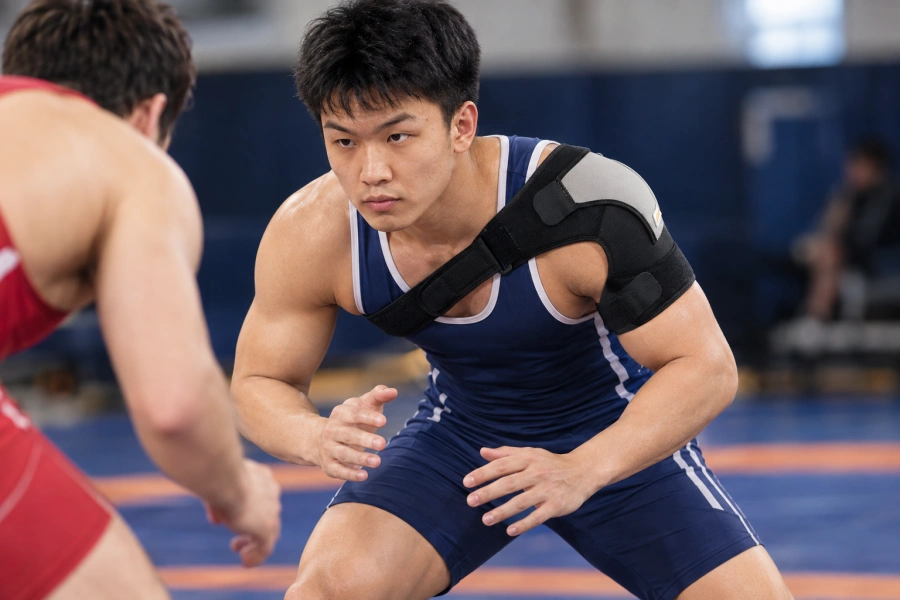
One awkward collision on the mat is all it takes. Your shoulder pops out, and suddenly every takedown feels like a gamble. Whether you’re strapping up preventatively before a tough season or working your way back from a subluxation, the right wrestling shoulder brace can keep you competing with confidence. But not every shoulder stability brace is built for the chaos of live wrestling. Some restrict your range too much. Others slip mid-match. A few aren’t rated for the demands of the sport at all.
I’m breaking down six of the top-performing shoulder braces for wrestling on the market, testing them for comfort, support, durability, and price. Plus, exactly how to pick the right shoulder brace for wrestling for your body, your injury history, and your level of competition.
DonJoy Sully Shoulder Stabilizer Brace

The DonJoy Sully is built around an adjustable strap system. The straps wrap around your shoulder and rib cage, physically limiting excessive abduction, external rotation, and forward/backward slippage. DonJoy markets it for joint awareness during high-risk movements, a different approach than most sports shoulder braces on this list.
What It’s Designed to Handle
DonJoy’s product page lists this brace for a wide range of instabilities:
Posterior, anterior, and inferior instabilities
Multi-directional instabilities
Muscle strains
Rotator cuff deceleration issues
It’s also positioned as a shoulder dislocation brace and shoulder subluxation support, with several buyers specifically mentioning labrum tear support in their reviews.
Real Wrestling Feedback
Actual wrestlers report the Sully “holds up really well” during live training and “fits snug and holds shoulder in place” through scrambles and takedowns. One BJJ user noted it balances mobility with security better than expected, letting them keep training without constant fear of re-dislocation.
The Catch: Durability
Not everyone loves it long-term. Some reviewers reported the material tearing “after only a month” or ripping “inside after first use.” The latex-free polyester Lycra fabric feels comfortable, but stitching and material strength seem to be where corners got cut.
Sizing (measure bicep unflexed)
|
Size |
Chest (in) |
Bicep (in) |
|---|---|---|
|
XS |
34–40 |
9–10.5 |
|
S |
34–40 |
11–13 |
|
M |
38–42 |
13–15 |
|
L |
42–46 |
14–17 |
|
XL |
45–51 |
15–17 |
Price: $139.95–$163.99 direct from DonJoy, though third-party sellers list it as high as $344.98; shop carefully.
Breg Shoulder Stabilizer

Think of this one as the “hard stop” option. Where the DonJoy Sully leans into flexibility, the Breg Shoulder Stabilizer takes the opposite approach: maximum mechanical restriction. Its design pairs a lightweight, breathable neoprene chest harness with an upper-arm cuff that physically blocks excessive abduction and external rotation. The goal isn’t to remind your shoulder where it shouldn’t go — it’s to stop it from getting there.
Built for Contact Sports and Heavy Loads
Breg positions this shoulder immobilizer for sports like football, hockey, and lacrosse, specifically for athletes with a history of dislocations, subluxations, or glenohumeral instability. Third-party reviewers call it one of the top wrestling shoulder braces, citing its mechanical rigidity over comfort-first designs.
Fit and Adjustability
Breg offers seven sizes — XS through XXL, including a M+ option — and the brace works on either shoulder. The strap and cuff system lets you dial in tension based on your injury history and activity demands.
Price and Trade-Offs
Retail pricing runs $214.95–$214.99, with an original list price of $280.99 — noticeably higher than the Sully’s $113.99–$163.99 range. Breg markets it as low-profile and ventilated, but that rigid abduction/rotation lockout means reduced mobility for wrestlers who need to scramble freely. No published durability testing exists either, so long-term wear data is limited. It’s a strong AC joint brace and rotator cuff support brace for high-contact, high-load situations — just don’t expect all-day comfort.
EVS Sports Shoulder Brace for Wrestling
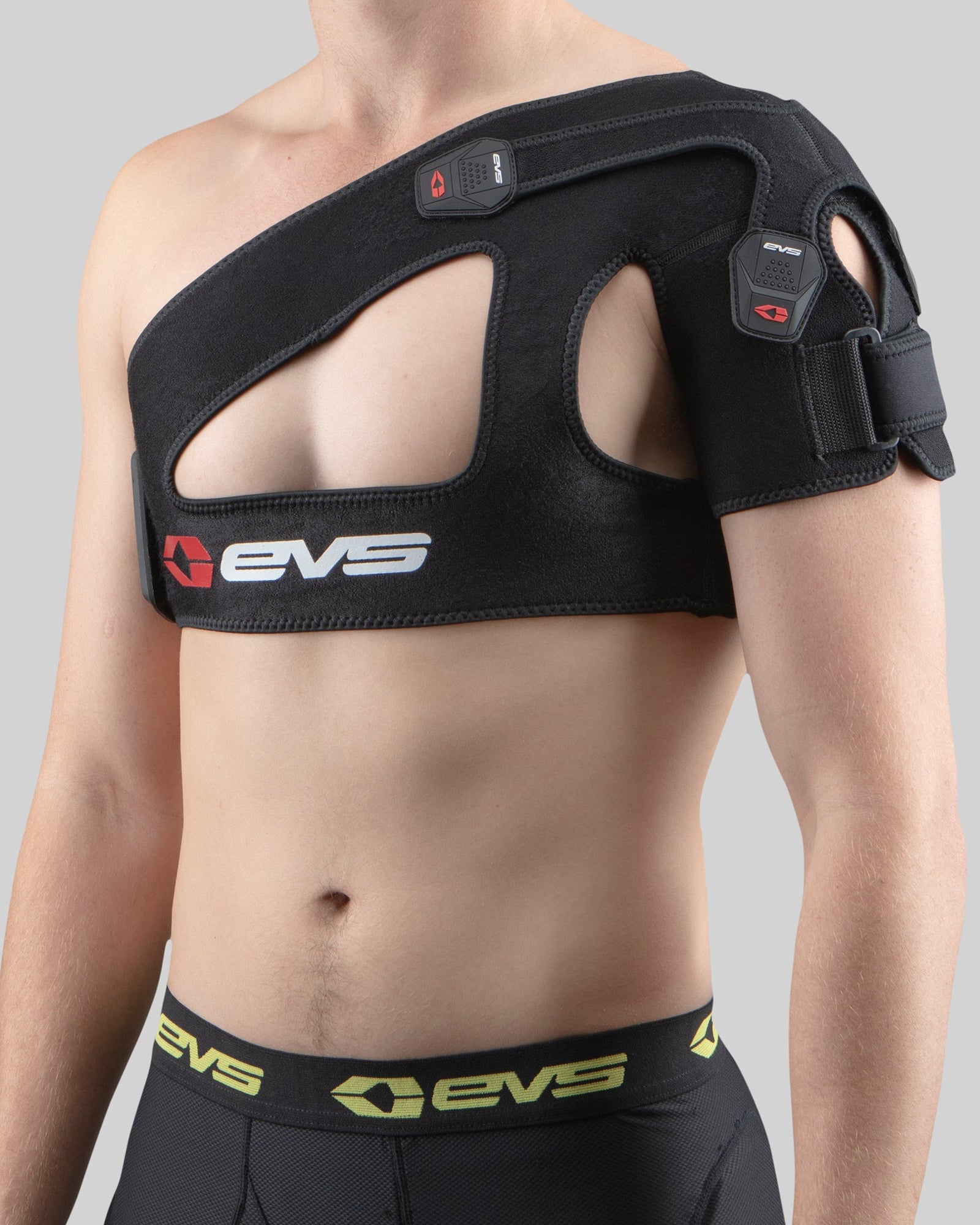
Multiple independent reviewers rate the EVS Sports SB03 Shoulder Support “Level 3,” which puts it in a different category from a basic compression shoulder sleeve. That rating isn’t a medical classification; it’s shorthand for high-strength support, impact resistance, and tight control over abnormal shoulder movement. This is a brace for athletes who need to keep training.
Fit and Construction
The SB03 works on either arm. Sizing runs by chest measurement:
|
Size |
Chest (in) |
|---|---|
|
S |
28–34 |
|
M |
34–38 |
|
L |
38–42 |
|
XL |
42–46 |
|
XXL |
46+ |
You get 1680D ballistic nylon, a molded EVA shoulder cap, neoprene support panels, an X-Strap impact stabilizer, and mesh paneling for airflow. Reviewers consistently call the mesh “comfortable and breathable,” a rare compliment for something this structurally rigid.
Support Without Total Lockdown
Users report the brace “sucks in” a loose shoulder and eliminates that dangling sensation, making it a solid option for shoulder subluxation and AC joint support in cases of recurring instability. It’s not a featherweight that fully restores activity, though. Some wrestlers note lingering tightness, and the rear X-strap sometimes needs a second person to cinch properly.
Best Fit: Drilling, Not Fighting
BJJ and MMA reviewers say it offers “high levels of support while also allowing you to train,” which makes it ideal for drilling, moderate sparring, and recovery-phase reps. For full-intensity competition where you need maximum upper-body freedom, it leans protection-first rather than flexibility-first.
Durability Caveat
Most feedback praises long-term durability, but there’s one recurring flaw: the loop fastener is heat-bonded to neoprene, and frequent daily wear can wear it smooth. Once that hook-and-loop connection degrades, holding power drops fast. This brace performs best with intermittent use, not as an everyday, all-day wrestling injury prevention option.
Price and Value
At roughly $50, it sits mid-pack. Reviewers call it “slightly higher price than others but worth it” and “a great performer for the price.” That’s solid value for a rotator cuff support brace with this level of build quality.
Shock Doctor Shoulder Support Brace
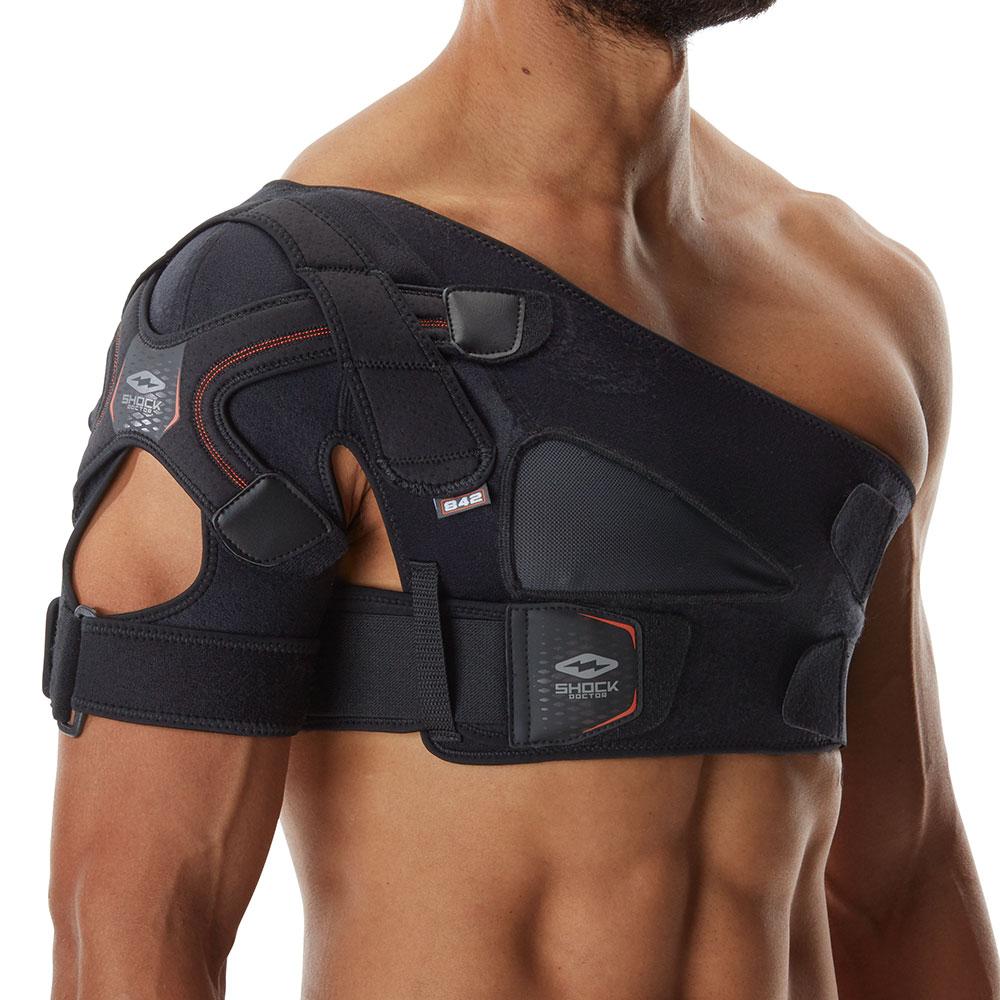
With 1,631 Amazon ratings and a 4.0-star average, the Ultra Shoulder Support with Stability Control has staying power in the market. Shock Doctor classifies it as a Level 3 maximum-protection shoulder brace, meaning it uses hinges, splints, and stays for serious stabilization, not just compression.
What It Targets
This brace is built for shoulder dislocations, AC sprains, rotator cuff injuries, and moderate separations. It fits daily training, return-to-sport rehab, and light recovery.
Support vs. Bulk
Reviewers praise the support but point out the trade-off. One buyer called it “a bit thicker than I thought,” and another said it was “complicated to figure out with all the straps and adjustments.” The stability-control strap system uses an X-Fit-style design to lock the shoulder into alignment. With five available sizes on Amazon, finding a good fit is realistic.
Real Results
One DICK’S reviewer completed a 2+ hour race without fatigue. Another said it cut pain enough to drop pain medication entirely, a meaningful signal for a shoulder subluxation support.
Price and Popularity
Pricing ranges from $48.33 to $66.99 depending on retailer. Amazon reports “200+ bought in past month,” and DICK’S carries 172 reviews.
Vs. EVS Sports
EVS leans rugged and impact-first. Shock Doctor prioritizes alignment, healing, and adjustability. It’s better suited for everyday athletic wear than heavy-contact armor.
Babo Care Shoulder Stability Brace
At under $20, this brace stands out. Other braces on this list cost over $150, but the Babo Care Shoulder Stability Brace is $19.98–$19.99, with 10,400+ reviews and a 3.9-star average on Amazon. It’s an entry-level compression shoulder sleeve for budget-conscious buyers who need good-enough support without the premium price tag.
For roughly $20, it’s a fraction of the cost of most rotator cuff brace competitors. It uses light and breathable neoprene that’s comfortable for daily wear. It fits either shoulder, so one design works for left or right. There’s a pocket for hot or cold packs, and it weighs about 160g without the pack—you barely notice it. Reviewers say “works well,” “worth every penny,” and “decent price.”
This works more like a compression sleeve than a rigid immobilizer. You get better range of motion for daily tasks, but it isn’t built for heavy contact. Users say the Velcro straps loosen during activity, and one review states: “The support is not strong enough for sports or sleeping.”
This is for mild strain recovery or everyday posture support, not for recurrent dislocations or live wrestling. There’s a 12-month satisfaction money-back guarantee.
AOFIT Shoulder Brace for Wrestling
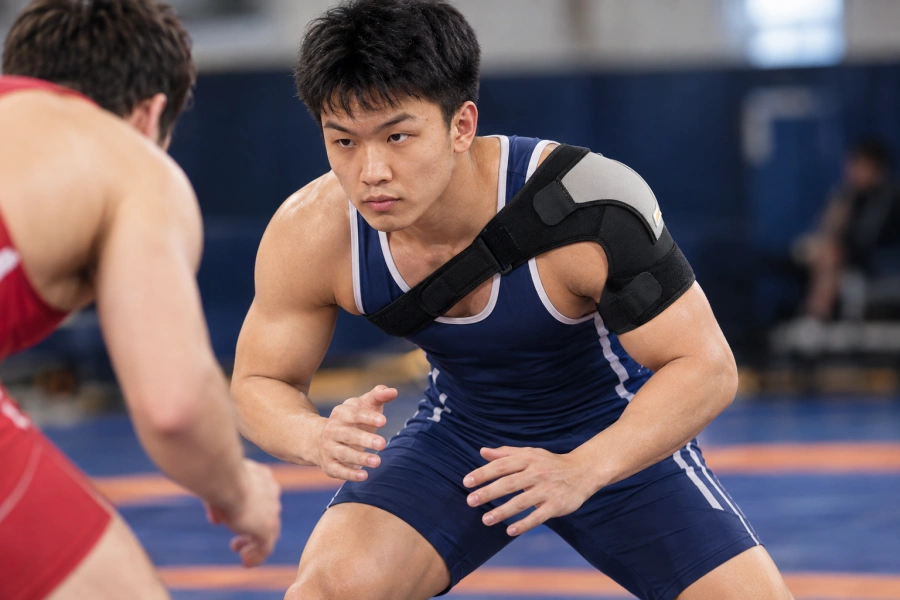
Budget matters, and AOFIT knows it. This brace (model HJ006) skips rigid straps and hard stops, using a simple “Breathable, Compression Shoulder Support Brace” approach. Built from neoprene, unisex, one-size-fits-all, it’s designed for accessibility.
Who This Brace Actually Works For?
AOFIT’s own product listings target sprains, post-dislocation recovery, and post-surgery rehabilitation. The compression fabric reduces pain and swelling without mechanically blocking movement. If you’re dealing with mild strain or basic joint awareness during light training, this compression shoulder sleeve delivers what you need. If you’ve got a history of recurring dislocations or severe instability, look elsewhere. AOFIT even sells separate immobilization systems for those heavier cases, which tells you where this particular brace sits in their lineup. For brands and distributors looking for customized shoulder support solutions, AOFIT also provides custom shoulder brace services for different product requirements.
Comfort Over Rigidity
The neoprene construction is breathable, elastic, and snug against the skin. Expect a warm, compression-first feel. It’s built for all-day wearability without blocking abduction.
Price and Fit for Beginners
The AOFIT HJ006 shoulder brace is priced from $19.99 to $35.99, depending on the configuration and product version. This entry-level price range makes it a practical option for young wrestlers or beginners who need light AC joint brace support during drills. This is not for full competition-level protection. Founded in 2007, AOFIT has built a reputation in the health/sports equipment space.
6 Shoulder Braces for Wrestling: Core Specs Comparison Table
|
Brace |
Support Level |
Mobility |
Material |
Price |
Best For |
|---|---|---|---|---|---|
|
DonJoy Sully |
High |
Full ROM with movement limits |
Polyester Lycra + hook material |
$139.95–$163.99 |
Recurrent dislocation, AC injury |
|
Breg Stabilizer |
Maximum (hard stop) |
Restricted abduction/rotation |
Neoprene harness + arm cuff |
$214.95–$280.99 |
High-contact, heavy-load athletes |
|
EVS Sports SB03 |
High |
Moderate (drilling-friendly) |
1680D nylon, EVA cap, mesh |
~$50 |
Sparring, subluxation, AC support |
|
Shock Doctor |
High (Level 3) |
Moderate |
Hinges, splints, stays |
$48.33–$66.99 |
Return-to-sport rehab |
|
Babo Care |
Basic compression |
High |
Breathable neoprene |
$19.98–$24.99 |
Mild strain, budget priority |
|
AOFIT HJ006 |
Basic compression |
High |
Neoprene, one-size |
$29.99–$35.99 |
Post-dislocation recovery, beginners |
How to Choose the Best Shoulder Brace for Wrestling?
1. High-Contact / Injury Prevention
You haven’t been hurt yet, but wrestling puts your shoulder at risk every match. Go with rigid or semi-rigid structures plus adjustable straps. Lock the joint down before contact happens. Look for multi-position cross straps, hook-and-loop adjustability, and a low-profile fit that slides under a singlet without bunching.
2. Rehab / Return-to-Sport
If you’ve had a dislocation, subluxation, or surgery, you need range-of-motion control. Compression alone isn’t enough. Most rehab protocols limit shoulder flexion to somewhere between 0–60° and 0–90° during early return phases, gradually opening up as you progress. A shoulder dislocation brace or shoulder subluxation support that restricts external rotation and abduction matches this stage better than a basic sleeve.
3. Daily Training Comfort
No acute injury? You just want to avoid overheating during long practices. Elastic fabric with mesh paneling wins here. You sacrifice some rigidity, but you gain breathability and freedom of movement for hours of drilling.
Material Matters More Than People Think
Neoprene: Strong compression, excellent joint containment, common in high-contact wrestling braces. Trade-off: heat builds up fast during extended wear.
Elastic fabric: More comfortable, more range of motion, weaker rigid support. Better for light-to-moderate stabilization.
Perforated/mesh construction: Cuts down on trapped heat significantly. Often paired with neoprene panels to balance stability and airflow.
Key Buying Criteria for Wrestling Shoulder Braces
Get the sizing wrong, and even the best wrestling shoulder brace on this list turns into dead weight. Most buyers fixate on brand reputation and skip the measurements entirely. That’s a mistake.
Measure Twice, Buy Once
Chest measurement comes first. Wrap a soft tape under your armpits, across the widest part of your chest, keeping it snug but not compressed. Some brands, like EVS Sports, use centimeters instead of inches, so double-check before you order.
Bicep measurement matters just as much, especially for adjustable systems like the DonJoy Sully. Measure the thickest part of your upper arm, either flexed or relaxed depending on brand instructions. Skip this step, and your shoulder stability brace will either restrict circulation or slide loose mid-scramble. Both numbers have to hit the brand’s chart. One out of two doesn’t cut it.
Strap Systems: Adjustable vs. Slip-On
Adjustable, multi-strap designs—chest compression, upper-arm lock, cross-body straps—give you real control. That’s what rehab cases and in-season competitors need. Slip-on sleeves work faster and feel less intrusive, but they’re built for light compression, not for stopping a shoulder from popping out during a takedown attempt.
Tournament Legality Isn’t Optional
NCAA and NFHS rules classify shoulder braces as special equipment, permitted only if they don’t restrict normal joint motion or interfere with legal holds. Hard plastic, metal, or exposed edges must be padded and fully covered.
OHSAA specifically requires a snug undershirt over any brace with rough material or exposed strapping to prevent skin abrasions or finger entanglement.
Look for “Tournament Legal” labeling referencing NFHS or NCAA compliance. Then confirm with your state association or tournament director before match day. Rules shift by region.
Wrestling Shoulder Brace FAQ
How tight should a wrestling shoulder brace fit?
A snug fit. You want zero sliding, zero shifting mid-scramble, and no pinching. If you feel numbness, tingling, sharp pain, deep skin indentations, or increasing tightness the longer you wear it, readjust or size up. A properly fitted shoulder stability brace should disappear once you start moving.
Can one wrestling shoulder brace work for either shoulder?
Yes, some can. The EVS Sports SB03 uses a universal no-snag design built for either shoulder, relying on adjustable arm closures and cross-body strap routing instead of a left/right-specific cut. That’s convenient if you’re outfitting a whole team roster.
Who actually needs a rigid brace versus a compression sleeve?
Anyone with a history of instability, prior dislocation, AC joint irritation, or a return-to-training timeline. Clinical protocols for AC separation often call for 3–6 weeks of protective bracing, sometimes extending to 6–8 weeks post-surgery. A compression sleeve alone can’t block the abduction and external rotation that trigger re-injury — you need a shoulder dislocation brace or AC joint brace with real strap structure for that.
Conclusion
Your shoulder is only as strong as the gear protecting it, and on the mat that’s non-negotiable. Whether you’re strapping in a wrestling shoulder brace for game-day prevention or working back from an AC joint injury, the right pick comes down to a fit that locks in without restricting your takedowns, materials that survive sweat-soaked five-minute rounds, and a support level that matches your injury stage rather than what looks good in an ad.
If you need serious post-dislocation stability, DonJoy or Breg are your safest bets. For everyday shoulder stability brace support during practice, EVS or AOFIT deliver solid value without breaking the bank.
Grab your top pick, size it correctly using our guide, and get back to training.