
That sudden, sharp pain in your elbow every time you grip, lift, or even type? It’s not just annoying — it’s stopping you from doing what you love. Tennis elbow, golfer’s elbow, tendonitis, arthritis — they all need a different solution, but most elbow brace for pain out there are one-size-fits-nobody. After testing and researching dozens of options, we cut through the noise to bring you the only 8 elbow braces worth your money. Each one is matched to a specific condition, so you can stop trying random supports and start actually healing.
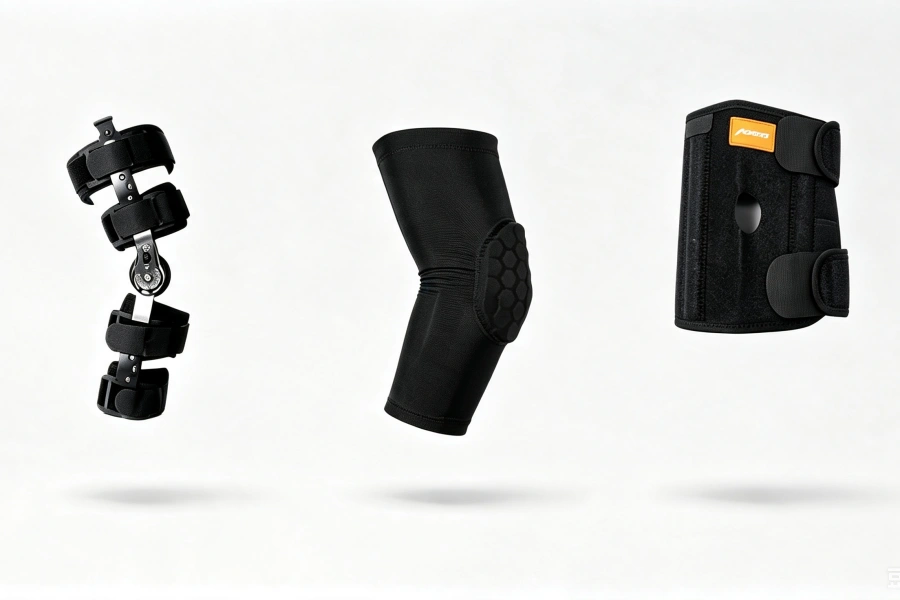
Why Elbow Pain Happens — And How an Elbow Brace Helps
- Tennis elbow (lateral epicondylitis) makes up 40–50% of elbow pain cases in clinics. Repetitive wrist extension and forearm rotation create micro-tears where the extensor tendon meets the lateral epicondyle. The result: sharp pain every time you grip, lift, or twist.
- Golfer’s elbow (medial epicondylitis) hits the inside of the elbow instead. Repeated wrist flexion and forceful gripping put steady strain on the flexor tendon. This is common in electricians, construction workers, and programmers. Over time, the tendon begins to break down.
- Tendinopathy follows a similar path — chronic overuse outpaces your body’s repair rate. Without proper support, recovery can drag on 6–12 months.
- Then there’s cubital tunnel syndrome — ulnar nerve compression at the elbow. It accounts for 20% of peripheral nerve entrapment cases. Spend long hours bent over a keyboard or phone? That’s how it starts.
How Does an Elbow Brace Step In?
A quality elbow brace for pain works through three distinct mechanisms:
- Offloading tendon stress — A forearm strap placed below the pain point shifts force away from the tendon attachment, significantly reducing peak stress.
- Joint stabilization — Semi-rigid supports limit harmful end-range motion and sharpen the body’s sense of joint position.
- Thermal effect — Neoprene raises local tissue temperature, improving blood flow and supporting faster tissue repair.
How to Choose the Right Elbow Brace for Pain?
Match the Brace to Your Condition First
- Tennis elbow (lateral epicondylitis) → Counterforce strap with a pressure pad.
- Golfer’s elbow (medial epicondylitis) → Medial pad strap.
- General tendonitis / diffuse aching → Compression sleeve (15–25 mmHg).
- Arthritis or chronic stiffness → Soft neoprene sleeve.
- Ligament instability, sprains, or post-surgery → Hinged rigid elbow brace.
- Cubital tunnel syndrome (ulnar nerve compression) → Cubital tunnel brace.
Understand Support Levels Before You Buy
| Support Level | Best For | Activity Restriction |
|---|---|---|
| Level 1 – Sleeve / soft strap | Mild pain, office work, light exercise | ~5–10% |
| Level 2 – Counterforce strap + reinforced sleeve | Moderate pain, gripping, and lifting tasks | ~15–30% |
| Level 3 – Hinged/rigid brace | Post-surgery, fractures, severe instability | 50–90% |
Get Your Sizing Right
- Let your arm hang loose, elbow bent about 30°.
- Measure your forearm circumference 3–5 cm below the elbow tip.
- Match that number to the manufacturer’s size chart — typical ranges: S, M, L.
The one-finger rule: After fitting, you should slide one finger under the brace. Too loose and it shifts during activity. Too tight and you’ll cut off circulation.
Warning signs to watch for: Numbness or tingling in your ring or pinky finger, skin going pale or purple, or swelling that extends beyond the brace edge. Any of these? Take the brace off right away and reassess the fit.
Choose the Right Material for Your Lifestyle
- Perforated neoprene — Strong support with solid warmth retention. Great for cold-weather sports or arthritis. One downside: it traps heat and sweat in summer.
- Knit compression fabric — Light and breathable. A better pick for all-day office wear or mild tendonitis management.
1. Mueller Tennis Elbow Support — Best Budget Counterforce Strap
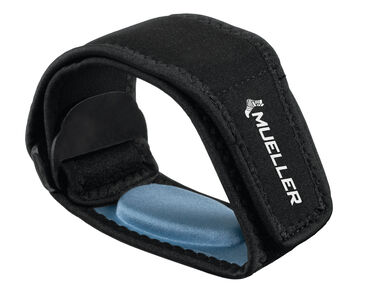
Mueller tennis elbow support is a single narrow band that wraps around your forearm, about 2–4 cm below the lateral epicondyle. The built-in pressure pad (or gel pad) pushes into the extensor muscle group. This shifts force away from the damaged tendon attachment point. The result? Less stress at the injury site. Less pain when you grip.
Who it’s built for: mild-to-moderate lateral elbow pain triggered by gripping, typing, or racket sports. Your pain sits on the outside of the elbow and flares during activity? This strap targets that spot.
What it won’t do: Golfer’s elbow (medial pain), severe ligament tears, or post-surgical instability all need something stronger.
Pros:
– Costs far less than Bauerfeind or mid-range competitors ($30–$100+)
– Low-profile design stays hidden under clothing
– Minimal restriction to elbow flexion or forearm rotation
– One-size, ambidextrous, easy on/off
Cons:
– Placement matters
– Neoprene and Velcro wear down with heavy use within 3–12 months
– No meaningful support for complex instability
Rating: Best entry-level counterforce strap for budget-conscious buyers trying elbow brace therapy for the first time.
2. Bauerfeind EpiTrain Elbow Support — Best Premium Compression Sleeve
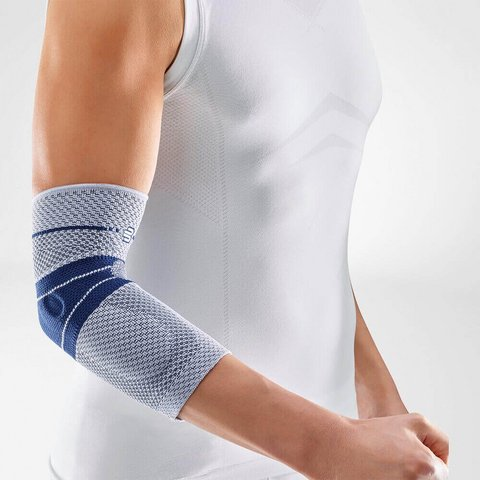
Bauerfeind EpiTrain elbow support is the top pick for people with diagnosed lateral or medial epicondylitis, chronic arthritis, or post-surgical swelling. What sets it apart from every generic compression sleeve out there: two shaped silicone pads placed over the radial and ulnar sides of the elbow. These pads create intermittent compression as you move. That builds a targeted massage effect, one that boosts circulation and eases tendon attachment stress.
Pros:
– Dual silicone pads target both tennis and golfer’s elbow at the same time
– Medical-grade knit breathes better than neoprene equivalents
– Works post-surgery and for chronic swelling management
Cons:
– AU$184.95 is a real investment — be sure it fits your needs
– Sizing runs precisely — measure your forearm before ordering, or the fit won’t hold up
Rating: The orthopedic elbow brace benchmark for serious recovery.
3. Bauerfeind EpiPoint Elbow Strap — Best Adjustable Targeted Strap
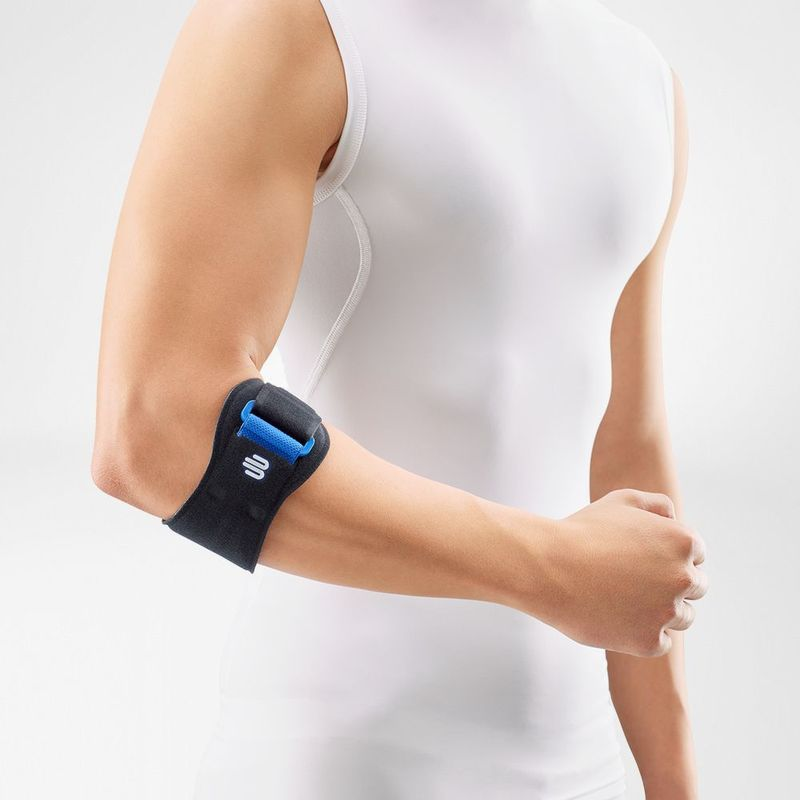
The EpiPoint elbow strap is a precision tool built around a five‑point viscoelastic pad that drives peak compression straight onto the tendon attachment point. The pad rotates and repositions for left or right arm, and for inner or outer epicondyle. An integrated red warning section on the elastic band shows you when the strap is too tight, acting as a built‑in guard against nerve compression.
Who should pick EpiPoint? You have one sharp, pinpoint pressure zone that flares up during activity.
Pros:
– Five-point pad delivers focused, high-peak compression at the tendon attachment
– Repositionable for tennis elbow and golfer’s elbow
– Red tension indicator stops you from over-tightening
– Universal size
Cons:
– No sleeve component — doesn’t address joint-wide swelling or warmth
– Premium pricing (~US$80+) for a single-purpose strap
Rating: The targeted elbow strap for pain that standard braces couldn’t fix.
4. Sleeve Stars Elbow Compression Sleeve — Best Everyday Lightweight Support
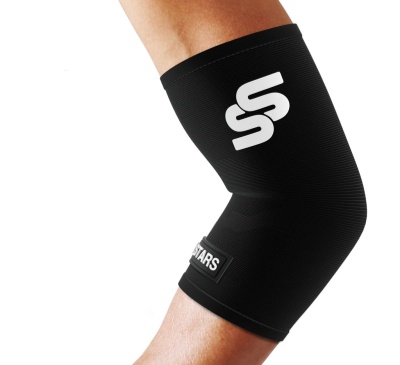
You reach for the Sleeve Stars compression sleeve when pain is real but not severe. It’s the kind of ache that makes a full workday uncomfortable, not impossible. Just a thin, knit compression sleeve delivering graduated compression around your elbow, all day long.
That steady pressure does two things well. First, it boosts circulation. That cuts down on chronic swelling and soreness after activity. Second, it raises the local tissue temperature. That small shift eases morning stiffness and keeps soft tissue loose during repetitive tasks.
Who it’s for: Mild tendonitis, arthritis in its beginning stages, and chronic overuse. This is for people who sit at keyboards for 8 hours and feel that dull, nagging ache creeping in by noon.
Who should skip it: Pain above 6/10, visible swelling, or any ligament instability.
Pros:
– Ultra-low profile — sits invisible under a dress shirt or gym sleeve
– Breathable knit fabric holds up through 4–10 hours of wear without trapping too much heat
– One-size ambidextrous fit
Cons:
– No structural support for instability or moderate-to-severe pain
– Sizing can run snug
Rating: The easiest daily-wear elbow wrap for pain.
5. Simien Tennis Elbow Brace — Best Dual-Strap for Stubborn Pain

The Simien tennis elbow brace is a dual‑strap counterforce brace – two independent hook‑and‑loop straps that wrap around your proximal forearm. It comes as a 2‑pack, making it one of the most budget‑friendly solutions for people who need a brace for both arms or want a spare. The included pressure pad can be shifted laterally (for tennis elbow) or medially (for golfer’s elbow), so you can fine‑tune exactly where the compressive force lands.
Who should use it?
-
People with chronic, localized tennis or golfer’s elbow
-
Manual workers lifting >5–10 kg repeatedly
-
Racquet sport athletes and gym goers doing heavy pulls
-
Patients under 45 who need to preserve grip strength
Single‑strap vs. Simien dual‑strap
-
Single strap (e.g., Mueller): great for mild/moderate, first‑time users.
-
Simien dual‑strap: better for high‑load activities, slippery forearms, and those who didn’t get enough relief from a single strap.
6. BraceAbility Wrist Extension Control Splint — Best for Wrist‑Aggravated Tennis Elbow
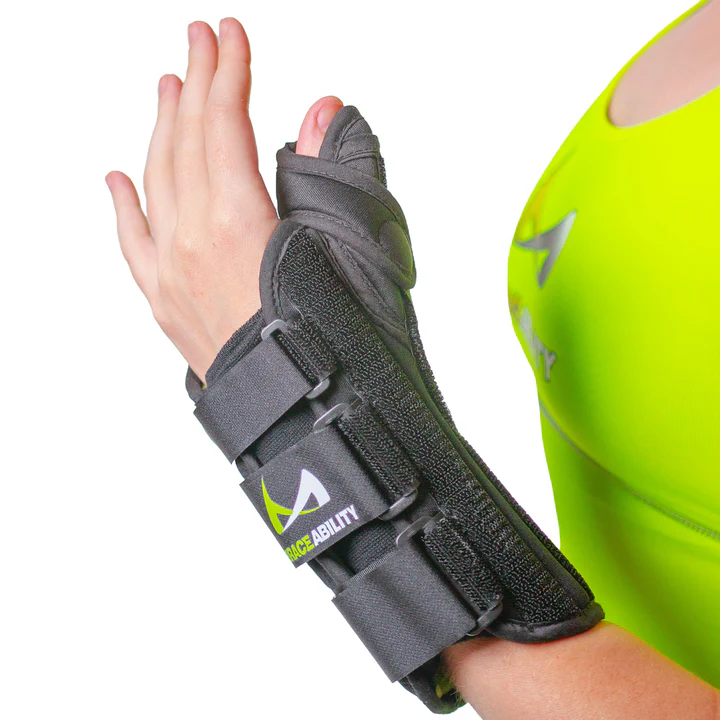
The BraceAbility Wrist Extension Control Splint is a static wrist splint that holds your wrist in a neutral to mildly extended position (0–30°), blocking painful wrist flexion. By limiting wrist motion, it unloads the common extensor tendon at its source – the lateral epicondyle. The splint is lightweight and adjustable, covering from your distal palm to mid‑forearm (15–20 cm) with a breathable padded liner and a bendable aluminium stay that lets you set the exact angle. This “wrist‑first” mechanism works because when your wrist flexes, your extensor muscles pull harder on an already inflamed tendon. Keep the wrist neutral, and the elbow gets the relief it needs.
Who should use it?
-
Your elbow pain flares up with wrist‑intensive activities
-
When you keep your elbow still (bent 90°) but actively flex or extend your wrist, you can reproduce the elbow pain.
-
A regular counterforce strap (like Mueller) helps with resting pain but doesn’t stop the pain when you move your wrist during work or sport.
7. DonJoy Performance Bionic Elbow Brace — Best Hinged Brace for Ligament Injury

The DonJoy Bionic Elbow Brace is designed for serious structural injuries such as UCL sprains, post-dislocation instability, and ligament reconstruction recovery — not for mild overuse or tendonitis. This Level 3–4 hinged ROM brace features rigid polycentric hinges, sturdy side uprights, and an adjustable range-of-motion dial. The dial allows precise control of flexion and extension limits, ensuring safe movement and preventing accidental overextension during critical recovery. Additionally, the brace protects against valgus and varus stress, stabilizing the elbow and supporting proper ligament healing.
Pros:
– Controlled ROM keeps healing ligaments safe without full immobilization
– Adjustable angle limits support a step-by-step recovery plan
– Blocks harmful lateral joint stress
Cons:
– Bulky — basic daily tasks get harder to manage
– The hinge axis must line up with your joint center, or the fit falls apart
– Too much brace for tendonitis or chronic soft-tissue pain
Rating: The right orthopedic elbow brace once a doctor has confirmed ligament damage or joint instability.
8. BraceAbility Cubital Tunnel Brace — Best for Nerve-Related Elbow Pain
That pins-and-needles sensation in your ring and pinky finger at 2 AM isn’t tendonitis. It’s your ulnar nerve — compressed, irritated, and demanding a different kind of fix.
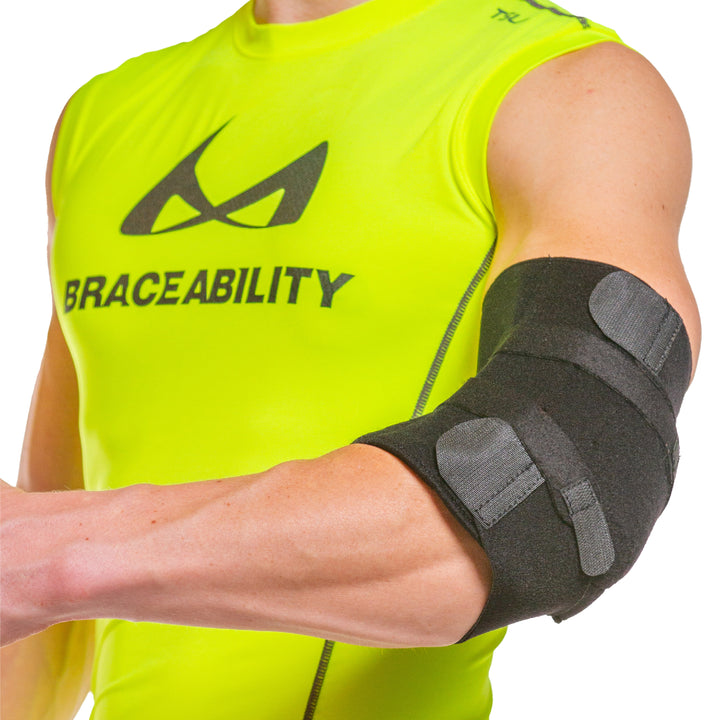
The BraceAbility Cubital Tunnel Brace targets that problem head-on. A moldable aluminum stay holds your elbow at a safe 30–60° angle overnight. This blocks the deep bend that crushes the ulnar nerve against the cubital tunnel. Thick medial padding shields the nerve pathway from bed-surface pressure. You get angle control and decompression at the same time.
Who needs this: Look for two or more of these symptoms — nighttime finger numbness, worsening pain after prolonged elbow bending, or a positive Tinel’s sign (tapping the inner elbow triggers a shooting sensation).
Pros:
– Aluminum stay adjusts to your specific angle limit
– Machine washable, soft lining holds up through regular use
– $20–40 USD — the most affordable nerve-specific solution on this list
Cons:
– Takes 5–7 nights to adapt to the restricted position
– No benefit for tendonitis or grip-related pain
Rating: The right call when numbness, not pain, is keeping you up at night.
Comparison Table: 8 Elbow Braces at a Glance
| Product | Type | Best For | Support Level | Price (USD) | During Activity | Key Fit Note | |
|---|---|---|---|---|---|---|---|
| 1 | Mueller Tennis Elbow Support | Counterforce strap | Lateral epicondylitis | 2 | $15–20 | ✅ Yes | Place it 2–3 cm below the elbow. One-finger rule applies. |
| 2 | Bauerfeind EpiTrain | Medical compression sleeve | Tennis/golfer’s elbow, arthritis, post-surgery | 2–3 | $80–120 | ✅ Yes | Comes in 7 sizes (0–6). Measure 12 cm below the elbow to find your size. |
| 3 | Bauerfeind EpiPoint | Adjustable targeted strap | Tough tennis/golfer’s elbow that won’t clear up | 2 | $80–90 | ✅ Yes | Rotate the pad for inner or outer epicondyle. Check the red tension indicator as you tighten. |
| 4 | Sleeve Stars Compression Sleeve | Lightweight sleeve | Mild tendonitis, repeated overuse | 1–2 | $15–25 (pair) | ✅ Low–moderate | Size S–XL by forearm circumference. Take it off mid-day to air out. |
| 5 | Simien Tennis Elbow Brace | Dual-strap counterforce | Ongoing tennis/golfer’s elbow | 2–3 | $18–22 (2-pack) | ✅ Yes | Fasten the upper strap first. Place the pad 2 cm past the pain point. |
| 6 | BraceAbility Wrist Splint | Static wrist extension splint | Wrist-aggravated tennis elbow | 2–3 | $20–40 | ⚠️ Partial | Locks the wrist at 0–30°. Expect a 10–30% drop in typing speed. |
| 7 | DonJoy Bionic Elbow Brace | Hinged ROM brace | UCL tears, post-surgical instability | 3–4 | $60–90 | ✅ Yes | Line up the hinge with the joint center. Set the ROM dial to your range. |
| 8 | BraceAbility Cubital Tunnel | Ulnar nerve night brace | Cubital tunnel syndrome | 2 | $20–40 | ❌ Night use | Holds the elbow at 30–60°. Medial padding sits over the ulnar groove. |
Elbow Brace for Pain — Common Questions Answered
How tight should my elbow brace be?
Snug — not strangling. After fastening, slide one to two fingers under the strap. Fingers tingling, going pale, or feeling cold within minutes? Loosen the strap. You want firm compression for elbow pain relief, not a tourniquet.
Where does the strap go?
Not on the joint. Place it 2–5 cm below the painful bump on your forearm. Tennis elbow (lateral epicondylitis)? Below the outer bump. Golfer’s elbow (medial epicondylitis)? Below the inner bump. Rotate the pad until it sits over the most tender spot.
How many hours a day — and for how many weeks?
Wear it during activities that trigger pain: typing, lifting, racket sports. Most orthopedic guidelines suggest a 3–6 week trial, combined with rest and ice, before reassessing. Skip the 24/7 routine long-term.
Sleeve or strap — what’s the actual difference?
A compression sleeve delivers even, all-around pressure. It works well for mild tendonitis, arthritis, and reducing post-activity swelling. A counterforce strap targets one focused point at the tendon attachment. This makes it better for active tennis elbow and golfer’s elbow during work or sport. Many clinicians pair both — strap during activity, sleeve at rest.
Conclusion
Elbow pain doesn’t have to slow you down. The right brace depends on your specific condition, activity level, and recovery goals.
If you need a personalized fit or specialized support, consider consulting a custom elbow brace supplier to ensure your brace meets your exact needs.
Your recovery starts with a single decision — make it today.