

You bought a double shoulder brace to fix that rounded, slouched posture, so you’re wearing it every waking hour, convinced that more time strapped in means faster results. But could all that dedication be working against you?
A double shoulder brace can do a lot to correct posture and provide shoulder support. But how you wear it matters just as much as whether you wear it. Strap in for too long without breaks, and you risk muscle dependency, restricted circulation, or skin irritation, the very opposite of what you’re aiming for.
So how long is too long? And when might all-day wear make sense? Let’s break down what your shoulders need, based on why you’re wearing the brace in the first place.
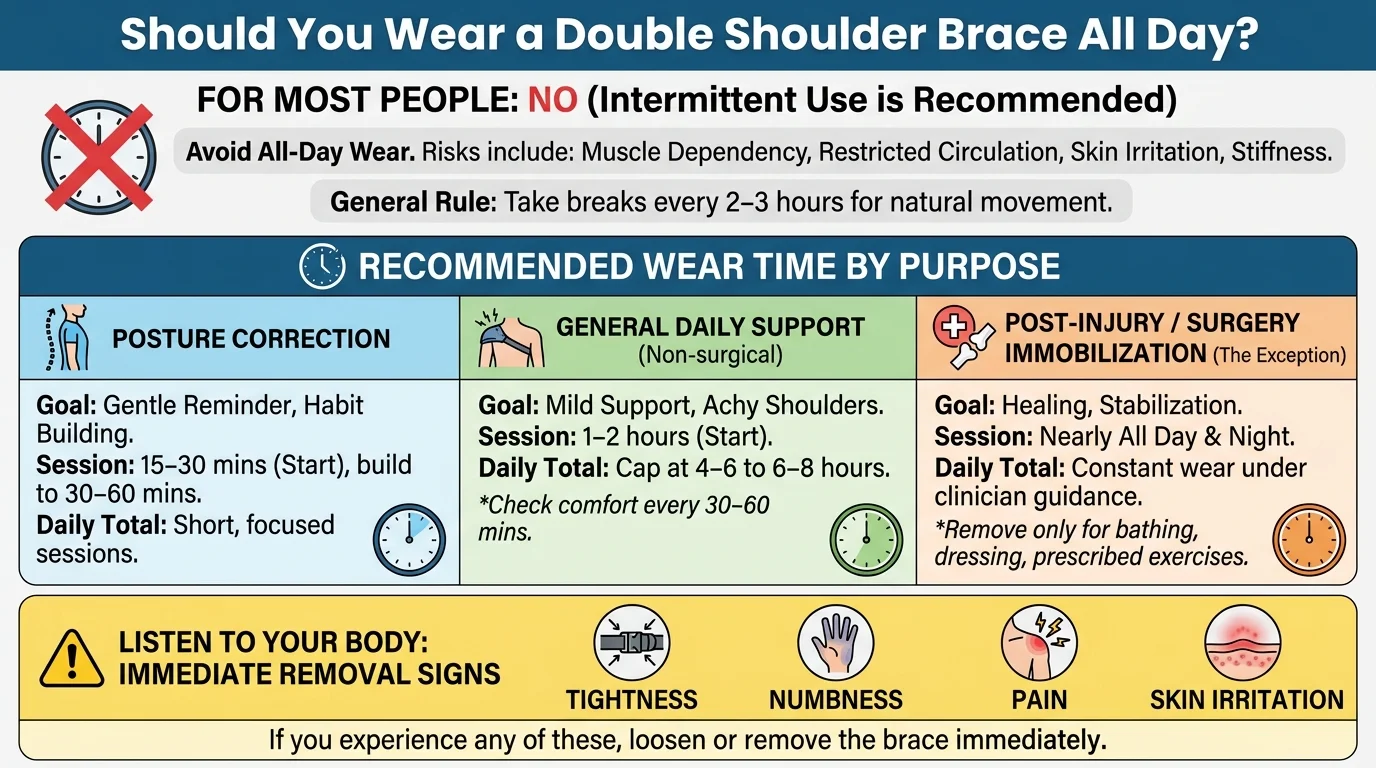
Should You Wear a Double Shoulder Brace All Day?
For most people, the answer is no. Wear your double shoulder brace intermittently, taking it off every 2–3 hours so your shoulders can breathe and move naturally. All-day wear is reserved for specific medical recovery situations like post-dislocation, post-fracture, or post-surgery immobilization, and only under a clinician’s guidance.
Here is how wear time typically breaks down:
-
Non-surgical support: Start with 30–60 minutes, or 1–2 hours at a stretch. Most guides cap routine daily use at 4–6 to 6–8 hours total.
-
Post-injury immobilizers: These are worn nearly all day and night, removed only for bathing, dressing, or prescribed exercises.
-
Posture correctors: Keep sessions short, 15–30 minutes daily, then build to 30–60 minutes per session.
If you feel tightness, numbness, pain, or skin irritation, loosen or remove the brace immediately. Prolonged, uninterrupted wear can lead to stiffness and muscle dependence, the opposite of what a good brace should do for you.
Recommended Wear Time by Purpose
Not every shoulder brace journey looks the same, and that’s the whole point. A gentle posture reminder and a post-dislocation recovery brace ask different things of your body, so here’s what makes sense for each.
General Daily Shoulder Support

-
For everyday support brace benefits (think mild rounding, achy shoulders after a long day), most people start at 1–2 hours.
-
Some sturdier products stretch that to 3–4 hours, provided you check comfort every 30–60 minutes.
-
A handful of designs allow up to 6 hours, but that’s the ceiling, not a target.
Recovering from a Shoulder Injury
This is where things shift from habit-building to healing. If you’re managing a rotator cuff issue or bracing after a dislocation, your physician sets the clock. Wear time can range from a few hours during activity to 8–23 hours a day for more serious immobilization needs. Some people only need the brace during workouts or physically demanding tasks; others need it almost constantly while tissue repairs.
Quick Reference Table
|
Purpose |
Recommended Duration |
Breaks Needed? |
|---|---|---|
|
Posture correction (beginner) |
15–30 min/session, building to 1 hr/day |
Yes, 2–3 breaks |
|
Everyday shoulder support |
30–60 min/session, 1–3 hrs total daily |
Yes |
|
Stronger daily support |
1–2 hrs/session, 3–4 hrs total daily |
Yes |
|
High-tolerance/upper limit |
Up to ~6 hrs/day |
Strongly advised |
|
Shoulder injury recovery |
Hours to near all-day, per doctor’s plan |
Doctor-directed, frequent checks |
Risks of Wearing a Double Shoulder Brace All Day
Your shoulders were built to move. A shoulder brace that never comes off starts working against the muscles it’s supposed to support.
Muscle Dependency and Weakness
When the double shoulder brace does the holding, your stabilizing muscles clock out. Research on prolonged immobilization shows surrounding muscle strength can drop by roughly 10% per week, and joint range of motion often suffers after about four weeks of continuous wear. The warning signs are easy to spot: your shoulder feels weirdly empty or unstable once you take the brace off, pain creeps in without it, and you find yourself reaching for it just to get through simple daily tasks.
Skin Irritation from Friction and Sweat
Your skin takes the brunt of all-day wear, especially around the shoulder blades, collarbone, underarms, and wherever the straps sit tightest. Neoprene and thick padded materials trap heat and sweat, which softens skin and increases friction. Nylon or lighter fabrics feel breezier but can still dig in if the edges are stiff or the sizing is off. Either way, expect redness, itching, chafing, blisters, or even signs of contact dermatitis if you push through discomfort instead of adjusting the fit.
Joint Stiffness
A shoulder that barely moves for hours on end forgets how to move freely. Around that same four-week mark, many wearers notice stiffness creeping in, showing up as awkward moments when washing your hair, dressing, or reaching overhead.
Circulation and Nerve Compression
Too tight or too small, and your double shoulder brace can quietly cut off blood flow. Watch for numbness, tingling, a bluish or pale tint to your skin, swelling, or indentation marks that won’t fade.
Restricted Breathing
Cross-back or double shoulder brace styles that sit too snug across the chest can genuinely limit how deeply you breathe. Chest tightness or shortness of breath after wearing it is a fit issue, full stop.
The Bottom Line on All-Day Wear
Continuous wear concentrates risk into three areas: muscle deactivation, skin friction, and circulation compression. Most guidance favors shorter, 20 to 90-minute sessions over marathon all-day use. If longer wear is unavoidable, keep an eye on skin color, numbness or tingling, breathing comfort, and shoulder stability once the brace comes off.
How to Wear a Double Shoulder Brace Safely
A Gentle Break-In Schedule
Start with 15–30 minutes, once or twice on day one. Watch how your skin and shoulders respond. No irritation, pinching, or numbness? Good. Add more time every 2–3 days.
-
Day 1: 15–30 minutes
-
Days 2–3: 30–60 minutes
-
Days 4–7: 1–2 hours
-
Week 2 onward: 2–3 hours per session, based on comfort
Jumping straight to all-day wear leads to skin damage and shoulder stiffness.
The 2–3 Hour Removal Rule
Take the brace off every 2–3 hours. Give your shoulders 5–10 minutes of gentle movement before putting it back on. Try:
-
Shoulder blade squeezes, 10 reps
-
Shrug and release, 10 reps
-
Arm circles, forward and back, 10 reps each
-
Pendulum swings, 30–60 seconds per arm
This keeps your muscles active and helps you avoid depending on the brace too much.
Treat It as a Tool
A shoulder posture corrector or double shoulder support brace works best when you pair it with actual strength and mobility work. Wear it during activities that need support. Take it off when you’re sitting still or resting, unless your doctor says otherwise.
Stop and Check If You Notice
-
Worsening pain, burning, numbness, or tingling
-
Fingers turning blue or pale
-
Swelling, redness, blistering, or broken skin
-
Warmth over one area, or straps digging in and slipping
Fit and Comfort Basics
-
Aim for a one-to-two finger gap under the strap
-
Check your shoulders, underarms, and collarbone 30–60 minutes after first putting it on
-
Sensitive skin? Wear a thin shirt underneath
-
For shoulder support while sleeping, follow your clinician’s advice. Most daily-use braces aren’t meant for all-night wear.
Special Cases: When All-Day Wear May Be Necessary
A double shoulder brace worn all day is the exception, reserved for specific recovery windows your doctor sets.
-
Shoulder dislocation recovery calls for 1–3 weeks of near-continuous immobilization right after reduction, rarely stretching past 4 weeks. Longer than that, and stiffness risk climbs fast.
-
Clavicle fractures work a bit differently. Most people wear a sling through the day for 3–6 weeks, removable for washing, dressing, or prescribed exercises. Mid-shaft fractures often need just 2–3 weeks, or “until comfortable.” Lateral clavicle breaks may need 4 weeks, sometimes just 3 weeks based on comfort, with heavy lifting off-limits for 6 weeks. Post-surgical fixation means around 4 weeks in the brace, with rehab starting near the 2-week mark.
-
AC joint separations and milder shoulder injuries need 1–3 weeks of full-time wear, occasionally stretching to 2–8 weeks depending on pain and stability, tapered gradually.
-
For desk work, skip the all-day habit. Wear your double shoulder brace only when poor posture, lifting, or leaning triggers discomfort. Sleeping in it is not standard. Most rehab plans skip nighttime wear unless your surgeon says otherwise, using a pillow for support instead.
Common Questions About Double Shoulder Brace Wear Time
Can you sleep with a shoulder brace?
No, unless the product is explicitly labeled for overnight use. Sleep already restricts natural movement, and adding a brace on top of that can compress circulation or leave you waking up stiffer than when you started.
How do I know I’m wearing it correctly?
Check for these signs:
– Straps feel snug — no pinching, no numbness
– You can breathe normally and move without sharp pain
– Shoulders sit in a neutral, open position, without forcing your chest up
– No tingling, skin irritation, or circulation changes
– Soreness doesn’t increase during your intended session length
If any of these fail, loosen the double shoulder brace, shorten the session, and rebuild gradually from there.
Conclusion
Your shoulders need brace-free breaks to keep muscles engaged and circulation flowing. That means wearing your double shoulder brace for 8-12 hours max, with rest periods, unless your doctor says otherwise for recovery from injury. Use your shoulder posture corrector during long desk-bound hours, workouts, or when your body genuinely needs support.
As a professional braces and supports supplier, AOFIT features ODM/OEM services for double compression shoulder brace. Contact us for all-day comfort.