
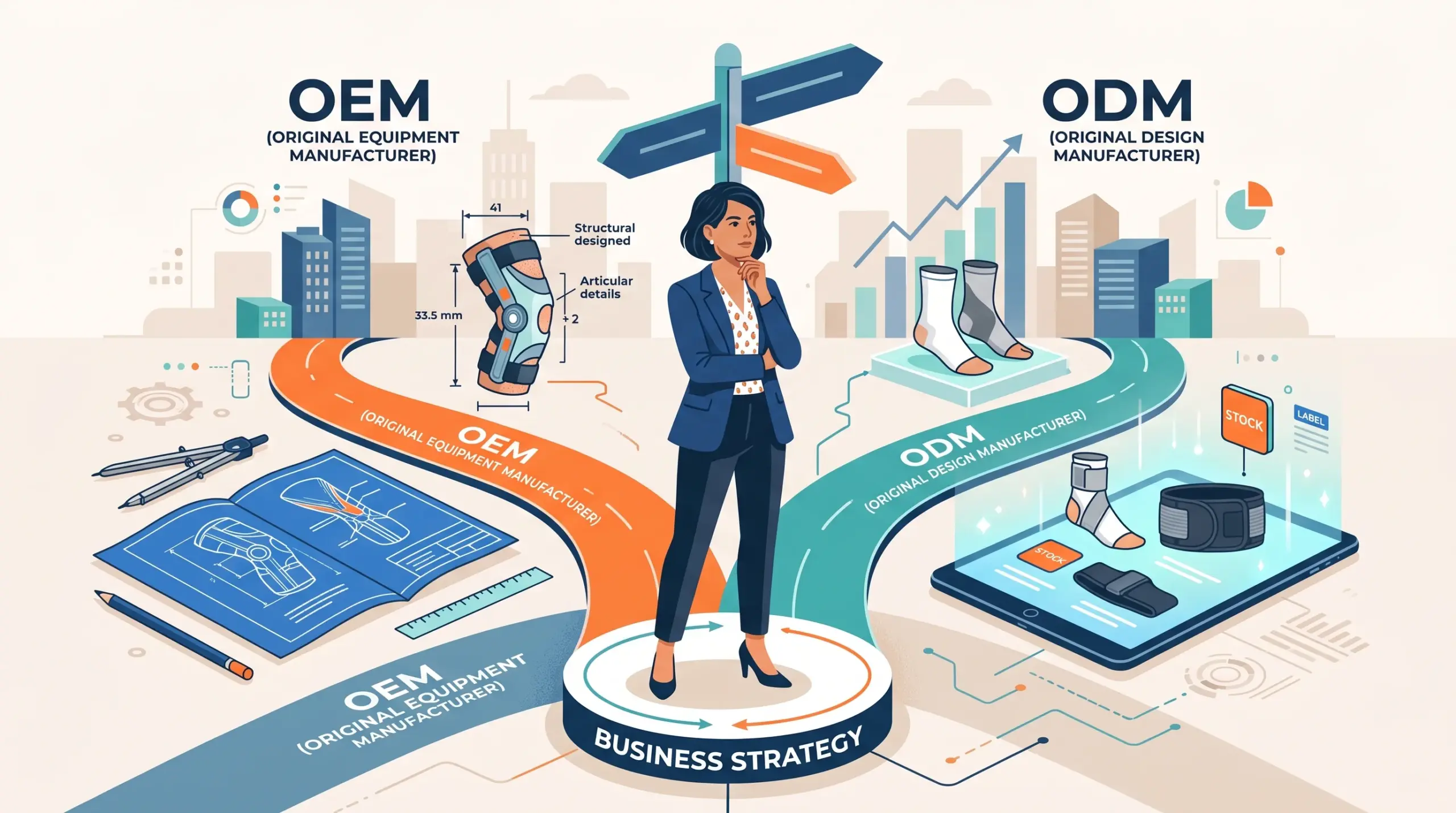
Picking the wrong manufacturing model costs you more than time. It drains your budget, pushes back your launch date, and gives your competitors a head start.
For brands and buyers sourcing braces and supports, the OEM vs ODM decision carries real weight. It’s one of the biggest calls you’ll make before your first product ships.
Most comparison content online just defines the two terms. It stops there. This guide goes further.
Here’s who will get the most from it:
-
Brand owners with proprietary designs ready for production
-
Startups that need to move fast using a proven product structure
-
E-commerce sellers running their first bulk brace manufacturing order
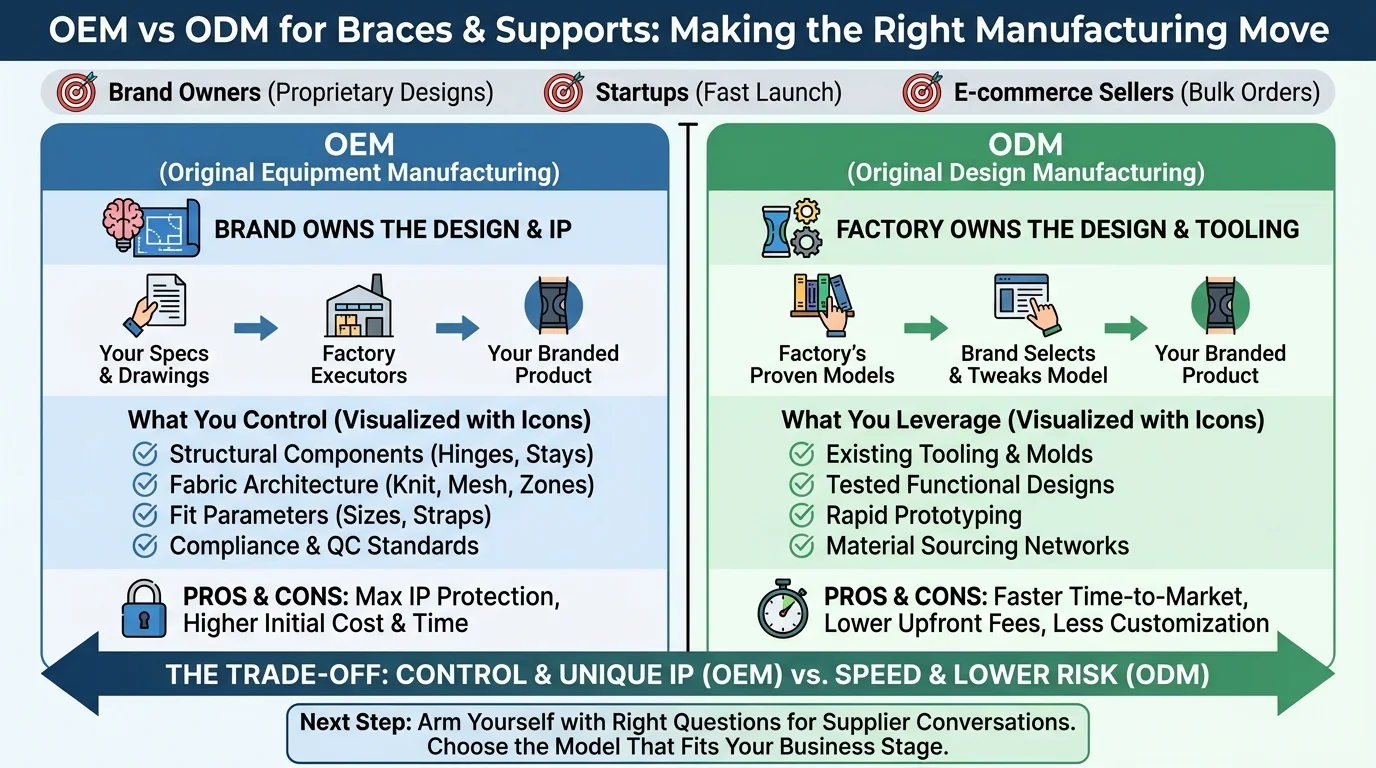
By the end, you’ll know which model fits your business situation. You’ll also walk into supplier conversations with the right questions ready.
What Is OEM Manufacturing for Braces and Supports?
The factory doesn’t own your product. You do. That’s the core of OEM.
Original Equipment Manufacturing puts design authority in your hands. You bring the technical drawings, material specs, compression zoning, and fit tolerances. The manufacturer builds what you’ve defined and ships it under your brand.
In the braces and supports category, that distinction carries more weight than most buyers expect. A knee brace isn’t a commodity item. Its hinge geometry, patella opening, and lateral support structure all have real functional consequences. Own those specs, and your custom orthopedic brace production delivers consistent, brand-specific performance, not a generic product with your logo swapped in.
What You Control in OEM
Your specification package drives the entire process:
-
Structural components — polycentric hinges, ROM limits, metal side stays
-
Fabric architecture — knit zones, neoprene panels, breathable mesh placement
-
Fit parameters — circumference ranges, strap dimensions, left/right configurations
-
Compliance documentation — QC records, test reports, traceability requirements
The factory takes care of manufacturing, assembly, and quality control. The product concept and the IP behind it stay with you.
OEM works best for brands that already have a design. You need a manufacturing partner who can execute it at scale with clean production runs, documented standards, and stable output every order.
What Is ODM Manufacturing for Braces and Supports?
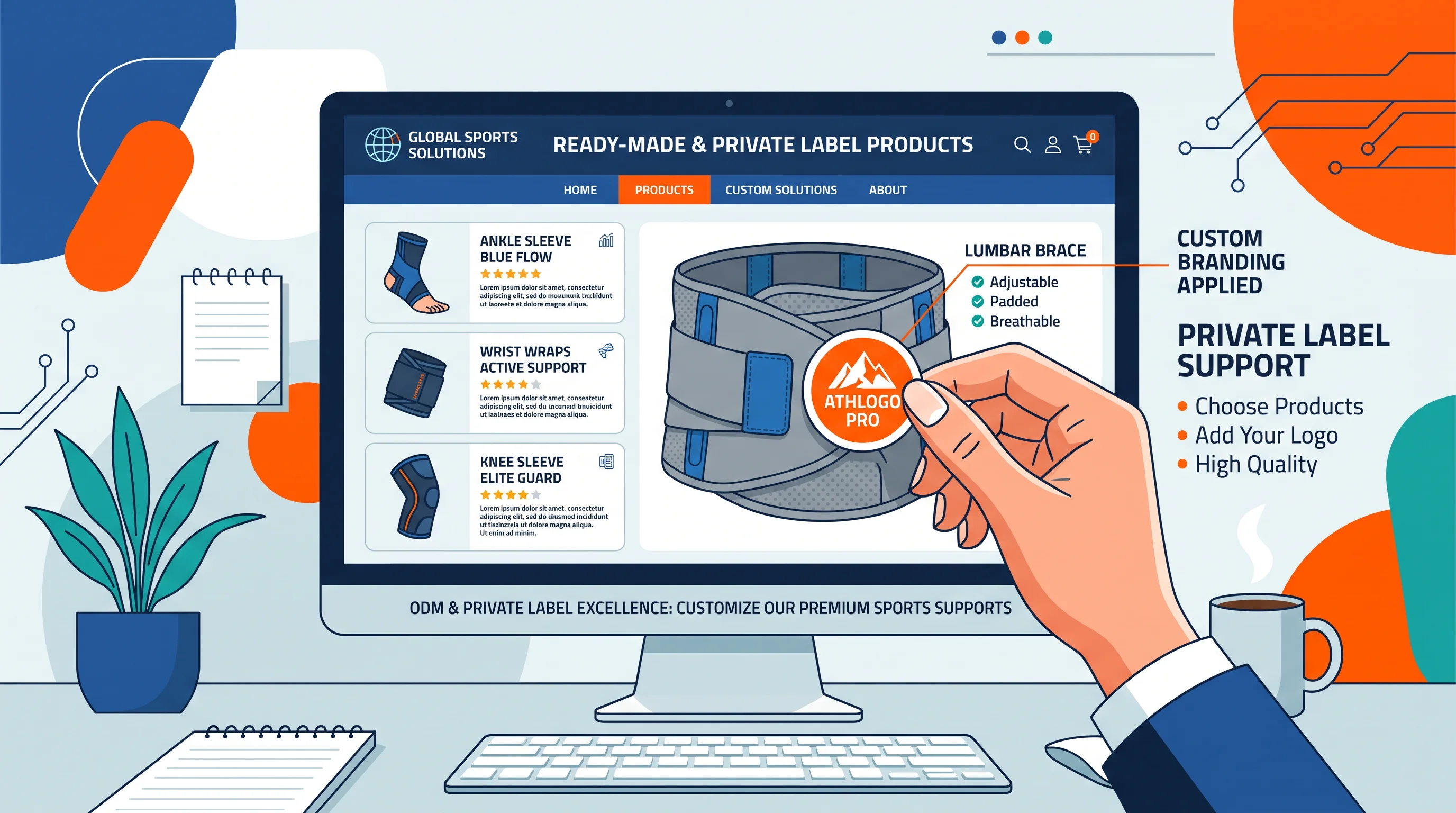
ODM flips the ownership equation. The factory holds the design. You hold the brand.
In Original Design Manufacturing, the supplier has done the hard work: R&D, prototyping, material validation, structural engineering. Their catalog is your starting point. You pick a knee brace, an ankle support, or a lumbar brace. Add your logo, choose your packaging, and sell it under your name. That’s private label brace production at its most straightforward.
What You Can and Cannot Change
ODM is a set product with a narrow customization lane.
What’s open to you:
-
Logo placement — printed, woven, or rubber-stitched labels (typical MOQ: 300–500 pcs per SKU)
-
Colorways — 2–5 standard options per brace; custom colors require 1,000–3,000 pcs minimum
-
Packaging — full custom box, polybag, or blister card (expect US$0.10–0.40 added per unit)
-
Minor trim adjustments — Velcro width, edge binding color, fabric variants within the factory’s validated BOM
What stays fixed:
-
Cut pattern, hinge placement, strap routing, structural reinforcements
-
Compression profile, support level, ROM-limiting architecture
-
Medical-grade materials tied to CE or FDA compliance documentation
Speed Is the Real Argument for ODM
Brands that need products on shelves fast get a real edge here. A full OEM development cycle from concept to delivery runs 6–12 months or longer. ODM cuts that down sharply:
|
Phase |
Typical Duration |
|---|---|
|
Product selection |
1–2 weeks |
|
Sampling & fit evaluation |
3–6 weeks |
|
Branding & packaging approval |
1–2 weeks |
|
Mass production & shipment |
4–8 weeks |
|
Total |
~2–4 months |
Say you’re an e-commerce seller launching your first bulk brace manufacturing run. Or a startup testing a new sports support category. That shorter timeline is what separates catching a market window from missing it entirely.
ODM is built for speed, scale, and lower upfront risk, not for buyers who need to control every detail of their product design.
OEM vs ODM: Core Differences in Braces and Supports Manufacturing
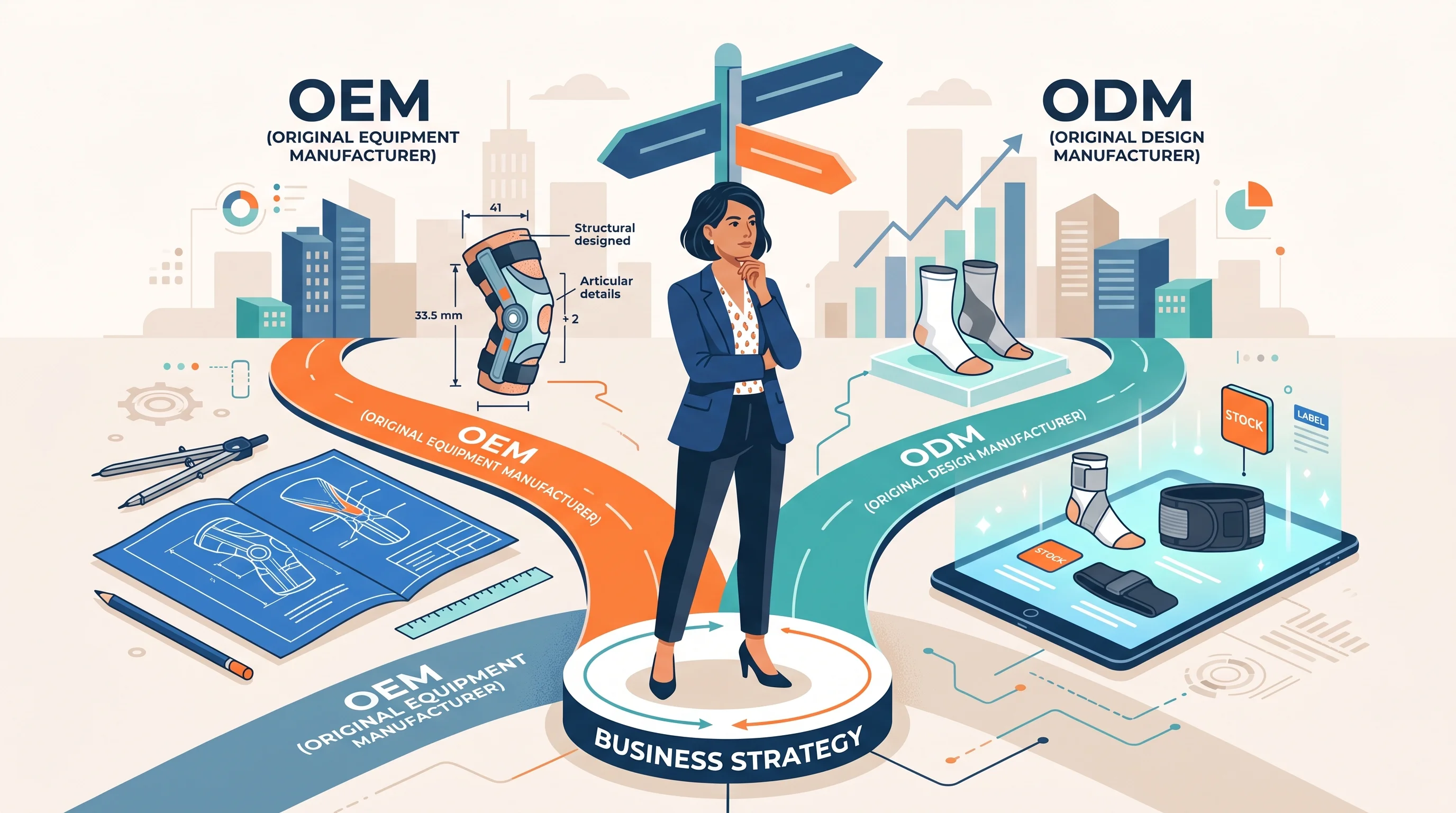
The table below provides the full picture across six key dimensions of contract manufacturing orthopedic products.
|
Dimension |
OEM |
ODM |
|---|---|---|
|
Design Control |
Buyer-led |
Factory-led |
|
IP Ownership |
Buyer owns specs, molds, patterns |
Factory retains core structure; buyer owns brand |
|
Customization Depth |
Deep — support grades, fabric weight, size systems |
Surface — colorways, logo, packaging, minor trim |
|
Upfront R&D Cost |
$5,000–$70,000+ (molds, testing, certification) |
Under $5,000–$10,000 to launch one SKU |
|
MOQ |
500–3,000 units per style |
100–500 units per style |
|
Lead Time |
3–6 months, concept to first shipment |
2–4 months total, often 25–40 days production |
Design Control and IP: Where the Real Divide Lives
-
In OEM manufacturing, your specification package drives everything. You define the support grade and set the fabric weight, the spandex ratio, and the ventilation density. The molds, the technical drawings, the structural innovations, all of it stays with you.
-
In ODM, the factory’s platform is the product. One shared knee brace skeleton may carry three or four different brand labels across the same production run. You control logo placement, color selection (2–5 options), and packaging. The hinge geometry, strap routing, and compression structure? Those are locked. The CE and FDA test documentation ties directly to those elements. Changing them means rebuilding the compliance file from scratch.
The Real Cost of Customization in Brace Product Customization
-
OEM front-loads the spend. A single plastic support component mold runs $3,000–$15,000. First-round sampling adds another $300–$1,000 per style. On an initial run of 3,000 units, mold amortization alone can hit 20–40% of your per-unit factory cost.
-
ODM flips that equation. A bulk brace manufacturing launch — 500 knee braces at $5 per unit — can start for under $3,500 all-in. That includes packaging design and samples. The factory spreads its R&D across 50,000 to 200,000 units per year. That brings its per-unit platform cost down to $0.05–$0.30.
The tradeoff is clear:
-
OEM builds walls around your product. Your specs, your molds, your IP. Competitors can’t copy what they can’t access.
-
ODM gets you to market fast. But your competitors can follow the same path, because the base product is the same.
OEM Is the Right Choice for Your Braces Line
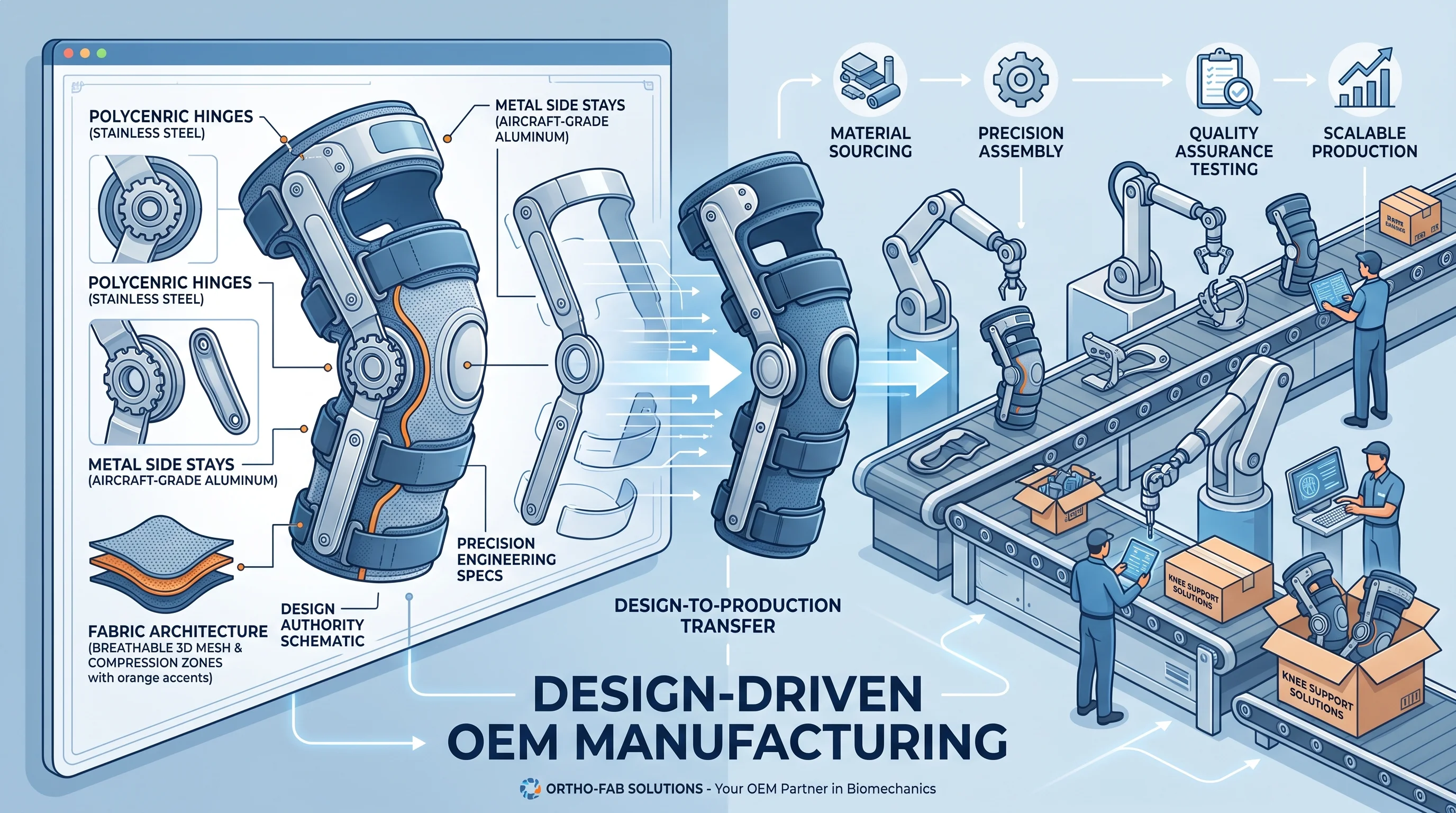
Some brands already know what they want to build. They have the design sketches, the compression specs, the hinge geometry. What they need is a factory that can execute that vision at scale without changing it.
That’s the buyer OEM was built for.
The Three Profiles That Belong in OEM
-
You have a proprietary design. Your spec package covers compression zoning, size gradients across S–XXL or beyond, and every branded element from silicone labels to custom packaging. A capable OEM partner takes that package and builds to it. Brand customization elements, logo, hang tags, wash labels, add 3–8% to per-unit cost.
-
You’re in medical or professional sports territory. Think hinged knee braces with ROM control at 0–120° flexion. Or lumbar supports with zone-specific strap tension reaching 20–30 kg of total compression force. These products carry ISO 13485 requirements, in-process defect targets below 0.5%, and on-time delivery expectations above 95%. ODM’s fixed platform can’t handle that level of engineering accountability. OEM can.
-
You’re building IP worth protecting. Exclusive hinge structures, patented compression architectures, and proprietary offloading frames need confidentiality agreements and locked mold ownership from day one. OEM contracts set that up clearly, your tooling stays yours, production stays exclusive.
What the Investment Actually Looks Like
OEM front-loads real costs. Plan your budget around that reality.
For a hinged knee brace or lumbar support line, the first-year development costs break down like this:
-
Mold and tooling development: 8–15% of total project budget. Metal hinge molds run US$3,000–10,000 per set.
-
Sampling and iteration: 3–6 rounds, 5–20 units each. Cumulative cost: 5–10% of budget.
-
Testing and validation: biocompatibility, material fatigue, ROM calibration — another 3–8%.
All in, expect 15–30% of your first-year budget to go into development before a single unit ships to market. For a target volume of 5,000–20,000 units, that means planning for US$50,000–200,000 as your starting range.
The math gets better fast. Those upfront costs spread out at scale. OEM gross margins in the medical and professional support category reach 40–60% — compared to 20–35% for resale or private label. Industry data also shows OEM brands generating aftermarket and accessory revenue at margins up to four times higher than the original product line.
The Timeline: 6–12 Months
|
Phase |
Duration |
|---|---|
|
Requirements lock and NDA |
1–2 months |
|
Engineering design and sampling |
2–3 months |
|
Pilot production and certification |
1–2 months |
|
Mass production ramp |
2–5 months |
Medical buyers validate with a 500–1,000 unit clinical run before scaling to 10,000+ units per month. That staged approach protects both sides, and serious OEM manufacturers build it into how they structure the engagement from the start.
MOQ entry points reflect product complexity. Compression sleeves and soft supports start at 500 units for volume pricing. Hinged braces and orthoses open at 300–500 units per style after tooling is complete.
Your brand is ready to own what it builds structurally, legally, and in the market. OEM is the model that builds on itself over time.
ODM: The Right Choice for Your Braces Line
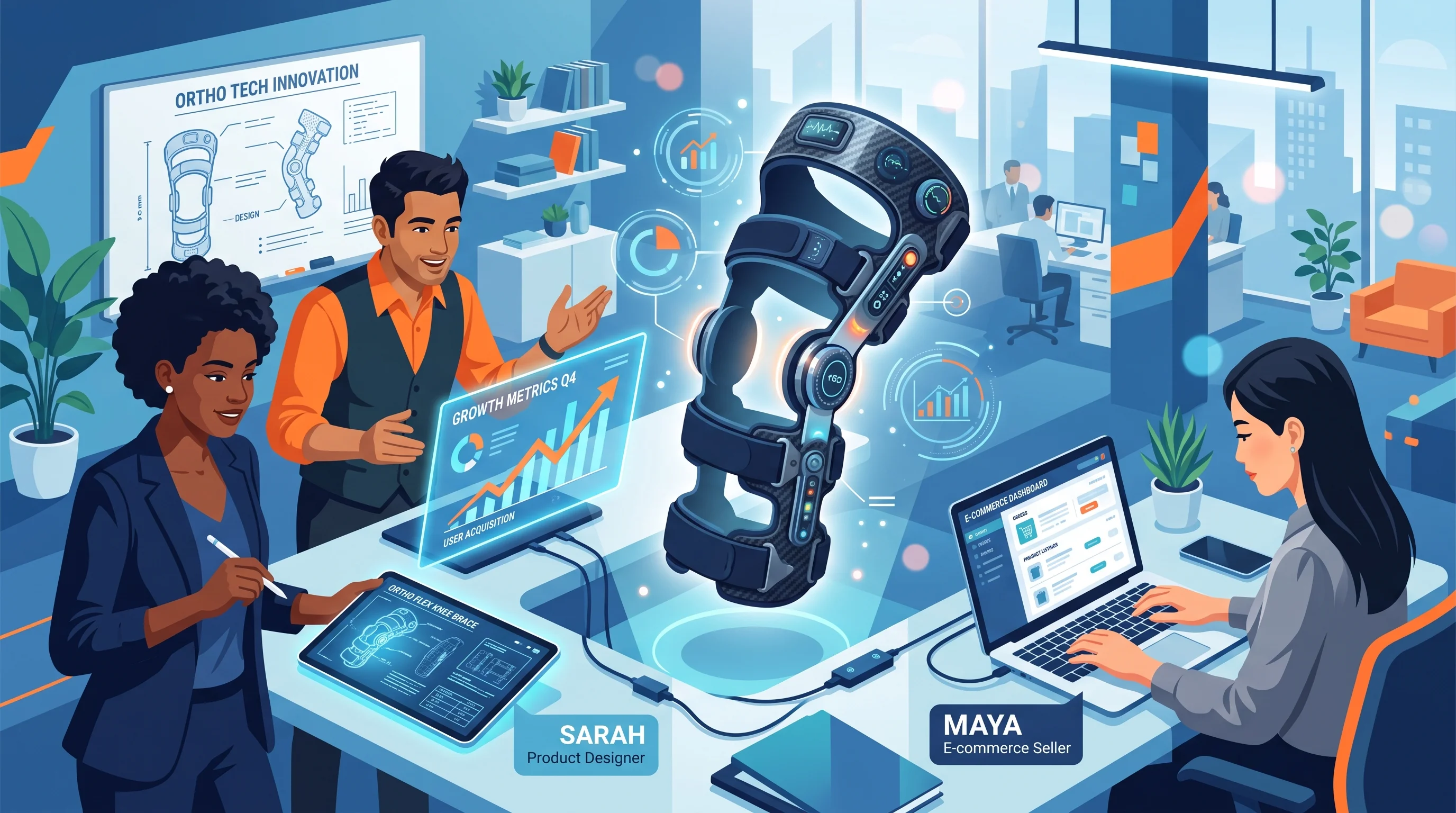
Not every brand needs to reinvent the knee brace. Some brands just need one on shelves, fast, lean, and good enough to test whether the market wants it at all.
That’s the honest case for ODM.
The Buyer Profiles That Belong in ODM
-
E-commerce sellers and cross-border brands moving at Amazon speed. You need a product live in 60–90 days. You’re optimizing for a listing, not a patent filing. ODM gives you a validated structure, a working design, and a production-ready BOM — no engineers required on your payroll.
-
Startups stress-testing demand. Your brand direction is clear. Your product specs aren’t. ODM lets you start with what the factory has already figured out — structure, sizing, materials. So you can focus on what you’re testing: whether customers buy it, repurchase it, and tell their friends.
-
Retailers building private label lines. You want your logo on a knee sleeve or posture corrector. You don’t need to own the mold. That’s the whole point of private label — the factory designs it, you brand it, you sell it.
The Braces Categories Where ODM Makes the Most Sense
-
Compression knee sleeves — sizing and knit structure are standardized across the industry
-
General-purpose ankle supports — the functional build is mature; your logo and colorway are the real differentiators
-
Wrist supports and posture correctors — high search volume, predictable SKU structure, low tooling dependency
Launching your first three SKUs as an ankle support ODM supplier customer? This is your fastest path to a testable product line. You get real sales data to guide your next decision.
What ODM Saves You And What It Costs You?
-
The financial case is straightforward. First-order investment stays low. No mold budget. No R&D team. No certification rebuild. Your spend goes toward sampling, branding, packaging, and your opening production run.
-
The first bulk brace manufacturing order — say, 500 ankle supports at $4–6 per unit — can move from factory confirmation to delivery in under 90 days. Compare that to 6–12 months on the OEM side.
-
The tradeoff is real, though. Your base product is available to any other brand working with the same factory. Your edge comes from packaging, content, and channel execution — not structural exclusivity. ODM rewards brands with strong marketing and distribution. It doesn’t protect brands that depend on product design as their primary moat.
Five Questions to Ask Any ODM Supplier Before You Commit
Before you sign anything, push the factory on these:
-
MOQ — What’s the minimum per SKU, and do they support trial orders?
-
Sample lead time — How many days from brief to confirmed sample?
-
Production lead time — Can it match your Amazon or DTC launch window?
-
Customization depth — Which elements can you change: materials, colors, packaging, sizing?
-
IP and exclusivity terms — Who owns the design? Can you buy it out? Is semi-exclusive available?
The answers tell you more about a factory’s ODM capability than any catalog ever will.
Your competitive edge is speed, channel strength, and brand execution. “Sell first, optimize second” is a real strategy. ODM is where it starts.
OEM vs ODM Decision Guide: 5 Questions to Ask Before You Choose
Q1: Do you have a complete design — tech pack, CAD files, material specs, or prototype data?
Yes? You’re OEM-ready. A full technical package lets you walk into a factory and say build this. Working from a competitor screenshot or a rough reference image? Start with ODM. Refine from an existing base. Move toward custom development once the market shows you what it wants.
Q2: Is your launch budget under $20,000 with a 4-month runway?
This is where mold costs reshape the math. A single custom injection mold runs $3,000–$15,000. On a 500-unit first order, that adds $6–$30 per unit. Scale to 5,000 units and that drops to $0.60–$3.00. Tight budget, short timeline? ODM is the more realistic path. Room to invest and a longer horizon? OEM starts making financial sense.
Q3: Is your competitive edge technical or brand, channel, and price?
Functional innovation belongs in OEM. Think proprietary compression architecture, ROM-controlled hinges, or zone-specific support structures. You need design control and spec exclusivity to protect that kind of edge. Your strength is channel speed, pricing, or brand positioning? ODM gets you the same shelf presence without the development cost.
Q4: Does your product require FDA clearance, CE marking, or specific compliance documentation?
Regulatory requirements change the math here. OEM gives you direct control over every design variable that certification testing touches — materials, structure, performance parameters. That said, some ODM suppliers already hold valid certifications on ready products. That documentation transfers with the design. It’s faster and cheaper than building a compliance file from scratch.
Q5: Is this a flagship product line you intend to own long-term or a market test?
Want to be the only brand selling this product? You need OEM and the IP ownership that comes with it. Testing demand before committing? ODM keeps the risk low. Validate first. Lock down the design once you know it’s worth protecting.
How to Evaluate an OEM or ODM Braces and Supports Manufacturer?
1. Verify Category Experience with Real Numbers
Ask about annual shipment volumes in the specific categories you care about:
-
Knee braces: ≥50,000–100,000 units/year from stable orders
-
Back supports: ≥20,000–50,000 units/year, including steel or plastic stay structures
-
Ankle supports: ≥30,000 units/year, with compression styles included
Ask for at least three client references per category. EU or North American brands work fine; names can be anonymized. Then request defect rate data from the past two years. Your target: finished goods defect rate ≤1–2%.
2. Audit Materials and Production Capability
-
Neoprene
Check that they stock standard thicknesses: 2mm, 3mm, and 5mm. Get REACH/RoHS compliance documents and skin contact test reports (ISO 10993-5/10). Ask how they cut: die or laser. Laser cutting should hold tolerances within ±1–2mm. -
Elastic knit fabrics
Look for knit density in the 260–320 gsm range. Elastic recovery should hit ≥95% after 120% stretch. Sourcing compression knee sleeves or ankle supports? Confirm they have gradient compression production experience — covering 15–20 mmHg and 20–30 mmHg ranges with ±3 mmHg tolerance control. -
Metal stays and structural components
Stainless steel (304 grade) and aluminum alloy are standard choices. Dimensional tolerances should hit ±0.5mm on length and ±0.1mm on thickness. Ask for fatigue test records — you want ≥5,000–10,000 bend cycles without failure.
On production capacity: a solid factory runs ≥30,000–50,000 units/month per category. At least 30–50% of critical processes should be automated.
3. Examine Quality Systems, Not Just Certifications
ISO 13485 certification matters for custom orthopedic brace production going into medical channels. But a certificate on the wall tells you nothing about how the floor runs day to day.
Go deeper:
-
Ask for sample IQ/OQ/PQ validation documents — installation, operational, and performance qualification records
-
Confirm AQL 2.5/4.0 inspection standards for both incoming materials and finished goods
-
Request a sizing consistency report from a trial run of 200–500 units. It should include mean and standard deviation data
Key technical benchmarks to verify:
|
Test |
Minimum Standard |
|---|---|
|
Strap/elastic tensile strength |
No breakage or permanent deformation >10% at 50–100N |
|
Velcro cycle durability |
≥5,000 open/close cycles, retaining ≥80% adhesion |
|
Colorfastness after sweat soak |
Grade ≥3–4 after 24–48 hour perspiration exposure |
4. Nail Down Commercial Terms Before Samples Are Cut
MOQ reality check:
For bulk brace manufacturing on standard sports knee or ankle styles, OEM minimums run at 1,000–2,000 units per colorway. ODM orders on existing patterns can drop to 300–500 units per SKU. That lower floor is critical for brands testing new categories through an ankle support ODM supplier.
Sample costs:
Standard knee or ankle braces run $10–30 per style. Complex back supports with metal stays go from $30–80. Check whether sample fees count toward your first production order. Most credible factories offset 50–100% once your order clears $5,000–10,000.
Lead time benchmarks:
-
First development run: 2–4 weeks for tooling, then 30–45 days of production after materials are confirmed
-
Repeat orders with no design changes: 25–35 days standard, 40–45 days in peak season
IP protection:
For OEM buyers, this is non-negotiable. Your NDA needs to cover technical drawings, pattern files, compression specs, and mold ownership. No written competitive isolation clauses? A factory running three other knee brace brands on the same equipment has zero obligation to keep your design separate from theirs.
The manufacturer you pick is a long-term operational decision, not a one-time sourcing call. Treat this evaluation with that weight behind it.
OEM vs ODM Summary Table: Quick Reference for Braces Buyers
|
Dimension |
OEM |
ODM |
|---|---|---|
|
Design Control |
Buyer provides full specs, drawings, tech pack |
Factory holds the base design. Buyer adjusts branding only |
|
IP Ownership |
Buyer owns design, molds, core IP |
Factory keeps structural IP. Buyer owns the brand layer |
|
Customization Depth |
Deep — materials, structure, sizing, compression zoning |
Narrow — colorways, logo, packaging, minor trim |
|
Time to Market |
90–150 days, often longer |
30–60 days typical |
|
Upfront Cost |
$15,000–$50,000+ |
$5,000–$15,000 |
|
MOQ |
500–2,000+ units per style |
100–500 units per style |
|
Competitive Barrier |
High — exclusive structure, proprietary molds |
Low-to-medium — same base product sold to others |
|
Best Fit |
Established brands, medical-grade, functional performance products |
Startups, market testing, private label, fast replenishment |
Conclusion
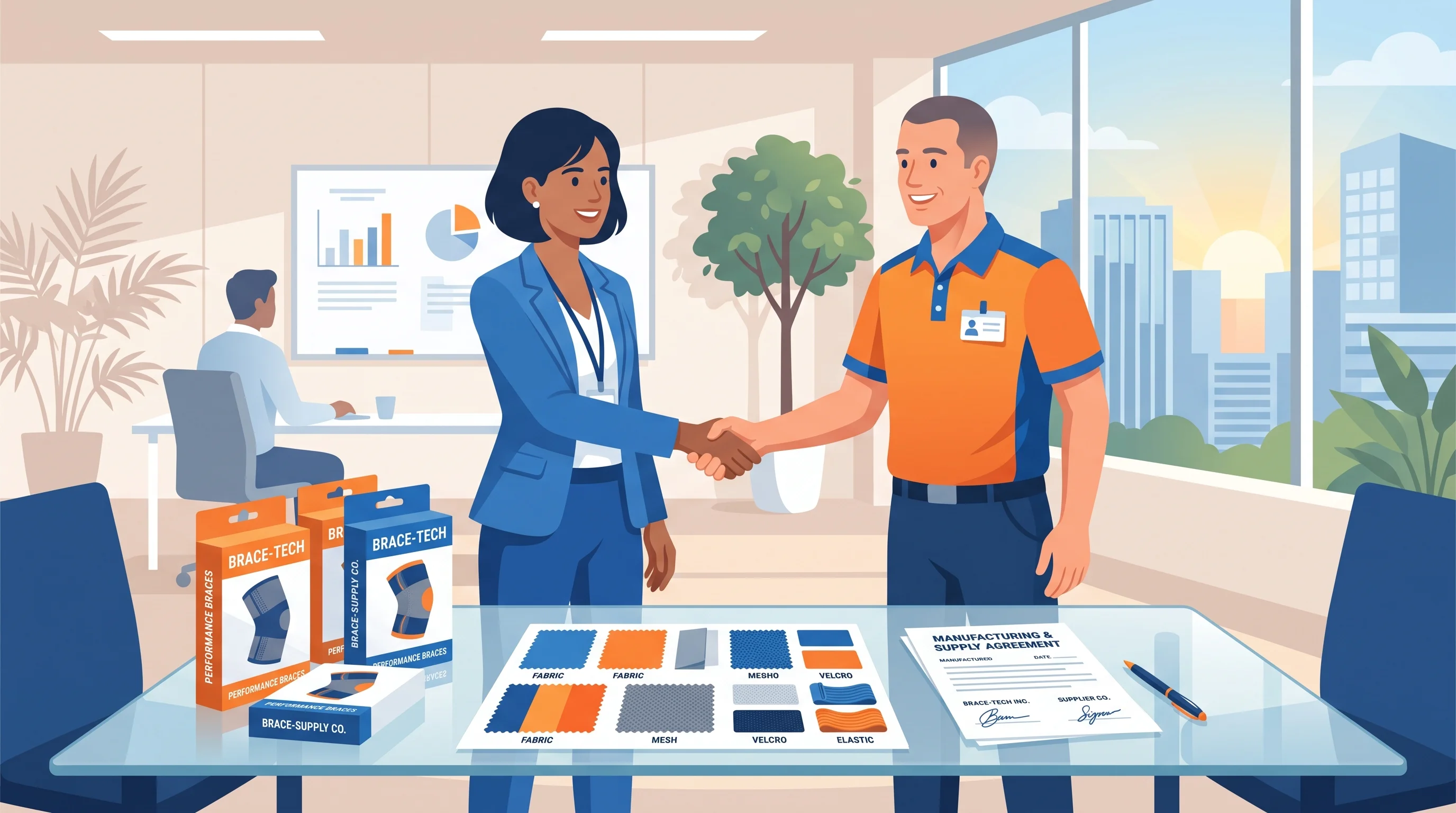
The right model isn’t about which is “better”—it’s about which fits your brand’s stage, speed, and strategy. Whether you bring a proprietary design (OEM) or need a market-ready product under your label (ODM), the key is a manufacturing partner who can execute both with precision.
At AOFIT, from custom knee brace production to ready-to-brand ankle supports, we cover it all. We’ll help you figure out which model fits your business before you commit to anything.
Ready to find your fit? Contact our team for a free manufacturing consultation and custom quote.
Your next product line is closer than you think.