
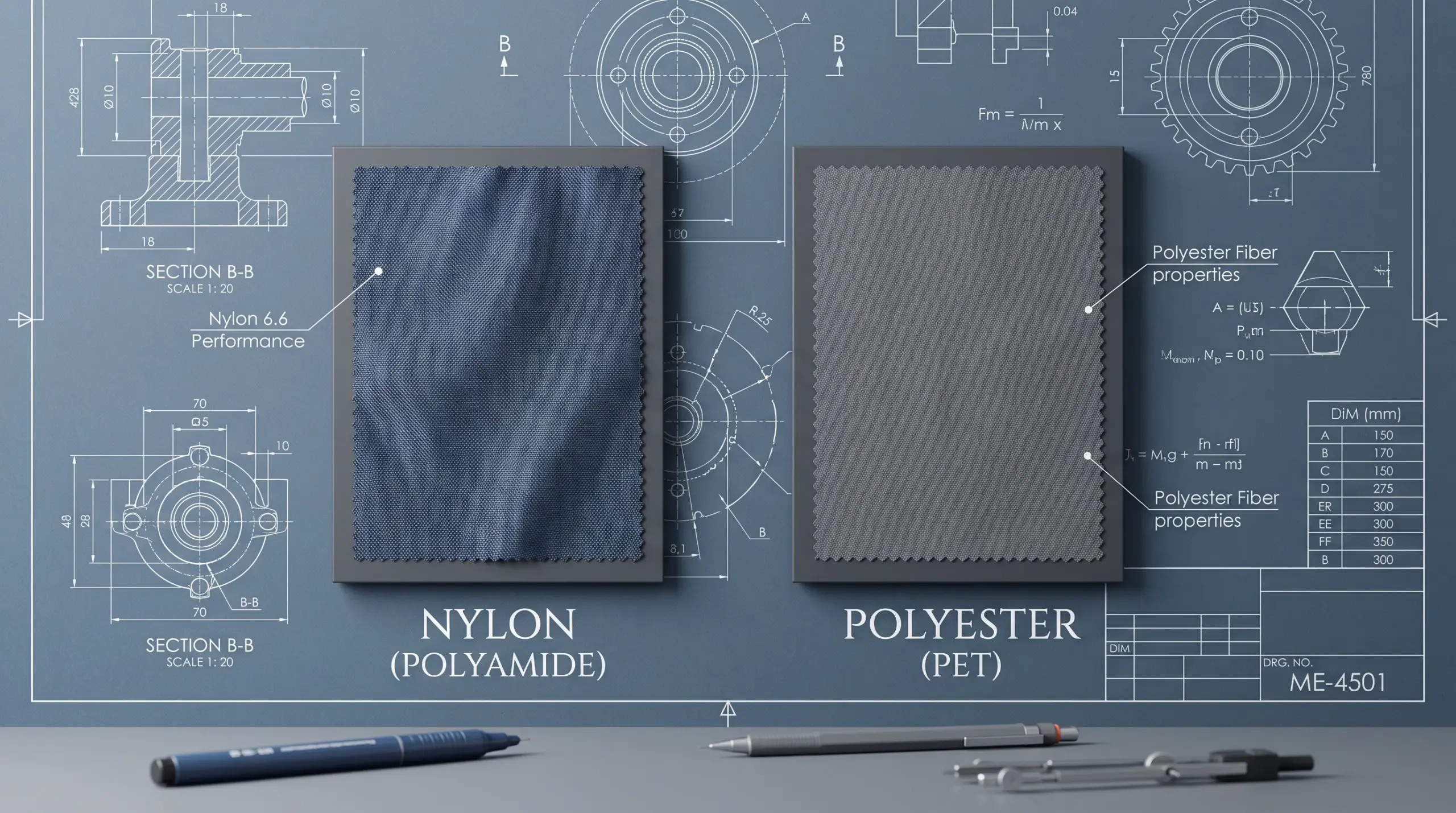
For brace manufacturers choosing nylon vs polyester, the wrong choice can erode product performance, increase return rates, and give competitors an edge you didn’t intend. Both materials dominate the medical textile space for good reason. They’re versatile, scalable, and cost-effective.
Look closer, though, and the differences matter. Tensile strength, moisture management, elasticity, and abrasion resistance, these factors can make or break a brace design.
This guide breaks it down with data-backed, application-specific comparisons. You get a clear framework for making better material decisions across every brace category in your product line, built for engineers and procurement teams who need practical answers.
Nylon vs. Polyester at a Glance: What Brace Manufacturers Need to Know First
Nylon trades on mechanical toughness, while polyester trades on moisture stability and cost control. Both earn their place in different braces, for different reasons.
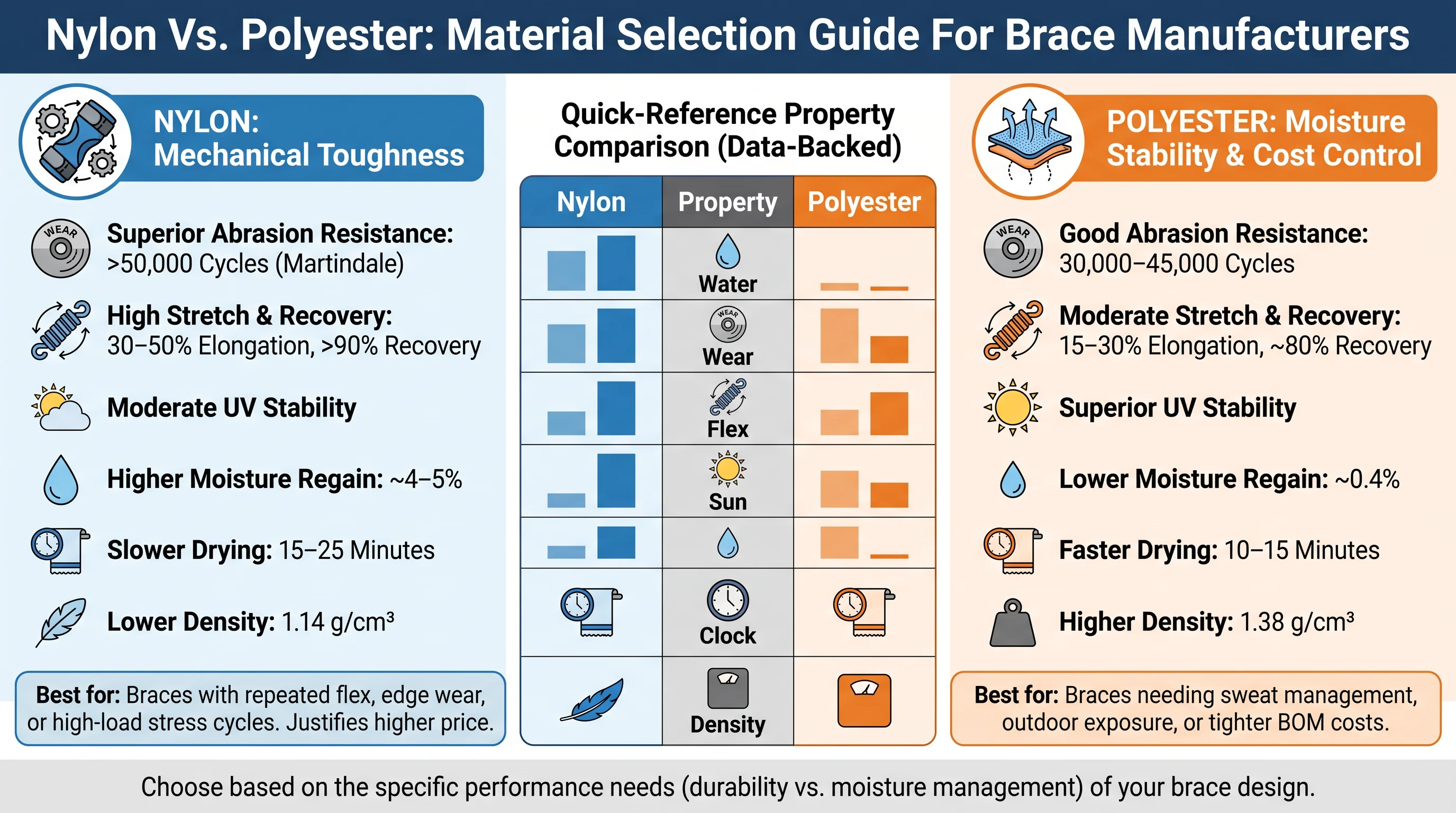
Here’s the quick-reference breakdown your engineering and procurement team should have before the first sample:
| Property | Nylon | Polyester |
|---|---|---|
| Moisture regain | ~4–5% | ~0.4% |
| Abrasion resistance | >50,000 Martindale cycles | 30,000–45,000 cycles |
| Stretch / recovery | 30–50% elongation, >90% recovery | 15–30% elongation, ~80% recovery |
| Drying time | 15–25 minutes | 10–15 minutes |
| UV stability | Moderate | Superior |
| Density | 1.14 g/cm³ | 1.38 g/cm³ |
- A brace that handles repeated flex, edge wear, or high-load stress cycles benefits from nylon. Its abrasion resistance and stretch recovery justify the higher price.
- A brace built around sweat management, outdoor exposure, or tighter BOM costs points to polyester. Lower moisture regain and faster drying make it the smarter starting spec.
- One critical caveat: fiber choice alone doesn’t determine brace performance. Denier, weave density, coating type, and seam construction can each outweigh the base fiber in real-world testing.
Nylon Fabric for Brace Manufacturing: Core Properties & Performance Profile
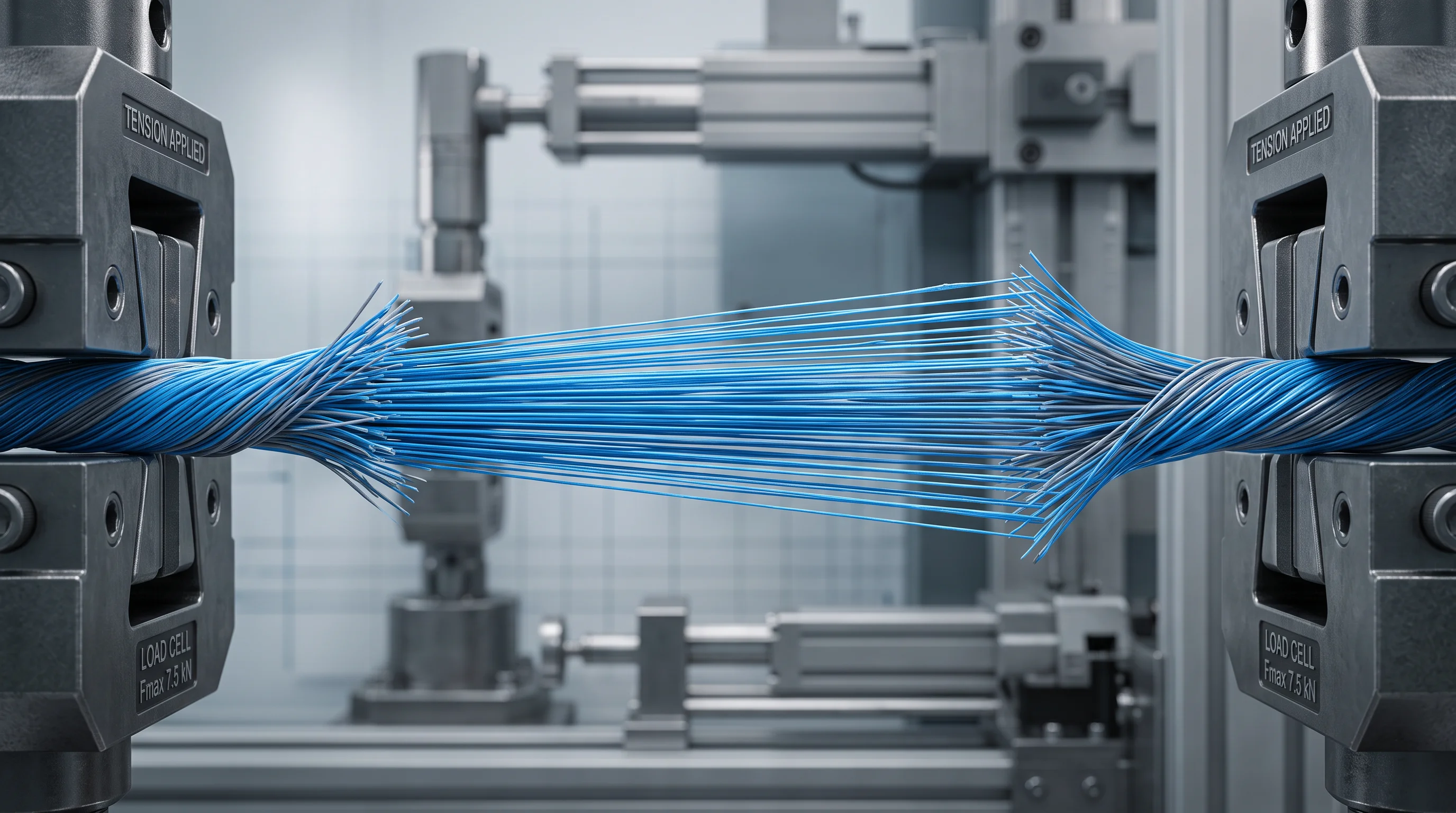
- From a mechanical point of view, the advantages of nylon fiber are obvious. Nylon fiber delivers a tenacity of 40–60 cN/tex, one of the strongest strength-to-weight ratios in functional textile construction. Yield strength runs 66.8–71.7 MPa. Elastic modulus sits at 2.95–4.5 GPa. Together, those numbers mean nylon absorbs load, holds shape under stress, and doesn’t collapse at the flex points where braces fail first.
- Abrasion resistance tells the same story. In Martindale testing, nylon-based brace fabrics hit 30,000–50,000 cycles. The upper range pulls well ahead of standard polyester equivalents. For knee, ankle, and elbow braces that take thousands of articulation cycles per week, that difference shows up in product lifespan.
- Recovery is where nylon earns its place in compression design. An 80/20 nylon-spandex construction hits 92% elastic recovery and generates 25 mmHg of compression pressure. The fiber doesn’t just stretch, it returns. That’s what keeps pressure distribution uniform after six hours of wear, not just the first thirty minutes.
The tradeoffs are real. Know them upfront:
- Moisture absorption runs at 3.5–4.5%, nylon is not moisture-resistant. Wet-state dimensional stability is a real engineering variable for precision-fit brace categories. Factor it into your spec.
- UV degradation is a known weakness. Outdoor brace applications need UV-stabilized finishing or coating treatments.
- BOM costs run higher than base polyester. The performance premium makes sense for mid-to-high compression SKUs, but price it in from the start.
For manufacturing specs: target 80/20 nylon-spandex as your baseline construction. Set abrasion targets at ≥30,000 Martindale cycles. Confirm fabrics at >90% recovery before you commit to a production run.
Polyester Fabric for Brace Manufacturing: Core Properties & Performance Profile
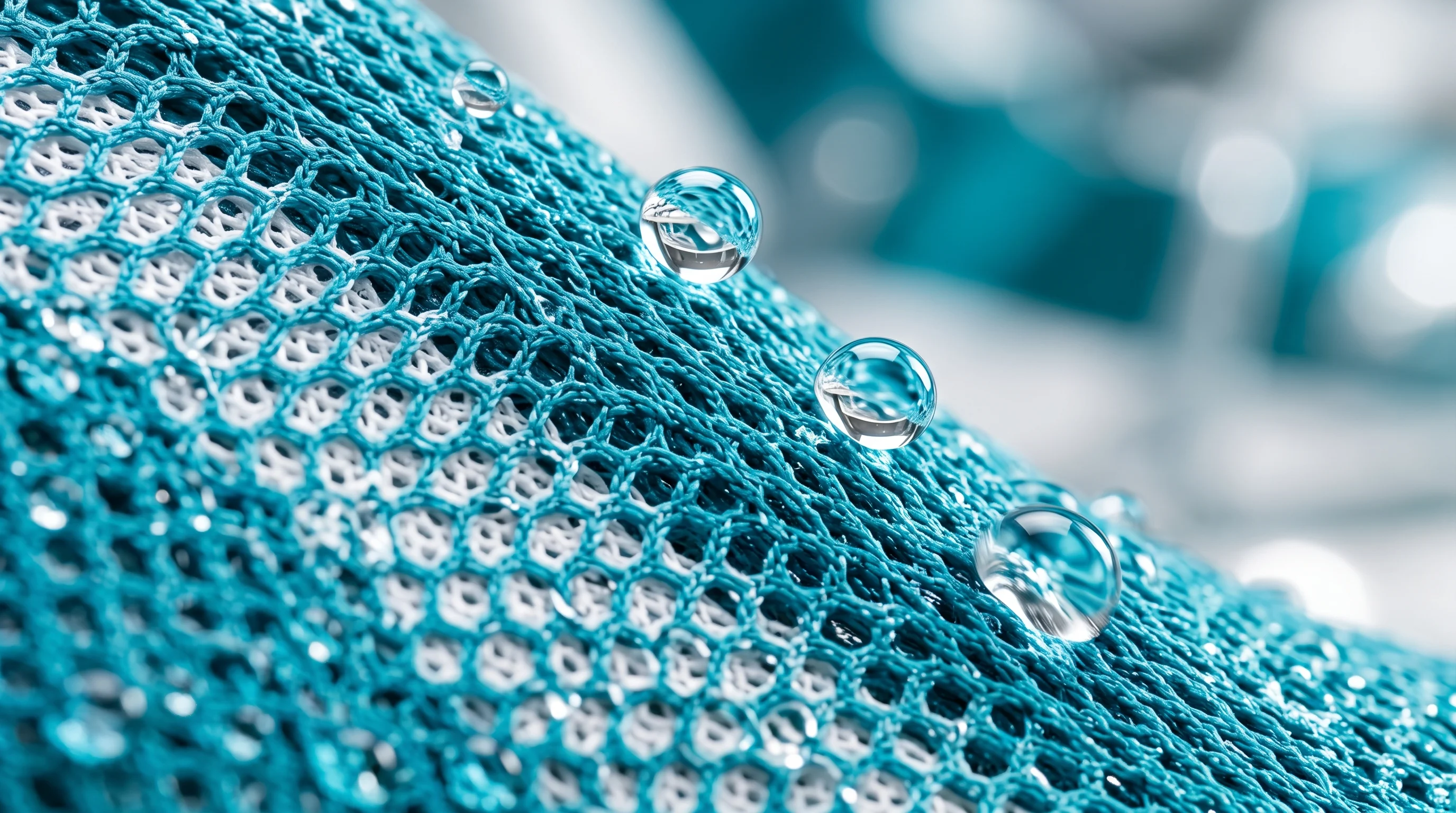
Polyester earns its place in brace manufacturing through one clear advantage: it doesn’t absorb moisture.
- The moisture regain sits at just 0.4–0.8%, nylon runs ~4% by comparison. So polyester is water-resistant by nature. It doesn’t swell under sweat. It doesn’t sag mid-shift. It also dries 40% faster than comparable nylon knits. That gap matters for braces worn through six-hour workdays, not just thirty-minute sessions.
- That water-resistant nature also keeps mechanical performance stable. A saturated brace still holds its shape with polyester. Compression stays consistent. The shape doesn’t drift. Heat-stabilized polyester yarns show less than 1% shrinkage in hot water, a spec that counts every time a brace runs through an industrial laundry cycle.
Where polyester wins outright:
- UV stability — built-in resistance to UV degradation; it holds tensile strength and color far longer than nylon under outdoor exposure
- Dimensional stability — thermal expansion coefficient of 2.5–5.5 × 10⁻⁵ K⁻¹; the geometry doesn’t shift with body heat or washing
- Cost — 20–35% cheaper per meter than equivalent nylon substrates, with no drop in structural panel performance
The honest tradeoffs:
Elastic recovery is polyester’s weakest point in brace design. Elongation at break runs 15–45%, but repeated loading causes compression to drift over time. You need a spandex blend — 5–15% is the standard range — or the straps lose their calibrated tension. Abrasion resistance is solid, but edges under constant movement will fuzz and pill faster than nylon does. Also, standard filament polyester feels stiff against skin. Brushed inner constructions or soft knit linings are a must for extended-wear SKUs.
For structural outer shells, mesh ventilation panels, and load-bearing straps on cost-focused product lines, polyester is the smart default.
Head-to-Head Comparison: Nylon vs. Polyester Across 8 Critical Performance Dimensions
| Dimension | Nylon | Polyester | What It Means for Braces and Supports |
|---|---|---|---|
| Tensile Strength | 800–1,200 MPa; webbing dry tensile 4,000–6,500 lbs | 500–800 MPa; webbing dry tensile 3,500–5,800 lbs | Nylon gives ~10–18% higher peak load capacity — critical for load-bearing straps and impact zones |
| Abrasion Resistance | >50,000 Martindale cycles | 30,000–45,000 Martindale cycles | Nylon outlasts polyester by 30–60% in high-friction zones like knee and elbow shells |
| Elasticity & Recovery | 30–50% elongation; >90% recovery | 15–30% elongation; ~80% recovery | Nylon stretches further and snaps back tighter — essential for compression sleeves and articulated joints |
| Moisture Absorption | Moisture regain 4–5%; absorbs up to 3.5% of its weight | Moisture regain 0.4%; hydrophobic | Polyester absorbs ~10× less moisture — no swelling, no cling, no mid-shift sag |
| Drying Speed & Wicking | Capillary flow ~0.3 cm/s; dries in 15–25 min | Capillary flow ~0.8 cm/s; dries in 10–15 min | Polyester wicks 3× faster and dries 40–50% quicker — the go-to for sweat-heavy brace categories |
| UV Resistance | Poor; breaks down faster under sustained sunlight | Excellent; ~60% better UV retention than nylon webbing | Outdoor and sports braces should use polyester on the UV-exposed shell layer |
| Wet Dimensional Stability | Loses 30–40% stiffness when wet; expands up to 3.5% | Near-zero swelling; no significant wet tensile loss | Polyester holds a precise fit in humid conditions and through industrial wash cycles |
| Handfeel / Skin Contact | Soft, silky, drapey — reduces friction at contact points | Crisper, more structural — holds shape and print integrity | Nylon for inner linings; polyester for outer shells and branded panels |
What These Numbers Tell You
- Nylon leads on mechanical performance. Stronger dry tensile load. Higher abrasion ceiling. Better stretch and recovery. Any brace component that flexes on repeat, takes edge wear, or needs to hold compression pressure through a full day, nylon belongs in that spec.
- Polyester leads on environmental stability. Faster drying. Lower moisture uptake. Better UV resistance. Zero wet-state dimensional drift. For outer shells, ventilation panels, and braces that face sweat, sun, or repeat washing, polyester is the more stable, predictable pick.
- Neither material works alone at the high end. The most durable, high-performing brace builds split the workload between both materials. Polyester outer shell handles UV and moisture. Nylon inner stretch panels or straps manage compression and skin contact. That split setup is a deliberate engineering choice.
- One number worth keeping in mind before you move into application-specific selection: a nylon inner lining at >90% elastic recovery paired with a polyester outer at <1% wet shrinkage gives you a brace that holds its shape and compression under conditions where single-material builds tend to fall short.
Material Selection by Brace Type: Which Fabric Wins for Each Product Category
Different joints break down in different ways. Different use cases wear out different properties. A knee brace that handles 10,000 flex cycles a week shares nothing with a wrist sleeve worn at a desk. Treat them as the same material problem, and you’ll collect quiet failures — compression that loosens, straps that warp, edges that fray before the warranty runs out.
Here’s the breakdown, category by category.
Knee Braces: Layer the Materials, Don’t Pick One
Knee braces ask the most from fabric. They carry the most stress. Hinge zones, patellar rings, strap anchor points, and inner compression panels all take different kinds of abuse at the same time.
For hinged/structural knee braces (heavy support):
- Frame straps: high-tenacity nylon webbing, ≥3 cm wide — holds up through hundreds of strap cycles each day without losing shape
- Sleeve body: nylon-spandex or polyester-spandex 4-way stretch
- High-wear zones (hinge perimeter, seam junctions): nylon reinforcement panels or nylon-coated patch fabric — adds an estimated 20–40% more local lifespan over single-layer base knits
- Anti-slip: silicone strips at upper/lower edges to stop the brace from shifting under load
For compression knee sleeves (mild pain / sports prevention):
- Main body: cotton/polyester blend or stretch nylon/polyester blend with spandex
- Running and high-dynamic sports: 4-way nylon-spandex — stretch and recovery beat polyester-only builds during long, repeated movement
Wrist Braces: Polyester Handles Most of the Work
Wrist soft braces run at lower stress and stay on longer. The material focus shifts to comfort and washability.
- Office and desk use: polyester or cotton/polyester blend base — lightweight, breathable, machine washable, cost-efficient
- Compression wrist sleeves: cotton/polyester blended fabric with spandex covers most compression sleeve needs
- Stay channels (volar/dorsal): thin aluminum or plastic stays, wrapped in polyester or nylon outer fabric
Ankle Braces: Split the Brace, Split the Material
Ankle braces work in two environments at once. The surface area deals with high sweat. The elastic bands take real tensile stress.
- Compression body (high-sweat, fast-dry priority): polyester-spandex blend — dries fast, holds shape despite moisture
- Cross-strap bands and Achilles-adjacent zones: stretch nylon-spandex — higher stretch range and stronger recovery through inversion/eversion load cycles
The Hybrid Configuration Most OEMs End Up Using
Across all categories, the most cost-effective high-performance builds follow the same logic: polyester base fabric + localized nylon reinforcement.
Polyester carries the main body. It’s lightweight, moisture-stable, machine-washable, and 20–35% cheaper per meter than equivalent nylon. Nylon takes the structural pressure points — hinges, strap exits, high-friction edges. The result is a BOM cost drop of 10–20% versus all-nylon or neoprene construction. Wear performance in critical zones stays close to premium single-material builds.
Quick-reference material matrix:
| Brace Category | Main Body | High-Stress Zones | Anti-Slip |
|---|---|---|---|
| Hinged knee (heavy support) | Nylon-spandex or polyester-spandex 4-way | Nylon webbing straps + nylon reinforcement patches | Silicone patellar ring |
| Compression knee sleeve | Cotton/polyester blend or stretch nylon blend | — | Silicone edge strips |
| Sports knee (running/court) | Perforated neoprene or nylon-spandex 4-way | Nylon patch at patella and lateral stabilizer zones | Silicone strips |
| Wrist (office/daily) | Polyester or cotton/polyester blend | Polyester or nylon stay wrap | — |
| Ankle compression | Polyester-spandex blend | Stretch nylon-spandex cross straps | — |
Beyond Fiber Choice: How Denier, Knit Structure & Coating Change the Equation
Fiber type sets the starting point. Denier, knit structure, and coating determine where you end up.
Denier: The Variable Most Teams Underspec
Denier measures fiber linear density — grams per 9,000 meters of filament. Higher denier means thicker filament, heavier fabric, and more abrasion resistance. It also means stiffer, bulkier, and less conformable.
For brace manufacturing, the practical ranges break down like this:
- 40–100D: thin, flexible, drapable — inner contact layers, compression sleeves, breathable panels
- 150–300D: the balanced zone for outer shells and general brace bodies
- 400–600D+: load-bearing frames, strap reinforcement, high-wear structural zones
Moving from 70D to 210D nylon in a comparable weave gives you 2–3× higher tear strength and pushes Martindale abrasion cycles 20–50% higher. The tradeoff: fabric thickness rises ~0.05–0.15mm and the hand feels shifts toward “hard brace” territory. At 500D+, you lose most of the flexibility. That’s fine at a hinge anchor point. On an inner knee sleeve, it becomes a comfort failure.
Knit vs. Woven: Structure Overrides Fiber
A 150D polyester warp knit gives you 20–30% stretch, air permeability around 150–250 L/m²/s, and moderate compression support. That makes it a solid fit for sleeves and soft orthopedic braces. Put that same 150D polyester in a plain weave? Stretch drops below 5%. Air permeability can fall under 80 L/m²/s. The panel resists buckling like a semi-rigid stay. Same fiber. Same denier. The brace behavior is different.
The structural logic for brace design follows from this:
| Zone | Structure | Denier Range |
|---|---|---|
| Dynamic flex / sleeve body | Warp or weft knit | 70–150D |
| Outer shell / branded panels | Knit or tight woven | 150–300D |
| Load-bearing frames / straps | Ripstop or ballistic woven | 300–600D+ |
Coatings: Fixing What Base Fabric Can’t
Coatings let you close performance gaps without changing your base material spec. The key is applying them with a clear purpose.
- Antimicrobial finishing (silver-based, zinc, or polymer-bound biocides via pad–dry–cure) adds just 1–3 g/m² to a 200 g/m² polyester substrate. You still get >99% bacterial reduction in ISO 20743 testing. Stretch and thickness stay the same. For any medical-grade textile claim, this is a must.
- Anti-slip silicone or PU dot coatings raise skin-contact friction from ~0.3–0.4 on bare polyester to 0.6–0.8. This reduces brace migration under dynamic load without stiffening the full panel. Coverage of 10–30% of surface area adds 10–40 g/m². Rigidity stays concentrated in the zones that need it.
- Thermal lamination (thin PU foam, stretch films, or nonwoven layers bonded via hot-melt or flame lamination) solves two problems at once. It softens high-denier polyester’s hard hand feel. It also caps maximum stretch to a defined window — 20–25% — turning a basic knit into a controlled-compression structure. No changes to the fiber spec needed.
Cost vs. Performance Trade-off: Building Your Material Budget Strategy
Material cost is a lever. Pull it wrong and you face two bad outcomes. You either overengineer a brace nobody will pay for, or you underbuild one that floods back as returns.
Here’s the pricing reality: nylon fiber runs 20–35% more expensive per unit than polyester at baseline. High-spec nylon (PA66, functional grades) can push that gap to 2–3×. That cost difference adds up across your BOM faster than most teams plan for.
The impact on a single SKU is real and measurable. At 0.25 kg of fabric per unit, a switch from polyester (est. $2.20/kg) to nylon (est. $2.86/kg) adds $0.17 per piece in raw material cost alone. Across a 50,000-unit run, that’s $8,500 in extra material spend before processing, finishing, or waste factors.
Three-tier material strategy:
- Premium line (target retail ≥$28): Nylon-dominant construction. Set material cost at 35–40% of total unit cost. Nylon handles abrasion better and snaps back to shape faster. Buyers read “nylon reinforced” as professional-grade; that perception supports the price point.
- Mainstream line (target retail $12–$22): Polyester base with spandex. Keep material cost to 25–30% of unit cost. Fast dry time and shape retention are real selling points here.
- Balanced line (mid-tier): Nylon makes up 20–40% of fabric composition, placed at high-wear structural zones. Blended unit cost lands 10–20% above pure polyester, well below full-nylon. This is the most common OEM configuration for good reason.
One more variable worth building into your cost roadmap: recycled polyester (rPET) has a lower carbon footprint and supports ESG-aligned brand positioning. It pulls a 5–10% retail premium over standard polyester without the cost structure of nylon. For mid-tier lines, rPET is a margin tool most brands leave on the table.
Decision Framework: A Step-by-Step Selection List for Brace and Supports Engineers
Step 1 — Define function and load case.
Start by classifying the brace type: rigid support, flexible compression, motion control, or positional. Then put hard numbers on what the structure has to survive. A knee brace takes 1.5–3× body weight during landing. Sports orthoses need ≥1,000,000 fatigue cycles. Daily-use braces target 100,000–500,000. Set your mass limits and max thickness before you open a material spec sheet.
Step 2 — Map the usage environment.
Sweat rate, UV exposure, wash frequency, these aren’t soft variables. Endurance sports produce 0.5–2.0 L/h of sweat. Outdoor braces must hold >80% tensile strength after 500 h of UV equivalent. Textiles need to survive ≥25–50 machine washes at 40°C with less than 10% stiffness loss.
Step 3 — Rank performance priorities (1–5).
Stack-rank your priorities across mechanical performance, moisture management, durability, and cost. Elastic recovery at rank 5 means compression straps need ≥90–95% recovery after 1,000 cycles at 50% strain — polyester without spandex won’t hit that. Sweat management at rank 5 means polyester’s 0.4–0.8% moisture regain and 30–50% faster dry time make it the clear first choice.
Step 4 — Apply cost constraints and shortlist.
Set a hard ceiling per tier: $1–3 for mass-market, $3–8 mid-range, $8–15+ for premium sports. Priority cost≥4 means polyester across large-area panels. Save nylon for comfort-critical or high-stress zones where the performance gap justifies the 10–30% cost premium.
Step 5 — Assign materials by zone, not by brace.
Do a three-zone review on every design:
- Zone A (skin contact): Comfort and moisture drive the choice → brushed nylon or soft-finish polyester
- Zone B (load path — straps, shells): Strength and fatigue resistance come first → high-tenacity nylon or reinforced PET webbing rated ≥1,000 N tensile and ≥20,000 Martindale rubs
- Zone C (outer cover/aesthetics): UV resistance, washability, and cost → polyester or solution-dyed PET for outdoor SKUs
Step 6 — Run the red-flag checklist before you lock the spec.
| Pitfall | Risk | Fix |
|---|---|---|
| Polyester-only compression straps | Compression loss >20–30% within weeks | Specify nylon + 10–20% spandex |
| Nylon on UV-exposed outdoor shells | >20–40% tensile strength loss under sustained sun | Use polyester or a UV-stabilized blend for outdoor wear >5 h/week |
| Nylon liner in high-sweat sports zones | Persistent dampness, elevated skin irritation | Put polyester next to skin; use nylon patches at sensitive pressure points |
| Lightweight PET knit at hinge edges | Pilling or cut-through under <5,000–10,000 cycles | Use nylon woven webbing at all hinge and strap interfaces |
Conclusion
The choice between nylon and polyester ultimately hinges on your specific performance requirements. As a specialized brace manufacturer, we translate these material properties into durable, breathable, and ergonomic products for every design. We offer more than just materials; we provide tailored, reliable solutions that integrate seamlessly with your production line. Let’s collaborate on your upcoming project and experience the precision of professional craftsmanship. Reach out to us today.