
A hinged elbow brace is a specialized orthopedic device designed not simply to immobilize the injured elbow, but to control its movement. Whether you are recovering from UCL reconstruction surgery, managing a complex fracture, or gradually returning to competitive football, understanding the mechanics, functions, and selection criteria of a hinged elbow brace is essential for a successful outcome. This guide provides an evidence-based overview of how these braces work, who needs them, and six key factors to consider before choosing one.
What Is a Hinged Elbow Brace?
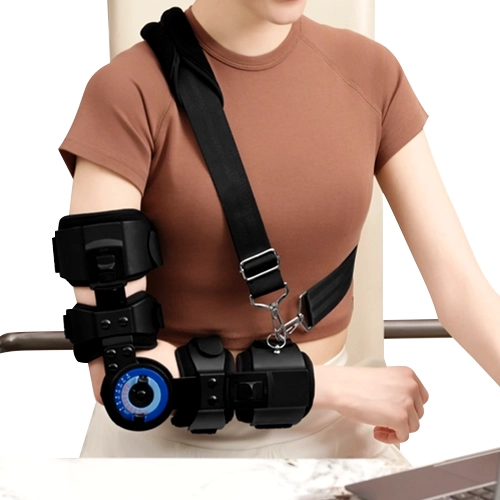
Definition and Structural Distinction
A hinged elbow brace is an externally worn orthosis equipped with bilateral mechanical hinges that align with the elbow‘s natural flexion-extension axis. Unlike standard compression sleeves, which provide only mild soft-tissue compression and proprioceptive feedback, or rigid non-hinged splints, which lock the elbow in a fixed position, a hinged elbow brace allows programmable motion restriction. The hinge mechanism does not merely permit movement—it actively defines the boundaries within which movement can occur, offering what clinicians call “controlled mobilization.”
The essential structural difference lies in the bilateral rigid hinges. Compression sleeves are made of elastic fabric that stretches with movement; hard non‑hinged braces hold the elbow immobile via rigid struts; external fixators are surgically implanted. A hinged elbow brace sits in the middle of this spectrum: it provides rigid structural support while allowing controlled flexion and extension through its hinge system.
How a Hinged Elbow Brace Works: The Mechanics Behind the Support
Anatomical Axis Alignment: Why Hinge Position Matters
A hinged elbow brace’s effectiveness depends critically on proper hinge alignment with the elbow’s anatomical axis—specifically, a line passing through the center of the capitellum and trochlea. When the brace’s hinge pivot aligns correctly with the lateral humeral epicondyle (the bony prominence on the outer elbow), the brace moves synchronously with the joint throughout flexion and extension.
Axis misalignment risks: If the hinge is placed too proximally or distally (too high or too low on the arm), the brace will not track the joint’s natural arc of motion. This can cause:
- Binding or resistance during movement
- Shearing forces on the skin and soft tissues
- Ineffective protection of the injured ligament
- Patient discomfort and reduced compliance
Many modern hinged elbow braces incorporate a telescoping design with push‑button length adjustment sliders (e.g., adjusting from 14.75″ to 18.75″ in 0.5″ increments) to ensure correct axis alignment across a variety of arm lengths.
ROM Dial / Turnbuckle Mechanism: How Low‑Load Prolonged Stretch Works
The ROM adjustment mechanism—whether a dial, turnbuckle, or worm gear—operates on a well‑established physiological principle: stress relaxation (also known as low‑load prolonged stretch, or LLPS). The mechanism operates as follows:
| Component | Function |
| Flexion stop | Limits how far the elbow can bend |
| Extension stop | Limits how far the elbow can straighten |
| Locking mechanism (press‑to‑lock) | Engages the selected stops after manual positioning |
| Graduated angle markings | Provide precise angle feedback (e.g., 0° extension, 15°, 30°, 45°) |
When a shortened or contracted tissue (e.g., the anterior capsule in a flexion contracture, or the posterior capsule in an extension deficit) is placed under a constant, low‑intensity stretch through the brace’s hinge mechanism, the tissue undergoes stress relaxation—the internal tension gradually decreases over time without requiring increased stretch force. This allows the collagen fibers of the joint capsule, ligaments, and tendons to undergo plastic (permanent) elongation rather than elastic (temporary) deformation, which is precisely what clinicians aim to achieve when correcting contractures.
Clinical ROM ranges typical on adjustable hinges include Flexion from 0° to 120° and Extension from 0° to 90° , often adjustable in 10° to 15° increments. The “low‑load, prolonged stretch” philosophy is supported by comparative studies: static progressive bracing has been shown to be markedly superior to turnbuckle and dynamic bracing for elbow stiffness, with the static progressive brace requiring 13 times less wear time than turnbuckle devices and 5 times less than dynamic devices, while achieving a 63% rate of regaining functional range of motion.
Cuff Pressure and Edema Reduction
The padded cuffs (upper arm and forearm) serve a dual purpose: comfort and edema management. When applied with appropriate tension, the cuffs generate gradient compression that facilitates venous and lymphatic return from the distal arm toward the heart. This compression:
- Reduces post‑operative or post‑injury edema
- Lowers the risk of complex regional pain syndrome by maintaining adequate circulation
- Improves proprioceptive input, which enhances neuromuscular control of the joint
- Prevents the brace from migrating or sliding during use
4 Core Functions of a Hinged Elbow Brace
1. Stabilization and Protection
Mechanism: Cross‑fixation straps and extension blocks work together to resist valgus or varus stresses at the elbow.
2. Post‑Surgical Rehabilitation and Progressive ROM Recovery
Mechanism: The incremental unlocking of ROM allows the therapist or patient to gradually expand the safe envelope of motion as healing progresses.
Clinical logic (using UCL repair as a model):
- Week 2: 30° to 90° active ROM in brace
- Week 3: 20° to 100°
- Week 4: 10° to 110°
- Weeks 5–6: Brace unlocked to full ROM (0°–145° typical goal)
- Weeks 7–8: Brace discontinued
This phased protocol respects the biological timeline of ligament healing—early protection prevents graft failure, while progressive ROM prevents capsular contracture.
3. Contracture Reduction
Mechanism: For contractures less than 6 months old, a hinged elbow brace can apply static progressive stretch in both flexion and extension directions. Unlike static splints that hold one fixed position, static progressive bracing allows the patient to incrementally increase the stretch by adjusting the ROM dials (e.g., advancing the extension stop every several days). The tissue undergoes stress relaxation and plastic elongation over time.
A comparative study of 156 patients with post‑traumatic elbow stiffness found that hinged external fixation in open elbow arthrolysis resulted in significantly greater improvements in flexion‑extension ROM (59.6° ± 26.1° vs. 46.2° ± 26.2°, p=0.004).
4. Sports Performance Support and Return‑to‑Play
Mechanism:Lightweight designs for sports (e.g., aluminum frames weighing as little as 360g) and low‑profile hinges allow athletes to participate in sport‑specific drills while maintaining essential protection.

ROM control strategy for returning athletes:
- Early return (weeks 1–4): Restrict ROM to 30°–90° to protect grafting
- Mid return (weeks 4–6): Expand to 15°–115°
- Late return (weeks 6+): Minimize ROM restriction while preventing hyperextension
Return‑to‑play compatibility: The brace must be compatible with sport regulations (e.g., padding requirements for football, weight limits for baseball). Always check league‑specific rules before competing while bracing.
Hinged vs. Non-Hinged Elbow Brace: Which One Do You Actually Need?
| Feature | Hinged Elbow Brace | Compression Sleeve / Strap | Rigid Non‑Hinged Splint | External Fixator |
| Motion control | Precise, programmable ROM limits | None | Complete immobilization | Full control (surgical) |
| Best for | Ligament tears, post‑op, contracture, return to sport | Tendonitis (tennis/golfer’s elbow), mild strains | Acute fractures, severe sprains (initial 7–14 days) | Severe instability, complex trauma |
| Comfort | Moderate–good (breathable foam, adjustable cuffs) | High (elastic fabric) | Low (rigid, no motion) | Low–moderate (surgical) |
| Daily use | Daytime only (typically not for sleep) | Day and night | Temporarily for acute phase | Continuous |
| Price range | 50–50–200+ | 10–10–40 | 20–20–80 | Surgical only ($$$$) |
How to Choose the Right Hinged Elbow Brace?
Factor 1: Injury Type Matching
| Injury / Condition | Recommended Brace Features | Wrong Choice Consequences |
| UCL tear, post‑Tommy John | ROM hinge, 0°–120° flexion / 0°–90° extension, cross‑straps to resist valgus | Using a non‑hinged sleeve → no valgus protection; using too much ROM too early → graft failure |
| Post‑op fracture fixation | Telescoping length adjustment, padded cuffs for edema control | Fixed‑length brace → hinge misalignment, poor protection |
| Tennis elbow (chronic with laxity) | Lightweight hinge with extension block only (30° extension stop), simple design | Over‑engineered ROM brace → needless bulk and cost |
| Contracture (<6 months) | Static progressive hinge, high‑resolution angle increments (10° or finer), bidirectional (flexion + extension) | Rigid splint → no progressive stretch benefit |
| Sports return (football, baseball, javelin) | Lightweight (<500g), low‑profile hinges, padding compliant with league rules | Heavy brace → fatigue; non‑padded hinge → league disqualification |
Factor 2: Adjustability and ROM Precision
What to look for:
- High‑resolution angle markings: Increments of 10°–15° allow fine‑tuned ROM progression
- Single‑action locking: A rotate‑and‑press mechanism is easier for patients with limited hand strength to operate
- Bilateral vs. unilateral hinges: Double hinges provide more symmetrical control and better tracking of the anatomical axis
- Worm gear vs. simple click‑stop: Worm gear mechanisms offer smoother, continuous adjustment but are bulkier; click‑stops are simpler and lighter but offer only discrete angle settings
Factor 3: Sizing and Fit – How to Measure and Avoid Nerve Compression
Telescoping sleeve measurement protocol:
- With the elbow bent at 90°, locate the lateral humeral epicondyle (outer elbow bony point).
- Adjust the brace’s telescoping arms so the hinge pivot sits directly over this landmark.
- Confirm that the upper arm and forearm cuffs do not impinge on the biceps or antecubital fossa when the elbow is fully extended.
- Check that the brace does not compress the ulnar nerve. Ulnar nerve compression causes tingling in the ring and small fingers.
Factor 4: Material and Comfort
Medical‑grade material assessment criteria:
- Breathability: Neoprene can trap heat; open‑cell foam or breathable polyester knit fabrics reduce maceration risk during prolonged wear.
- Skin friendliness: Hypoallergenic, latex‑free materials are essential for patients with sensitive skin or prolonged (>8 hours/day) wear.
- Moisture management: Removable, washable pads are a valuable feature for hygiene maintenance during long‑term use.
- Weight: Lighter braces (e.g., 360g aluminum construction) significantly improve patient compliance, especially for daytime wear.
Daytime vs. nighttime protocols:
- Daytime bracing: Prioritize lightweight, breathable materials and ROM adjustability for functional activities.
- Nighttime bracing (for contracture management): Materials that accommodate sustained positioning (e.g., serial bracing worn 24 hours when possible) may require more robust padding to prevent pressure ulcers. The RNOH (Royal National Orthopaedic Hospital) guide notes that with serial bracing, “ideally is worn for as long as possible in a 24 hour period,” but each case requires individual assessment.
Factor 5: Lifestyle and Usage Scenario Matching
- Return‑to‑play athlete (football, baseball, javelin): Lightweight (<500g) with low‑profile padded hinges; adjustable ROM stop; consult league equipment rules (padding requirements, maximum hinge protrusion). Some braces weigh as low as 360g, which minimizes energy cost during sport‑specific drills.
- Post‑operative patient (lower activity demand): Stability and protection take priority over weight. Look for robust cross‑straps and a stable hinge lock; a shoulder strap may help redistribute weight and reduce neck fatigue.
- Chronic pain / contracture patient (low‑load prolonged stretch): High‑resolution angle increments (10° or better) and bidirectional adjustment (both flexion and extension stops) are essential for tissue remodeling. Static progressive stretch braces have demonstrated superior outcomes compared to turnbuckle and dynamic devices for elbow stiffness.
Conclusion
A hinged elbow brace controls motion to protect healing and restore function—choosing the right one depends on your injury, ROM needs, and lifestyle.
At AOFIT, we design and manufacture premium hinged elbow braces for clinics, sports teams, and distributors worldwide. From OEM/ODM custom solutions to bulk wholesale with ISO/CE/FDA standards, we deliver quality, precision, and competitive factory pricing. Whether you need a private‑label line or post‑op bracing for professional athletes, partner with us to bring reliable orthopedic solutions to your market.