
You’ve probably stood in front of the mirror, noticed rounded shoulders staring back at you, and typed something like “do hunchback posture correctors actually work” into Google — right before adding a posture corrector to your cart. Smart move. Before you spend your money, you deserve real answers.
A hunchback posture corrector can genuinely help — but only if you understand what it’s designed to do and what it isn’t. We break down what the research says, which benefits are realistic, and exactly how to use one and which type fits your specific level of kyphosis. That way you don’t waste money on the wrong solution.
Do Hunchback Posture Correctors Actually Work?

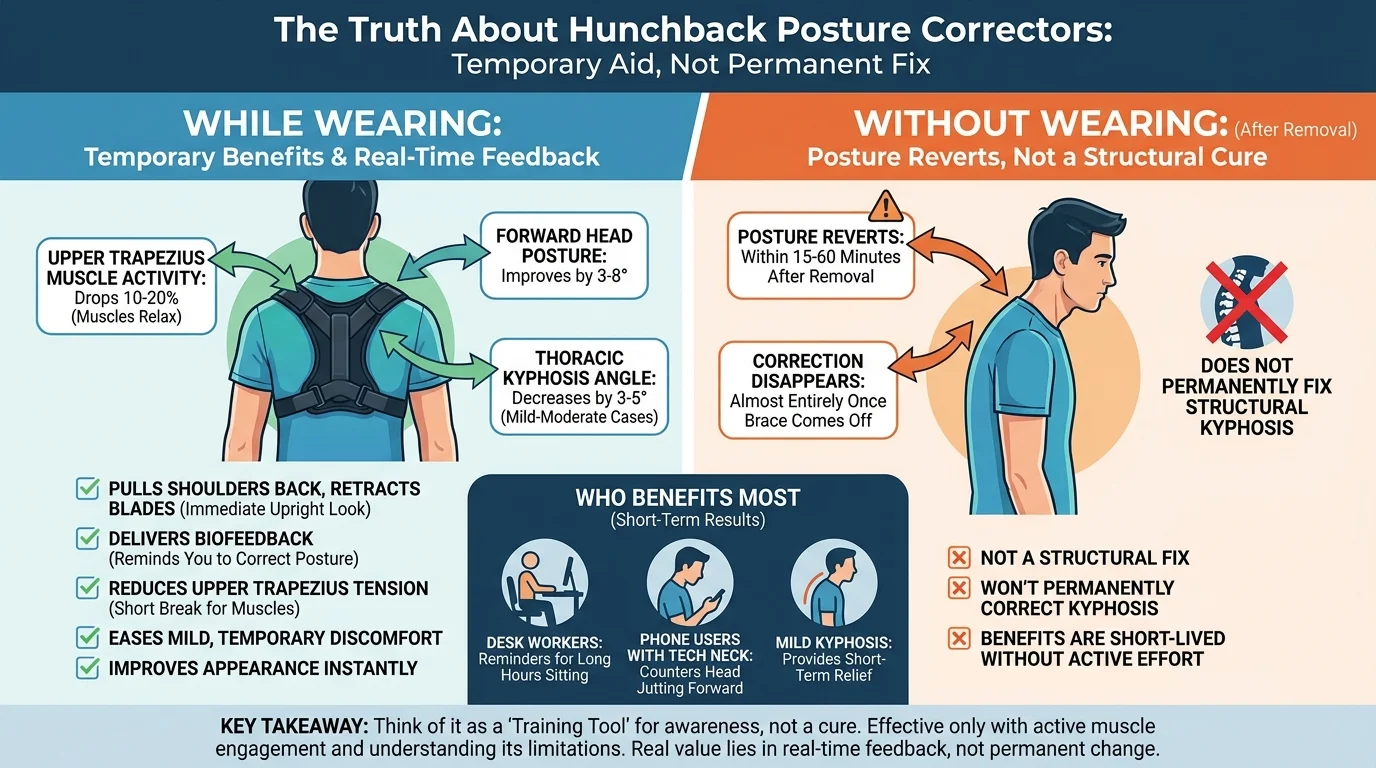
Hunchback posture correctors do work, but only while you’re wearing them.
Studies using EMG tracking show upper back and trapezius muscle activity drops by 10-20% during wear, meaning your muscles relax and stop overworking. Forward head posture improves by 3-8 degrees, and thoracic kyphosis angle decreases by 3-5 degrees in mild-to-moderate cases.
Remove the brace and posture reverts within 15-60 minutes. Clinical reviews confirm that the correction holds while the brace is on and then disappears almost entirely once it comes off.
Think of a posture correction device as a training tool, a reminder system for your muscles. It won’t permanently fix structural kyphosis.
What a Hunchback Posture Corrector CAN Do?
Once you know what a hunchback posture corrector can do, you can use it effectively and get real value from it.
The Concrete Benefits You Can Expect
Pulls shoulders back and retracts the shoulder blades. The straps or back panel physically pull you into a more upright position, immediately reducing that rounded, “caved-in” chest look.
Delivers biofeedback in real time. Think of it as training wheels for your posture. It doesn’t fix anything on its own; it just makes you aware in the moment that you’re slouching. That awareness is what lets you correct it yourself.
Reduces upper trapezius activity. Wearing a brace lowers activation in the upper trap muscles, giving your overworked shoulder and neck muscles a short break.
Eases mild, temporary discomfort. Some users report a bit less neck and shoulder tension during wear.
Improves your appearance instantly. You’ll look straighter and more put-together the moment you put it on. This is visual, not structural, but it’s still a real, tangible effect.
Who Actually Benefits Most
Not everyone gets the same payoff. Three groups tend to see the clearest short-term results:
Desk workers. Long hours sitting with shoulders creeping forward respond well to the reminder effect and muscle relief.
Phone users with tech neck. If your head juts forward every time you check your phone, a brace interrupts that pattern while you’re wearing it.
People with mild rounded shoulders. If your kyphosis is early-stage, a posture correction device works best as a subtle nudge rather than a fix for a rigid, structural curve.
The Smart Way to Use One
Skip the all-day wear. Most evidence points to shorter, targeted sessions, around 20 to 30 minutes or a few hours max per day, during the activities where you slouch the most: desk work, screen time, meetings.
Pair it with active work, scapular stability drills, thoracic mobility exercises, and upper back strengthening. That combination is what turns “straighter while wearing it” into “straighter because you built the habit.”
Set your expectations accordingly. A back straightener brace helps you feel more upright and less fatigued right now. It won’t permanently correct kyphosis in a few days, and no product legitimately can.
What a Hunchback Posture Corrector Cannot Do?
Once thoracic kyphosis crosses 50-55° on the Cobb angle scale, you’re dealing with structural deformity. Vertebral bodies that are wedged, fractured, or surgically fused won’t budge for any kyphosis brace, no matter how tight the straps. Osteoporotic compression fractures make this worse. Each one adds roughly 3-4° of additional curvature and can cost you 1-2 cm of height. No spine alignment brace on the market can restore that lost vertebral height or reverse fracture damage.
Neuromuscular conditions like cerebral palsy or muscular dystrophy require medical-grade orthoses.
It Can’t Build Muscle; It Only Supports It
A posture corrector doesn’t strengthen anything. It provides passive support. Wear it too much, and you risk muscle atrophy and dependency. Postural muscles that never have to work start to weaken.
California Pain caps daily use at 20-30 minutes, and GoodRx echoes similar limits of no more than a couple hours daily, never all day, never while sleeping.
It Can’t Replace Medical Care
If you’re dealing with nerve tingling, dizziness, or persistent pain despite sitting straighter, a brace can’t diagnose or treat that. Healthline and NIH reviews both confirm that no current studies show these devices produce lasting postural correction on their own.
How to Use a Hunchback Posture Corrector for Best Results?
Build Up Wear Time Gradually
Don’t strap it on for hours right away. Start small.
Days 1-3: 15 to 30 minutes a day, while you’re reading or sitting still.
Days 4-7: 45 to 60 minutes. Add in some light walking.
Weeks 2-4: One to two hours a day, split into two sessions.
After 1 month: Cap it at one to two hours. The makers are clear: wearing it longer won’t fix your rounded shoulders any faster.
Get the Fit Right – Support, Not Restriction
The rule: it should feel like a nudge, not a straitjacket.
After strapping in, take three deep breaths. If your chest feels tight, loosen the straps by one or two cm.
Any skin marks should fade within 10 to 15 minutes. If they’re still red after 30 minutes, it’s too tight.
Numbness or tingling in your arms or fingers? That’s nerve compression. Remove the brace right away.
Your shoulders should sit back and down, not pulled up toward your ears.
Position Before You Lock It In
Never strap on a posture brace while you’re slouched. You’ll just lock in bad alignment. Stand against a wall first, with your head, shoulder blades, and heels touching it. Then fasten the corrector in that upright position.
Pair It With Active Training
A brace alone won’t rebuild your muscles. You need to pair it with strengthening work.
Week 1: 15 to 45 minutes of wear time plus a 5-minute daily routine (chest stretch, chin tucks).
Week 2: 60 to 90 minutes of wear plus scapular squeezes and wall chest stretches.
Weeks 3-4: Cut wear time by 25 to 50 percent. Add resistance band pulls and thoracic mobility work, four times a week.
This support-plus-training approach is what actually makes a posture corrector work long-term.
Which Type of Hunchback Posture Corrector Is Right for Your Severity?
Not all posture correctors solve the same problem. Use the wrong strength for your condition, and you get zero benefit or unnecessary discomfort.
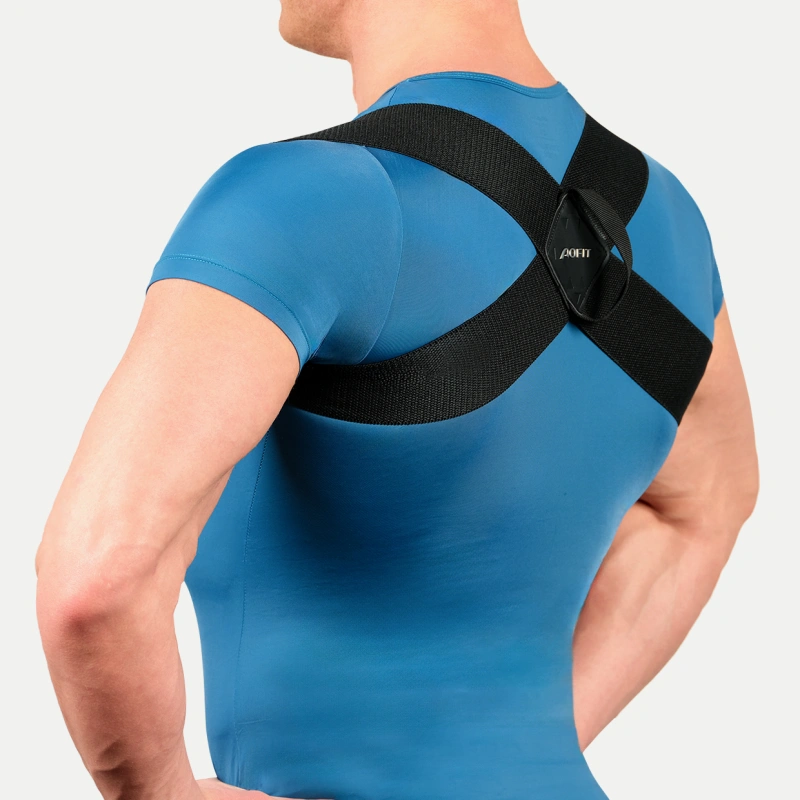
Mild rounded shoulders (Cobb angle under 40°, no structural change): You can still straighten up when you try. A soft shoulder posture brace works best here. Look for elastic straps 3-5 cm wide, breathable mesh, and adjustable sizing. Wear it 2-3 hours daily, split into 30-60 minute sessions. This is AOFIT‘s Upper Back Posture Corrector, designed for desk workers, students, and anyone managing daily posture rather than treating deformity.
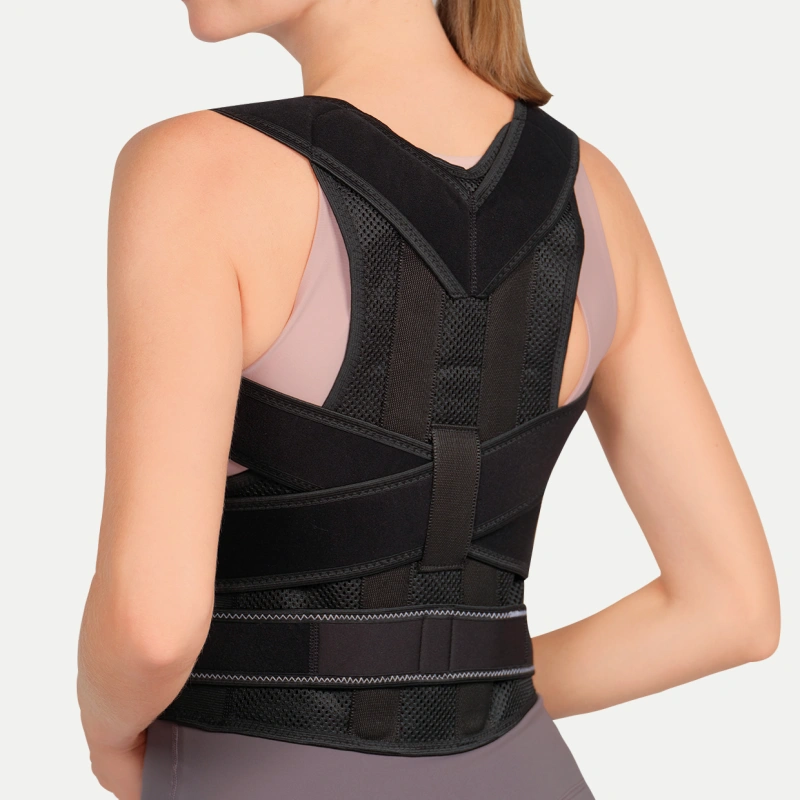
Moderate posture issues (harder to straighten without lying flat or leaning against a wall): You likely need more structure. A full back brace with rigid support strips (often 4 steel or plastic panels running from T1 to L5) provides stronger correction for adults on their feet all day or dealing with back fatigue from lifting. These sit in AOFIT’s Posture Corrector For Back.
Severe structural kyphosis (visible on X-ray, height loss, nerve symptoms): Stop shopping and see an orthopedic specialist first. A store-bought spine alignment brace won’t correct fixed vertebral deformity. Medical-grade TLSO orthoses, prescribed after imaging, are the appropriate route, not a consumer-grade back straightener brace.
Two more options worth knowing: Posture shirts offer low-to-moderate, all-day tension for people who dislike strap pressure. Smart posture devices vibrate when you slouch past a set angle (typically 15-25°), training behavior without any physical support at all.
Beyond the Hunchback Brace: Exercises and Habits That Create Lasting Posture Change
No brace ever built a stronger back. Muscles do that. If you want your rounded shoulders to stay corrected when the straps come off, you need a routine that targets the thoracic spine, the scapular retractors, and the chest muscles that got tight from years of slouching.
The High-Yield Exercise Sequence
Run through this order for the best results:
Thoracic foam-roller extension — 30-60 seconds, up to 2 minutes with deep breathing.
Chest stretch at a wall or doorway — 20-30 seconds, 3-4 reps per side.
Rows or band rows — 3 sets of 12-15 reps, resting 30-60 seconds between sets.
Wall angels/wall slides — 2 sets of 15 reps.
Chin tucks — 2-3 sets of 10 reps, holding each 3-5 seconds.
Prone Y/W raises or cobra-style back extensions — 3 sets, 30-second holds.
Make It a Habit, Not a One-Time Fix
Consistency beats intensity. Do this daily, or at least twice a day for a full month. That’s the timeframe most posture-improvement trials use before seeing measurable change.
Fix Your Desk, Not Just Your Back
Exercises won’t stick if your workspace keeps dragging you back into a slump.
Set your screen at eye level so your head stops drifting forward.
Adjust your chair so hips and knees sit near 90°, feet flat on the floor.
Keep elbows close to your sides, shoulders relaxed.
Move every 30-60 minutes. Static sitting is the enemy of any thoracic kyphosis treatment plan.
A hunchback brace can remind you to sit up. Only strength and movement will keep you there.
Conclusion
A hunchback posture corrector won’t rebuild your spine, but used right, it will accelerate your progress. Think of it as training wheels for your posture: it retrains your muscle memory, reminds your body what “shoulders back” actually feels like, and supports your postural muscles while you strengthen them with targeted exercises.
Real progress comes from pairing a quality posture corrector with consistent daily habits. Don’t expect the brace to do all the work alone. Wear the hunchback brace strategically, stay realistic about timelines, and combine it with the exercises we covered above.
Browse our range of posture correctors at Top Custom Posture Corrector Manufacturer, designed for different severity levels, and start rebuilding better posture one day at a time.