
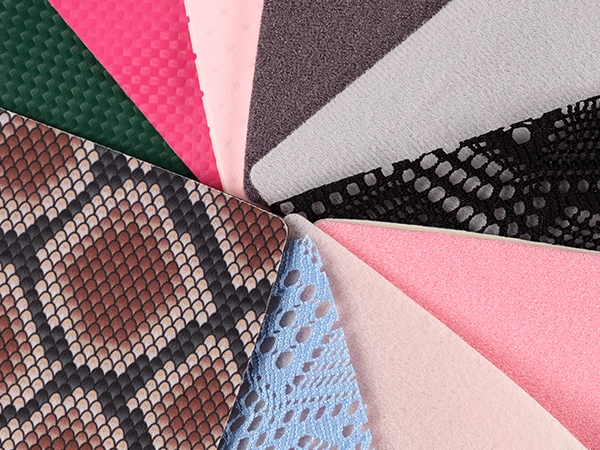
Not all ankle braces are the same, and the difference usually hides in the ankle brace material. An ankle brace made with the wrong material can leave athletes overheating mid-game or give patients support that stretches out after a few weeks. For brands sourcing at scale, picking the wrong neoprene or fabric blend means costly returns and unhappy customers.
Whether you’re a physical therapist recommending a product, a weekend runner comparing options, or a brand owner vetting suppliers for your next OEM run, knowing what goes into these ankle brace materials — and why it matters — changes how you buy. We break down every major fabric type, how they compare on comfort and durability, and what to look for when customizing or sourcing at volume.
What Ankle Brace Materials Are Used?
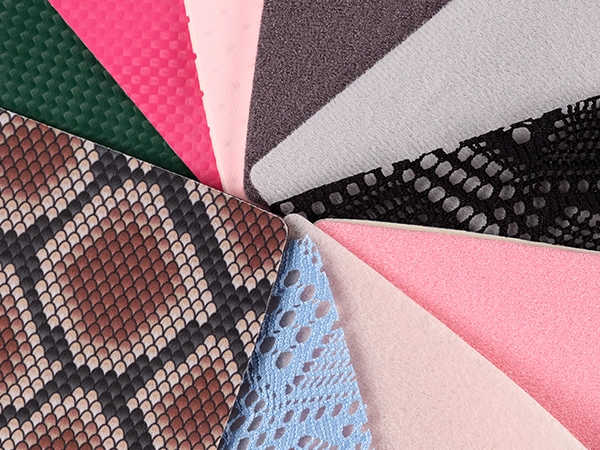
Six fabrics do most of the work in ankle brace construction. Each one solves a different problem — heat, stretch, durability, airflow — and manufacturers blend them because no single fiber checks every box.
Neoprene: The Support-and-Warmth Fabric
Neoprene is thick, elastic, compressive, and water-resistant. It’s the go-to medical-grade brace material for sprain recovery and stabilization designs where you need both compression and heat retention. A standard ankle brace often runs 62% neoprene, 8% spandex, and 30% nylon, while higher-spec hard-shell braces use 25% SBR neoprene for added rigidity. In sports medicine, neoprene ankle supports are built to retain heat, reduce discomfort, and minimize swelling.
Nylon: The Durability Layer
Nylon ankle brace shells hold up to abrasion, stay lightweight, and dry fast. You’ll find it in outer shells, straps, and reinforcement zones. Real builds show ratios like 48% nylon, 26% neoprene, 25% polyester, and 1% elastane, or 40% nylon, 50% polyester, and 10% spandex in laced designs. It’s the backbone fiber when a brace needs to survive daily wear without losing shape.
Spandex: The Stretch-and-Recovery Fiber
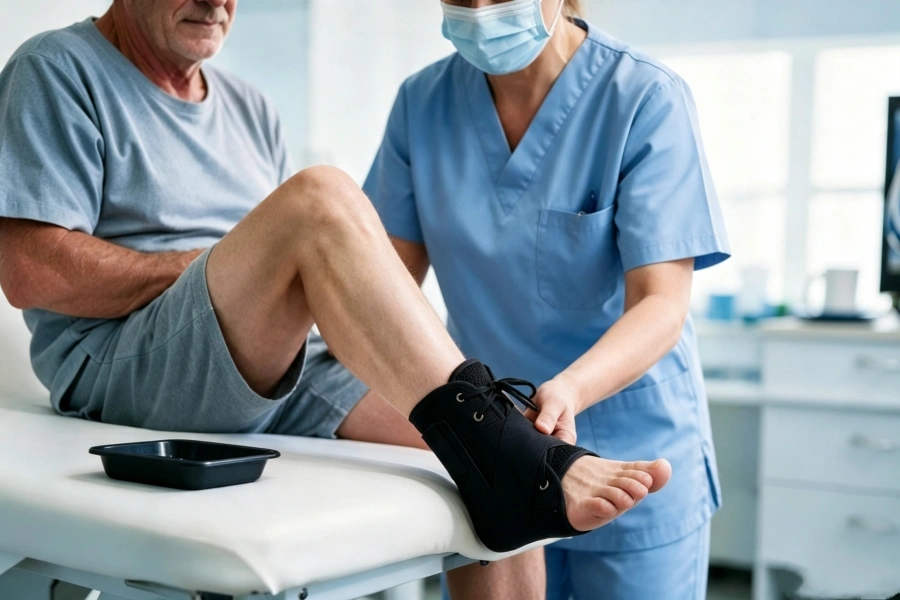
Spandex rarely acts alone. As an elastic ankle support material, it adds stretch and snap-back. Think 10% spandex blended into a laced brace, or 5% inside a hard-shell design. It lets a brace move with the ankle instead of fighting it.
Polyester: The Balance Fabric
Polyester manages moisture, resists wear, and knits easily into support textiles. Common ratios include 50% polyester with 40% nylon and 10% spandex, or 25% polyester paired with neoprene shells.
Mesh: The Breathable Panel
For breathable ankle brace fabric, 100% polyester mesh panels ventilate sweat-prone zones, a staple in hot-weather sports braces.
Latex/Elastic Thread: The Tension System
Latex bands deliver strong rebound for adjustable compression, seen in builds like 38.5% latex, 55% nylon, and 6.5% spandex. Some users may be allergic to latex, so keep that in mind.
Ankle Brace Material Comparison Table: Support vs Breathability vs Comfort
|
Material |
Support |
Breathability |
Moisture Wicking |
Warmth/Recovery |
Flexibility |
Best For |
|---|---|---|---|---|---|---|
|
Neoprene |
5/5 |
1/5 |
1/5 |
5/5 |
3/5 |
Cold-weather use, sprain recovery, compression + heat retention, short-duration stabilization |
|
Nylon |
3/5 |
3/5 |
4/5 |
2/5 |
3/5 |
Outer shells, straps, reinforcement zones, daily-wear durability |
|
Spandex |
2/5 |
3/5 |
3/5 |
2/5 |
5/5 |
Stretch and snap-back in laced/hard-shell blends; low-profile fit |
|
Polyester |
2/5 |
4/5 |
5/5 |
2/5 |
4/5 |
Moisture-managing liners, balanced support textiles, blends |
|
Mesh |
1/5 |
5/5 |
4/5 |
1/5 |
5/5 |
Breathable ventilation panels in hot-weather/sport braces |
|
Latex/Elastic Thread |
4/5 |
2/5 |
1/5 |
3/5 |
5/5 |
Adjustable compression/tension straps; latex allergy caution |
How to Choose Ankle Brace Material by Use Case?
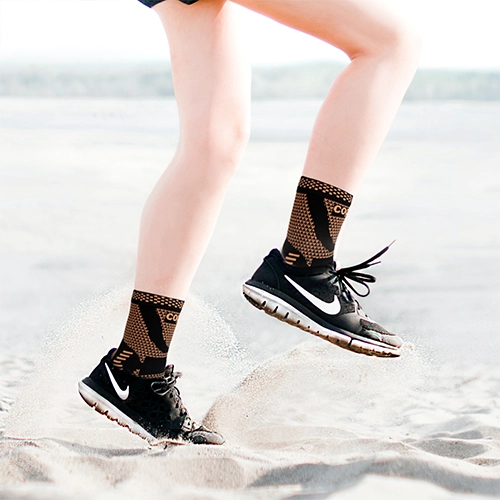
Fit the ankle brace material to the job. A physical therapist stocking recovery braces has different priorities than a brand sourcing gear for a basketball line, and the fabric choice should reflect that.
Match Ankle Brace Material to Activity Level
Active users — runners, court-sport athletes, anyone training multiple directions at once — do best with nylon + spandex or mesh/knit builds. Bauerfeind’s Active Knit Fabric is marketed as “soft, breathable and machine-washable,” and that’s the profile worth chasing for warm-weather, long-duration wear. Skip thick neoprene here; it traps heat during high-output movement.
Post-injury recovery users need the opposite trade-off. Neoprene blends, often neoprene, nylon, elastane, polyester, polypropylene combinations, deliver compression and warmth over pure breathability. Neoprene compression sleeves offer “mild compression and warmth but minimal structural support,” which suits early-to-mid recovery, not competitive return-to-play.
Cold environments or extended recovery periods call for thicker neoprene coverage. The priority shifts to wrap-around warmth and a secure feel, not airflow.
Hot climates and all-day wear favor moisture-wicking knitted polyester, nylon, and elastic blends — the same logic Bauerfeind applies to reduce heat buildup and odor over an 8-hour workday.
Quick Decision Shortcuts
Want breathability + all-day comfort → nylon/polyester/mesh
Want compression + warmth → neoprene blend
Want lightweight agility → nylon + spandex + mesh
Want brace-level rigidity → add lace-up or side stabilizer structures over the fabric base
Budget vs. Comfort Trade-offs
Lightweight nylon/polyester knits are the most affordable and comfortable for daily protection. Mid-priced neoprene blends balance compression and warmth for recovery use. The neoprene + nylon + spandex mix remains the most common “balanced” choice: fit, base support, and some breathability in one package. Support-first budget models with stabilizer bars can run as low as $9.98–$10.97, though comfort takes a back seat in that price bracket.
Custom Ankle Brace Material & OEM/ODM Options
Brands pick a supply chain that can execute at scale. A professional custom ankle brace factory works with neoprene, knitted nylon, breathable mesh, medical-grade elastic, bamboo fiber, SBR cloth, LYCRA, OK cloth, EVA foam, silicone gel, memory foam, and reinforced aluminum or plastic stays.
Each material has processing limits worth knowing before you spec a design. Neoprene typically comes in 2mm, 3mm, or 5mm thickness, and factories will ask for REACH/RoHS documentation plus skin-contact test data. Elastic knit fabrics run 260–320 gsm with rebound rates of 95% or higher, the benchmark for compression that holds shape after repeated wear.
Customization Dimensions
Support level: light, compression, semi-rigid, or rigid (ODM reuses existing molds; OEM rebuilds the frame)
Sizing: S/M/L/XL, left/right-specific, adult or youth versions
Color: black, grey, skin-tone, blue, or brand-matched custom colors
Logo placement: woven label, heat transfer, screen print, hook-and-loop tab
Packaging: retail boxes, OPP bags, hang tags, barcode stickers
Certifications: CE, ISO13485, BSCI, AQL 2.5/4.0
Common OEM/ODM Ankle Brace Material Combinations
Nylon + spandex: lightweight compression for daily/sport use
Neoprene + elastic band: medical-grade wraparound support with adjustable straps
Composite fabric + stays: semi-rigid builds for sprain prevention
ODM gets you to market fast on existing molds; OEM gives full control over material, stays, and padding, starting from sample development. MOQs commonly start around 200 pieces for private label, with some ankle brace manufacturers requiring 500 pieces per design.
Ankle Brace Manufacturer & Supply Chain Capability
The supply base is deep, and picking a partner takes more than a Google search. Certifications, lead times, and MOQ structures separate a real orthopedic brace supplier from a trading company reselling someone else’s stock.
Certification Benchmark
AOFIT ‘s braces and supports are medical-grade, with ISO 13485, CE/MDR, and FDA 510(k) coverage (verify per SKU).
Reported terms: MOQ 500 pcs/SKU, 25–35-day lead times, and FOB pricing between $1.20–$5.00/pc.
What Broad Product Lines Signal
Factories that pair ankle braces with knee pads, wrist guards, back supports, and walker boots (like AOFIT) tend to have stronger pattern libraries and multi-material sewing capability. That breadth lowers development risk on custom runs.
Due Diligence Checklist
MOQ: 100–500+ pcs/SKU for existing molds; custom OEM often starts at 500 pcs
Lead time: 25–35 days standard, up to 45 for heavy customization
Price band: $1.20–$5.00/pc FOB depending on material and certification scope
Ask for: OEM/ODM case studies, export market history, sample lead time, and SKU-specific compliance docs
Ankle Brace Material FAQ
Is neoprene the best ankle brace material overall?
Not universally. It wins on compression, warmth, and mid-range stability, which is why rehab and short-session sports lean on it. Nylon-spandex blends beat it on breathability every time. Neoprene traps heat and sweat over long wear.
Are nylon and spandex more breathable than neoprene?
Yes. That’s their whole job. A 62% nylon / 38% spandex ratio is common precisely because it holds fit and rebound while staying cool.
What materials show up most in ankle braces?
Neoprene, nylon, spandex, polyester, and elastic fiber form the base. High-support builds add TPU, PU foam, or TPR structural pieces. “Neoprene + nylon + polyester” and “nylon + spandex + latex thread” are the two mixes you’ll see repeated across ankle brace material specs.
Do stitching and straps matter as much as fabric?
Yes. Figure-8 straps, lace-up panels, and reinforced seams control fit and adjustability as much as the fabric underneath.
Can I add my logo?
Standard OEM/ODM offering: woven label, printed logo, or rubber patch.
Do suppliers offer fabric swatches?
Reputable factories stock 50+ material options and ship swatches on request before you commit to a production run.
Conclusion
Choosing the right ankle brace material comes down to matching fiber to function. Neoprene locks in warmth and compression for injury recovery, nylon blends deliver durability for daily wear, and breathable mesh keeps athletes cool during high-intensity training. No single fabric wins across the board; the best choice depends on your use case, budget, and performance priorities.
At AOFIT, we source medical-grade ankle brace material and help you prototype, test, and scale it, from custom logos and colorways to full OEM/ODM production runs with certified quality control.
If you’re sourcing your next ankle support line or refining an existing product, send us your specs, and we’ll turn them into a sample you can actually feel the difference in. Contact us now!