

That awkward roll off a blocker’s foot, the pop you felt landing from a spike, the tape job that never quite holds up past the third set—if any of that sounds familiar, you already know why you’re here. Volleyball delivers brutal, repetitive stress to your ankles with sudden lateral cuts, hard landings, and constant contact at the net where one bad step can end a season. A solid pair of volleyball ankle braces keeps you on the court instead of the sidelines.
We tested and researched the top ankle braces for volleyball on the market right now, from rigid, hinged designs built for post-injury stability to lace-up and compression styles for players who want protection without sacrificing mobility. Below you’ll find seven standout options, plus a practical breakdown of how to match the right ankle stabilizer to your injury history, playing style, and level of competition.

AOFIT Elastic Ankle Compression Sleeve — Overall Support
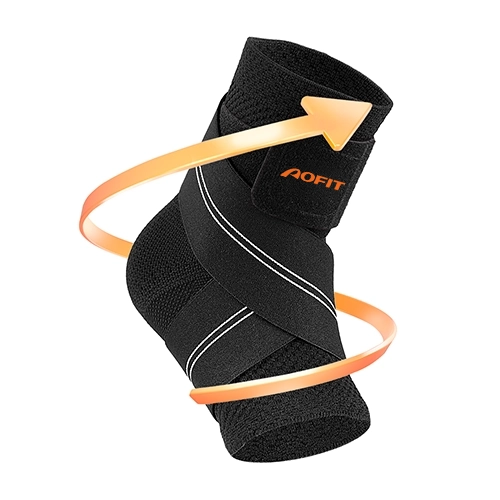
AOFIT Elastic Ankle Compression Sleeve is for a different kind of scenario: the daily grind of training, the lingering instability after a mild sprain, and the preventive edge that keeps you on the court. It’s about confidence.
Unlike rigid braces that lock down 50‑65% of your ankle’s normal range, this sleeve uses graduated compression to support muscles and joints while allowing full, natural motion. You feel stable, but you can still plant, cut, and jump without fighting the brace—exactly what volleyball players need when they’re reacting to a tip or landing from a spike.
That freedom is what makes it work for volleyball. The sport lives on explosive jumps, rapid direction changes, and repetitive hard landings. Here, a compression sleeve shines by enhancing proprioception (your body’s awareness of joint position) and reducing micro‑swelling, so you stay reactive and fresh set after set. It’s built for hitters, defenders, and all‑around players who want lightweight, breathable support, not immobilization.
Comfort comes from the seamless knit construction, moisture‑wicking fabric, and contoured fit that reviewers consistently praise for disappearing under your socks. The sleeve stays put without pinching, rolling, or bunching, even through multiple matches—and the skin‑friendly material means you can wear it all day without irritation.
One practical note: the sleeve is low‑profile and takes up minimal space inside your shoe, so it usually works with your normal size. However, if your volleyball shoes already run snug, check for any tightness across the arch or the heel. A half‑size up might still be a safe bet if you prefer a roomier forefoot—but most players find their usual fit works just fine.
At roughly $19.99, it’s priced like an accessible entry point into serious ankle protection. AOFIT also offers custom and OEM options if you’re outfitting a full team.
Ultra Zoom Hinged Ankle Brace — Maximum Support for Recurrent Injury
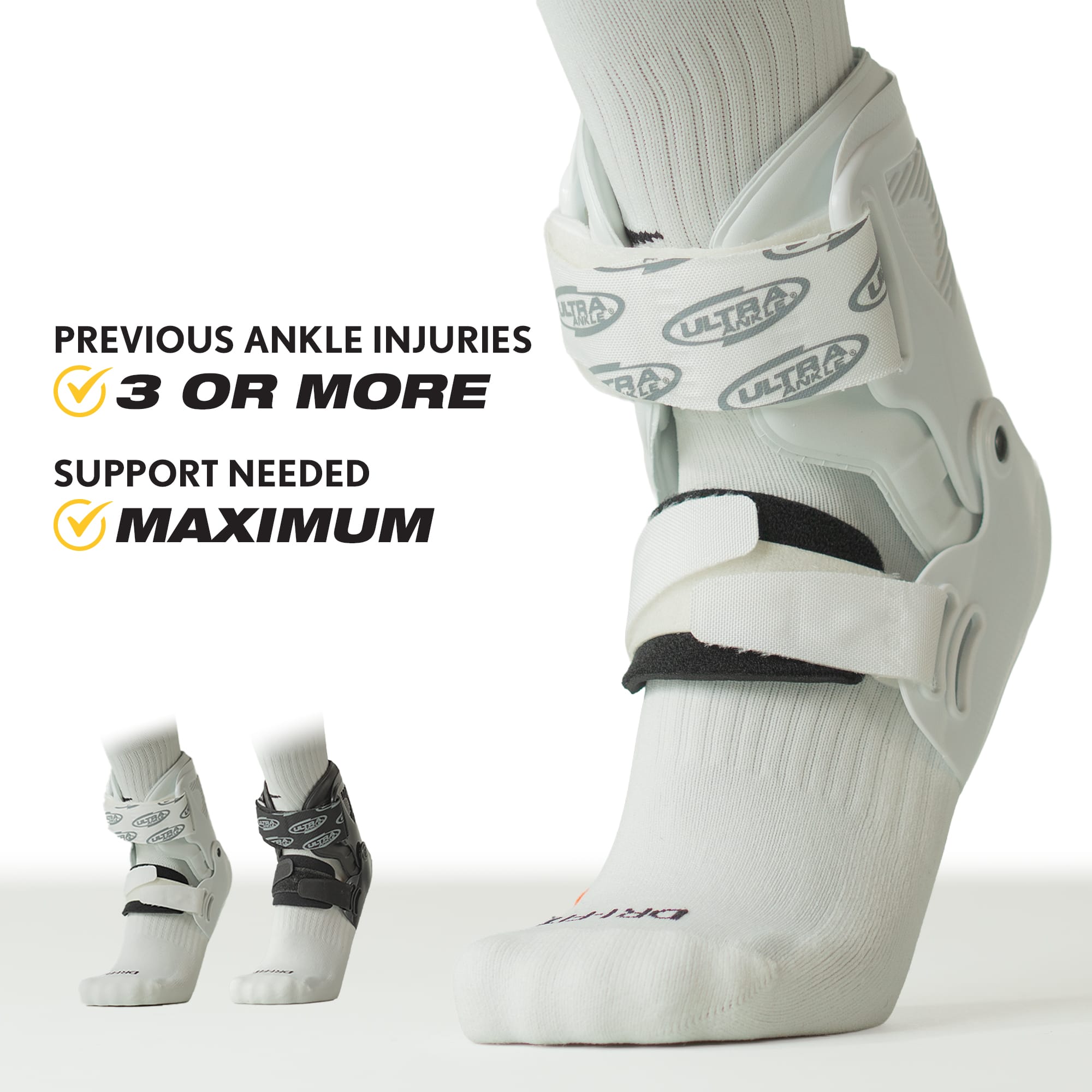
Recurrent sprains change the calculus entirely. If your ankle has rolled once, twice, three times, you’re managing chronic instability. That’s the exact problem Ultra Zoom was engineered to solve.
The hinged-cuff design separates this from a standard lace-up ankle brace. The cuff moves with your joint’s natural range while clamping down hard on the excessive twisting and turning that causes inversion sprains. You get restriction where it matters and freedom everywhere else.
Traditional lace-up braces tend to limit motion broadly. Ultra Zoom gives maximum support with full mobility intact, so you’re not fighting your own brace mid-rally.
Zamst’s A2-DX takes a different route to the same destination—left/right-specific fit, rear application, three-way stabilization aimed squarely at chronic instability and jumping sports. Both live in the “serious support” tier. Ultra Zoom leans performance-first; A2-DX leans stability-first.
Sizing runs by shoe size. Small/Medium fits 10.5–14, and Large/X-Large fits 14–16.
Expect a short break-in period; most players need one to three sessions to adjust to the lateral snugness and the slightly different feel on landing. That’s normal for anyone moving from a soft sleeve into a semi-rigid hinged structure.
At $69.95, it sits above budget rigid braces but below premium clinical-grade options—reasonable for players managing genuine recurrent injury risk.
Med Spec ASO Ankle Stabilizer — Lace-Up Support for Serious Athletes
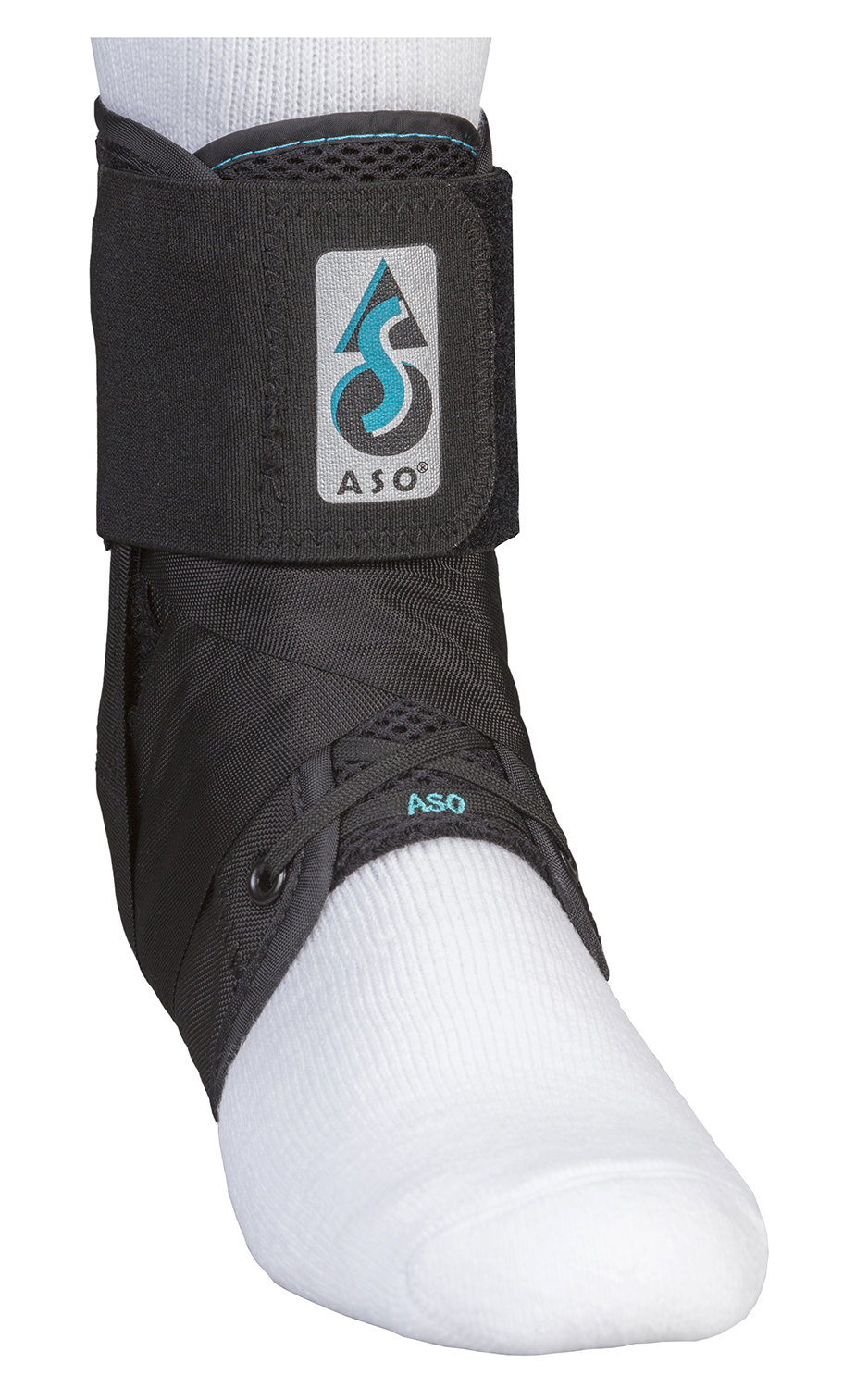
Ask ten athletic trainers what’s in their kit bag, and Med Spec ASO Ankle Stabilizer shows up. The lace-up design has earned trust among collegiate and professional athletes over the years. Retailers describe it as trusted by athletic trainers and orthopedic surgeons worldwide. It reflects a level of adoption you don’t see with most volleyball ankle braces on the market.
The design includes angled stabilizing straps that contour above the malleoli, a spacer mesh tongue, and Achilles-friendly mesh at the back for a seamless, chafe-free fit. It is indicated for inversion and eversion sprains, medial/lateral instability, and subtalar joint instability, covering the full spectrum of recurring ankle problems.
Research backs it up. In controlled studies, the ASO significantly delayed time-to-peak inversion during sudden rolls, and separate testing showed reduced maximum inversion angle without increasing risk to the untaped ankle. That’s real ankle sprain prevention for volleyball.
The design is left/right universal, so fit comes down to lace-up and figure-8 strapping. Narrow ankles can cinch down tighter; wider feet rely more on shoe space cooperating.
Sizing: Medium through 3XL, with Large fitting roughly 13–14 inch ankle circumference. Pricing runs $35.77–$40.99 for a single, around $69.99 for two-packs. If you want more rigidity, the ASO with Plastic Stays adds medial and lateral stays for extra proprioceptive support.
McDavid 195 Ankle Brace with Straps: High-Support Strap System
Tape jobs loosen. That’s just physics working against you over three sets. McDavid built the 195 to solve that exact problem. It simulates the restraint of athletic tape without the mid-match unraveling, and you can tighten it at any point during play without unlacing your shoe.
The construction uses a single-layer nylon/polyester shell (600 denier polyester, according to one retailer’s spec sheet), a figure-6/figure-8 strap system, padded lining, a ventilated tongue, and a sewn-in arch for stability underfoot. The strap system lets you custom-fit tension on the fly, which matters when you’re rotating between serve-receive and blocking and your ankle needs slightly different support for each.
Sizing runs by shoe size: XS covers men’s 6–7/women’s 7–8, scaling up to M at men’s 9–11/women’s 10–12, with XL available on some listings. Ankle circumference sizing exists too: XS at 19.1–20.3 cm up through XL at 24.1–25.4 cm.
The McDavid 195 costs around $34.50–$46.99, undercutting the Active Ankle T2’s $44.99 brand-site price and well below the ASO’s $79.95 catalog listing. If you need fast in-game adjustment without full rigid restriction, this is the more budget-friendly rigid ankle brace for jumping sports worth trying first.
McDavid 511 Ankle Brace — Compression + Support Combo
Not every ankle needs a fortress. Sometimes you just need a compression ankle sleeve volleyball players can slip on before warm-ups and forget about until the final whistle. That’s the entire philosophy behind the McDavid 511.
This is a knitted elastic sleeve, not a brace in the traditional sense. McDavid lists it as Level 1/basic protection, and that classification matters—it tells you exactly what you’re buying. No rigid stays, no hinged cuff, no lace-up strapping. Just a breathable, non-neoprene knit built from 65% polyester, 25% rubber, and 10% nylon that hugs your ankle and stays low-profile enough to disappear inside your shoe.
Who it actually works for:
Back-row defenders and liberos who need constant footwork over heavy impact absorption
Players warming up or managing minor soreness, not recovering from a real sprain
Anyone who wants proprioceptive feedback and mild support without sacrificing range of motion
Pull-on design means it’s on your foot in seconds—no lacing, no adjusting straps mid-set. The tradeoff is obvious: this won’t stop a hard inversion roll the way a rigid ankle brace for jumping sports would.
Sizing runs by shoe size, S through XL, with EU/UK equivalents listed if you’re shopping internationally. Pricing sits around $17.99–$21.99 depending on region, making it one of the more affordable entries here.
Think of the 511 as a supplement to healthy ankles, not a replacement for real stabilization after injury.
Shock Doctor Ultra Wrap Lace Ankle Brace — Customizable Wrap Fit
Sprains don’t come in one size, and neither should your brace. Shock Doctor’s model 851 tackles that problem with a hybrid lace-up and wrap design built for Grade 2–3 sprains and genuine ankle instability.
The multi-directional adjustable strap wrap stability system gives you lateral and medial support without taping. You dial it in through wrap path and strap tension together. Color-coded figure-8 strap ends make it easier to find the correct routing every time you gear up, so you’re not guessing at wrap patterns mid-season.
Up front, low-profile lacing loops and a pre-curved tongue let you fine-tune tightness around swelling or a higher instep. Finger tabs and an easy-grip pull system make tightening less of a wrestling match, though this isn’t a speed-lace product. Budget a few extra minutes pre-match for proper calibration.
Build details worth knowing:
Integrated antimicrobial technology and latex-free construction
Anatomical footbed with no-slip silicone gripper pattern
Fits both left and right feet, simplifying sizing for teams
Shock Doctor classifies this as Level 3 maximum support, priced around $39.99–$46.99 in the US ($99.99 AUD). Skip the dryer. Hand wash cold, air dry flat, and loosen straps fully after use to protect elastic fibers long-term.
Zamst A2-DX / FILMIST — Rigid vs Lightweight Volleyball-Specific Options
Two Zamst braces, two distinct approaches. The A2-DX and FILMISTA ANKLE serve different needs, and picking the wrong one means either fighting unnecessary bulk or under-supporting a genuinely unstable joint.
A2-DX is Zamst’s strong-support model. It’s built for chronic ankle instability, moderate-to-severe sprains, and players who need rigid protection over pure mobility. Zamst’s own volleyball guidance calls it the strongest support in the series, with a protective guard and dual X-strap stabilizer that deliver three-way support — anterior, lateral, medial. This is the right choice for front-row hitters, blockers, and anyone with a real injury history who’s landing hard, repeatedly.
FILMISTA is the opposite. It uses two-film stability tech, and Zamst describes it explicitly as an alternative to traditional taping — light, ultra-thin, and low-profile. The support level is listed as “Light.” Back-row players and liberos who prioritize footwork and court feel tend to prefer it.
Pricing matches the positioning. In Japan, the A2-DX is ¥8,690, and the FILMISTA is ¥5,500. In Europe, you’re looking at €69.95–€74.95 for the A2-DX against €45.00 for the FILMISTA. In Canada, it’s C$104.99 versus C$69.99. Across these markets, the FILMISTA runs 25–40% cheaper.
If you have chronic instability and take hard landings, go with the A2-DX. If you want a taping-like feel without the bulk, start with the FILMISTA.
How to Choose the Right Volleyball Ankle Brace?
Start with type. Hinged braces give the highest support and the lowest flexibility. They’re for acute recovery and severe instability, not everyday drills. Lace-up designs sit in the middle, with the most balanced support-to-mobility ratio, which is why they’re the volleyball workhorse for Grade I–II sprains and return-to-play training. Compression sleeves sit at the flexibility extreme. They add minimal restriction and mostly proprioceptive feedback, which works for prevention but not for a joint that’s already unstable.
Match the brace to your position. Front-row hitters and middles jump repeatedly, so they need a low-profile lace-up ankle brace that fits inside volleyball shoes without sacrificing landing stability. Liberos and setters cut and change direction constantly, so they usually do better with a more flexible lace-up or compression option. Anyone with a prior sprain and heavy net contact should default to semi-rigid or hinged.
Recovery timeline matters too. Acute sprain recovery calls for hinged or semi-rigid support. Most players wear it until they can complete a pain-free single-leg hop test, roughly 3–6 weeks for Grade II injuries. Chronic instability warrants lace-up or hinged support worn consistently through training and matches. Lace-up ankle braces cut re-sprain risk by roughly 50–70%, which is why trainers recommend wearing one through the full first 12 months after returning to play.
Sizing is where people mess up. Ankle braces size by ankle circumference, not shoe size. Measure the narrowest point above the ankle bone, check it against the brand’s chart, and prioritize low-profile, thin-edge designs if the brace needs to fit inside your shoe. Bulk there kills landing stability fast.
Quick filter: no injury history, training only → compression. Old sprain, preventing recurrence → lace-up. Fresh sprain, visible instability, return-to-play phase → hinged or semi-rigid.
Conclusion
Your ankles take a beating every time you jump, cut, or land wrong on a volleyball court. The right gear lets you play without holding back. If you’ve got a history of sprains, go rigid. If you’re playing preventively, a lace-up like the ASO or a compression sleeve gives you support without sacrificing mobility. And don’t sleep on fit. The best volleyball ankle braces work only when they match your sport’s specific movement demands, not generic advice you’ll find elsewhere.
The most expensive brace isn’t necessarily the best. Match your ankle’s history, your position, and your intensity level to the right product. Pick one from this list and break it in before your next big match.