
Finding the right neck brace manufacturers in India shouldn’t be this hard. But for medical device distributors, hospital procurement teams, and OEM buyers, it often turns into a frustrating cycle. Cold inquiries go nowhere. Specs come back inconsistent. Suppliers look solid on paper until they don’t.
India’s orthopedic manufacturing sector has grown into a serious global force. Manufacturers here produce everything from basic foam cervical collars to rigid cervical orthoses that meet CE and ISO standards. Still, the quality gap between the top players and the rest is wide.
This guide gives you a clear, side-by-side look at ten manufacturers worth adding to your shortlist.
What Makes a Reliable Neck Brace Manufacturer in India: Key Buyer Criteria
Certifications: The Non-Negotiable Floor
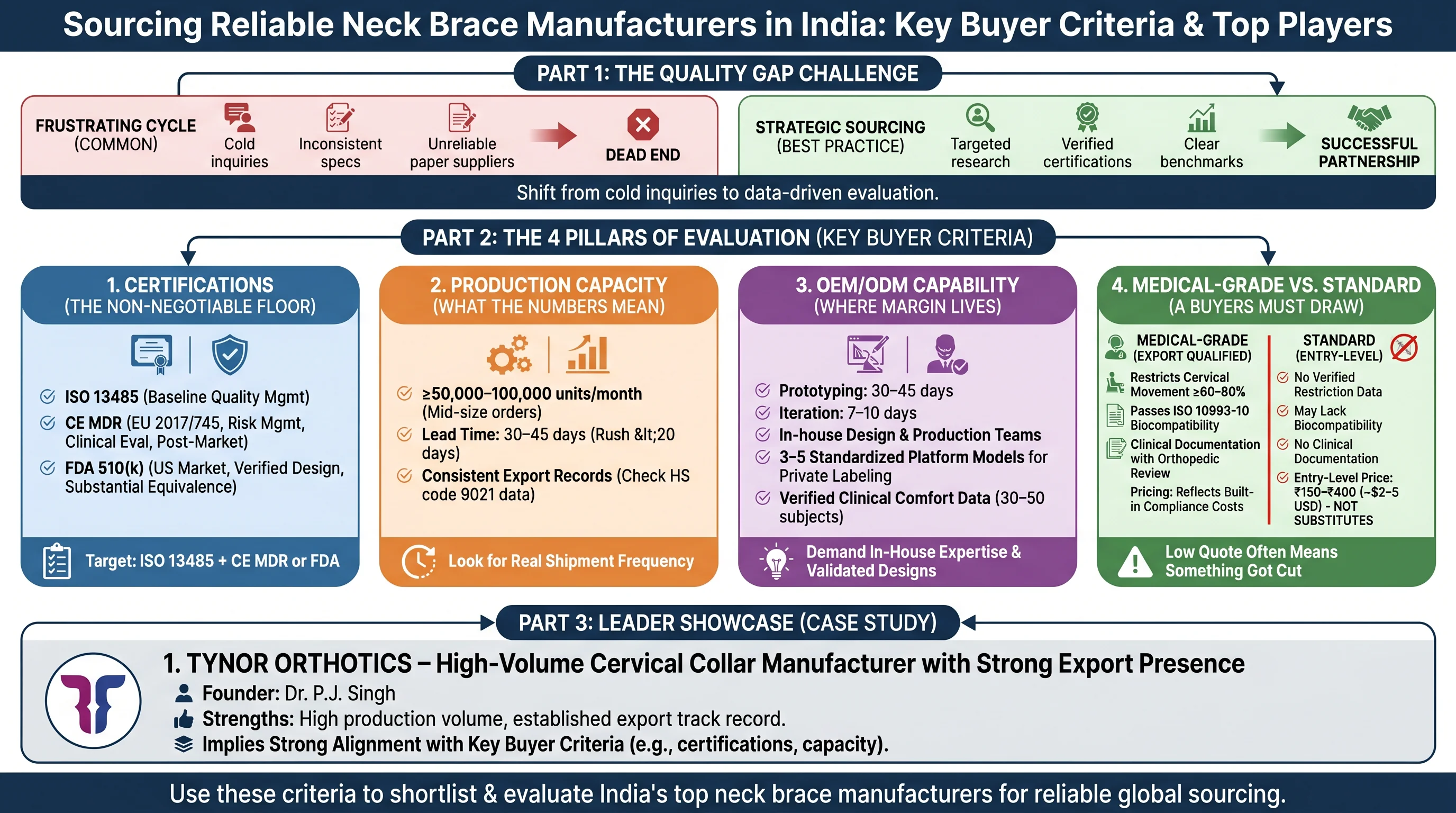
ISO 13485 is the baseline. It covers quality management across design, production, sterilization, and traceability, the full chain. For buyers targeting the EU, CE MDR (EU 2017/745) goes further. It requires risk management documentation, clinical evaluation, and post-market surveillance.
For North American supply chains, FDA 510(k) registration shows that a manufacturer has built verified design files and can prove substantial equivalence. Set “ISO 13485 + CE MDR or FDA” as your minimum threshold for any export-grade medical neck brace supplier.
Production Capacity: What the Numbers Actually Mean
Here are the benchmarks worth holding them to:
≥50,000–100,000 units/month for mid-size international orders
Standard lead time: 30–45 days; rush capability under 20 days
Consistent export records across multiple quarters
Check HS code 9021 export data. Real shipment frequency tells you more than any sales deck.
OEM/ODM Capability: Where Margin Lives
The best manufacturers prototype in 30–45 days and iterate within 7–10 days per cycle. They run in-house design teams, not just production lines. They also deliver 3–5 standardized platform models ready for private labeling. No clinical comfort data from at least 30–50 wear-test subjects? Their “OEM capability” is marketing, not manufacturing.
Medical-Grade vs. Standard: A Line Buyers Must Draw
Medical-grade cervical orthoses restrict cervical movement by ≥60–80% in verified mechanical tests. They pass ISO 10993-10 biocompatibility standards. They ship with clinical documentation reviewed alongside orthopedic specialists. Standard neck supports offer none of that. At India’s entry-level price of ₹150–₹400 (~$2–5 USD), don’t treat them as substitutes.
For export-grade medical collars, expect FOB pricing that reflects built-in compliance costs. A quote that looks too low almost always means something got cut, and it wasn’t the profit margin.
1. Tynor Orthotics — High-Volume Cervical Collar Manufacturer with Strong Export Presence
Dr. P.J. Singh started the company in 1993 with five employees. Today, Tynor Orthotics runs three plants and puts out 250,000 units/month. The company claims to be India’s largest manufacturer and exporter of orthopedic aids, and 45% annual growth over multiple years backs that up.
Cervical collars sit at the core of that output. The range includes:
Soft foam collars
Semi-rigid two-piece hard collars
Height-adjustable designs
Adult sizing covers S/M/L/XL, plus pediatric options are available. Cervical collar volume runs at 12,500–25,000 units/month. The certifications are export-ready. ISO certification and CE marking cover the full portfolio. That satisfies hospital formulary checks and importer registration needs across most target markets.
Bulk buyers get clear terms:
MOQ: 300–500 pieces per size for private-label orders
Lead time: 30–45 days
OEM packaging is also on the table at volume: cartons, IFUs, and barcode localization all included.
Best fit: Large importers consolidating SKUs, hospital distribution groups, and OEM brand owners targeting emerging markets where CE/ISO coverage and price point both matter.
2. Vissco Healthcare — Pan-India Distribution Network & Broad Orthopedic Support Range

Founded in 1963 and headquartered in Mumbai’s Nariman Point, Vissco Healthcare has built something rare in Indian orthopedic brands: genuine pan-India reach across both retail pharmacies and hospital networks. Few brands cover both channels at this scale.
Their cervical collar lineup runs the full spectrum:
Soft foam collars (Core range) — retail at ₹250–₹450; FOB export benchmark ~US$2–3/unit
Semi-rigid cervical collars — retail ₹600–₹1,200; FOB ~US$5–8/unit
Four-tier product structure — Core, Pro, Advance, Active — so buyers can segment by budget and clinical need
That tiered structure matters for procurement teams. Hospitals ordering post-operative soft collars fall into Core. Physiotherapy clinics that need higher immobilization go into Pro or Advance. One supplier, multiple price points.
Distribution covers two channels. Institutional sales go into hospitals and physio clinics. Consumer fulfillment runs through Tata 1mg and their own vissconext.com. “Trusted by surgeons and physios across India” isn’t just a tagline. For overseas private-label buyers, that clinical endorsement is something you can use directly in your own marketing materials.
Best fit: Distributors targeting mid-range market positioning, hospital procurement teams across South and West India, and OEM buyers who need solid clinical credibility behind their private-label cervical collar line.
3. Flamingo (Ascent Meditech) — Mid-Range Neck Brace Supplier for Retail & Hospital Channels

Ascent Meditech didn’t build Flamingo into a household name by competing on specs. They competed on reach.
Based in Valsad, Gujarat, the company runs its flagship Flamingo brand, a mid-range orthopedic label. It now moves product through 70,000+ retail points across India. Over 120 distributors push SKUs into pharmacy chains, hospital supply rooms, and e-commerce platforms at the same time.
The cervical collar lineup covers what the middle market needs:
Soft foam collars (S–XL) — polyurethane core, cotton-blend outer, Velcro closure; retail MRP ~₹295–₹350
Adjustable hard collar — plastic shell with comfort padding, height-adjustable for post-surgical use
OC2003 semi-rigid collar — soft-to-rigid support for regular wear and post-injury follow-up
International compliance is in place. Both soft and hard collar variants carry NAFDAC registration in Nigeria. That’s a real advantage for West African and GCC importers dealing with government procurement tenders.
Best fit: Regional distributors managing mixed pharmacy and hospital accounts. Also a solid pick for mid-volume importers targeting public hospital “economy tier” cervical collar categories. Procurement teams that need steady stock flow over clinical-grade specs will find this brand a reliable option.
4. Dyna (Dynamic Techno Medicals) — ISO-Certified Orthopedic Soft Goods Manufacturer
DYNA has been running since 1979. That’s 45 years of non-stop manufacturing from one Kerala facility. The certifications they hold today show what four decades of discipline actually looks like.
The numbers speak for themselves: 300+ SKUs and 6 certifications — ISO 13485:2016, ISO 9001:2015, ISO 14001:2015, CE for both sterile and non-sterile products, plus dual US FDA facility certificates. Few Indian orthopedic soft goods makers carry that full stack. It signals real export-market readiness.
Their cervical collar and orthopedic support line is built for a clinical audience. We’re talking orthopedic surgeons, physical therapists, vascular surgeons, and O&P practitioners. This is hospital procurement territory.
OEM buyers get a clear advantage here. The ISO 13485 scope, combined with CE and FDA certificates, means Dyna’s facility qualifies as a contract manufacturing site for private-label soft cervical collars and orthopedic supports. Export customers can expect MOQs in the 1,000–5,000 units/SKU range.
Best fit: Importers targeting EU, GCC, or Southeast Asian markets. You need a certified soft-goods supplier with real clinical depth and solid regulatory documentation — Dyna fits that profile.
5. GPC Medical Ltd. — Export-Oriented Hard Cervical Collar & Surgical Device Supplier
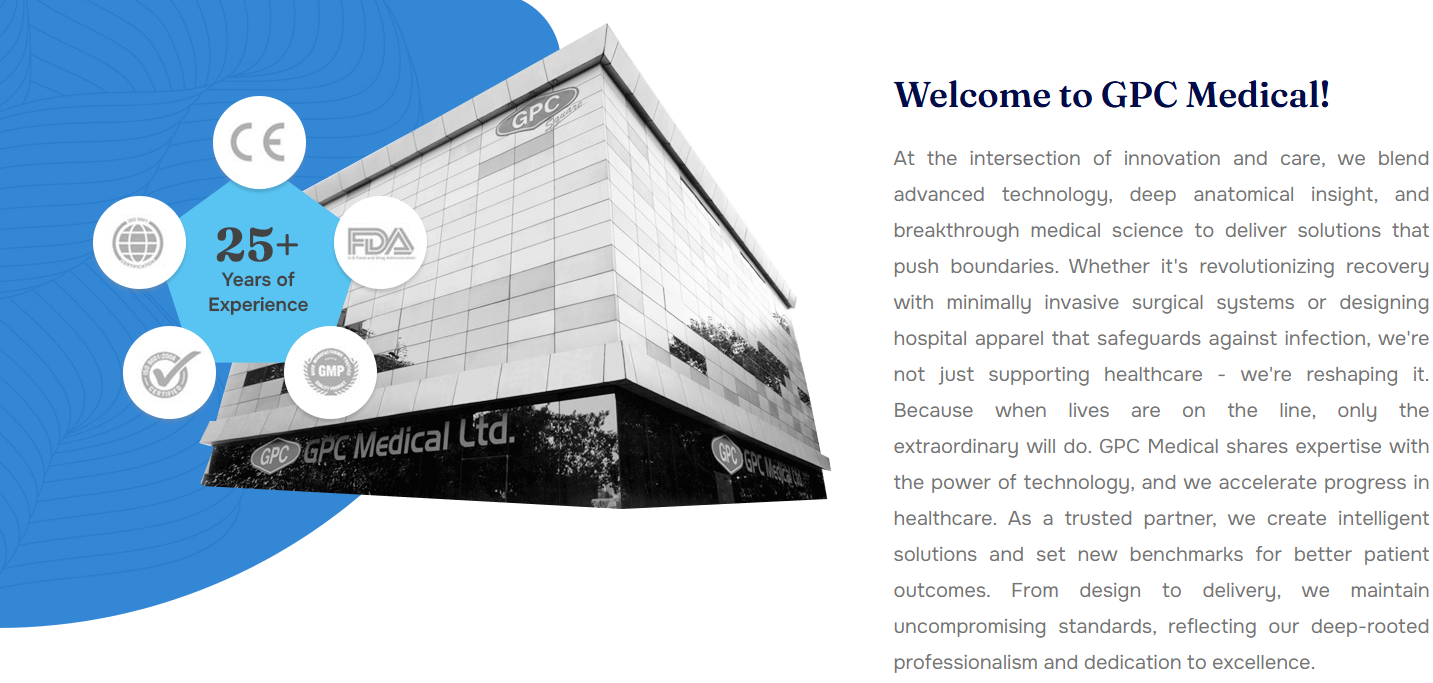
GPC Medical is based in New Delhi and ships to healthcare facilities in more than 90 countries. They’ve spent two decades building that supplier network, and it shows.
Their product range goes well beyond cervical collars. You’ll find:
Orthopedic implants
Surgical instruments
Hospital furniture
Sterilization equipment
GPC works as a true one-stop orthopedic and surgical supplier. For international buyers, that range is a real advantage. You can consolidate a trauma kit order and a rigid cervical orthosis shipment under one supplier. That cuts logistics overhead and simplifies your procurement process.
On compliance: GPC holds ISO 13485 certification and an FDA 510(k) clearance (K210198). Their Ghaziabad manufacturing plant meets US regulatory documentation standards.
Hard cervical collars fall within their rehabilitation aids line. Key specs:
Philadelphia-type rigid collar design
Polyethylene shell construction
Radiolucent build — compatible with X-ray imaging
Available in adult sizing
Export terms follow standard Indian OEM practice. MOQ runs 500–1,000 units for branded orders.
6. Orthosys — In-House Design & OEM-Capable Cervical Support Manufacturer
Orthosys builds orthopedic soft supports from scratch. Cervical aids are a dedicated product category here.
Their range covers ankle supports, body belts, and cervical aids. That multi-joint soft brace experience feeds straight into OEM value. For private-label buyers, this is a real difference. You’re not working with a single-SKU trader. This is a manufacturer that understands structural design across multiple body segments.
OEM parameters worth noting:
Foam density: 25–35 kg/m³, adjustable for stiffness and comfort balance
Shell options: PE/PP board (1.5–3 mm) up to hard ABS frames (3–4 mm)
Ventilation customization: aperture ~2 mm, pitch 6–8 mm, open-area ratio 20–35%
Sampling cycle: 7–15 days standard; fit adjustments within 5–10 days after
MOQ range: 500–2,000 pcs/style for private-label runs
Semi-rigid collar designs limit cervical flexion/extension by 40–60% under correct fit. That’s solid clinical performance for post-injury and post-surgical follow-up cases.
Best fit: Private-label brand owners and test-order importers who need a design-capable Indian cervical neck brace OEM manufacturer.
7. Samson — Budget-to-Mid Tier Neck Brace Manufacturer for Volume Buyers

Samson Orthopaedics fills a clear spot in the Indian neck brace market. They make basic rehabilitation collars aimed at cost-sensitive buyers.
Their Neck Support Collection covers injury recovery, chronic neck pain, and everyday relief. These are standard clinical uses. The listed price says it all: a Philadelphia Cervical Orthosis (Large) retails at ₹920/unit. That puts it squarely in the budget-to-mid tier range.
Volume buyers targeting Southeast Asia, Africa, or the Middle East will find that price point relevant. These markets prioritize cost efficiency.
Verify these four points before committing to volume orders:
Full size matrix (S/M/L/XL) per SKU
Material specs — foam density, shell composition, closure hardware
Batch consistency data — dimensional tolerances, rebound performance
Carton specs — units per case, gross weight, container utilization
MOQ, capacity per month, and lead time data are not listed anywhere on their site. Treat Samson as a preliminary shortlist candidate for now. Send a direct inquiry first. Confirm those four points before locking them in as a bulk supplier.
Best fit: Regional distributors in emerging markets who are price-sensitive, placing first-contact orders, and need a reliable basic collar at a controlled cost.
8. Amron — Competitive Pricing Neck Brace Supplier for Regional Distribution
Amron doesn’t chase the premium segment. That’s a deliberate choice, and it’s the right one for regional distributors.
The pricing is clear and practical:
Soft foam collars: ₹120–₹220/unit to regional distributors
Semi-rigid adjustable designs: ₹220–₹380/unit
End retail stays well below imported brands, which hit ₹600–₹900 at pharmacy counters
The product line covers standard clinical use: everyday cervical strain, light-to-moderate immobilization, post-accident recovery. Build specs are straightforward: PU foam core at 25–35 kg/m³, breathable knit outer, 2.5–4 cm Velcro closure. Four sizes — S/M/L/XL — cover neck circumferences from 30–45 cm. Just the core products a pharmacy chain or small DME outlet can sell and restock without issues.
MOQ starts at 100–200 units/style for first-time buyers. That’s far below the 500–1,000 unit minimums most larger Indian manufacturers ask for. Trial orders run 150–400 mixed units, with a 30–50% advance payment structure. So you can test the product before committing to full volume.
Best fit: Regional distributors in North India, South Asia export markets (Nepal, Bangladesh, Sri Lanka), and emerging market buyers in Africa or the Middle East. Amron works well for buyers who need a dependable, low-cost soft neck brace bulk supplier without heavy certification overhead.
9. Komal Health Care Pvt. Ltd. — Contract Manufacturing & Wholesale Soft Cervical Collar Supplier
Komal Health Care Pvt. Ltd. has been making and exporting orthopedic products from the Mumbai/Thane area since 2003. Their 15,000 sq. ft. GMP-standard facility shows a real production operation.
Their soft cervical collar line includes an Orthopedic Cervical Extra Soft Collar. It fits into a wider orthopedics range that covers implants and surgical dressings. Worth noting here: this is not a collar-only specialist. It’s a multi-line orthopedic maker that includes soft cervical collars as part of the mix.
What buyers should verify before committing:
Confirm soft cervical collar production runs as an in-house line, not a traded item
Request a full product spec sheet: foam density, fabric type, Velcro grade, and size range
Get written MOQ, pricing tiers, and OEM/branding terms
Ask for ISO/GMP certificates and any compliance documents your target market requires
Best fit: Wholesale buyers and small-batch OEM buyers who are comfortable starting with samples and negotiating direct with the supplier.
10. AOFIT — Surgical & Orthopedic Neck Brace Manufacturer for Hospital Supply
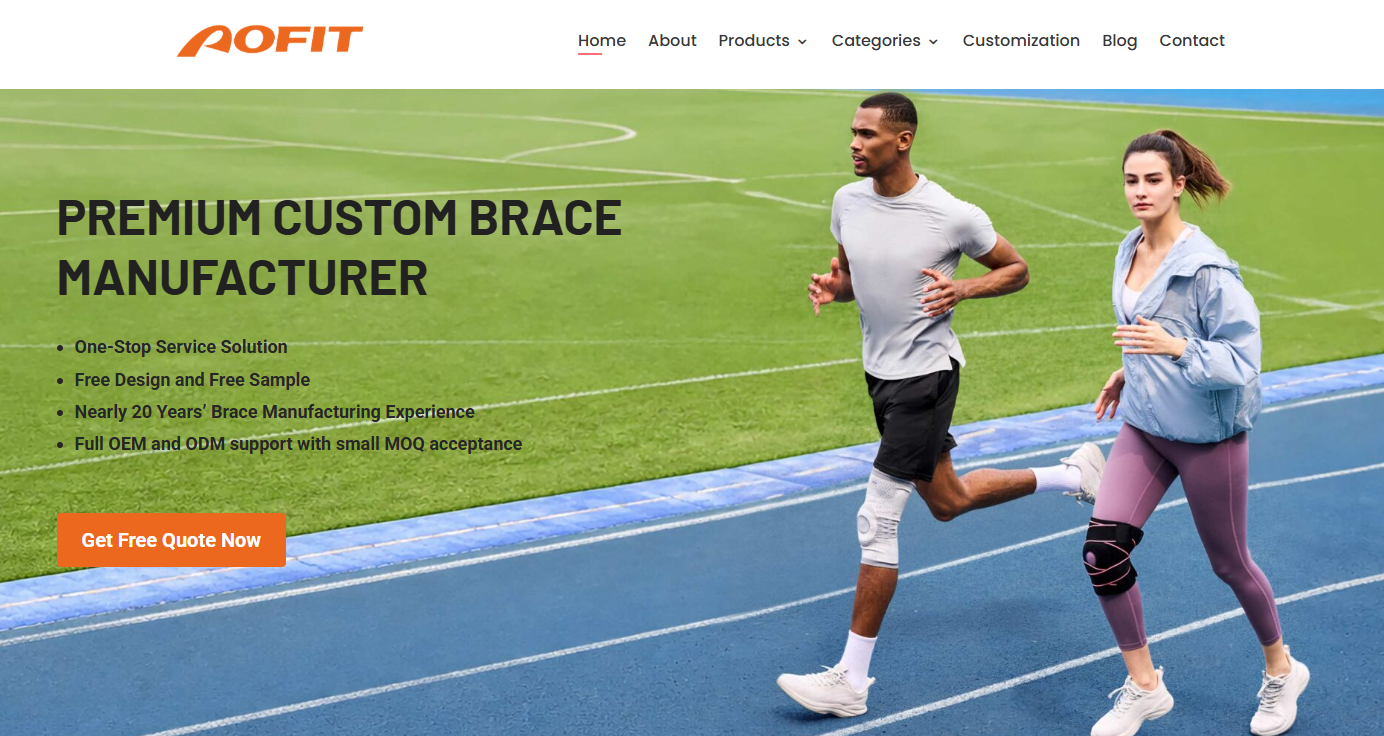
Twenty years of OEM manufacturing shapes a company in distinct ways. With AOFIT, you can see that clearly in how they operate and what they’ve built.
Based in China, AOFIT runs active export channels into hospital and distributor networks. They work as a custom medical brace factory focused on OEM/ODM production. Their product range includes cervical collars, lumbar supports, knee braces, and wrist supports. That breadth is useful for hospital procurement teams that want to consolidate surgical consumable orders under one supplier.
Their adjustable soft cervical collar features a U-shaped ergonomic foam core with a breathable fabric outer layer. It’s built for post-op recovery and outpatient cervical support. Sizes run S through L, covering neck circumferences of 30–45 cm.
OEM terms:
MOQ: 300–500 pcs standard; logo-only orders start from 100–300 pcs
Sampling: 7–15 days; bulk production: 30–45 days
FOB pricing: soft foam collars from US$0.60–1.50/unit
They have ISO 13485 and CE certifications. Before you commit to any hospital tender submission, request and verify their current documentation.
Best fit: Medical device distributors building private-label orthopedic lines, surgical consumable importers sourcing post-operative brace kits, and hospital procurement teams pulling multi-SKU orthopedic packages under one contract.
India vs. Other Sourcing Markets: Why Indian Neck Brace Manufacturers Compete Globally?
The numbers are hard to ignore. Indian labor costs run 50–70% below China. That gap holds even in orthopedic soft goods like cervical collars.
A Zetwerk analysis on labor-intensive assembly put total landed costs in India at $450,000 vs. $654,000 in China. That’s a 31% saving before tariffs even enter the picture. For neck brace sourcing, that difference goes straight to your margin.
Then Section 301 kicks in. U.S. buyers importing from China face 25–35% tariff exposure on medical device and plastic component HS codes. India is exempt. On a fully-loaded cost basis, the same cervical collar shipped from Guangzhou can cost 25–35% more by the time it clears U.S. customs.
Certification gives India another edge. 70–80% of India’s export-focused orthopedic brace makers hold ISO 13485. Many also carry CE and FDA registration. That combination opens the door to EU and North American hospital tenders. China’s mid-tier soft goods factories? That full certification stack is less common than most buyers expect.
Logistics hold up well too. Mumbai (JNPT) and Chennai are both solid departure points. Door-to-door to the U.S. East Coast takes 30–40 days. Rotterdam and Hamburg land within 28–35 days. That’s on par with China minus the tariff hit.
The one real risk: batch consistency. Foam density variance, Velcro fatigue, and injection-molded tolerances are weak points at smaller Indian facilities. Before you commit to volume, check for:
ISO 13485 audit records
Incoming material test reports
Documented EU/U.S. export history
Screen these upfront. They tell you fast whether a neck brace supplier can hold quality at scale.
How to Choose the Right Neck Brace Manufacturer in India?
Match the manufacturer to your business model:
Distributors/wholesalers — Focus on stable standard SKUs, low MOQ, and fast replenishment cycles. Soft collar retail pricing in India runs ₹200–₹500. Use that as your entry-tier benchmark.
Private-label brands — Look for factories with real OEM/ODM capability. That means custom packaging, barcodes, colorways, and size variations. You need a multi-SKU supplier.
Hospital/rehab procurement — Stick to hard collars, adjustable designs, and full medical documentation. Consistency, size coverage, and batch traceability carry more weight than price.
The non-negotiable checklist:
Ask for ISO certificates with the certificate number, issuing body, and expiry date
For EU exports, get the CE Declaration of Conformity linked to specific product models
Check the factory QC flow: incoming inspection, in-process checks, and outgoing records
Test samples for fit, edge comfort, Velcro durability, and any odor from skin-contact materials
Red flags that end the conversation: suppliers who won’t share original certificates, block factory walkthroughs, quote prices far below market with no explanation, or can’t produce batch traceability records. Walk away fast.
Five-step screening sequence: confirm your buyer type → request certificates and MOQ terms → compare samples → set up a video or on-site factory audit → negotiate pricing, payment, and exclusivity clauses. Lock every key term in writing before you move forward.
Conclusion
India’s neck brace manufacturing has moved far beyond low-cost assembly. Today, you’ll find neck brace suppliers like Tynor and AOFIT that meet international compliance standards, offer OEM flexibility, and hold consistent MOQ commitments. The ecosystem is mature and export-ready.
Use this guide as a starting point, not the final word. Cross-reference certifications. Request technical datasheets. Validate regulatory compliance before you commit to volume orders.
Surgical-grade quality and responsive OEM capability matter for your supply chain. AOFIT checks both boxes and is worth a direct conversation.
Good sourcing decisions take time. But they all start with a first step. You’ve already taken it.